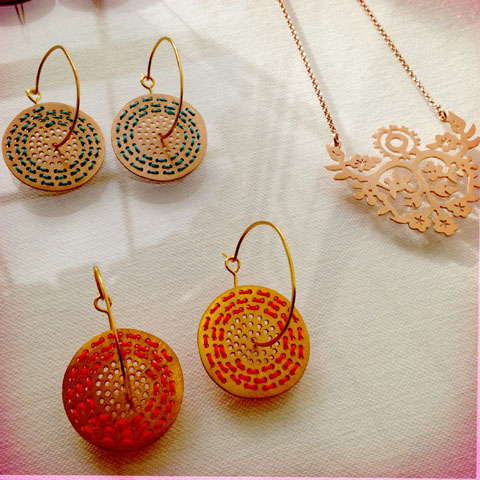
Joanna Cave has become synonymous with both ethical consciousness and beautiful design. Her mother is Greek and her father is English, so after attending an international school in Greece she went onto study jewellery design at Central Saint Martins. Whilst there she interned with designer Scott Wilson. After graduating, she returned to Greece, where she now works from her studio in Athens.
Joanna Cave‘s designs are modern yet classic – created from simple patterns, delicate motifs and refined metals, all created using ethically sourced and recycled materials. She buys her metal from dealers who specialise in recycled silver, and the stones and gems from ethical sellers in Greece.
She has always been very vocal about her environmental inclinations, and has received a lot of recognition for her hand-made and sensitive work. She is a regular name on the British Fashion Council’s ethical initiative ‘Estethica‘ at London Fashion Week, and was the only jewellery designer to be featured on the A/W 2012 stands. She is of course also profiled in Amelia’s Compendium of Fashion Illustration, as one of the best eco designers working today.
I spoke to Joanna Cave about her passion for jewellery design and the influences behind her new collection.
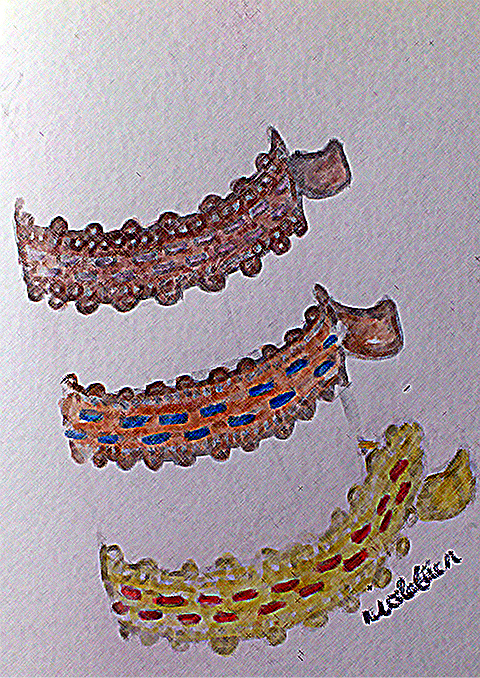
Joanna Cave A/W 2012 Velvet and Metal Hairband
What can we expect from the new A/W 2012 collection?
There are lots of bright coloured tassels combined with gold plating, rose plating and charcoal black. I’ve also used Indian motifs such as paisley patterns, elephants and peacocks.
What were the inspirations behind it?
My new collection is inspired by and dedicated to the working women of India. The beautiful and traditional women who labour in the fields, on the roads and building sites doing back-breaking work. They perform these humble tasks with such dignity, and their appearance can take your breath away. Their everyday working clothes are a riot of extravagant colours – pinks, greens, purples and blues. Their bold jewellery is intricate, and worn with pride. For me, these women embody India, they have a powerful and enduring femininity.
Can you explain a little about your passion for design, and explain how you moved into jewellery design?
I’m not sure how to explain this too well. I grew up in Greece on a small island in the Aegean where my father (who is English and who moved there when he met and fell in love with my mother) owned a jewellery shop. I grew up among the jewellery. From a young age I watched people trying jewellery on, falling in love with it, purchasing it… I met jewellery makers and designers. Some quite well known in Greece at the time.
When I was 19 (and studying jewellery making) I even opened my own small shop to sell my beaded creations. It was great fun and it funded my summer holidays. Designing jewellery is all I’ve ever wanted to do: I think I inherited my fathers passion for it. It’s always been a big part of my life and I always discuss everything with him.
Joanna Cave A/W 2012 Bindu and Indru Necklaces
Can you tell me a little about the process of your work?
I work in 2D, in flat silver cut out designs. Everything is initially cut out by hand where most people would use a laser cutter or router machine. I think that the hand made prototype is evident in the organic feel of the designs. You can see it’s not perfect. I use recycled silver and ethically sourced pearls at times. And lately I’ve been using artificial silk thread which I’m very into.
Why is it important for there to be an environmental conscience to your work?
It’s about how I feel; I think it’s important to know how things are made and where they come from… to do as little damage as possible where we can.
2009 was quite a year for ethical fashion. Dazed and Confused featured an in-depth interview with fashion icon Vivienne Westwood and leading environmentalist James Lovelock. Vogue devoted a sizable spread to green fashion, medical and London Fashion Week kicked off with Esthetica, a showcase of 28 ethical designers. Ecofashion it would seem edged its way from the periphery into something approaching centre stage. Out were the unshapely, unflattering garments previously seen on only the most hardened of the eco-warriors. In were beautifully crafted clothes with a conscience as a growing number of designers and consumers tackled the prickly issue of clothing, style, and the environment. This momentum seems only likely to gain in strength judging by the numerous events and exhibitions planned for 2010.
Essentially what we are seeing is a growing realisation that while it is absolutely imperative that far more is said on the environmental and human consequences of fast fashion, there is no need to sacrifice a sense of style to take part in this dialogue. Like music and art, fashion is an extension of culture, a manifestation of the changing influences of the society within which it exists. There should be no shame in wanting to take part in this expressive medium, but nor should this interest be at the expense of our planet. However on making the decision to marry an interest in clothing and green issues you may find yourself stumped with where exactly to source reasonably priced stylish garments whose production has not impacted negatively both socially and environmentally. Herein lies something of a problem.
Alexa Chung in Oxfam Remade campaign, photographed by Kai Z Feng
Ecofashion may now be occupying headlines, but hugely desirable as this clothing may be, cheap it is not. Dressing sustainably and stylishly can come with a considerable price tag. Of course there is a reason for this and the answer is to save and buy responsibly, but at the cost of most ethical lines and my current income I’d average 2 garments a year and shoes every other. The rise of fast fashion is undoubtedly one of the major scourges of our time, and while I can in no way condone its revolving door of trends, neither do I particularly want to spend my year interchanging two outfits. So until I get a wage that affords me a capsule wardrobe of organically grown, naturally dyed, fairly traded wonder garments, you’ll find me in Oxfam.
Image courtesy of Oxfam Boutique
Rethinking the charity shop
The reinvention of the charity shop is long overdue and still a considerable way from anything you could call complete. Currently thanks to the efforts of fashion guru and creative director Jane Shepherdson, Oxfam would appear to be one of the few charities pulling its stores through a major image reworking and providing us with anything approaching a viable option to mainstream buying.
Shepherdson’s vision of the Oxfam Boutique has reinvented recycled fashion, turning on its head any idea you may have about ill-fitting dresses secured with safety pins. In doing so she has firmly established the charity shop as a major resource for the environmentally conscious style seeker on a budget, while bringing to our attention the main reasons behind why choosing to buy donated clothing is one of the easiest ways to reduce our environmental footprint which, where clothing is concerned, is big. Image courtesy of Esthetica, web sponsored by Monsoon
2009 was quite a year for ethical fashion. Dazed and Confused featured an in-depth interview with fashion icon Vivienne Westwood and leading environmentalist James Lovelock. Vogue devoted a sizable spread to green fashion, drug and London Fashion Week kicked off with Esthetica, a showcase of 28 ethical designers. Ecofashion it would seem edged its way from the periphery into something approaching centre stage. Out were the unshapely, unflattering garments previously seen on only the most hardened of the eco-warriors. In were beautifully crafted clothes with a conscience as a growing number of designers and consumers tackled the prickly issue of clothing, style, and the environment. This momentum seems only likely to gain in strength judging by the numerous events and exhibitions planned for 2010.
Essentially what we are seeing is a growing realisation that while it is absolutely imperative that far more is said on the environmental and human consequences of fast fashion, there is no need to sacrifice a sense of style to take part in this dialogue. Like music and art, fashion is an extension of culture, a manifestation of the changing influences of the society within which it exists. There should be no shame in wanting to take part in this expressive medium, but nor should this interest be at the expense of our planet. However on making the decision to marry an interest in clothing and green issues you may find yourself stumped with where exactly to source reasonably priced stylish garments whose production has not impacted negatively both socially and environmentally. Herein lies something of a problem.
Alexa Chung in Oxfam Remade campaign, photographed by Kai Z Feng
Ecofashion may now be occupying headlines, but hugely desirable as this clothing may be, cheap it is not. Dressing sustainably and stylishly can come with a considerable price tag. Of course there is a reason for this and the answer is to save and buy responsibly, but at the cost of most ethical lines and my current income I’d average 2 garments a year and shoes every other. The rise of fast fashion is undoubtedly one of the major scourges of our time, and while I can in no way condone its revolving door of trends, neither do I particularly want to spend my year interchanging two outfits. So until I get a wage that affords me a capsule wardrobe of organically grown, naturally dyed, fairly traded wonder garments, you’ll find me in Oxfam.
Image courtesy of Oxfam Boutique
Rethinking the charity shop
The reinvention of the charity shop is long overdue and still a considerable way from anything you could call complete. Currently thanks to the efforts of fashion guru and creative director Jane Shepherdson, Oxfam would appear to be one of the few charities pulling its stores through a major image reworking and providing us with anything approaching a viable option to mainstream buying.
Shepherdson’s vision of the Oxfam Boutique has reinvented recycled fashion, turning on its head any idea you may have about ill-fitting dresses secured with safety pins. In doing so she has firmly established the charity shop as a major resource for the environmentally conscious style seeker on a budget, while bringing to our attention the main reasons behind why choosing to buy donated clothing is one of the easiest ways to reduce our environmental footprint which, where clothing is concerned, is big.
The environmental impact of clothing
According to DEFRA an estimated 8000 chemicals are used in turning a raw material into the finished product. There’s the bleaching and dying, page the use of petrochemicals and heavy metals, not to mention the demand on water. The manufacture of synthetic fabrics such as polyester has no less of an impact being hugely energy intensive and dependent on large amounts of crude oil. Keeping clothing in circulation and out of the landfill bypasses this process, saving energy and resources while reducing the pressures of finding the space to dump all our discarded garments.
Image courtesy of Oxfam- who accept clothing donations both in store and at clothes banks (above) nationwide.
Greening your style on a budget
Consumerism has become an integral part of our economy, but the recent crisis has forced many to reassess this status quo. Now is the time for those concerned about the ramifications of intensive fashion to demonstrate that a sustainable version is every bit as stylish and need not break the bank. So for those of us who are hard up and concerned about the impact of our shopping practices, I’d recommend beefing out your no doubt sparse but worthy wardrobes by making a beeline for an Oxfam Boutique near you. Not in the metropolis? Here’s some handy tips to get your average charity shop clobber looking bang on trend.
Image courtesy of Rachael Oku. Clothing can also be donated in designated bins (above) in TRAID stores nationwide.
Transforming that charity dress:
Charity shop dresses. I know. Odd sizes, odd shapes, dubious sleeves. Solution? Belt high, chop short, detach offending sleeves. Voila. On trend.
Men’s as Women’s:
Androgyny is never far out of the fashion eye and charity shops can certainly deliver on this one. Oversized men’s shirts and jumpers will look great belted over skinny jeans or leggings. Grab a tweed jacket for the much loved boyfriend blazer and scrunch up the sleeves, or turn up the bottoms on a pair of man trousers and wear with brogues or statement heals.
Mix it up:
Charity shops are a source extraordinaire for vintage finds which look great when styled with something modern.
Eveningwear as Daywear:
Sequined dresses circa 1989? Floor length velvet? Who says it’s not to be seen in the daytime. Cut short and team with a wooly jumper/blazer and converse or Victorian style booties.
Accessories:
Quirky jewelry, brilliant bags, scarves, belts, ties worn as belts. Head to a charity shop in a well-to-do area for some real finds.
Customizing:
Jackets, coats and cardies can all be transformed with a new set of buttons. Simple yet effective. Get yours and head down the nearest haberdashery for instant garment rejuvenation.
Grandma Skirts:
Wear as a dress and belt at the waist.
Grandpa Knitwear:
Huge heavy cardigans and sweaters featuring the likes of sheep and autumn leaves can be amazing worn over your mini dress/shorts, legging, jeggings, skinnies, whatever. This is charity shop gold. And as they usually outnumber most other garments 10:1 you can be sure to get your hands one.
Happy Hunting!!
Written by Sisi King on Tuesday February 2nd, 2010 3:48 pm
I’ll put up my hands and admit that as a girl, healthmedications not yet a quarter of a century old, remedy talking about music is utterly intimidating. Yet I try. At some point in my life I’ll make a concerted effort to dance about architecture too. There is an endless wealth of information on bands that have already been, that I am never, ever going to be able to catch up on. Yet I try. As a music fan (enough to write about it), I’m embarrassed to admit that I only really discovered my, now, all time favourite band, Talking Heads within the last five years. I know, shoot me down. My convoluted point is that, as much as I try and piece it together, I can only imagine what The Slits releasing ‘Cut’ meant to the females and general youth and music fans of 1979. Yes there was a sex bomb fronted Blondie, intriguingly androgynous Patti Smith and unconventional Kate Bush, but an all female, punk rock band that posed naked on their album sleeve and generally didn’t give a f***. No one saw that coming and their influence has reverberated ever since.
Fast forward then 30 years and their new album, Trapped Animal, has been unleashed to a society that is certainly far from sorted. But can the music still have the same punch? The garage approach of Cut has inevitably given way to a slicker product all round. That same mixture of reggae rhythms, scratchy guitars, anger and mischief abounds. Rather than sounding like a band thirty years past their prime, as could be said of many a reunion album, there is a freshness that means you could be mistaken for thinking you’re hearing the latest South London council estate collective. This could be explained by the new multi-generational line-up that features Sex Pistol Paul Cook’s daughter, Hollie. You also get the impression that frontwoman Ari Up has as much energy as her fourteen year old self that met original member, Palmolive, at a Patti Smith gig.
Lyrically, the album doesn’t stretch the boundaries of the concept of rhyming but you wouldn’t hear Girls Aloud bemoaning of “Men who want us to be their mother/Men who hate us because of their mother.” Where the Pop Idol-ers are concerned with their “cappuccinos to go-o”, Up and her girls are hollering about ‘Peer Pressure’, “issues with child abuse” and eschewing the shackles of a nine to five: “We don’t pay rent with a passion, and we don’t wanna follow fashion.”
The fact that foul-mouthed Lily Allen launched her career on the wave of reggae-tinged pop is no accident. The Slits invented the model for anti-establishment, men-bashing, unselfconscious pop and even though this new offering will never live up to Cut standards, it’s a welcome return of punk’s finest.
Helping to keep the pressure on governments across the world, health activists in Australia held a mass action last week against Hazelwood Coal Power Station, erectile one of the dirtiest in the world. The climate camp held a day of planning and workshops, nurse followed by the day of action where a group of over 500 people placed a ‘Community Decommission Order’ on Hazelwood to switch on the renewable energy transition.
Twenty-two people were arrested on the day and, with the Governments lack of conviction, it seems many more are ready for the same sacrifice. As one secondary school teacher put it, “not such a big sacrifice in the scheme of things.” Looking at pictures and reports as well as listening to the radio report, it looks like a well planned day of disobedience. Affinity groups such as the Wombat Warriors, Radical Cheerleaders and Climate Clowns show great initiative. Apparently the police wouldn’t let “bikezilla”, a massive 8-person bike, join the protest though. Shame.
I caught up with Louise Morris, one of the organisers of the action to get her account of the action and see what’s in store for climate action in Australia.
How long have you been involved in the protest movement in Australia and was there a catalyst for getting involved?
I’ve been involved in campaigning in Australia for over a decade, starting off with the campaign to stop the Jabiluka Uranium mine in Kakadu National park and spending many years as a forest activist and blockader in Tasmania (as a result now one of the Gunns 20) and Western Australia.
I decided to devote my time to climate campaigning in 2006, as the realisation set in that no matter how many pieces of forest we saved through campaigning and blockades etc – if climate change is not dealt with, the climatic conditions forecast will spell the end for all the places we have campaigned for and protected over the years.
I grew up in mining towns in Western Australia, so am very aware of the sort of environmental and social scars the mining and logging industry inflict. My decision to work on climate issues has been heavily based on the mitigation angle. I am a strong believer in trying to solve a problem, rather than trying cope with the problem as best we can through adaptation measures. This has led me to focus strongly on coal issues and to work within the grassroots realm of climate campaigning. I really do think it’s in the grassroots community movement that we have the most power.
What was your personal experience on last weeks action?
I was one of the key organisers of the Switch off Hazelwood – Switch on Renewables weekend. My experience ranged from having to deal with the police in the lead up to the event and during the event with their complete over-reaction to the whole affair, talking with people who were prepared to be arrested and acting as media spokesperson for the group.
My experience of the action and watching other peoples reaction to the day was extremely positive.
This action was the first of it’s type for the Victorian Climate Movement. For the past few years people have lobbied, rallied in cities etc but never actually taken action at the site of the pollution and been prepared to be arrested.
We had 500-plus people from all possible walks of life turn up. A lot of families, older folk and a massive representation from the quite mainstream ‘Climate Action Group’ demographic that is strong in Australia. We had 22 people manage to scale the security fences and police lines that were put up prior to our action. In that list of arrestees are doctors, teachers, electricians, stay at home mums… the list goes on.
Our state government tried to label us as eco-terrorists in the lead up to the event. This failed dismally, as our lead up media campaign was very solutions focused (just transition to renewable energy) and we were very open in our aim of civil disobedience… this combined with images of the people who were at the action, got out to the wider world of so many kids, families, professionals and respected members of the community were taking action. We have had a lot of support from the public and arms of the mainstream media.
The feeling post this action is that people are ready for more peaceful community driven direct action, and more people are prepared to get arrested to push the government into some real action on climate change.
How did the mainstream media and the public react?
In the lead up to this event we put a lot of thought and energy into talking about our message of switching on a transition to renewable energy and switching off coal. Part of this outreach included a public meeting at the town of Morwell, which is the heart of coal country in our state. This was a ‘robust’ meeting but we got great feedback from everyone who came about the transition message and we were supported by unions representing coal workers that we were pushing for a just transition to renewable energy.
In terms of media – we ran a pretty tight messaging strategy around the fact that this is a community driven event that is calling for a switch from renewable energy and this requires that we switch off coal.
At first we got very little interest, but as the word that people were going to partake in peaceful mass civil disobedience got out, the interest grew. On the whole, we got a pretty fair run in the media in the lead up to the event. A lot of time was spent explaining what civil disobedience was, as Australia has not had a strong activist culture in recent years. Once again the core message that we were calling for a switch from coal to renewables, with a just transition was central in a lot of the willingness of commercial media to hear us out.
Obviously on the day of the action some of the conservative media ran the ‘rowdy protester’ line and showed the fence shaking but considering the sort of coverage we usually get in the mainstream Australian press, I think we have seen a shift in how community protest and civil disobedience is being covered. That said, the large representation of families and ‘ordinary looking folk’ really did help that.
Do you think Australia is ready for a broader movement relating to climate change and what do you think the comparison is to movements across the world?
Yes. We had our first climate camp last year in Newcastle [NSW] and from this it was decided that in 2009 we would have state based events, of which the Switch off Hazelwood event was one. The reasons for this were many, including the fact that Australia is so geographically large that it’s not feasible (financially or environmentally) for people to trek across the country to come to a single climate camp.
For the next 3 months there will be Climate Camp style events across the country from South Australia, New South Wales to Western Australia. The interest and willingness is there for a movement that is prepared to take action at the site of the big polluters and put some targeted pressure on government and the big polluters who are shaping the climate policy.
In terms of the broader movement relating to climate change there is definitely a lot more scope for more varied forms of action and campaigning. We are currently organising a bunch of movement building events and workshops using the lessons learnt from many countries and campaigns, including elements of the Obama community mobilisation strategy.
Comparisons are hard to make as we live in a massive continent with quite a sparse population, in comparison to many other countries who have strong climate movements. We also have a populace that has been alienated from the concepts of protest, civil disobedience and strong social movements from previous (and still current) governments who have demonised such things as ‘Anti-Australian.’
As one of the organisers of the action, what have you learnt from the process?
Honestly, the importance of networks, community and talking to people face-to-face to get them involved and part of creating the event they want to be a part of. Another lesson we always learn from these events is that people need to have fun organising and being part of events like this – best way to keep them coming back and get more people involved.
The Affinity Group and Working Group model was central in making a lot of elements of this event work. From the public meeting, the promotions, independent media to the action itself.
What’s next for Climate Camp in Australia?
There are still a number of state based Climate Camps to come in the next few months across Australia after the ‘Switch off Hazelwood – Switch on Renewables’ event. The next immediate one is in South Australia and after that is the one at the Helensbugh coal mine in NSW. So much more Climate Camp action is on the cards. And here in Victoria we are looking ahead to what is next in the lead up to Copenhagen as a national climate event.
Looks like a lot going on in Australia, shame it would have to be a carbon intensive flight away, that or a 6 month cycle mission, hmmm.. now thats an idea.
MATT AND KIM are a destructive dance duo hailing from Brooklyn, pilule NYC. There are very few bands that can always guarantee you a real good time with one single push of a button, but Matt & Kim never let me down. Ever. We caught this Brooklyn duo live back in June and they knocked our socks off.
Yeah, there are tons of happy-go-lucky bands with that high-energy, high-on-life exuberance, throwing shapes and keeping their toothy smiles fixed, verging on the robotic and the slightly scary. But there’s always the inevitable grating after a few listens as the cheer morphs into a cheesy mess of slobbery, over-enthusiastic group hugs and high-fives that leave you backing away into the safety of Morrissey‘s comforting drones, vowing never to venture away again. Promise.
The weird thing is, Matt & Kim are super cheesy, but they seem so genuinely fun and unaffected that it’s tough not to abandon any self-concious hang-ups and just leap along with their carefree charm. And if their new tracks are anything to go by, they show no sign of quietening down and getting all mature on us.
As the jaunty keys and sharp, tapping sticks that start ‘Daylight”s introduction trip and pop, the call and response of “We cut the legs off of our pants/Threw our shoes into the ocean/Sit back and wave through the daylight/Sit back and wave through the daylight” gets louder and fuller, there an immediate hit of teenage nostalgia. It’s a reminder to never grow up too much and when that alarm rings to get you out of bed in the morning – it’s time to wake up.
Watch the duo having fun in their DIY-esque video here:
‘Daylight’ is out on 28th September on Fader Label/Nettwerk.
Obstinately avoiding the typical artistic “nude” and the potential sexist connotations of the form, medicineSheila Wallis’s Threadneedle Prize-winning “Self-portrait” does feature the artist without clothes, medical but avoids rendering herself as a sexual object. Instead the artist describes herself as appearing to be a “small, look naked creature” rather than a coquette.
The painting feels very real as opposed to a being a fantasy of female sexiness. She gazes back at the onlooker with a slightly knotted brow but, despite being aware of the attention, doesn’t seem either to play up to it or to be exploited by it. She is vulnerable but remains in control through the action of painting herself. Perhaps a deciding factor in seeing the painting without sexual connotations as a female viewer is knowledge of the gender of the artist and that she is also the subject of the painting; it’s easier to enjoy a nude for what it is without the overtones of an artist/muse relationship.
The prize is voted for online by visitors to the exhibition, at the Mall Galleries. This year’s exhibition was strong and there was a theme of interaction between man-made structures and nature. For example, Jennifer Godlieb’s eerie “Lurker” (below) seems to depict a gasometer set in a future time when cities are devoid of people and all is overgrown and transformed into a spookily beautiful Scandinavian forest. The message could be an environmentalist one: despite the messages about “saving our world” from climate change, eventually Mother Nature will reclaim all our efforts.
In contrast to the fairy-castle appearance of Godlieb’s post-human architecture, Zachary Peirce’s painting of “Pripyat, Chernobyl Exclusion Zone 1” bleaches the colours out of the natural landscape, leaving washed-out pinks, bruise purples and a colour the same yellow tone as human skin. A slight touch of green appears murky and poisonous. In the background there is a building that appears to be melting: the black outlines drip down the canvas into the overgrowth. Here the impact of humanity’s failings on nature has created a dirty, deserted area without any of the peace of Godlieb’s twilight scene.
Peter Wylie’s brutalist tower block “Goldfinger four (with Le Corbusier flaking paint from Villa La Roche)” is actually still occupied but the exterior of the worn old concrete monster offers little comfort. The golden windows that presumably inspired the title do seem to imply little pockets of cosy humanity lurking within.
Dotted across the image are pieces of flaking paint taken from a Le Corbusier building – perhaps the remains of a previous, shining image, gradually chipped away to reveal the reality of high-rise communal living? Le Corbusier’s use of concrete has led to some grim surroundings for those living there and it has been noted that as a material it wears much worse in the wet conditions of Britain compared to the sunnier climes of the South of France.
The buildings in “Goldfinger” block out any glimpse of sky and look like they belong in the pages of “1984”; but it’s unclear what commentary Wylie is making beyond the appearance of the building. How do these designs impact of the lifestyle of those who live in them? As in the other works, people are invisible but here they are not absent. I didn’t feel comfortable making assumptions about whether this represented a dystopian future or present because of the possibly classist assumptions – these buildings are usually destined for lower-income people. Can high-density urban estates ever live up to the utopian dreams of those who design them?
As the crowd waited perched on sofas, leaning against walls as we huddled round the catwalk Dolly Jones announced the winners: Mark Liu, Henrietta Ludgate (who was championed by Amelia’s Magazine earlier this year as a one to watch), MIA and Lalesso (both of whom you will have noticed were mentioned earlier in reference to winning the PURE awards in June).
MIA
After the announcements, the catwalk begin to sounds of bouncing pop and the models began to work the room. Each designer sent two designs down the catwalk, as teasers for their entire line. I would have loved to have seen more of the collections. Especially as the majority, if not the entirety, of what was sent down the Innovation catwalk was jump-off-the-catwalk-and-onto-my-back wearable.
Lalesso
To accompany the catwalk, the Ethical Fashion Forum provided recycled cardboard handouts detailing the reasons behind each designer’s selection. Mark Liu for developing a pattern cutting process that minimizes the amount of waste material produced by each garment, helping to “pioneering Zero Waste Fashion”. This made me think instantly of the “A-POC” line by Issey Miyake or taking it out of the acronym; the A piece of cloth project. From which the wearer is able to create endless items out of a single well-cut piece of fabric. Myakke is said to be continuing to develop this idea after becoming concerned about the impact of textile waste on the environment. It’s great to see young and established designers tackling the industry’s waste problem and turning it into a conceptual wearable idea. To compliment Liu’s pattern cutting he uses organic fabrics, low impact dyes and water based pigments. The two dresses, sent down the catwalk, were reminiscent of Peter Pan or an elfish child as they hung playfully off the models. Perfect for a summer’s day in the park.
Lalesso
Henrietta Ludgate worked with Osman Yousefzada after graduating from St. Martins and is now starting her own label. Ludgate’s philosophy lies in the maintenance of British craftsmanship. All the materials are sourced from British Mills and the collection is made entirely in a traditional Scottish crofting village. Her dresses really intrigue me being a combination of what appears to be felt and fleece. The pieces (not shown on the catwalk, but worn by members of the audience) had a similar feel in their shapes as Matthew Williamson’s graduate collection at St Martins. The new collection contained a wearable jersey dress with interesting piping detail to structure the back. Alongside a maxi dress which appeared to be an extended bankers shirt.
Henrietta Ludgate
Lalesso creates women’s wear out of traditional East African Fabrics, which translate perfectly for a Saturday spent walking around town and sitting in parks. The bold floral patterns were instantly eye catching.
MIA’s recycled fabrics and traditional Malawain textiles produced a refreshing take on up-cycling old urban sportswear into summer dresses.
The Innovation competition is importantly drawing attention to the numerous ways new designers are tackling challenges of sustainability that the fashion industry faces as a whole.
Henriette Ludgate
MIA is tackling craftsman’s jobs lost through the abundance of cheap second hand clothes on Malawi’s market stalls by employing local people in the process of up-cycling. All profits are put back into the community support, as well as buying equipment and training to maintain market access and community livelihoods. Furthermore (thanks again to the cards handing out by the Ethical Fashion Industry at the show), Lalesso recently founded SOKO – an ethical and eco fashion production plant in Kenya. Offering opportunities for other design companies to produce collections with the profits and increased job market to benefit communities in Kenya.
Mark Liu
The Ethical Fashion Forum and Innovation are proving not only that designers are environmentally aware when making their clothes and considering waste. But importantly they are using their businesses to recreate jobs and a skill based workforce in local communities effected by both the waste and desire for Fast Fashion.
Written by Sally Mumby-Croft on Thursday September 17th, 2009 6:26 pm