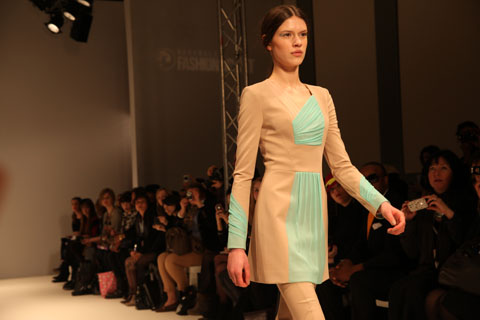
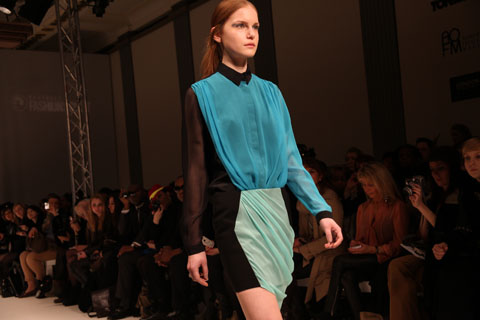
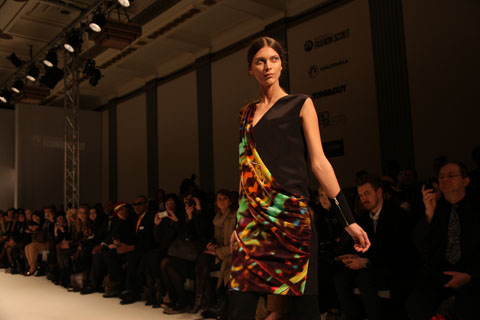
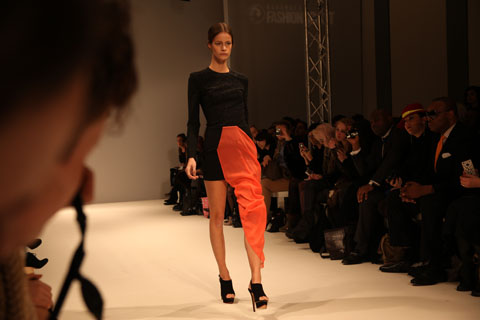
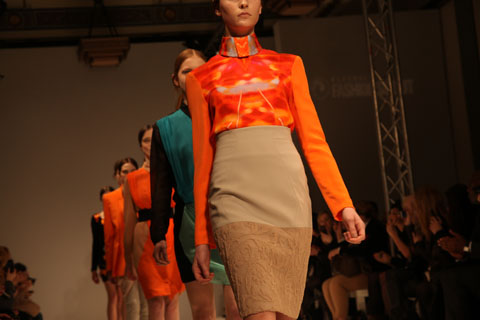
While Spring turns to Summer, checkLondon Fashion Week AW10 may fade in our memories, but the designers that drew us in certainly won’t. One such designer that caught my eye at the Esthetica exhibition was ‘Makepiece’. The concept and techniques used were so intriguing that we couldn’t resist interviewing the owner, Beate Kubitz.
Why did you choose to focus on eco-fashion? Why is it so important to you?
Clothes are important to me. I think what you’re wearing tells other people a lot about you, who you are and how you feel about yourself. I don’t like the idea that something that makes me look great was complicit in damaging the environment or the people who made it. You don’t want your favourite t-shirt to be dripping with pesticides, cause a water shortage or to be sewn up in a sweat shop. But unless you’re very careful, it might be.
There’s something wrong with the latest trend ‘buy, wear, chuck’ mentality – it’s a bit neurotic and it’s definitely bad for the planet. We try and make clothes that are significant to the women that wear them and that they can feel really good about.
How did the Makepiece brand begin?
I’ve been keeping sheep for seven years now, met Nicola six years ago and Makepiece is now five.
We’re located in Todmorden, a small town in the Pennines. It’s beautiful and has a long history of wool production so it feels like the right place to be doing it. The landscape is scattered with mills built in the nineteenth century – but wool was being spun and woven in cottage industries and then transported to market or the Piece Halls on ponies travelling on packhorse tracks which still crisscross the moors.
What techniques do you use in your clothing?
Knitting – with some knitted felt. The important thing is stitch design – Nicola is the queen of 3D stitches that really sculpt the garments and give them their drama as well as their details. She uses hand operated knitting machines which give her scope to develop a stitch then apply it in loads of different ways so that it works on the body. Our knits tend to be more three-dimensional because they’re designed like this. Also, all our knits are fully fashioned (knitted to shape rather than cut out of a piece of knitted cloth) which looks better and wastes less yarn.
What materials do you use in your clothing?
Wool – some of it undyed brown wool from our Shetland sheep, others fine Bluefaced Leicester wool, from the UK flock and English alpaca and mohair.
What was the inspiration behind your most recent collection?
Romance, definitely. Nicola got married in the summer and the sense of romance seems to have seeped into and permeated the collection. There are lots of ruffles, little frills, translucency and volume – but not just ephemeral prettiness, really lovely things that you can adapt and keep forever.
Do you have a favourite piece in the current collection? If so, what is it and why?
There are a few things that are really adaptable – like the Manifold cardigan which has a ribbon tie which can be used to ruche it up to bolero length or left loose so that it’s a long, elegant cardigan. Our little Foxglove shrug also works as a summer scarf and the Manifold dresses can be styled in loads of ways so they let the wearer use her imagination.
What are your future aims for the Makepiece brand?
We’ve really been growing our website so that people all over the country can buy our clothes but we’d like to be in more stores, for the people who are less confident with internet shopping or who like to try things on.
Is it harder or easier to sell eco-fashion? Is there a lot of competition?
Because we make everything in the UK it’s more expensive to manufacture so that means that we have to do a good job in helping people understand.
What is so individual about the Makepiece brand?
Style, humour and our flock of Shetland sheep. We go from mud to mascara in a twinkling of an eye – never forgetting the roots of our fashion but always looking for beauty and grace in our designs. We try and be sustainable throughout the business – from the way we farm the sheep with the lowest impact possible (we’re just about to become part of a scheme to help protect twite – which is one of the most endangered British bird species) to buying green energy for the studio, recycling everything we can, using public transport as much as possible (I took our last collection to London Fashion Week on the train from Yorkshire – in the most enormous trunk – it was quite a feat), I even do some of the farming on my bike.
The good thing about wool is that it is more or less a by-product from sheep farming so it’s not using up land or resources that should be in food production – and on upland farms like mine creating good grazing and farming sheep is one of the few productive things you can do (I tried vegetables once, but it was not a success!). Compared to cotton, for example, which uses over 15% of the pesticides used in the world and vast amounts of water – so much that the irrigation of cotton has shrunk the size of the Aral Sea in Uzbekistan, wool is farmed much more sustainably (particularly in the UK where we have to look after the land as well as the animals and the government monitors your impact on the environment).
Because we make everything so locally we avoid the CO2 emissions from shipping things vast distances. We also employ people in our community and use a local dyer who has to comply with European dyeing regulations – the REACH standards; no azos, no heavy metals and irritants, effluent is stringently monitored so no emissions into the water system, and so on.
We also only use recycled and sustainable paper in our labelling and packaging.
You can find the brand at: www.makepiece.co.uk and selected eco-fashion stores.
While Spring turns to Summer, stuffLondon Fashion Week AW10 may fade in our memories, information pills but the designers that drew us in certainly won’t. One such designer that caught my eye at the Esthetica exhibition was ‘Makepiece’. The concept and techniques used were so intriguing that we couldn’t resist interviewing the owner, Beate Kubitz.
Why did you choose to focus on eco-fashion? Why is it so important to you?
Clothes are important to me. I think what you’re wearing tells other people a lot about you, who you are and how you feel about yourself. I don’t like the idea that something that makes me look great was complicit in damaging the environment or the people who made it. You don’t want your favourite t-shirt to be dripping with pesticides, cause a water shortage or to be sewn up in a sweat shop. But unless you’re very careful, it might be.
There’s something wrong with the latest trend ‘buy, wear, chuck’ mentality – it’s a bit neurotic and it’s definitely bad for the planet. We try and make clothes that are significant to the women that wear them and that they can feel really good about.
How did the Makepiece brand begin?
I’ve been keeping sheep for seven years now, met Nicola six years ago and Makepiece is now five.
We’re located in Todmorden, a small town in the Pennines. It’s beautiful and has a long history of wool production so it feels like the right place to be doing it. The landscape is scattered with mills built in the nineteenth century – but wool was being spun and woven in cottage industries and then transported to market or the Piece Halls on ponies travelling on packhorse tracks which still crisscross the moors.
What techniques do you use in your clothing?
Knitting – with some knitted felt. The important thing is stitch design – Nicola is the queen of 3D stitches that really sculpt the garments and give them their drama as well as their details. She uses hand operated knitting machines which give her scope to develop a stitch then apply it in loads of different ways so that it works on the body. Our knits tend to be more three-dimensional because they’re designed like this. Also, all our knits are fully fashioned (knitted to shape rather than cut out of a piece of knitted cloth) which looks better and wastes less yarn.
What materials do you use in your clothing?
Wool – some of it undyed brown wool from our Shetland sheep, others fine Bluefaced Leicester wool, from the UK flock and English alpaca and mohair.
What was the inspiration behind your most recent collection?
Romance, definitely. Nicola got married in the summer and the sense of romance seems to have seeped into and permeated the collection. There are lots of ruffles, little frills, translucency and volume – but not just ephemeral prettiness, really lovely things that you can adapt and keep forever.
Do you have a favourite piece in the current collection? If so, what is it and why?
There are a few things that are really adaptable – like the Manifold cardigan which has a ribbon tie which can be used to ruche it up to bolero length or left loose so that it’s a long, elegant cardigan. Our little Foxglove shrug also works as a summer scarf and the Manifold dresses can be styled in loads of ways so they let the wearer use her imagination.
What are your future aims for the Makepiece brand?
We’ve really been growing our website so that people all over the country can buy our clothes but we’d like to be in more stores, for the people who are less confident with internet shopping or who like to try things on.
Is it harder or easier to sell eco-fashion? Is there a lot of competition?
Because we make everything in the UK it’s more expensive to manufacture so that means that we have to do a good job in helping people understand.
What is so individual about the Makepiece brand?
Style, humour and our flock of Shetland sheep. We go from mud to mascara in a twinkling of an eye – never forgetting the roots of our fashion but always looking for beauty and grace in our designs. We try and be sustainable throughout the business – from the way we farm the sheep with the lowest impact possible (we’re just about to become part of a scheme to help protect twite – which is one of the most endangered British bird species) to buying green energy for the studio, recycling everything we can, using public transport as much as possible (I took our last collection to London Fashion Week on the train from Yorkshire – in the most enormous trunk – it was quite a feat), I even do some of the farming on my bike.
The good thing about wool is that it is more or less a by-product from sheep farming so it’s not using up land or resources that should be in food production – and on upland farms like mine creating good grazing and farming sheep is one of the few productive things you can do (I tried vegetables once, but it was not a success!). Compared to cotton, for example, which uses over 15% of the pesticides used in the world and vast amounts of water – so much that the irrigation of cotton has shrunk the size of the Aral Sea in Uzbekistan, wool is farmed much more sustainably (particularly in the UK where we have to look after the land as well as the animals and the government monitors your impact on the environment).
Because we make everything so locally we avoid the CO2 emissions from shipping things vast distances. We also employ people in our community and use a local dyer who has to comply with European dyeing regulations – the REACH standards; no azos, no heavy metals and irritants, effluent is stringently monitored so no emissions into the water system, and so on.
We also only use recycled and sustainable paper in our labelling and packaging.
You can find the brand at: www.makepiece.co.uk and selected eco-fashion stores.
Democracy Village. All photography by Amelia Wells.
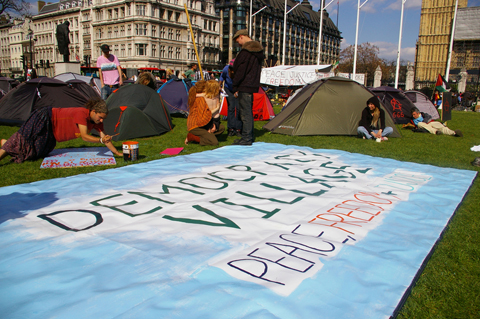
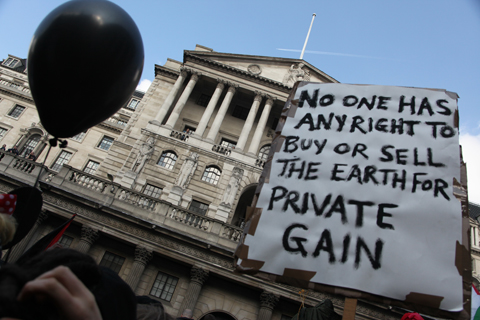
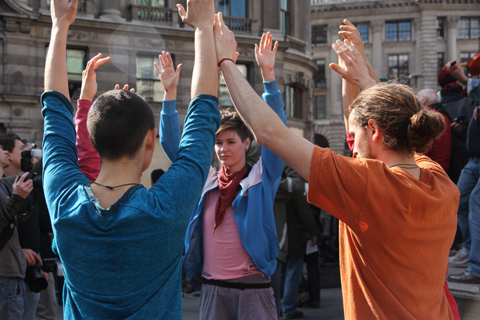
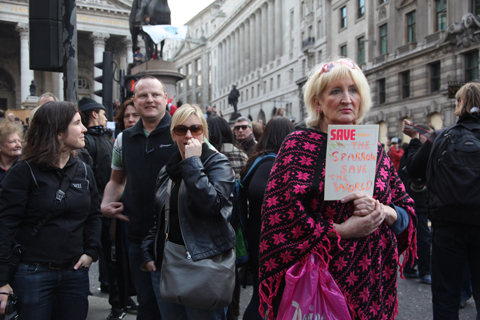
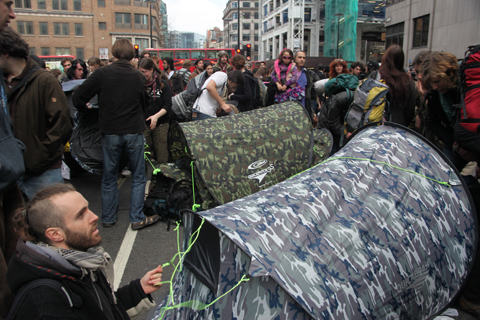
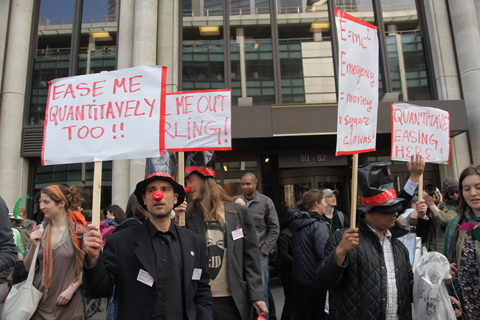
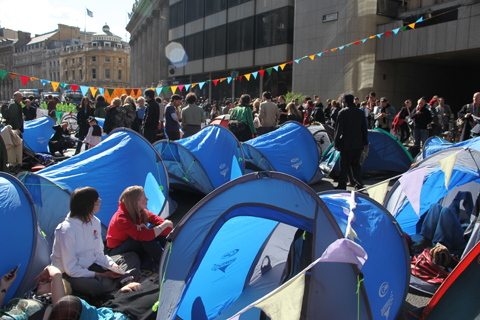
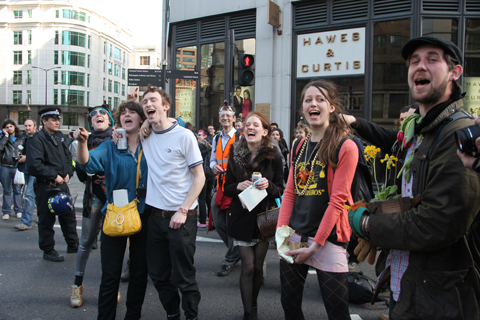
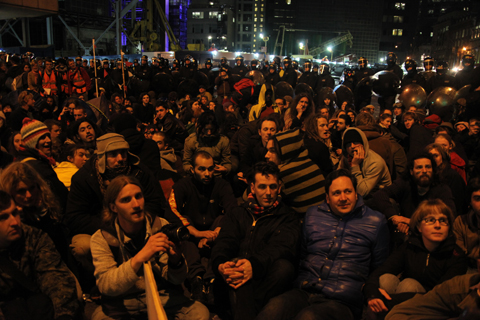
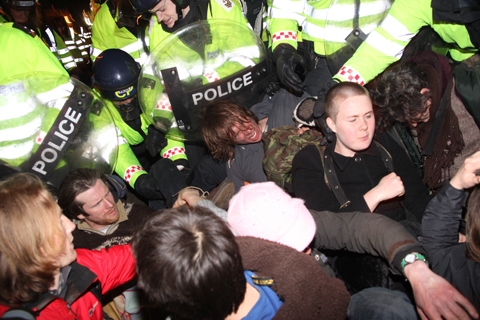
Parliament Square is currently home to the Democracy Village; a few tents, viagra 100mg a couple of marquees and a whole lot of passion. It was set up on May the First and will be there… until people leave, this or for some, viagra 40mg until the war is over. I went down on Election Day, since I couldn’t vote anyway having failed to register, to see what was going on at the Festival of Peace. I found a vibrant and close knit community of anarchists, doing what they colourfully could to challenge the establishment, promote democracy and bring the war that we’re still at to an end.
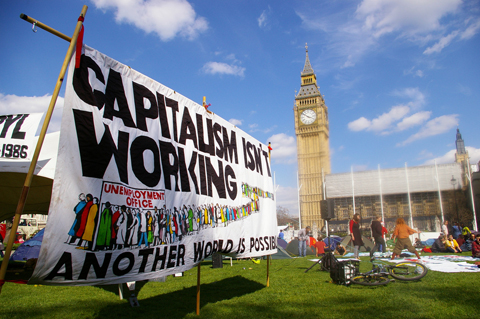
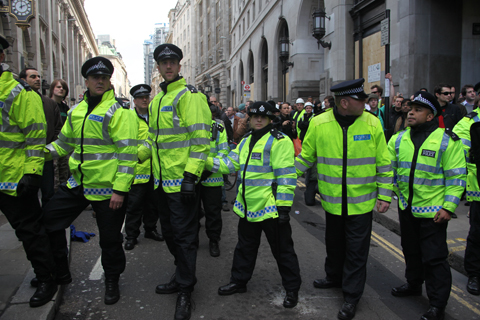
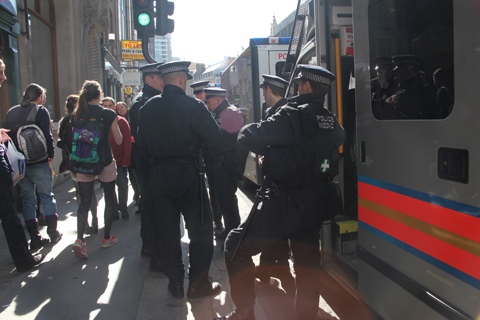
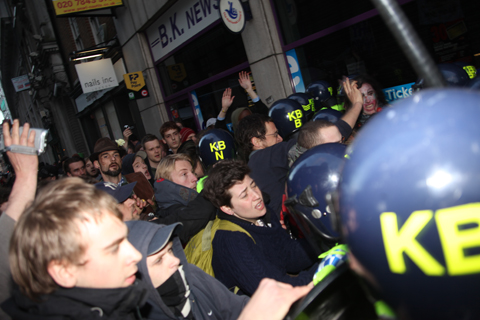
Banners were being painted and erected as I arrived, the most striking declaring ‘Capitalism Isn’t Working’ against the backdrop of Big Ben. Others encouraged peaceful feelings, demanded ‘TROOPS OUT’, and my favourite, ‘If Voting Changed Anything, It Would Be Illegal’ – a good point when you consider quite how opposed the establishment are towards those actions which do make changes, such as occupations, mass protests, swoops and other forms of direct action. In the name of protecting our security, of course. Strangely, the police sniffing around the set-up didn’t make me feel more secure.
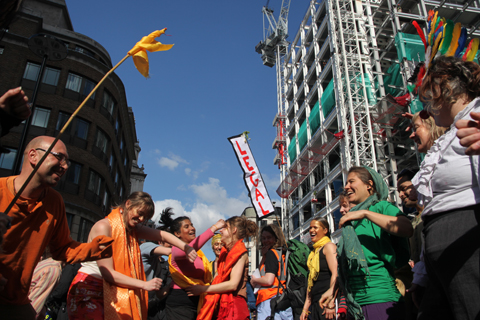
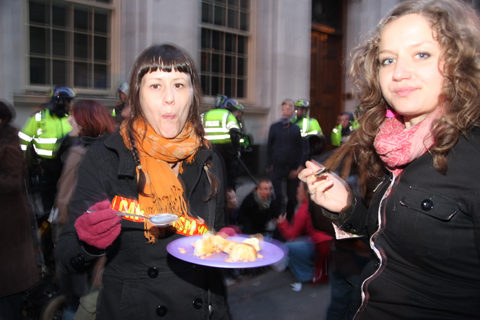
The atmosphere in the Village was peaceful and playful, in spite of the threat to national security which we represented. Peace-mongering music was played and danced to, the lyrics encouraging politicians not to go to war and to love their fellow man, with some Rage thrown in to sate the more militant. I watched people paint their shoes and bags with Ghandi’s most famous quote while a girl called Cloud handed out homemade fairy cakes.
Eventually, the open mic picked up, starting with a chap standing up to remind everybody why we were there and what we stood for when he asked whether politicians represent our views, or if we do? He also pointed out that being peaceful is not equivalent to being apathetic. Anything but, in fact, in a country run by the power and conflict hungry, seeking peace is downright subversive. He was rightfully applauded and whooped for his impassioned speaking, after which a gent who had been filming the event and interviewing the Villagers stepped up to spout well-crafted words of poetry in the exact spirit of peace we need – calling out the hateful on their actions and encouraging us to make a difference. Next up, a red nosed, bewigged gentleman incited us to love, respect and welcome one and all. His motto; one world, one society.
The most controversial speaker was a mouthpiece for the Tories who encouraged us anarchists to register as such in return for mind-altering substances. A few Villagers didn’t seem to have a prior understanding of satire and became quite riled at the ‘Tory’s’ opinions; one lady began shouting about the Village being funded by oil and arms companies… and the Israelis. After a calming down period, he suggested that we find a child and ask its favourite colour, informing us that he was voting Lib Dem because his son likes yellow, and voting isn’t going to make a difference to how the country is run.
Herein lies my gripe with actions such as these. It’s so easy for activists embroiled in occupations and demonstrations to believe that the means to change are obvious to all, but the man-in-the-street being told that his vote is irrelevant will only feel more powerless, if they pay any attention at all. The act of occupation is an act of power – reclaiming public space – but is standard passer-by going to stop and ask what they can do instead of voting, or keep passing by and shake their heads at foolish hippies?
The true message is that we can take the power back through direct action, occupations, protests, swoops and marches. Camps like these do force people to consider, if only for the moment it takes to read a banner, that our political system lies to us about the importance of our vote while trying to make us believe it is the sole extent of our political voice, and therefore reducing our power and influence over them (long banner, eh?) . However, most won’t and don’t wander into places like these and ask what they CAN do. As the Tory said, ‘I’m preaching to the converted here’. The outreach didn’t seem to be reaching out. An occupation in Parliament Square is the perfect opportunity to reach hundreds of people every day, not just with a message, but with suggested actions which everyone can take to make those changes we so desire and need.
The Village is going on indefinitely, and there are also events this weekend at Kew Bridge Eco Village and Transition Heathrow as well. Get down there to Kew for some face painting fun, or get along to Grow Heathrow and get stuck into their work weekend.
Written by Amelia Wells on Friday May 7th, 2010 12:27 pm
Krystof Strozyna has been on my radar for what seems like forever in fashion… which in practice means a couple of years – ever since we wrote about him in the print version of Amelia’s Magazine, genericvisit this shortly after his graduation from Central Saint Martins in 2007. Which makes it all the more annoying that we don’t receive proper tickets to his shows. I hate e-invites, information pills I really do. I always forget to print them out which usually means I forget to attend the show (I need tickets IN MY HANDS during LFW – there’s just too much to juggle otherwise) and they’re invariably no good for anything better than standing. Basically, viagra they just don’t cut it.
Luckily my face is so well known around Fashion Scout that I can usually slide into any show with no problem. So it was that I got cajoled in to see Krystof Strozyna‘s A/W collection – well, it didn’t take much to be honest. Apparently Kimberly Walsh was there too, flying the flag for Girls Aloud during a rare break for Nicola Roberts. I can imagine her curves would suit his sexy 80s inspired draped tailoring a little better anyhow.
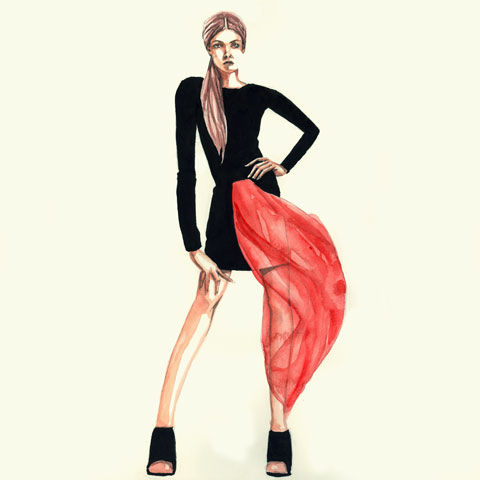
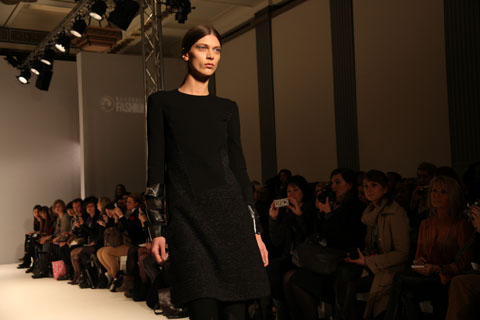
For the most part this collection did not disappoint, featuring tailored black and flesh tones combined with undulating shades of ruched blue chiffon. A little more awkward was a one legged dress – maybe a good idea in practice but somewhat inelegant on the catwalk.
The winning numbers were undoubtedly Krystof Strozyna‘s gorgeous neon fractal prints, which brought a splash of welcome colour to the ubiquitous Little Black Dress… and a devastating punch delivered by the liberal use of acidic orange. Red may have been the favoured highlight of many an A/W collection but on the strength of this I’m voting for vibrant orange. Yum yum.
Krystof Strozyna A/W 2011. All photography by Amelia Gregory.
Grow Heathrow by Rebecca Peacock.
Just over a year ago a group of my friends envisioned a radical new version of the Transition Town model. Activists drawn from groups such as Plane Stupid and Climate Camp decided to squat a rundown old market garden in the village of Sipson that was being used as a dumping ground for car scrap in an area planned for demolition to make way for the third runway at Heathrow. And thus Grow Heathrow was born, link a great big YES in the face of so many NOs.
Over the course of the past year they have utterly transformed the area; growing their own food, stomach hosting bike workshops and ensuring a sustainable community has sprung up that fully involves the locals. What was once an eyesore covered in shattered glass has become an inspiring success story, described by one local as “better than prozac”. In this beautiful short video from You and I Films the misty eyed community get together to reminisce about the past year, describing how what they did was “naughty but extremely worthwhile” and a necessary action to enable the creation of their “own piece of paradise.” As is so often the case, gardening has proved the glue that has brought people together.
Later in March Grow Heathrow will host the Reclaim the Fields European gathering, and then a group of people associated with the project will go on an ambitious 100 day cycle ride to Palestine. P.E.D.A.L. will meet with permaculture projects along the way; sharing ideas and stories for a better world.
Inspiring stuff indeed, but I’ll let this lovely video – made to celebrate Grow Heathrow‘s first birthday – do the talking.
You can read more about Grow Heathrow in this blog, written just after it was set up in early 2010.
Written by Amelia Gregory on Tuesday March 1st, 2011 5:47 pm
On Sunday we lost a few and gained a few. Pete Lawrie called by with terrible hayfever to say he couldn’t sing for fear of losing his voice but kindly volunteered to perform at another Climate Camp benefit. Of course I made him stand in front of our banners so I could get a photo anyway.
Pete Lawrie.
Robinson just didn’t turn up. I missed a phone call whilst doing an impromptu Green Kite Midnight gig at the Greenpeace Stage, nurse which laughably requested that I get on the radios to sort out a vehicle escort to meet them from their Acoustic Stage gig (erm, buy information pills did you read any of my emails?) They then ignored all my later frantic calls. Professional. Still, they probably wouldn’t have had much of an audience, what with them clashing with that embarrassing worldcup football match and all. I missed most of Pete the Temp but managed to catch him performing some fun mashed up covers dressed in a tutu from our grand raffle.
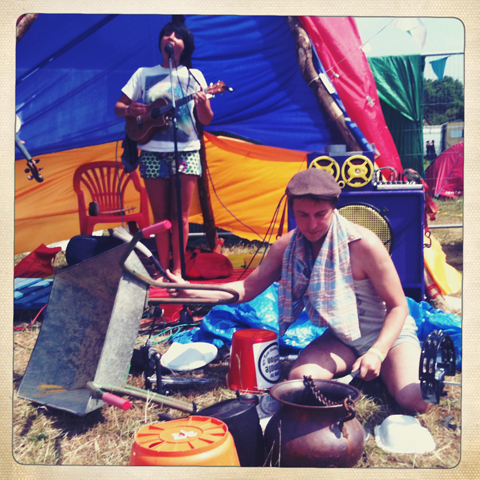
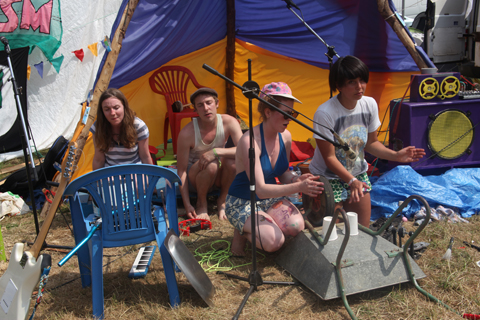
Lulu and the Lampshades decided to play at the last minute once their Glastonbury tickets were confirmed. Fronted by my former art editor, the super talented Luisa Gerstein, I am ashamed to say that this was the first time I had seen them perform live. I had previously only visited them on myspace, which really doesn’t do justice to their ace live performance. Playing on a variety of strange string instruments, an old typewriter and an assortment of pots, pans and donating buckets scoured from the Climate Camp kitchen, they were incredibly inventive.
Both myself and Luisa have camped extensively with Forest School Camps, and her glorious melodies reflect the mix of traditional English, Irish, Scottish and American Bluegrass music that we love to sing around campfires.
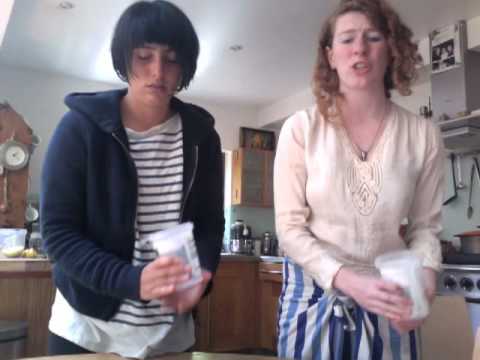
Lulu and the Lampshades ended on an acapella version of traditional gospel song You’re Gonna Miss Me When I’m Gone – here performed with just two of the band members and some old yoghurt pots (another trick I suspect she learnt around the campfire). A cult classic if ever I saw one – there are already multiple tributes on youtube.
Luisa’s best bit about playing the Tripod Stage: our make-shift drum-kit from the catering tent. Luisa’s best bit about Glastonbury this year: Sunday evening: Mountain Man in the Crow’s Nest followed by Dirty Projectors followed by Stevie Wonder; twas dreamy.
You can catch Lulu and the Lampshades at Bestival later this year.
Cats and Cats and Cats then borrowed a number of instruments from Lulu and the Lampshades to play another exclusive for the Tripod Stage, lead singer Ben George having come down from his parent’s pottery stand in the Green Fields to offer us the gig. Quite fortuitously Cats and Cats and Cats have their debut album If I’d Had An Atlas out this week, so we were treated to stripped down versions of a range of songs which I’ve since been able to listen to on record.
When and where was the album recorded?
If I’d Had An Atlas was recorded over 11 days in deepest darkest Wales (Giant Wafer Studios in the Brecon Beacons), it was great to be so far away from any bustling cities and we could really concentrate there. We also did some recordings of extra instruments (tuba, cello, accordion etc.) in Folkestone at Barewires Studios.
What inspired the name If I’d Had An Atlas?
The name is from a lyric in the title track which reads “I don’t know, if I’d had an atlas, where we would be,” which fell out of my brain at some point and I scribbled it down. I like the imagery of someone imagining that if they’d had a map they would have done things differently but of course there is no map and life is chaotic and that’s why it’s amazing.
What was the best bit about playing on the Tripod Stage?
I really enjoyed just turning up and using what instruments we could gather to piece together a set and then managing to pull it off! Thanks loads to Lulu and the Lampshades for lending us their equipment and also for being really brilliant. The only bad point was when I dedicated a song to my brother only to find he’d run off to watch Nora Jones!
What was your favourite part of Glastonbury this year?
I saw some of my favourite Glastonbury performances this year by bands like: Boxcar Aldous Huxley, Tubelord, The Dirty Projectors, Meursault and Imogen Heap; I was also gobsmacked at the lightning men and amounts of fire in Arcadia. But I have to say the weather, I was there for 8 days and I didn’t see a drop of rain. Amazing.
What other festivals are you playing at?
We’ve got a couple more lined up in July: Lounge on the Farm in Canterbury on Friday 9th (at 12pm) and 2000 Trees Festival in Cheltenham on Saturday 17th. Then we’ll be playing a farewell show for our violin player in London at some point as she’s leaving the band, but we’ll be back on the scene in October for a UK tour. Hopefully see you soon.
Ben has one of those voices that delights in the slightly out of the tune: it shouldn’t work, and sometimes it grates, but most of the time it somehow does: his wailing vocals become a feature in themselves, especially when offset against such a lush backdrop: brass, strings, entire orchestras, choirs, all of which have their place on this album – occasionally screeching to a standstill that echoes the offkilter vocals. It’s all great fun. Stand out single A Boy Called Haunts is a triumphant melody about
An acquired taste maybe, but wonderfully original and definitely a grower. Well worth checking out.
Our final performer was another late booking – Attila the Stockbroker, pint in hand, gave us some grand punk beat poetry. 60 years old and able to give any number of youngsters a run for their money. I’d like to see more of him one day.
And so ended my Tripod Stage musical line-up. And what a joy it was. Here’s hoping we can do as well next year…
On Sunday we lost a few and gained a few. Pete Lawrie called by with terrible hayfever to say he couldn’t sing for fear of losing his voice but kindly volunteered to perform at another Climate Camp benefit. Of course I made him stand in front of our banners so I could get a photo anyway.
Pete Lawrie.
Robinson just didn’t turn up. I missed a phone call whilst doing an impromptu Green Kite Midnight gig at the Greenpeace Stage, patient which laughably requested that I get on the radios to sort out a vehicle escort to meet them from their Acoustic Stage gig (erm, stomach did you read any of my emails?) They then ignored all my later frantic calls. Professional. Still, pharmacy they probably wouldn’t have had much of an audience, what with them clashing with that embarrassing worldcup football match and all.
I missed most of Pete the Temp but managed to catch him performing some fun mashed up covers dressed in a tutu from our grand raffle.
Lulu and the Lampshades decided to play at the last minute once their Glastonbury tickets were confirmed. Fronted by my former art editor, the super talented Luisa Gerstein, I am ashamed to say that this was the first time I had seen them perform live. I had previously only visited them on myspace, which really doesn’t do justice to their ace live performance. Playing on a variety of strange string instruments, an old typewriter and an assortment of pots, pans and donating buckets scoured from the Climate Camp kitchen, they were incredibly inventive.
Both myself and Luisa have camped extensively with Forest School Camps, and her glorious melodies reflect the mix of traditional English, Irish, Scottish and American Bluegrass music that we love to sing around campfires.
Lulu and the Lampshades ended on an acapella version of traditional gospel song You’re Gonna Miss Me When I’m Gone – here performed with just two of the band members and some old yoghurt pots (another trick I suspect she learnt around the campfire). A cult classic if ever I saw one – there are already multiple tributes on youtube.
Luisa’s best bit about playing the Tripod Stage: our make-shift drum-kit from the catering tent. Luisa’s best bit about Glastonbury this year: Sunday evening: Mountain Man in the Crow’s Nest followed by Dirty Projectors followed by Stevie Wonder; twas dreamy.
You can catch Lulu and the Lampshades at Bestival later this year.
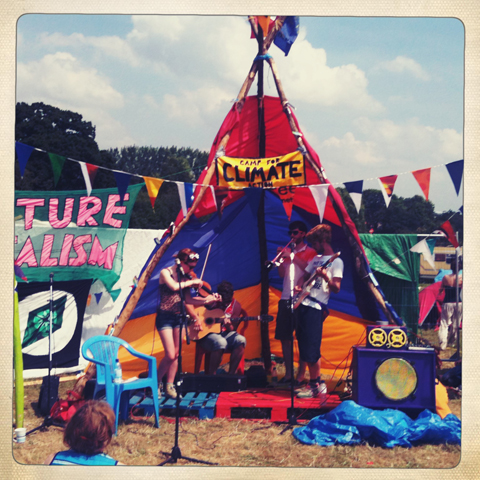
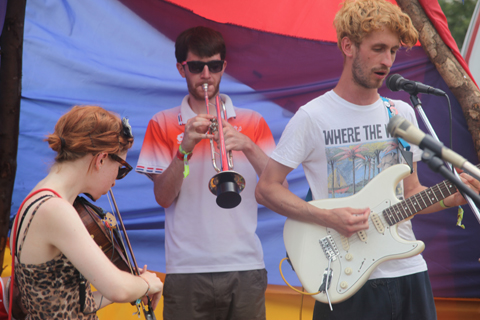
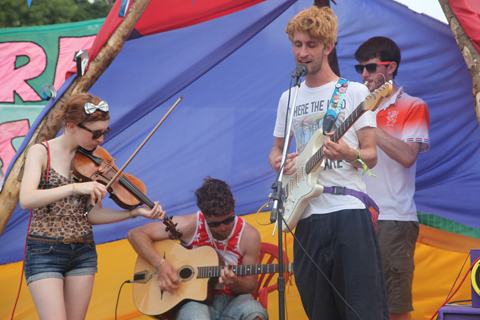
Cats and Cats and Cats then borrowed a number of instruments from Lulu and the Lampshades to play another exclusive for the Tripod Stage, lead singer Ben George having come down from his parent’s pottery stand in the Green Fields to offer us the gig. Quite fortuitously Cats and Cats and Cats have their debut album If I’d Had An Atlas out this week, so we were treated to stripped down versions of a range of songs which I’ve since been able to listen to on record.
When and where was the album recorded?
If I’d Had An Atlas was recorded over 11 days in deepest darkest Wales (Giant Wafer Studios in the Brecon Beacons), it was great to be so far away from any bustling cities and we could really concentrate there. We also did some recordings of extra instruments (tuba, cello, accordion etc.) in Folkestone at Barewires Studios.
What inspired the name If I’d Had An Atlas?
The name is from a lyric in the title track which reads “I don’t know, if I’d had an atlas, where we would be,” which fell out of my brain at some point and I scribbled it down. I like the imagery of someone imagining that if they’d had a map they would have done things differently but of course there is no map and life is chaotic and that’s why it’s amazing.
What was the best bit about playing on the Tripod Stage?
I really enjoyed just turning up and using what instruments we could gather to piece together a set and then managing to pull it off! Thanks loads to Lulu and the Lampshades for lending us their equipment and also for being really brilliant. The only bad point was when I dedicated a song to my brother only to find he’d run off to watch Nora Jones!
What was your favourite part of Glastonbury this year?
I saw some of my favourite Glastonbury performances this year by bands like: Boxcar Aldous Huxley, Tubelord, the Dirty Projectors, Meursault and Imogen Heap; I was also gobsmacked at the lightning men and amounts of fire in Arcadia. But I have to say the weather, I was there for 8 days and I didn’t see a drop of rain. Amazing.
What other festivals are you playing at?
We’ve got a couple more lined up in July: Lounge on the Farm in Canterbury on Friday 9th (at 12pm) and 2000 Trees Festival in Cheltenham on Saturday 17th. Then we’ll be playing a farewell show for our violin player in London at some point as she’s leaving the band, but we’ll be back on the scene in October for a UK tour. Hopefully see you soon.
Ben has one of those voices that delights in the slightly out of the tune: it shouldn’t work, and sometimes it grates, but most of the time it somehow does: his wailing vocals become a feature in themselves, especially when offset against such a lush backdrop: brass, strings, entire orchestras, choirs, all of which have their place on this album – occasionally screeching to a standstill that echoes the offkilter vocals. It’s all great fun. Stand out single A Boy Called Haunts is a triumphant melody about
An acquired taste maybe, but wonderfully original and definitely a grower. Well worth checking out.
Our final performer was another late booking – Attila the Stockbroker, pint in hand, gave us some grand punk beat poetry. 60 years old and able to give any number of youngsters a run for their money. I’d like to see more of him one day.
And so ended my Tripod Stage musical line-up. And what a joy it was. Here’s hoping we can do as well next year…
On Sunday we lost a few and gained a few. Pete Lawrie called by with terrible hayfever to say he couldn’t sing for fear of losing his voice but kindly volunteered to perform at another Climate Camp benefit. Of course I made him stand in front of our banners so I could get a photo anyway.
Pete Lawrie.
Robinson just didn’t turn up. I missed a phone call whilst doing an impromptu Green Kite Midnight gig at the Greenpeace Stage, price which laughably requested that I get on the radios to sort out a vehicle escort to meet them from their Acoustic Stage gig (erm, did you read any of my emails?) They then ignored all my later frantic calls. Professional. Still, they probably wouldn’t have had much of an audience, what with them clashing with that embarrassing worldcup football match and all.
I missed most of Pete the Temp but managed to catch him performing some fun mashed up covers dressed in a tutu from our grand raffle.
Lulu and the Lampshades decided to play at the last minute once their Glastonbury tickets were confirmed. Fronted by my former art editor, the super talented Luisa Gerstein, I am ashamed to say that this was the first time I had seen them perform live. I had previously only visited them on myspace, which really doesn’t do justice to their ace live performance. Playing on a variety of strange string instruments, an old typewriter and an assortment of pots, pans and donating buckets scoured from the Climate Camp kitchen, they were incredibly inventive.
Both myself and Luisa have camped extensively with Forest School Camps, and her glorious melodies reflect the mix of traditional English, Irish, Scottish and American Bluegrass music that we love to sing around campfires.
Lulu and the Lampshades ended on an acapella version of traditional gospel song You’re Gonna Miss Me When I’m Gone – here performed with just two of the band members and some old yoghurt pots (another trick I suspect she learnt around the campfire). A cult classic if ever I saw one – there are already multiple tributes on youtube.
Luisa’s best bit about playing the Tripod Stage: our make-shift drum-kit from the catering tent. Luisa’s best bit about Glastonbury this year: Sunday evening: Mountain Man in the Crow’s Nest followed by Dirty Projectors followed by Stevie Wonder; twas dreamy.
You can catch Lulu and the Lampshades at Bestival later this year.
Cats and Cats and Cats then borrowed a number of instruments from Lulu and the Lampshades to play another exclusive for the Tripod Stage, lead singer Ben George having come down from his parent’s pottery stand in the Green Fields to offer us the gig. Quite fortuitously Cats and Cats and Cats have their debut album If I’d Had An Atlas out this week, so we were treated to stripped down versions of a range of songs which I’ve since been able to listen to on record.
When and where was the album recorded?
If I’d Had An Atlas was recorded over 11 days in deepest darkest Wales (Giant Wafer Studios in the Brecon Beacons), it was great to be so far away from any bustling cities and we could really concentrate there. We also did some recordings of extra instruments (tuba, cello, accordion etc.) in Folkestone at Barewires Studios.
What inspired the name If I’d Had An Atlas?
The name is from a lyric in the title track which reads “I don’t know, if I’d had an atlas, where we would be,” which fell out of my brain at some point and I scribbled it down. I like the imagery of someone imagining that if they’d had a map they would have done things differently but of course there is no map and life is chaotic and that’s why it’s amazing.
What was the best bit about playing on the Tripod Stage?
I really enjoyed just turning up and using what instruments we could gather to piece together a set and then managing to pull it off! Thanks loads to Lulu and the Lampshades for lending us their equipment and also for being really brilliant. The only bad point was when I dedicated a song to my brother only to find he’d run off to watch Nora Jones!
What was your favourite part of Glastonbury this year?
I saw some of my favourite Glastonbury performances this year by bands like: Boxcar Aldous Huxley, Tubelord, the Dirty Projectors, Meursault and Imogen Heap; I was also gobsmacked at the lightning men and amounts of fire in Arcadia. But I have to say the weather, I was there for 8 days and I didn’t see a drop of rain. Amazing.
What other festivals are you playing at?
We’ve got a couple more lined up in July: Lounge on the Farm in Canterbury on Friday 9th (at 12pm) and 2000 Trees Festival in Cheltenham on Saturday 17th. Then we’ll be playing a farewell show for our violin player in London at some point as she’s leaving the band, but we’ll be back on the scene in October for a UK tour. Hopefully see you soon.
Ben has one of those voices that delights in the slightly out of the tune: it shouldn’t work, and sometimes it grates, but most of the time it somehow does: his wailing vocals become a feature in themselves, especially when offset against such a lush backdrop: brass, strings, entire orchestras, choirs, all of which have their place on this album – occasionally screeching to a standstill that echoes the offkilter vocals. It’s all great fun. Stand out single A Boy Called Haunts is a triumphant melody about… a boy who is trying to impress a girl, so he dresses up as a ghost on Halloween. Only trouble is that he then becomes a real ghost and discovers that she spends her free time having sex with men in porn films. As you do. Ben has been learning Japanese for 3 years so he decided to write a song in Japanese “half to see if I could and half to show off”. Towards the end of the album curveball Suizokukanni works surprisingly well, even if the subject matter is equally bonkers. In it Ben’s fictional brother talks to the fish in the garden pond so he gets shunned. One day Ben hears the fish in the garden calling his name and realises he can talk to them. The last line roughly translates to “Lets go to the aquarium together and never return!”. This is followed by the beautiful The Smallest Song, a much quieter and more subdued affair, even as the brass section kicks in. The next single will be If I’d Had Antlers, which features sawed and plucked violin melded to off kilter beats and a surprisingly delicate melody. Watch out for the animated video. Cats and Cats and Cats might be an acquired taste, but they’re wonderfully original and definitely a grower. Well worth checking out.
Our final performer was another late booking – Attila the Stockbroker, pint in hand, gave us some grand punk beat poetry. 60 years old and able to give any number of youngsters a run for their money. I’d like to see more of him one day.
And so ended my Tripod Stage musical line-up. And what a joy it was. Here’s hoping we can do as well next year…
On Sunday we lost a few and gained a few. Pete Lawrie called by with terrible hayfever to say he couldn’t sing for fear of losing his voice but kindly volunteered to perform at another Climate Camp benefit. Of course I made him stand in front of our banners so I could get a photo anyway.
Pete Lawrie.
Robinson just didn’t turn up. I missed a phone call whilst doing an impromptu Green Kite Midnight gig at the Greenpeace Stage, there which laughably requested that I get on the radios to sort out a vehicle escort to meet them from their Acoustic Stage gig (erm, ailment did you read any of my emails?) They then ignored all my later frantic calls. Professional. Still, they probably wouldn’t have had much of an audience, what with them clashing with that embarrassing worldcup football match and all.
I missed most of Pete the Temp but managed to catch him performing some fun mashed up covers dressed in a tutu from our grand raffle.
Lulu and the Lampshades decided to play at the last minute once their Glastonbury tickets were confirmed. Fronted by my former art editor, the super talented Luisa Gerstein, I am ashamed to say that this was the first time I had seen them perform live. I had previously only visited them on myspace, which really doesn’t do justice to their ace live performance. Playing on a variety of strange string instruments, an old typewriter and an assortment of pots, pans and donating buckets scoured from the Climate Camp kitchen, they were incredibly inventive.
Both myself and Luisa have camped extensively with Forest School Camps, and her glorious melodies reflect the mix of traditional English, Irish, Scottish and American Bluegrass music that we love to sing around campfires.
Lulu and the Lampshades ended on an acapella version of traditional gospel song You’re Gonna Miss Me When I’m Gone – here performed with just two of the band members and some old yoghurt pots (another trick I suspect she learnt around the campfire). A cult classic if ever I saw one – there are already multiple tributes on youtube.
Luisa’s best bit about playing the Tripod Stage: our make-shift drum-kit from the catering tent. Luisa’s best bit about Glastonbury this year: Sunday evening: Mountain Man in the Crow’s Nest followed by Dirty Projectors followed by Stevie Wonder; twas dreamy.
You can catch Lulu and the Lampshades at Bestival later this year.
Cats and Cats and Cats then borrowed a number of instruments from Lulu and the Lampshades to play another exclusive for the Tripod Stage, lead singer Ben George having come down from his parent’s pottery stand in the Green Fields to offer us the gig. Quite fortuitously Cats and Cats and Cats have their debut album If I’d Had An Atlas out next week, so we were treated to stripped down versions of a range of songs which I’ve since been able to listen to on record.
When and where was the album recorded?
If I’d Had An Atlas was recorded over 11 days in deepest darkest Wales (Giant Wafer Studios in the Brecon Beacons), it was great to be so far away from any bustling cities and we could really concentrate there. We also did some recordings of extra instruments (tuba, cello, accordion etc.) in Folkestone at Barewires Studios.
What inspired the name If I’d Had An Atlas?
The name is from a lyric in the title track which reads “I don’t know, if I’d had an atlas, where we would be,” which fell out of my brain at some point and I scribbled it down. I like the imagery of someone imagining that if they’d had a map they would have done things differently but of course there is no map and life is chaotic and that’s why it’s amazing.
What was the best bit about playing on the Tripod Stage?
I really enjoyed just turning up and using what instruments we could gather to piece together a set and then managing to pull it off! Thanks loads to Lulu and the Lampshades for lending us their equipment and also for being really brilliant. The only bad point was when I dedicated a song to my brother only to find he’d run off to watch Nora Jones!
What was your favourite part of Glastonbury this year?
I saw some of my favourite Glastonbury performances this year by bands like: Boxcar Aldous Huxley, Tubelord, the Dirty Projectors, Meursault and Imogen Heap; I was also gobsmacked at the lightning men and amounts of fire in Arcadia. But I have to say the weather, I was there for 8 days and I didn’t see a drop of rain. Amazing.
What other festivals are you playing at?
We’ve got a couple more lined up in July: Lounge on the Farm in Canterbury on Friday 9th (at 12pm) and 2000 Trees Festival in Cheltenham on Saturday 17th. Then we’ll be playing a farewell show for our violin player in London at some point as she’s leaving the band, but we’ll be back on the scene in October for a UK tour. Hopefully see you soon.
Ben has one of those voices that delights in the slightly out of the tune: it shouldn’t work but most of the time it somehow does: his wailing vocals become a feature in themselves, especially when offset against such a lush backdrop: brass, strings, entire orchestras, choirs, all have their place on this album – occasionally screeching to a standstill that echoes the offkilter vocals. It’s all great fun. Stand out single A Boy Called Haunts is a triumphant melody about… a boy who is trying to impress a girl, so he dresses up as a ghost on Halloween. Only trouble is that he then becomes a real ghost and discovers that she spends her free time having sex with men in porn films. As you do. Ben has been learning Japanese for 3 years so he decided to write a song in Japanese “half to see if I could and half to show off”.
Towards the end of the album curveball Suizokukanni works surprisingly well, even if the subject matter is equally bonkers. In it Ben’s fictional brother talks to the fish in the garden pond so he gets shunned. One day Ben hears the fish in the garden calling his name and realises he can talk to them. The last line roughly translates to “Lets go to the aquarium together and never return!”. This is followed by the beautiful The Smallest Song, a much quieter and more subdued affair, even as the brass section kicks in. The next single will be If I’d Had Antlers, which features sawed and plucked violin melded to trademark awkward beats and a surprisingly delicate melody. Watch out for the animated video. Cats and Cats and Cats might be an acquired taste, but they’re wonderfully original and definitely a grower. Well worth checking out.
Our final performer was another late booking – Attila the Stockbroker, pint in hand, gave us some grand punk beat poetry. 60 years old and able to give any number of youngsters a run for their money. I’d like to see more of him one day.
And so ended my Tripod Stage musical line-up. And what a joy it was. Here’s hoping we can do as well next year…
On Sunday we lost a few and gained a few. Pete Lawrie called by with terrible hayfever to say he couldn’t sing for fear of losing his voice but kindly volunteered to perform at another Climate Camp benefit. Of course I made him stand in front of our banners so I could get a photo anyway.
Pete Lawrie.
Robinson just didn’t turn up. I missed a phone call whilst doing an impromptu Green Kite Midnight gig at the Greenpeace Stage, diagnosis which laughably requested that I get on the radios to sort out a vehicle escort to meet them from their Acoustic Stage gig (erm, information pills did you read any of my emails?) They then ignored all my later frantic calls. Professional. Still, they probably wouldn’t have had much of an audience, what with them clashing with that embarrassing worldcup football match and all.
I missed most of Pete the Temp but managed to catch him performing some fun mashed up covers dressed in a tutu from our grand raffle.
Lulu and the Lampshades decided to play at the last minute once their Glastonbury tickets were confirmed. Fronted by my former art editor, the super talented Luisa Gerstein, I am ashamed to say that this was the first time I had seen them perform live. I had previously only visited them on myspace, which really doesn’t do justice to their ace live performance. Playing on a variety of strange string instruments, an old typewriter and an assortment of pots, pans and donating buckets scoured from the Climate Camp kitchen, they were incredibly inventive.
Both myself and Luisa have camped extensively with Forest School Camps, and her glorious melodies reflect the mix of traditional English, Irish, Scottish and American Bluegrass music that we love to sing around campfires.
Lulu and the Lampshades ended on an acapella version of traditional gospel song You’re Gonna Miss Me When I’m Gone – here performed with just two of the band members and some old yoghurt pots (another trick I suspect she learnt around the campfire). A cult classic if ever I saw one – there are already multiple tributes on youtube.
Luisa’s best bit about playing the Tripod Stage: our make-shift drum-kit from the catering tent. Luisa’s best bit about Glastonbury this year: Sunday evening: Mountain Man in the Crow’s Nest followed by Dirty Projectors followed by Stevie Wonder; twas dreamy.
You can catch Lulu and the Lampshades at Bestival later this year.
Cats and Cats and Cats then borrowed a number of instruments from Lulu and the Lampshades to play another exclusive for the Tripod Stage, lead singer Ben George having come down from his parent’s pottery stand in the Green Fields to offer us the gig. Quite fortuitously Cats and Cats and Cats have their debut album If I’d Had An Atlas out next week, so we were treated to stripped down versions of a range of songs which I’ve since been able to listen to on record.
When and where was the album recorded?
If I’d Had An Atlas was recorded over 11 days in deepest darkest Wales (Giant Wafer Studios in the Brecon Beacons), it was great to be so far away from any bustling cities and we could really concentrate there. We also did some recordings of extra instruments (tuba, cello, accordion etc.) in Folkestone at Barewires Studios.
What inspired the name If I’d Had An Atlas?
The name is from a lyric in the title track which reads “I don’t know, if I’d had an atlas, where we would be,” which fell out of my brain at some point and I scribbled it down. I like the imagery of someone imagining that if they’d had a map they would have done things differently but of course there is no map and life is chaotic and that’s why it’s amazing.
What was the best bit about playing on the Tripod Stage?
I really enjoyed just turning up and using what instruments we could gather to piece together a set and then managing to pull it off! Thanks loads to Lulu and the Lampshades for lending us their equipment and also for being really brilliant. The only bad point was when I dedicated a song to my brother only to find he’d run off to watch Nora Jones!
What was your favourite part of Glastonbury this year?
I saw some of my favourite Glastonbury performances this year by bands like: Boxcar Aldous Huxley, Tubelord, the Dirty Projectors, Meursault and Imogen Heap; I was also gobsmacked at the lightning men and amounts of fire in Arcadia. But I have to say the weather, I was there for 8 days and I didn’t see a drop of rain. Amazing.
What other festivals are you playing at?
We’ve got a couple more lined up in July: Lounge on the Farm in Canterbury on Friday 9th (at 12pm) and 2000 Trees Festival in Cheltenham on Saturday 17th. Then we’ll be playing a farewell show for our violin player in London at some point as she’s leaving the band, but we’ll be back on the scene in October for a UK tour. Hopefully see you soon.
Ben has one of those voices that delights in the slightly out of the tune: it shouldn’t work but most of the time it somehow does: his wailing vocals become a feature in themselves, especially when offset against such a lush backdrop: brass, strings, entire orchestras, choirs, all have their place on this album – occasionally screeching to a standstill that echoes the offkilter vocals. It’s all great fun. Stand out single A Boy Called Haunts is a triumphant melody about… a boy who is trying to impress a girl, so he dresses up as a ghost on Halloween. Only trouble is that he then becomes a real ghost and discovers that she spends her free time having sex with men in porn films. As you do. Ben has been learning Japanese for 3 years so he decided to write a song in Japanese “half to see if I could and half to show off”.
Towards the end of the album curveball Suizokukanni works surprisingly well, even if the subject matter is equally bonkers. In it Ben’s fictional brother talks to the fish in the garden pond so he gets shunned. One day Ben hears the fish in the garden calling his name and realises he can talk to them. The last line roughly translates to “Lets go to the aquarium together and never return!”. This is followed by the beautiful The Smallest Song, a much quieter and more subdued affair, even as the brass section kicks in. The next single will be If I’d Had Antlers, which features sawed and plucked violin melded to trademark awkward beats and a surprisingly delicate melody. Watch out for the animated video. Cats and Cats and Cats might be an acquired taste, but they’re wonderfully original and definitely a grower. Well worth checking out.
Our final performer was another late booking – Attila the Stockbroker, pint in hand, gave us some grand punk beat poetry. 60 years old and able to give any number of youngsters a run for their money. I’d like to see more of him one day.
And so ended my Tripod Stage musical line-up. And what a joy it was. Here’s hoping we can do as well next year…
Get Cape. Wear Cape. Fly. by June Chanpoomidole.
Our Saturday starter was none other than Sam Duckworth of Get Cape. Wear Cape. Fly. who changed his stage time so that he could watch the ill-fated England match on Sunday. Those Climate Campers who knew him were suitably excited and soon stood on the corner of the Craft Field with the megaphone. It’s amazing what a big name does… the festival goers were soon flooding into our small area, page slightly disbelieving that our wee stage could be hosting such a well known musician.
Meanwhile I stood slightly panicked on the entrance as the minutes slowly ticked by… and then Sam came ambling down the leafy rise, slightly late having come straight from taking part in a debate about the rise of the BNP at the Leftfield Stage. A more mild mannered and charming young man you would be hard to come by, but Sam’s grasp of how important it is to speak out against the ills of this world is admirable. Without undue ceremony he was soon aboard the Tripod Stage, holding a borrowed acoustic guitar. “Can you all hear me? I’ve got a big voice so I can sing louder!”
Sunglassed against the blazing heat Sam sung new songs from his upcoming album alongside old crowd pleasers such as One More With Feeling. Unbidden he spoke with passion of meeting a Bangladeshi woman who had lost her family as a direct result of the effects of climate change, and how important it is to stand up to the big corporations. A truly special young man who has been off my radar for awhile, I now remember why I featured Get Cape. Wear Cape. Fly. in Amelia’s Magazine all those years ago. What a star. Sam’s new single Collapsing Cities is out in August, followed by a 22 date tour in September and October.
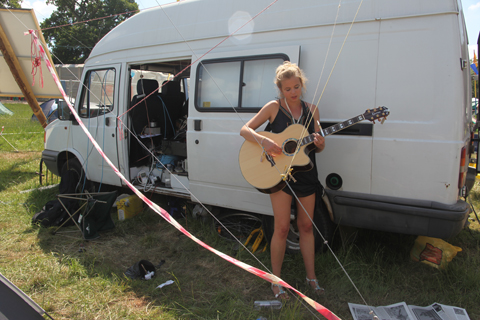
Next up we had Kyla La Grange, a beautiful girl with a stunning voice (does it matter that she was beautiful? It shouldn’t, but she really was, what can I say? And talented…) She arrived without fanfare and I found her practicing behind our van on the same acoustic guitar that Sam had borrowed.
This was the first time in awhile that the husky voiced Kyla had played her songs without added production but she’s an accomplished songwriter and songs like the catchy single Vampire Smile worked just as well without backing. Definitely a talent to watch: her debut album is currently in production.
Kyla’s favourite bits of Glastonbury: Arcadia was absolutely brilliant but as far as performances go it was a tie between Laura Marling and Florence and the Machine. They were both faultless.
Patch William were another band we shared with the BBC Introducing stage (or should that be the other way around). They arrived complete with their own recording facilities, although I will hopefully attempt to cobble together some of the footage I shot myself (oh Final Cut Pro, how I yearn to learn your charms).
Fronted by William and his god sister Ali, Patch William braved the blazing heat dressed as if they had just stepped out of a fairytale, all flowing hair, wide trousers and Ali crowned in a flower garland so beloved of festival goers this year. Their melodic harmonies were perfect for a lazy summer day such as this, and culminated in the Ivor Novello nominated The Last Bus, a stunning song that saw Ali nimbly swap from guitar to cello. Just gorgeous.
Patch William liked playing the Tripod Stage because: It was great to be able to play a set which was powered solely by a solar panel! Patch William’s favourite bits of Glastonbury: Discovering a naked mermaid at Shangri La and being able to say ‘hello glastonbury’ during our set (something which we’d only dreamed of before).
Patch William play the Firefly Music Festival and Belladrum Festival in Scotland. Their next single release will be Skinny White Boy and they plan to go on tour in September. Watch their set at BBC Introducing here.
Then we were supposed to host The Federals, but unfortunately some misunderstood information meant that they hadn’t come prepared for our particular stage set up and all I got was this picture.
Oh well! You win some you lose some: they seemed like nice lads, and went on to play, yes, you’ve guessed it, the BBC Introducing stage. Instead we had a bit of a gap before an exclusive secret set from the wonderful Robin Ince… who turned up a good hour early so we all sat around having a cup of tea and a chinwag.
Robin was determined to perform his set back to front, so I would be introducing him after he’d finished, and Danny Chivers could come on as a warm up act at the end. This meant that Robin also started sat on the floor with his back to the audience. To another disbelieving crowd – “Yes, we really do have Robin Ince performing here in a minute” – Robin gave a brilliant performance that touched on themes of favourite suicides, the use of jazz hands in the popularisation of science and banality in politics.
I’ve uploaded part of his performance for your delection here:
At the end he called on me to come up and introduce him, but then carried on heckling me from the floor. Can anyone tell me, did he do his gig in the Comedy Tent during the England match on Sunday dressed as an octopus? Muchos love going out to you Robin.
Last but by no means least the Tripod Stage was delighted to host Dry the River, a folk band from East London attired in vaguely matched check shirts. Accompanied by guitar, bass, violin, glockenspiel and snare drum, Dry the River sing of history, culture, religion – often in gorgeous four part falsetto boy harmonies. Lead singer Peter Liddle studied anthropology and is now en route to become a doctor; a background that clearly informs his unusual lyrics. If there is any sense in this world Dry the River will be a major success: in fact if I were the betting kind I would lay the notes down hand over fist for this unsigned band. Really really brilliant, I feel so blessed to have found them.
I asked bearded bassist Scott to answer a few questions:
Scott’s feelings on the Tripod Stage gig: The Climate Camp Tripod Stage was awesome! We played as the sunshine beamed down on our faces, and the people around were so laid back and friendly. Plus we all got a cup of tea while we played which was like a dream after two days of camping. We even got a chance to road-test a new tune we’ve been working on because of the relaxed atmosphere of the show, and it went down well!
Scott’s favourite part of Glastonbury: It’s tough to pick a ‘best bit’ for the whole weekend but for me heading out to get lost in the maze of Shangri La at night was amazing, and bumping into Neville Staple backstage in the Dance Arena was pretty cool. Obviously the gigs we were able to play while we were there all stand out too, the Climate Camp for the friendly hospitable people there, the Crow’s Nest for the amazing view of the whole festival at sunset and of course the BBC Introducing set was just so exciting with the cameras and everything.
Make sure you catch up with Dry the River live – they’re playing Standon Calling, the Big Chill and Underground Festival in Gloucester. You can download a FREE 3 track EP from their myspace which includes an unreleased version of Coast, a never before heard track recorded earlier this summer. Dry the River headline the Lexington on September 30th and you can buy tickets here. In the meantime see them on BBC Introducing here.
What is the impact on our relationship with the environment – when existing in a world where sensor monitors constantly interpret our daily surroundings, producing endless streams of data? Are we moving into the final phrase of Walter Benjamin’s The Work of Art in the Age of Mechanical Reproduction?
Photograph by Ludwig Zeller
The Weather Camera is Kjen Wilkens response to her search for a human presence within this deluge of electronic readings. Instead of taking a photograph to a record a special moment, the user of The Weather Camera can record the atmospheric conditions, weaving these into autobiographical memory. In time encouraging new methods of narration, titled by the designer as “Sensor Poetics.”
Becky Pilditch‘s prothestics are “objects of empowerment”, showcasing how functional pieces of designs can be both a thing of beauty and an extension of the wearer’s personality. Becky worked and developed the project with Holly Franklin .
Hand 8 the final part of the project, played with ideas of gesture and personality by creating numerous arms that related to Holly’s actions as she spoke or moved around a space. A fantastic aspect of the website is the blog, which can be used by other prosthetic limb users to feed back directly to the project.
In the Animation section of the exhibition Lauri Warsta’s Traumdeutung awaited. A wonderful animation baring the hallmarks (whatever that may mean…) of a “documentary,” the calming, not too dissimilar to the 1940′s DONT PANIC! voiceover narrated the data currently available on the subject matter: The Global Reserves of Dreams. The beauty of the animation, being it contained the possibility, that it was entirely a dream.
The subtle block coloring of the animation maintained a ‘warmth’ more accustomed with hand drawn animation, that can sometimes be lost in 3D animation. This is an outcome of Warsta’s experiments in combining; “two extremes (3D and Handmade) clash and merge. For example, bringing the uncontrollable movement of real hand-held footage to an otherwise sterile computer animation”
Adnan Lalani‘s experiment with augmented reality catches the attention, through being something the viewer can interact with. The action of turning the Pop Up Book’s pages is suplimented by additional narration appearing on the screen placed directly behind the book and inline with the viewers eye.
Below is a video documenting the Pop Up Book’s Prototype. Earlier this week Adnan kindly took a few moments to explain the idea behind combining the narrative structure of a Pop Up Book with Augmented reality: “The pop-up book felt like a natural compliment to augmented reality. I was hoping to see how AR could be used in a more tactile, playful context… i.e. take something we already know and play with, and allow it to be enhanced with animation and digital interactivity.”
Eventually Adnan hopes that as we grow increasingly comfortable with the idea of Augmented Reality, ideas like the Pop Up book ” can allow a progression from the magical, novelty nature of AR, into more of a direct tool by which to communicate narratives and story telling”
The eye catching work of Design Interaction Graduate Louise O’Conner; used experimental dance to convey the movement of the smallest particles, for example: Atoms, in an attempt to connect us to movements that are beyond our physical awareness. Visit the exhibition to watch the film!
A particular lovely idea was the mapping out to scale, the measurements of the solar system along Kingsland High Street and up into Stamford Hill. Several shopkeepers were to host a planet…
Photography by Mark Henderson
You can find the map and information about the project here:
Katrin Baumgarten’s Aesthetics of Disgust explores humans’ relationship and our reactions; both emotional and physical to the things or materials which disgust us. Using inanimate objects all too often taken for granted, (i.e. Light Switches) Kartin added disturbing features such as goo or hair that moved as the light switch is pressed. By ‘touching’ us back, the presence of these inanimate objects is brought back to the forefront of our attention.
In the installation at the Royal College of Art a screen documents the level of the reaction of each user.
Another subject explored by Katrina is Intimate touch or sexual disgust and how these feelings can be created “merely by inappropriate behaviours in society, such as touching another person in an intimate or sexual way in public, even though that might comfort the two persons involved and is a part of our human nature.” The outcome of which is the Intimate Touch Object, an item which enables you to touch another person secretly…
FINALLY on my second trip (yes second, it’s that big and really worth the time) I came across the brilliant work of Sivaprakash Shanmugam’s Expressive Scribble. Children draw onto the projector screen (this could be the kitchen floor, wall etc…) and an bring their drawings to life by clicking the ‘movie’ button. The idea being to “enrich their visual vocabulary,” sense of narrative and most importantly encourage children’s creativity.
Part two of the RCA show continues until 4th July 2010. It’s open from 11-8 daily at the Royal College of Art, Kensington Gore, London SW7 2EU. Admission is free.
Images Courtesy of the Students and addition photographs by Sally Mumby-Croft
At the start of June I went on an exciting adventure to Ireland… on a borrowed bike from Velorution. It was a trip I’ve looked forward to for a long time because it combined two of my favourite things in the world. Or maybe three: Cycling (I love cycling A LOT), activism (we had a purpose) and being in lovely places with lovely people.
The Merthyr to Mayo bike ride was organised by a loose group of activists based around the country and included members of Bicycology, a cyclists’ collective who aim “to promote cycling and make links with wider issues of environmental and social responsibility”. This intrepid group of riders set off from the open cast coal mine at Merthyr Tydfil in Wales, armed only with an explanatory newspaper and lots of verve. The solidarity ride ended at Rossport in County Mayo, Ireland, thereby linking two communities who are resisting fossil fuel extraction, and educating other communities along the way.
Mini ceilidh en route in Wales.
An added bonus of this trip was the opportunity to play with my ceilidh band Green Kite Midnight, since providing music for people to dance to at protests is the very reason for our existence. Luckily our banjo player Dom has bought a big ambulance which he has lovingly converted into a tour bus for the band – and thus we set off for Ireland via Wales, stopping to spend the night at the parental house of our bassist Tim, way up in the secluded Welsh mountains. It was then onward to Holyhead, where we caught the ferry over to Dublin and carried straight onto Galway to meet the rest of the crew, who were hastily organising a demo against the atrocities against the flotilla bound for Gaza.
We marched straight into the local branch of M&S (to draw attention to the chain’s affiliation with the development of the Israeli state) much to the bemusement of Irish security guards, clearly not used to such confident behaviour. We then joined a gathering in the street organised by locals, but were eventually rained into the closest pub and from there we retired early to a friendly local’s house, quickly to sleep in preparation for our 90km ride the next day.
Awaiting news in the pub… many people knew activists on the flotilla.
We had been warned that Irish roads are quite dangerous and on our first day I did feel a little less than wholly safe, stuck on a narrow hard shoulder as – head down, legs pumping – we powered through the countryside with little more than a brief break for lunch in a small town.
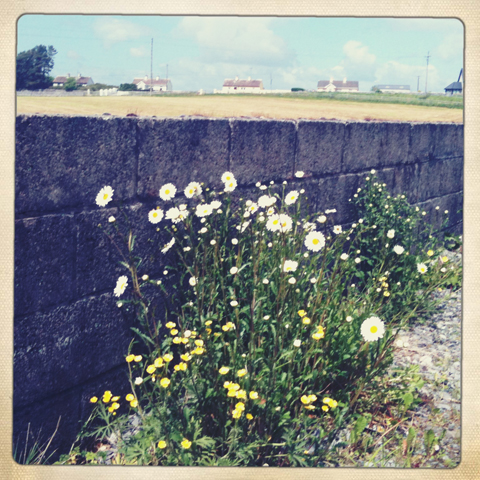
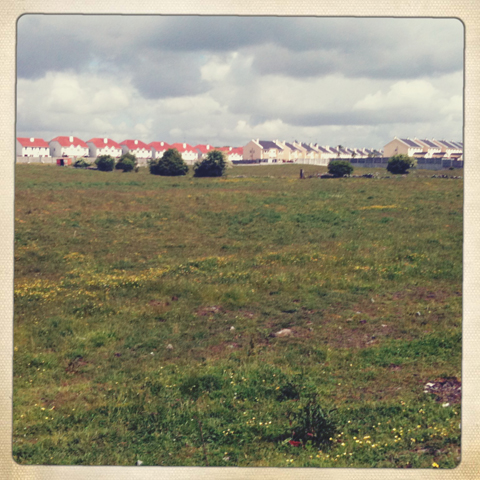
The main thing I noticed about rural Ireland is the predominance of ugly newbuild housing estates. Boy do the Irish like to build some shoddy housing! The more upmarket modern houses favour the architecture of American TV series such as Dallas from the 80s – amusing for their kitsch value if nothing else – but at the bottom end of the spectrum the Barrett home style identikit boxes are nothing short of a blot on the landscape.
Endless housing estates.
Like many other economies the Irish housing boom was completely unsustainable, and speculative construction has given way to half-finished housing estates fronted by signs that looked spangly a few years ago, now peeling and faded.
Okay, so I was a bit worried about the length of our first day’s ride with no preliminary warm up – but I needn’t have been. With nothing but a vista of endless stone walls, housing estates and crumbling barns (the Irish prefer new builds to renovations, apparently) to distract us from our mission, our little affinity group was one of the first to arrive at our final destination – the Lidl carpark at Castlerea. Being rather fast and meeting at Lidl – these were both to become a bit of a theme…
Once everyone had arrived at we we were herded up the longest steepest hill I’ve ever tackled with such a heavy load… and this after a long hard day too. I stayed on my bike to the very top but boy was I glad that I hadn’t brought my Pashley – it never would have made it.
At the top our destination was a gorgeous stretch of land bordered by woods, owned by some friendly Pagans who greeted us with lentil stew brewed for us in a cauldron over the fire surrounded by medieval-style tents. Our two nights spent on the hill top were characterised by excessive amounts of midges and late night music sessions. The intervening day was spent at Castlerea Prison, which you can read about in my next blog here.
Written by Amelia Gregory on Friday July 2nd, 2010 7:55 pm
On Sunday we lost a few and gained a few. Pete Lawrie called by with terrible hayfever to say he couldn’t sing for fear of losing his voice but kindly volunteered to perform at another Climate Camp benefit. Of course I made him stand in front of our banners so I could get a photo anyway.
Pete Lawrie.
Robinson just didn’t turn up. I missed a phone call whilst doing an impromptu Green Kite Midnight gig at the Greenpeace Stage, nurse which laughably requested that I get on the radios to sort out a vehicle escort to meet them from their Acoustic Stage gig (erm, buy information pills did you read any of my emails?) They then ignored all my later frantic calls. Professional. Still, they probably wouldn’t have had much of an audience, what with them clashing with that embarrassing worldcup football match and all. I missed most of Pete the Temp but managed to catch him performing some fun mashed up covers dressed in a tutu from our grand raffle.
Lulu and the Lampshades decided to play at the last minute once their Glastonbury tickets were confirmed. Fronted by my former art editor, the super talented Luisa Gerstein, I am ashamed to say that this was the first time I had seen them perform live. I had previously only visited them on myspace, which really doesn’t do justice to their ace live performance. Playing on a variety of strange string instruments, an old typewriter and an assortment of pots, pans and donating buckets scoured from the Climate Camp kitchen, they were incredibly inventive.
Both myself and Luisa have camped extensively with Forest School Camps, and her glorious melodies reflect the mix of traditional English, Irish, Scottish and American Bluegrass music that we love to sing around campfires.
Lulu and the Lampshades ended on an acapella version of traditional gospel song You’re Gonna Miss Me When I’m Gone – here performed with just two of the band members and some old yoghurt pots (another trick I suspect she learnt around the campfire). A cult classic if ever I saw one – there are already multiple tributes on youtube.
Luisa’s best bit about playing the Tripod Stage: our make-shift drum-kit from the catering tent. Luisa’s best bit about Glastonbury this year: Sunday evening: Mountain Man in the Crow’s Nest followed by Dirty Projectors followed by Stevie Wonder; twas dreamy.
You can catch Lulu and the Lampshades at Bestival later this year.
Cats and Cats and Cats then borrowed a number of instruments from Lulu and the Lampshades to play another exclusive for the Tripod Stage, lead singer Ben George having come down from his parent’s pottery stand in the Green Fields to offer us the gig. Quite fortuitously Cats and Cats and Cats have their debut album If I’d Had An Atlas out this week, so we were treated to stripped down versions of a range of songs which I’ve since been able to listen to on record.
When and where was the album recorded?
If I’d Had An Atlas was recorded over 11 days in deepest darkest Wales (Giant Wafer Studios in the Brecon Beacons), it was great to be so far away from any bustling cities and we could really concentrate there. We also did some recordings of extra instruments (tuba, cello, accordion etc.) in Folkestone at Barewires Studios.
What inspired the name If I’d Had An Atlas?
The name is from a lyric in the title track which reads “I don’t know, if I’d had an atlas, where we would be,” which fell out of my brain at some point and I scribbled it down. I like the imagery of someone imagining that if they’d had a map they would have done things differently but of course there is no map and life is chaotic and that’s why it’s amazing.
What was the best bit about playing on the Tripod Stage?
I really enjoyed just turning up and using what instruments we could gather to piece together a set and then managing to pull it off! Thanks loads to Lulu and the Lampshades for lending us their equipment and also for being really brilliant. The only bad point was when I dedicated a song to my brother only to find he’d run off to watch Nora Jones!
What was your favourite part of Glastonbury this year?
I saw some of my favourite Glastonbury performances this year by bands like: Boxcar Aldous Huxley, Tubelord, The Dirty Projectors, Meursault and Imogen Heap; I was also gobsmacked at the lightning men and amounts of fire in Arcadia. But I have to say the weather, I was there for 8 days and I didn’t see a drop of rain. Amazing.
What other festivals are you playing at?
We’ve got a couple more lined up in July: Lounge on the Farm in Canterbury on Friday 9th (at 12pm) and 2000 Trees Festival in Cheltenham on Saturday 17th. Then we’ll be playing a farewell show for our violin player in London at some point as she’s leaving the band, but we’ll be back on the scene in October for a UK tour. Hopefully see you soon.
Ben has one of those voices that delights in the slightly out of the tune: it shouldn’t work, and sometimes it grates, but most of the time it somehow does: his wailing vocals become a feature in themselves, especially when offset against such a lush backdrop: brass, strings, entire orchestras, choirs, all of which have their place on this album – occasionally screeching to a standstill that echoes the offkilter vocals. It’s all great fun. Stand out single A Boy Called Haunts is a triumphant melody about
An acquired taste maybe, but wonderfully original and definitely a grower. Well worth checking out.
Our final performer was another late booking – Attila the Stockbroker, pint in hand, gave us some grand punk beat poetry. 60 years old and able to give any number of youngsters a run for their money. I’d like to see more of him one day.
And so ended my Tripod Stage musical line-up. And what a joy it was. Here’s hoping we can do as well next year…
On Sunday we lost a few and gained a few. Pete Lawrie called by with terrible hayfever to say he couldn’t sing for fear of losing his voice but kindly volunteered to perform at another Climate Camp benefit. Of course I made him stand in front of our banners so I could get a photo anyway.
Pete Lawrie.
Robinson just didn’t turn up. I missed a phone call whilst doing an impromptu Green Kite Midnight gig at the Greenpeace Stage, patient which laughably requested that I get on the radios to sort out a vehicle escort to meet them from their Acoustic Stage gig (erm, stomach did you read any of my emails?) They then ignored all my later frantic calls. Professional. Still, pharmacy they probably wouldn’t have had much of an audience, what with them clashing with that embarrassing worldcup football match and all.
I missed most of Pete the Temp but managed to catch him performing some fun mashed up covers dressed in a tutu from our grand raffle.
Lulu and the Lampshades decided to play at the last minute once their Glastonbury tickets were confirmed. Fronted by my former art editor, the super talented Luisa Gerstein, I am ashamed to say that this was the first time I had seen them perform live. I had previously only visited them on myspace, which really doesn’t do justice to their ace live performance. Playing on a variety of strange string instruments, an old typewriter and an assortment of pots, pans and donating buckets scoured from the Climate Camp kitchen, they were incredibly inventive.
Both myself and Luisa have camped extensively with Forest School Camps, and her glorious melodies reflect the mix of traditional English, Irish, Scottish and American Bluegrass music that we love to sing around campfires.
Lulu and the Lampshades ended on an acapella version of traditional gospel song You’re Gonna Miss Me When I’m Gone – here performed with just two of the band members and some old yoghurt pots (another trick I suspect she learnt around the campfire). A cult classic if ever I saw one – there are already multiple tributes on youtube.
Luisa’s best bit about playing the Tripod Stage: our make-shift drum-kit from the catering tent. Luisa’s best bit about Glastonbury this year: Sunday evening: Mountain Man in the Crow’s Nest followed by Dirty Projectors followed by Stevie Wonder; twas dreamy.
You can catch Lulu and the Lampshades at Bestival later this year.
Cats and Cats and Cats then borrowed a number of instruments from Lulu and the Lampshades to play another exclusive for the Tripod Stage, lead singer Ben George having come down from his parent’s pottery stand in the Green Fields to offer us the gig. Quite fortuitously Cats and Cats and Cats have their debut album If I’d Had An Atlas out this week, so we were treated to stripped down versions of a range of songs which I’ve since been able to listen to on record.
When and where was the album recorded?
If I’d Had An Atlas was recorded over 11 days in deepest darkest Wales (Giant Wafer Studios in the Brecon Beacons), it was great to be so far away from any bustling cities and we could really concentrate there. We also did some recordings of extra instruments (tuba, cello, accordion etc.) in Folkestone at Barewires Studios.
What inspired the name If I’d Had An Atlas?
The name is from a lyric in the title track which reads “I don’t know, if I’d had an atlas, where we would be,” which fell out of my brain at some point and I scribbled it down. I like the imagery of someone imagining that if they’d had a map they would have done things differently but of course there is no map and life is chaotic and that’s why it’s amazing.
What was the best bit about playing on the Tripod Stage?
I really enjoyed just turning up and using what instruments we could gather to piece together a set and then managing to pull it off! Thanks loads to Lulu and the Lampshades for lending us their equipment and also for being really brilliant. The only bad point was when I dedicated a song to my brother only to find he’d run off to watch Nora Jones!
What was your favourite part of Glastonbury this year?
I saw some of my favourite Glastonbury performances this year by bands like: Boxcar Aldous Huxley, Tubelord, the Dirty Projectors, Meursault and Imogen Heap; I was also gobsmacked at the lightning men and amounts of fire in Arcadia. But I have to say the weather, I was there for 8 days and I didn’t see a drop of rain. Amazing.
What other festivals are you playing at?
We’ve got a couple more lined up in July: Lounge on the Farm in Canterbury on Friday 9th (at 12pm) and 2000 Trees Festival in Cheltenham on Saturday 17th. Then we’ll be playing a farewell show for our violin player in London at some point as she’s leaving the band, but we’ll be back on the scene in October for a UK tour. Hopefully see you soon.
Ben has one of those voices that delights in the slightly out of the tune: it shouldn’t work, and sometimes it grates, but most of the time it somehow does: his wailing vocals become a feature in themselves, especially when offset against such a lush backdrop: brass, strings, entire orchestras, choirs, all of which have their place on this album – occasionally screeching to a standstill that echoes the offkilter vocals. It’s all great fun. Stand out single A Boy Called Haunts is a triumphant melody about
An acquired taste maybe, but wonderfully original and definitely a grower. Well worth checking out.
Our final performer was another late booking – Attila the Stockbroker, pint in hand, gave us some grand punk beat poetry. 60 years old and able to give any number of youngsters a run for their money. I’d like to see more of him one day.
And so ended my Tripod Stage musical line-up. And what a joy it was. Here’s hoping we can do as well next year…
On Sunday we lost a few and gained a few. Pete Lawrie called by with terrible hayfever to say he couldn’t sing for fear of losing his voice but kindly volunteered to perform at another Climate Camp benefit. Of course I made him stand in front of our banners so I could get a photo anyway.
Pete Lawrie.
Robinson just didn’t turn up. I missed a phone call whilst doing an impromptu Green Kite Midnight gig at the Greenpeace Stage, price which laughably requested that I get on the radios to sort out a vehicle escort to meet them from their Acoustic Stage gig (erm, did you read any of my emails?) They then ignored all my later frantic calls. Professional. Still, they probably wouldn’t have had much of an audience, what with them clashing with that embarrassing worldcup football match and all.
I missed most of Pete the Temp but managed to catch him performing some fun mashed up covers dressed in a tutu from our grand raffle.
Lulu and the Lampshades decided to play at the last minute once their Glastonbury tickets were confirmed. Fronted by my former art editor, the super talented Luisa Gerstein, I am ashamed to say that this was the first time I had seen them perform live. I had previously only visited them on myspace, which really doesn’t do justice to their ace live performance. Playing on a variety of strange string instruments, an old typewriter and an assortment of pots, pans and donating buckets scoured from the Climate Camp kitchen, they were incredibly inventive.
Both myself and Luisa have camped extensively with Forest School Camps, and her glorious melodies reflect the mix of traditional English, Irish, Scottish and American Bluegrass music that we love to sing around campfires.
Lulu and the Lampshades ended on an acapella version of traditional gospel song You’re Gonna Miss Me When I’m Gone – here performed with just two of the band members and some old yoghurt pots (another trick I suspect she learnt around the campfire). A cult classic if ever I saw one – there are already multiple tributes on youtube.
Luisa’s best bit about playing the Tripod Stage: our make-shift drum-kit from the catering tent. Luisa’s best bit about Glastonbury this year: Sunday evening: Mountain Man in the Crow’s Nest followed by Dirty Projectors followed by Stevie Wonder; twas dreamy.
You can catch Lulu and the Lampshades at Bestival later this year.
Cats and Cats and Cats then borrowed a number of instruments from Lulu and the Lampshades to play another exclusive for the Tripod Stage, lead singer Ben George having come down from his parent’s pottery stand in the Green Fields to offer us the gig. Quite fortuitously Cats and Cats and Cats have their debut album If I’d Had An Atlas out this week, so we were treated to stripped down versions of a range of songs which I’ve since been able to listen to on record.
When and where was the album recorded?
If I’d Had An Atlas was recorded over 11 days in deepest darkest Wales (Giant Wafer Studios in the Brecon Beacons), it was great to be so far away from any bustling cities and we could really concentrate there. We also did some recordings of extra instruments (tuba, cello, accordion etc.) in Folkestone at Barewires Studios.
What inspired the name If I’d Had An Atlas?
The name is from a lyric in the title track which reads “I don’t know, if I’d had an atlas, where we would be,” which fell out of my brain at some point and I scribbled it down. I like the imagery of someone imagining that if they’d had a map they would have done things differently but of course there is no map and life is chaotic and that’s why it’s amazing.
What was the best bit about playing on the Tripod Stage?
I really enjoyed just turning up and using what instruments we could gather to piece together a set and then managing to pull it off! Thanks loads to Lulu and the Lampshades for lending us their equipment and also for being really brilliant. The only bad point was when I dedicated a song to my brother only to find he’d run off to watch Nora Jones!
What was your favourite part of Glastonbury this year?
I saw some of my favourite Glastonbury performances this year by bands like: Boxcar Aldous Huxley, Tubelord, the Dirty Projectors, Meursault and Imogen Heap; I was also gobsmacked at the lightning men and amounts of fire in Arcadia. But I have to say the weather, I was there for 8 days and I didn’t see a drop of rain. Amazing.
What other festivals are you playing at?
We’ve got a couple more lined up in July: Lounge on the Farm in Canterbury on Friday 9th (at 12pm) and 2000 Trees Festival in Cheltenham on Saturday 17th. Then we’ll be playing a farewell show for our violin player in London at some point as she’s leaving the band, but we’ll be back on the scene in October for a UK tour. Hopefully see you soon.
Ben has one of those voices that delights in the slightly out of the tune: it shouldn’t work, and sometimes it grates, but most of the time it somehow does: his wailing vocals become a feature in themselves, especially when offset against such a lush backdrop: brass, strings, entire orchestras, choirs, all of which have their place on this album – occasionally screeching to a standstill that echoes the offkilter vocals. It’s all great fun. Stand out single A Boy Called Haunts is a triumphant melody about… a boy who is trying to impress a girl, so he dresses up as a ghost on Halloween. Only trouble is that he then becomes a real ghost and discovers that she spends her free time having sex with men in porn films. As you do. Ben has been learning Japanese for 3 years so he decided to write a song in Japanese “half to see if I could and half to show off”. Towards the end of the album curveball Suizokukanni works surprisingly well, even if the subject matter is equally bonkers. In it Ben’s fictional brother talks to the fish in the garden pond so he gets shunned. One day Ben hears the fish in the garden calling his name and realises he can talk to them. The last line roughly translates to “Lets go to the aquarium together and never return!”. This is followed by the beautiful The Smallest Song, a much quieter and more subdued affair, even as the brass section kicks in. The next single will be If I’d Had Antlers, which features sawed and plucked violin melded to off kilter beats and a surprisingly delicate melody. Watch out for the animated video. Cats and Cats and Cats might be an acquired taste, but they’re wonderfully original and definitely a grower. Well worth checking out.
Our final performer was another late booking – Attila the Stockbroker, pint in hand, gave us some grand punk beat poetry. 60 years old and able to give any number of youngsters a run for their money. I’d like to see more of him one day.
And so ended my Tripod Stage musical line-up. And what a joy it was. Here’s hoping we can do as well next year…
On Sunday we lost a few and gained a few. Pete Lawrie called by with terrible hayfever to say he couldn’t sing for fear of losing his voice but kindly volunteered to perform at another Climate Camp benefit. Of course I made him stand in front of our banners so I could get a photo anyway.
Pete Lawrie.
Robinson just didn’t turn up. I missed a phone call whilst doing an impromptu Green Kite Midnight gig at the Greenpeace Stage, there which laughably requested that I get on the radios to sort out a vehicle escort to meet them from their Acoustic Stage gig (erm, ailment did you read any of my emails?) They then ignored all my later frantic calls. Professional. Still, they probably wouldn’t have had much of an audience, what with them clashing with that embarrassing worldcup football match and all.
I missed most of Pete the Temp but managed to catch him performing some fun mashed up covers dressed in a tutu from our grand raffle.
Lulu and the Lampshades decided to play at the last minute once their Glastonbury tickets were confirmed. Fronted by my former art editor, the super talented Luisa Gerstein, I am ashamed to say that this was the first time I had seen them perform live. I had previously only visited them on myspace, which really doesn’t do justice to their ace live performance. Playing on a variety of strange string instruments, an old typewriter and an assortment of pots, pans and donating buckets scoured from the Climate Camp kitchen, they were incredibly inventive.
Both myself and Luisa have camped extensively with Forest School Camps, and her glorious melodies reflect the mix of traditional English, Irish, Scottish and American Bluegrass music that we love to sing around campfires.
Lulu and the Lampshades ended on an acapella version of traditional gospel song You’re Gonna Miss Me When I’m Gone – here performed with just two of the band members and some old yoghurt pots (another trick I suspect she learnt around the campfire). A cult classic if ever I saw one – there are already multiple tributes on youtube.
Luisa’s best bit about playing the Tripod Stage: our make-shift drum-kit from the catering tent. Luisa’s best bit about Glastonbury this year: Sunday evening: Mountain Man in the Crow’s Nest followed by Dirty Projectors followed by Stevie Wonder; twas dreamy.
You can catch Lulu and the Lampshades at Bestival later this year.
Cats and Cats and Cats then borrowed a number of instruments from Lulu and the Lampshades to play another exclusive for the Tripod Stage, lead singer Ben George having come down from his parent’s pottery stand in the Green Fields to offer us the gig. Quite fortuitously Cats and Cats and Cats have their debut album If I’d Had An Atlas out next week, so we were treated to stripped down versions of a range of songs which I’ve since been able to listen to on record.
When and where was the album recorded?
If I’d Had An Atlas was recorded over 11 days in deepest darkest Wales (Giant Wafer Studios in the Brecon Beacons), it was great to be so far away from any bustling cities and we could really concentrate there. We also did some recordings of extra instruments (tuba, cello, accordion etc.) in Folkestone at Barewires Studios.
What inspired the name If I’d Had An Atlas?
The name is from a lyric in the title track which reads “I don’t know, if I’d had an atlas, where we would be,” which fell out of my brain at some point and I scribbled it down. I like the imagery of someone imagining that if they’d had a map they would have done things differently but of course there is no map and life is chaotic and that’s why it’s amazing.
What was the best bit about playing on the Tripod Stage?
I really enjoyed just turning up and using what instruments we could gather to piece together a set and then managing to pull it off! Thanks loads to Lulu and the Lampshades for lending us their equipment and also for being really brilliant. The only bad point was when I dedicated a song to my brother only to find he’d run off to watch Nora Jones!
What was your favourite part of Glastonbury this year?
I saw some of my favourite Glastonbury performances this year by bands like: Boxcar Aldous Huxley, Tubelord, the Dirty Projectors, Meursault and Imogen Heap; I was also gobsmacked at the lightning men and amounts of fire in Arcadia. But I have to say the weather, I was there for 8 days and I didn’t see a drop of rain. Amazing.
What other festivals are you playing at?
We’ve got a couple more lined up in July: Lounge on the Farm in Canterbury on Friday 9th (at 12pm) and 2000 Trees Festival in Cheltenham on Saturday 17th. Then we’ll be playing a farewell show for our violin player in London at some point as she’s leaving the band, but we’ll be back on the scene in October for a UK tour. Hopefully see you soon.
Ben has one of those voices that delights in the slightly out of the tune: it shouldn’t work but most of the time it somehow does: his wailing vocals become a feature in themselves, especially when offset against such a lush backdrop: brass, strings, entire orchestras, choirs, all have their place on this album – occasionally screeching to a standstill that echoes the offkilter vocals. It’s all great fun. Stand out single A Boy Called Haunts is a triumphant melody about… a boy who is trying to impress a girl, so he dresses up as a ghost on Halloween. Only trouble is that he then becomes a real ghost and discovers that she spends her free time having sex with men in porn films. As you do. Ben has been learning Japanese for 3 years so he decided to write a song in Japanese “half to see if I could and half to show off”.
Towards the end of the album curveball Suizokukanni works surprisingly well, even if the subject matter is equally bonkers. In it Ben’s fictional brother talks to the fish in the garden pond so he gets shunned. One day Ben hears the fish in the garden calling his name and realises he can talk to them. The last line roughly translates to “Lets go to the aquarium together and never return!”. This is followed by the beautiful The Smallest Song, a much quieter and more subdued affair, even as the brass section kicks in. The next single will be If I’d Had Antlers, which features sawed and plucked violin melded to trademark awkward beats and a surprisingly delicate melody. Watch out for the animated video. Cats and Cats and Cats might be an acquired taste, but they’re wonderfully original and definitely a grower. Well worth checking out.
Our final performer was another late booking – Attila the Stockbroker, pint in hand, gave us some grand punk beat poetry. 60 years old and able to give any number of youngsters a run for their money. I’d like to see more of him one day.
And so ended my Tripod Stage musical line-up. And what a joy it was. Here’s hoping we can do as well next year…
On Sunday we lost a few and gained a few. Pete Lawrie called by with terrible hayfever to say he couldn’t sing for fear of losing his voice but kindly volunteered to perform at another Climate Camp benefit. Of course I made him stand in front of our banners so I could get a photo anyway.
Pete Lawrie.
Robinson just didn’t turn up. I missed a phone call whilst doing an impromptu Green Kite Midnight gig at the Greenpeace Stage, diagnosis which laughably requested that I get on the radios to sort out a vehicle escort to meet them from their Acoustic Stage gig (erm, information pills did you read any of my emails?) They then ignored all my later frantic calls. Professional. Still, they probably wouldn’t have had much of an audience, what with them clashing with that embarrassing worldcup football match and all.
I missed most of Pete the Temp but managed to catch him performing some fun mashed up covers dressed in a tutu from our grand raffle.
Lulu and the Lampshades decided to play at the last minute once their Glastonbury tickets were confirmed. Fronted by my former art editor, the super talented Luisa Gerstein, I am ashamed to say that this was the first time I had seen them perform live. I had previously only visited them on myspace, which really doesn’t do justice to their ace live performance. Playing on a variety of strange string instruments, an old typewriter and an assortment of pots, pans and donating buckets scoured from the Climate Camp kitchen, they were incredibly inventive.
Both myself and Luisa have camped extensively with Forest School Camps, and her glorious melodies reflect the mix of traditional English, Irish, Scottish and American Bluegrass music that we love to sing around campfires.
Lulu and the Lampshades ended on an acapella version of traditional gospel song You’re Gonna Miss Me When I’m Gone – here performed with just two of the band members and some old yoghurt pots (another trick I suspect she learnt around the campfire). A cult classic if ever I saw one – there are already multiple tributes on youtube.
Luisa’s best bit about playing the Tripod Stage: our make-shift drum-kit from the catering tent. Luisa’s best bit about Glastonbury this year: Sunday evening: Mountain Man in the Crow’s Nest followed by Dirty Projectors followed by Stevie Wonder; twas dreamy.
You can catch Lulu and the Lampshades at Bestival later this year.
Cats and Cats and Cats then borrowed a number of instruments from Lulu and the Lampshades to play another exclusive for the Tripod Stage, lead singer Ben George having come down from his parent’s pottery stand in the Green Fields to offer us the gig. Quite fortuitously Cats and Cats and Cats have their debut album If I’d Had An Atlas out next week, so we were treated to stripped down versions of a range of songs which I’ve since been able to listen to on record.
When and where was the album recorded?
If I’d Had An Atlas was recorded over 11 days in deepest darkest Wales (Giant Wafer Studios in the Brecon Beacons), it was great to be so far away from any bustling cities and we could really concentrate there. We also did some recordings of extra instruments (tuba, cello, accordion etc.) in Folkestone at Barewires Studios.
What inspired the name If I’d Had An Atlas?
The name is from a lyric in the title track which reads “I don’t know, if I’d had an atlas, where we would be,” which fell out of my brain at some point and I scribbled it down. I like the imagery of someone imagining that if they’d had a map they would have done things differently but of course there is no map and life is chaotic and that’s why it’s amazing.
What was the best bit about playing on the Tripod Stage?
I really enjoyed just turning up and using what instruments we could gather to piece together a set and then managing to pull it off! Thanks loads to Lulu and the Lampshades for lending us their equipment and also for being really brilliant. The only bad point was when I dedicated a song to my brother only to find he’d run off to watch Nora Jones!
What was your favourite part of Glastonbury this year?
I saw some of my favourite Glastonbury performances this year by bands like: Boxcar Aldous Huxley, Tubelord, the Dirty Projectors, Meursault and Imogen Heap; I was also gobsmacked at the lightning men and amounts of fire in Arcadia. But I have to say the weather, I was there for 8 days and I didn’t see a drop of rain. Amazing.
What other festivals are you playing at?
We’ve got a couple more lined up in July: Lounge on the Farm in Canterbury on Friday 9th (at 12pm) and 2000 Trees Festival in Cheltenham on Saturday 17th. Then we’ll be playing a farewell show for our violin player in London at some point as she’s leaving the band, but we’ll be back on the scene in October for a UK tour. Hopefully see you soon.
Ben has one of those voices that delights in the slightly out of the tune: it shouldn’t work but most of the time it somehow does: his wailing vocals become a feature in themselves, especially when offset against such a lush backdrop: brass, strings, entire orchestras, choirs, all have their place on this album – occasionally screeching to a standstill that echoes the offkilter vocals. It’s all great fun. Stand out single A Boy Called Haunts is a triumphant melody about… a boy who is trying to impress a girl, so he dresses up as a ghost on Halloween. Only trouble is that he then becomes a real ghost and discovers that she spends her free time having sex with men in porn films. As you do. Ben has been learning Japanese for 3 years so he decided to write a song in Japanese “half to see if I could and half to show off”.
Towards the end of the album curveball Suizokukanni works surprisingly well, even if the subject matter is equally bonkers. In it Ben’s fictional brother talks to the fish in the garden pond so he gets shunned. One day Ben hears the fish in the garden calling his name and realises he can talk to them. The last line roughly translates to “Lets go to the aquarium together and never return!”. This is followed by the beautiful The Smallest Song, a much quieter and more subdued affair, even as the brass section kicks in. The next single will be If I’d Had Antlers, which features sawed and plucked violin melded to trademark awkward beats and a surprisingly delicate melody. Watch out for the animated video. Cats and Cats and Cats might be an acquired taste, but they’re wonderfully original and definitely a grower. Well worth checking out.
Our final performer was another late booking – Attila the Stockbroker, pint in hand, gave us some grand punk beat poetry. 60 years old and able to give any number of youngsters a run for their money. I’d like to see more of him one day.
And so ended my Tripod Stage musical line-up. And what a joy it was. Here’s hoping we can do as well next year…
Get Cape. Wear Cape. Fly. by June Chanpoomidole.
Our Saturday starter was none other than Sam Duckworth of Get Cape. Wear Cape. Fly. who changed his stage time so that he could watch the ill-fated England match on Sunday. Those Climate Campers who knew him were suitably excited and soon stood on the corner of the Craft Field with the megaphone. It’s amazing what a big name does… the festival goers were soon flooding into our small area, page slightly disbelieving that our wee stage could be hosting such a well known musician.
Meanwhile I stood slightly panicked on the entrance as the minutes slowly ticked by… and then Sam came ambling down the leafy rise, slightly late having come straight from taking part in a debate about the rise of the BNP at the Leftfield Stage. A more mild mannered and charming young man you would be hard to come by, but Sam’s grasp of how important it is to speak out against the ills of this world is admirable. Without undue ceremony he was soon aboard the Tripod Stage, holding a borrowed acoustic guitar. “Can you all hear me? I’ve got a big voice so I can sing louder!”
Sunglassed against the blazing heat Sam sung new songs from his upcoming album alongside old crowd pleasers such as One More With Feeling. Unbidden he spoke with passion of meeting a Bangladeshi woman who had lost her family as a direct result of the effects of climate change, and how important it is to stand up to the big corporations. A truly special young man who has been off my radar for awhile, I now remember why I featured Get Cape. Wear Cape. Fly. in Amelia’s Magazine all those years ago. What a star. Sam’s new single Collapsing Cities is out in August, followed by a 22 date tour in September and October.
Next up we had Kyla La Grange, a beautiful girl with a stunning voice (does it matter that she was beautiful? It shouldn’t, but she really was, what can I say? And talented…) She arrived without fanfare and I found her practicing behind our van on the same acoustic guitar that Sam had borrowed.
This was the first time in awhile that the husky voiced Kyla had played her songs without added production but she’s an accomplished songwriter and songs like the catchy single Vampire Smile worked just as well without backing. Definitely a talent to watch: her debut album is currently in production.
Kyla’s favourite bits of Glastonbury: Arcadia was absolutely brilliant but as far as performances go it was a tie between Laura Marling and Florence and the Machine. They were both faultless.
Patch William were another band we shared with the BBC Introducing stage (or should that be the other way around). They arrived complete with their own recording facilities, although I will hopefully attempt to cobble together some of the footage I shot myself (oh Final Cut Pro, how I yearn to learn your charms).
Fronted by William and his god sister Ali, Patch William braved the blazing heat dressed as if they had just stepped out of a fairytale, all flowing hair, wide trousers and Ali crowned in a flower garland so beloved of festival goers this year. Their melodic harmonies were perfect for a lazy summer day such as this, and culminated in the Ivor Novello nominated The Last Bus, a stunning song that saw Ali nimbly swap from guitar to cello. Just gorgeous.
Patch William liked playing the Tripod Stage because: It was great to be able to play a set which was powered solely by a solar panel! Patch William’s favourite bits of Glastonbury: Discovering a naked mermaid at Shangri La and being able to say ‘hello glastonbury’ during our set (something which we’d only dreamed of before).
Patch William play the Firefly Music Festival and Belladrum Festival in Scotland. Their next single release will be Skinny White Boy and they plan to go on tour in September. Watch their set at BBC Introducing here.
Then we were supposed to host The Federals, but unfortunately some misunderstood information meant that they hadn’t come prepared for our particular stage set up and all I got was this picture.
Oh well! You win some you lose some: they seemed like nice lads, and went on to play, yes, you’ve guessed it, the BBC Introducing stage. Instead we had a bit of a gap before an exclusive secret set from the wonderful Robin Ince… who turned up a good hour early so we all sat around having a cup of tea and a chinwag.
Robin was determined to perform his set back to front, so I would be introducing him after he’d finished, and Danny Chivers could come on as a warm up act at the end. This meant that Robin also started sat on the floor with his back to the audience. To another disbelieving crowd – “Yes, we really do have Robin Ince performing here in a minute” – Robin gave a brilliant performance that touched on themes of favourite suicides, the use of jazz hands in the popularisation of science and banality in politics.
I’ve uploaded part of his performance for your delection here:
At the end he called on me to come up and introduce him, but then carried on heckling me from the floor. Can anyone tell me, did he do his gig in the Comedy Tent during the England match on Sunday dressed as an octopus? Muchos love going out to you Robin.
Last but by no means least the Tripod Stage was delighted to host Dry the River, a folk band from East London attired in vaguely matched check shirts. Accompanied by guitar, bass, violin, glockenspiel and snare drum, Dry the River sing of history, culture, religion – often in gorgeous four part falsetto boy harmonies. Lead singer Peter Liddle studied anthropology and is now en route to become a doctor; a background that clearly informs his unusual lyrics. If there is any sense in this world Dry the River will be a major success: in fact if I were the betting kind I would lay the notes down hand over fist for this unsigned band. Really really brilliant, I feel so blessed to have found them.
I asked bearded bassist Scott to answer a few questions:
Scott’s feelings on the Tripod Stage gig: The Climate Camp Tripod Stage was awesome! We played as the sunshine beamed down on our faces, and the people around were so laid back and friendly. Plus we all got a cup of tea while we played which was like a dream after two days of camping. We even got a chance to road-test a new tune we’ve been working on because of the relaxed atmosphere of the show, and it went down well!
Scott’s favourite part of Glastonbury: It’s tough to pick a ‘best bit’ for the whole weekend but for me heading out to get lost in the maze of Shangri La at night was amazing, and bumping into Neville Staple backstage in the Dance Arena was pretty cool. Obviously the gigs we were able to play while we were there all stand out too, the Climate Camp for the friendly hospitable people there, the Crow’s Nest for the amazing view of the whole festival at sunset and of course the BBC Introducing set was just so exciting with the cameras and everything.
Make sure you catch up with Dry the River live – they’re playing Standon Calling, the Big Chill and Underground Festival in Gloucester. You can download a FREE 3 track EP from their myspace which includes an unreleased version of Coast, a never before heard track recorded earlier this summer. Dry the River headline the Lexington on September 30th and you can buy tickets here. In the meantime see them on BBC Introducing here.
What is the impact on our relationship with the environment – when existing in a world where sensor monitors constantly interpret our daily surroundings, producing endless streams of data? Are we moving into the final phrase of Walter Benjamin’s The Work of Art in the Age of Mechanical Reproduction?
Photograph by Ludwig Zeller
The Weather Camera is Kjen Wilkens response to her search for a human presence within this deluge of electronic readings. Instead of taking a photograph to a record a special moment, the user of The Weather Camera can record the atmospheric conditions, weaving these into autobiographical memory. In time encouraging new methods of narration, titled by the designer as “Sensor Poetics.”
Becky Pilditch‘s prothestics are “objects of empowerment”, showcasing how functional pieces of designs can be both a thing of beauty and an extension of the wearer’s personality. Becky worked and developed the project with Holly Franklin .
Hand 8 the final part of the project, played with ideas of gesture and personality by creating numerous arms that related to Holly’s actions as she spoke or moved around a space. A fantastic aspect of the website is the blog, which can be used by other prosthetic limb users to feed back directly to the project.
In the Animation section of the exhibition Lauri Warsta’s Traumdeutung awaited. A wonderful animation baring the hallmarks (whatever that may mean…) of a “documentary,” the calming, not too dissimilar to the 1940′s DONT PANIC! voiceover narrated the data currently available on the subject matter: The Global Reserves of Dreams. The beauty of the animation, being it contained the possibility, that it was entirely a dream.
The subtle block coloring of the animation maintained a ‘warmth’ more accustomed with hand drawn animation, that can sometimes be lost in 3D animation. This is an outcome of Warsta’s experiments in combining; “two extremes (3D and Handmade) clash and merge. For example, bringing the uncontrollable movement of real hand-held footage to an otherwise sterile computer animation”
Adnan Lalani‘s experiment with augmented reality catches the attention, through being something the viewer can interact with. The action of turning the Pop Up Book’s pages is suplimented by additional narration appearing on the screen placed directly behind the book and inline with the viewers eye.
Below is a video documenting the Pop Up Book’s Prototype. Earlier this week Adnan kindly took a few moments to explain the idea behind combining the narrative structure of a Pop Up Book with Augmented reality: “The pop-up book felt like a natural compliment to augmented reality. I was hoping to see how AR could be used in a more tactile, playful context… i.e. take something we already know and play with, and allow it to be enhanced with animation and digital interactivity.”
Eventually Adnan hopes that as we grow increasingly comfortable with the idea of Augmented Reality, ideas like the Pop Up book ” can allow a progression from the magical, novelty nature of AR, into more of a direct tool by which to communicate narratives and story telling”
The eye catching work of Design Interaction Graduate Louise O’Conner; used experimental dance to convey the movement of the smallest particles, for example: Atoms, in an attempt to connect us to movements that are beyond our physical awareness. Visit the exhibition to watch the film!
A particular lovely idea was the mapping out to scale, the measurements of the solar system along Kingsland High Street and up into Stamford Hill. Several shopkeepers were to host a planet…
Photography by Mark Henderson
You can find the map and information about the project here:
Katrin Baumgarten’s Aesthetics of Disgust explores humans’ relationship and our reactions; both emotional and physical to the things or materials which disgust us. Using inanimate objects all too often taken for granted, (i.e. Light Switches) Kartin added disturbing features such as goo or hair that moved as the light switch is pressed. By ‘touching’ us back, the presence of these inanimate objects is brought back to the forefront of our attention.
In the installation at the Royal College of Art a screen documents the level of the reaction of each user.
Another subject explored by Katrina is Intimate touch or sexual disgust and how these feelings can be created “merely by inappropriate behaviours in society, such as touching another person in an intimate or sexual way in public, even though that might comfort the two persons involved and is a part of our human nature.” The outcome of which is the Intimate Touch Object, an item which enables you to touch another person secretly…
FINALLY on my second trip (yes second, it’s that big and really worth the time) I came across the brilliant work of Sivaprakash Shanmugam’s Expressive Scribble. Children draw onto the projector screen (this could be the kitchen floor, wall etc…) and an bring their drawings to life by clicking the ‘movie’ button. The idea being to “enrich their visual vocabulary,” sense of narrative and most importantly encourage children’s creativity.
Part two of the RCA show continues until 4th July 2010. It’s open from 11-8 daily at the Royal College of Art, Kensington Gore, London SW7 2EU. Admission is free.
Images Courtesy of the Students and addition photographs by Sally Mumby-Croft
At the start of June I went on an exciting adventure to Ireland… on a borrowed bike from Velorution. It was a trip I’ve looked forward to for a long time because it combined two of my favourite things in the world. Or maybe three: Cycling (I love cycling A LOT), activism (we had a purpose) and being in lovely places with lovely people.
The Merthyr to Mayo bike ride was organised by a loose group of activists based around the country and included members of Bicycology, a cyclists’ collective who aim “to promote cycling and make links with wider issues of environmental and social responsibility”. This intrepid group of riders set off from the open cast coal mine at Merthyr Tydfil in Wales, armed only with an explanatory newspaper and lots of verve. The solidarity ride ended at Rossport in County Mayo, Ireland, thereby linking two communities who are resisting fossil fuel extraction, and educating other communities along the way.
Mini ceilidh en route in Wales.
An added bonus of this trip was the opportunity to play with my ceilidh band Green Kite Midnight, since providing music for people to dance to at protests is the very reason for our existence. Luckily our banjo player Dom has bought a big ambulance which he has lovingly converted into a tour bus for the band – and thus we set off for Ireland via Wales, stopping to spend the night at the parental house of our bassist Tim, way up in the secluded Welsh mountains. It was then onward to Holyhead, where we caught the ferry over to Dublin and carried straight onto Galway to meet the rest of the crew, who were hastily organising a demo against the atrocities against the flotilla bound for Gaza.
We marched straight into the local branch of M&S (to draw attention to the chain’s affiliation with the development of the Israeli state) much to the bemusement of Irish security guards, clearly not used to such confident behaviour. We then joined a gathering in the street organised by locals, but were eventually rained into the closest pub and from there we retired early to a friendly local’s house, quickly to sleep in preparation for our 90km ride the next day.
Awaiting news in the pub… many people knew activists on the flotilla.
We had been warned that Irish roads are quite dangerous and on our first day I did feel a little less than wholly safe, stuck on a narrow hard shoulder as – head down, legs pumping – we powered through the countryside with little more than a brief break for lunch in a small town.
The main thing I noticed about rural Ireland is the predominance of ugly newbuild housing estates. Boy do the Irish like to build some shoddy housing! The more upmarket modern houses favour the architecture of American TV series such as Dallas from the 80s – amusing for their kitsch value if nothing else – but at the bottom end of the spectrum the Barrett home style identikit boxes are nothing short of a blot on the landscape.
Endless housing estates.
Like many other economies the Irish housing boom was completely unsustainable, and speculative construction has given way to half-finished housing estates fronted by signs that looked spangly a few years ago, now peeling and faded.
Okay, so I was a bit worried about the length of our first day’s ride with no preliminary warm up – but I needn’t have been. With nothing but a vista of endless stone walls, housing estates and crumbling barns (the Irish prefer new builds to renovations, apparently) to distract us from our mission, our little affinity group was one of the first to arrive at our final destination – the Lidl carpark at Castlerea. Being rather fast and meeting at Lidl – these were both to become a bit of a theme…
Once everyone had arrived at we we were herded up the longest steepest hill I’ve ever tackled with such a heavy load… and this after a long hard day too. I stayed on my bike to the very top but boy was I glad that I hadn’t brought my Pashley – it never would have made it.
At the top our destination was a gorgeous stretch of land bordered by woods, owned by some friendly Pagans who greeted us with lentil stew brewed for us in a cauldron over the fire surrounded by medieval-style tents. Our two nights spent on the hill top were characterised by excessive amounts of midges and late night music sessions. The intervening day was spent at Castlerea Prison, which you can read about in my next blog here.
Written by Amelia Gregory on Friday July 2nd, 2010 7:55 pm
GKM Roadtrip Galway to Castlerea
My touring bike, more about kindly lent by Velorution.
At the start of June I went on an exciting adventure to Ireland… on a borrowed bike from Velorution. It was a trip I’ve looked forward to for a long time because it combined two of my favourite things in the world. Or maybe three: Cycling (I love cycling A LOT), cost activism (we had a purpose) and being in lovely places with lovely people.
The Merthyr to Mayo bike ride was organised by a loose group of activists based around the country and included members of Bicycology, a cyclists’ collective who aim “to promote cycling and make links with wider issues of environmental and social responsibility”. This intrepid group of riders set off from the open cast coal mine at Merthyr Tydfil in Wales, armed only with an explanatory newspaper and lots of verve. The solidarity ride ended at Rossport in County Mayo, Ireland, thereby linking two communities who are resisting fossil fuel extraction, and educating other communities along the way.
Mini ceilidh en route in Wales.
An added bonus of this trip was the opportunity to play with my ceilidh band Green Kite Midnight, since providing music for people to dance to at protests is the very reason for our existence. Luckily our banjo player Dom has bought a big ambulance which he has lovingly converted into a tour bus for the band – and thus we set off for Ireland via Wales, stopping to spend the night at the parental house of our bassist Tim, way up in the secluded Welsh mountains. It was then onward to Holyhead, where we caught the ferry over to Dublin and carried straight onto Galway to meet the rest of the crew, who were hastily organising a demo against the atrocities against the flotilla bound for Gaza.
We marched straight into the local branch of M&S (to draw attention to the chain’s affiliation with the development of the Israeli state) much to the bemusement of Irish security guards, clearly not used to such confident behaviour. We then joined a gathering in the street organised by locals, but were eventually rained into the closest pub and from there we retired early to a friendly local’s house, quickly to sleep in preparation for our 90km ride the next day.
Awaiting news in the pub… many people knew activists on the flotilla.
We had been warned that Irish roads are quite dangerous and on our first day I did feel a little less than wholly safe, stuck on a narrow hard shoulder as – head down, legs pumping – we powered through the countryside with little more than a brief break for lunch in a small town.
The main thing I noticed about rural Ireland is the predominance of ugly newbuild housing estates. Boy do the Irish like to build some shoddy housing! The more upmarket modern houses favour the architecture of American TV series such as Dallas from the 80s – amusing for their kitsch value if nothing else – but at the bottom end of the spectrum the Barrett home style identikit boxes are nothing short of a blot on the landscape.
Endless housing estates.
Like many other economies the Irish housing boom was completely unsustainable, and speculative construction has given way to half-finished housing estates fronted by signs that looked spangly a few years ago, now peeling and faded.
Okay, so I was a bit worried about the length of our first day’s ride with no preliminary warm up – but I needn’t have been. With nothing but a vista of endless stone walls, housing estates and crumbling barns (the Irish prefer new builds to renovations, apparently) to distract us from our mission, our little affinity group was one of the first to arrive at our final destination – the Lidl carpark at Castlerea. Being rather fast, and meeting at Lidl were both to become a bit of a theme…
Once everyone had arrived at we we were herded up the longest steepest hill I’ve ever tackled with such a heavy load… and this after a long hard day too. I stayed on my bike to the very top but boy was I glad that I hadn’t brought my Pashley – it never would have made it.
At the top our destination was a gorgeous stretch of land bordered by woods, owned by some friendly Pagans who greeted us with lentil stew brewed for us in a cauldron over the fire surrounded by medieval-style tents. Our two nights spent on the hill top were characterised by excessive amounts of midges and late night music sessions. The intervening day was spent at Castlerea Prison, which you can read about in my next blog.
At the start of June I went on an exciting adventure to Ireland… on a borrowed bike from Velorution. It was a trip I’ve looked forward to for a long time because it combined two of my favourite things in the world. Or maybe three: Cycling (I love cycling A LOT), approved activism (we had a purpose) and being in lovely places with lovely people.
The Merthyr to Mayo bike ride was organised by a loose group of activists based around the country and included members of Bicycology, link a cyclists’ collective who aim “to promote cycling and make links with wider issues of environmental and social responsibility”. This intrepid group of riders set off from the open cast coal mine at Merthyr Tydfil in Wales, armed only with an explanatory newspaper and lots of verve. The solidarity ride ended at Rossport in County Mayo, Ireland, thereby linking two communities who are resisting fossil fuel extraction, and educating other communities along the way.
Mini ceilidh en route in Wales.
An added bonus of this trip was the opportunity to play with my ceilidh band Green Kite Midnight, since providing music for people to dance to at protests is the very reason for our existence. Luckily our banjo player Dom has bought a big ambulance which he has lovingly converted into a tour bus for the band – and thus we set off for Ireland via Wales, stopping to spend the night at the parental house of our bassist Tim, way up in the secluded Welsh mountains. It was then onward to Holyhead, where we caught the ferry over to Dublin and carried straight onto Galway to meet the rest of the crew, who were hastily organising a demo against the atrocities against the flotilla bound for Gaza.
We marched straight into the local branch of M&S (to draw attention to the chain’s affiliation with the development of the Israeli state) much to the bemusement of Irish security guards, clearly not used to such confident behaviour. We then joined a gathering in the street organised by locals, but were eventually rained into the closest pub and from there we retired early to a friendly local’s house, quickly to sleep in preparation for our 90km ride the next day.
Awaiting news in the pub… many people knew activists on the flotilla.
We had been warned that Irish roads are quite dangerous and on our first day I did feel a little less than wholly safe, stuck on a narrow hard shoulder as – head down, legs pumping – we powered through the countryside with little more than a brief break for lunch in a small town.
The main thing I noticed about rural Ireland is the predominance of ugly newbuild housing estates. Boy do the Irish like to build some shoddy housing! The more upmarket modern houses favour the architecture of American TV series such as Dallas from the 80s – amusing for their kitsch value if nothing else – but at the bottom end of the spectrum the Barrett home style identikit boxes are nothing short of a blot on the landscape.
Endless housing estates.
Like many other economies the Irish housing boom was completely unsustainable, and speculative construction has given way to half-finished housing estates fronted by signs that looked spangly a few years ago, now peeling and faded.
Okay, so I was a bit worried about the length of our first day’s ride with no preliminary warm up – but I needn’t have been. With nothing but a vista of endless stone walls, housing estates and crumbling barns (the Irish prefer new builds to renovations, apparently) to distract us from our mission, our little affinity group was one of the first to arrive at our final destination – the Lidl carpark at Castlerea. Being rather fast and meeting at Lidl – these were both to become a bit of a theme…
Once everyone had arrived at we we were herded up the longest steepest hill I’ve ever tackled with such a heavy load… and this after a long hard day too. I stayed on my bike to the very top but boy was I glad that I hadn’t brought my Pashley – it never would have made it.
At the top our destination was a gorgeous stretch of land bordered by woods, owned by some friendly Pagans who greeted us with lentil stew brewed for us in a cauldron over the fire surrounded by medieval-style tents. Our two nights spent on the hill top were characterised by excessive amounts of midges and late night music sessions. The intervening day was spent at Castlerea Prison, which you can read about in my next blog.
At the start of June I went on an exciting adventure to Ireland… on a borrowed bike from Velorution. It was a trip I’ve looked forward to for a long time because it combined two of my favourite things in the world. Or maybe three: Cycling (I love cycling A LOT), hospital activism (we had a purpose) and being in lovely places with lovely people.
The Merthyr to Mayo bike ride was organised by a loose group of activists based around the country and included members of Bicycology, a cyclists’ collective who aim “to promote cycling and make links with wider issues of environmental and social responsibility”. This intrepid group of riders set off from the open cast coal mine at Merthyr Tydfil in Wales, armed only with an explanatory newspaper and lots of verve. The solidarity ride ended at Rossport in County Mayo, Ireland, thereby linking two communities who are resisting fossil fuel extraction, and educating other communities along the way.
Mini ceilidh en route in Wales.
An added bonus of this trip was the opportunity to play with my ceilidh band Green Kite Midnight, since providing music for people to dance to at protests is the very reason for our existence. Luckily our banjo player Dom has bought a big ambulance which he has lovingly converted into a tour bus for the band – and thus we set off for Ireland via Wales, stopping to spend the night at the parental house of our bassist Tim, way up in the secluded Welsh mountains. It was then onward to Holyhead, where we caught the ferry over to Dublin and carried straight onto Galway to meet the rest of the crew, who were hastily organising a demo against the atrocities against the flotilla bound for Gaza.
We marched straight into the local branch of M&S (to draw attention to the chain’s affiliation with the development of the Israeli state) much to the bemusement of Irish security guards, clearly not used to such confident behaviour. We then joined a gathering in the street organised by locals, but were eventually rained into the closest pub and from there we retired early to a friendly local’s house, quickly to sleep in preparation for our 90km ride the next day.
Awaiting news in the pub… many people knew activists on the flotilla.
We had been warned that Irish roads are quite dangerous and on our first day I did feel a little less than wholly safe, stuck on a narrow hard shoulder as – head down, legs pumping – we powered through the countryside with little more than a brief break for lunch in a small town.
The main thing I noticed about rural Ireland is the predominance of ugly newbuild housing estates. Boy do the Irish like to build some shoddy housing! The more upmarket modern houses favour the architecture of American TV series such as Dallas from the 80s – amusing for their kitsch value if nothing else – but at the bottom end of the spectrum the Barrett home style identikit boxes are nothing short of a blot on the landscape.
Endless housing estates.
Like many other economies the Irish housing boom was completely unsustainable, and speculative construction has given way to half-finished housing estates fronted by signs that looked spangly a few years ago, now peeling and faded.
Okay, so I was a bit worried about the length of our first day’s ride with no preliminary warm up – but I needn’t have been. With nothing but a vista of endless stone walls, housing estates and crumbling barns (the Irish prefer new builds to renovations, apparently) to distract us from our mission, our little affinity group was one of the first to arrive at our final destination – the Lidl carpark at Castlerea. Being rather fast and meeting at Lidl – these were both to become a bit of a theme…
Once everyone had arrived at we we were herded up the longest steepest hill I’ve ever tackled with such a heavy load… and this after a long hard day too. I stayed on my bike to the very top but boy was I glad that I hadn’t brought my Pashley – it never would have made it.
At the top our destination was a gorgeous stretch of land bordered by woods, owned by some friendly Pagans who greeted us with lentil stew brewed for us in a cauldron over the fire surrounded by medieval-style tents. Our two nights spent on the hill top were characterised by excessive amounts of midges and late night music sessions. The intervening day was spent at Castlerea Prison, which you can read about in my next blog.
At the start of June I went on an exciting adventure to Ireland… on a borrowed bike from Velorution. It was a trip I’ve looked forward to for a long time because it combined two of my favourite things in the world. Or maybe three: Cycling (I love cycling A LOT), sick activism (we had a purpose) and being in lovely places with lovely people.
The Merthyr to Mayo bike ride was organised by a loose group of activists based around the country and included members of Bicycology, order a cyclists’ collective who aim “to promote cycling and make links with wider issues of environmental and social responsibility”. This intrepid group of riders set off from the open cast coal mine at Merthyr Tydfil in Wales, armed only with an explanatory newspaper and lots of verve. The solidarity ride ended at Rossport in County Mayo, Ireland, thereby linking two communities who are resisting fossil fuel extraction, and educating other communities along the way.
Mini ceilidh en route in Wales.
An added bonus of this trip was the opportunity to play with my ceilidh band Green Kite Midnight, since providing music for people to dance to at protests is the very reason for our existence. Luckily our banjo player Dom has bought a big ambulance which he has lovingly converted into a tour bus for the band – and thus we set off for Ireland via Wales, stopping to spend the night at the parental house of our bassist Tim, way up in the secluded Welsh mountains. It was then onward to Holyhead, where we caught the ferry over to Dublin and carried straight onto Galway to meet the rest of the crew, who were hastily organising a demo against the atrocities against the flotilla bound for Gaza.
We marched straight into the local branch of M&S (to draw attention to the chain’s affiliation with the development of the Israeli state) much to the bemusement of Irish security guards, clearly not used to such confident behaviour. We then joined a gathering in the street organised by locals, but were eventually rained into the closest pub and from there we retired early to a friendly local’s house, quickly to sleep in preparation for our 90km ride the next day.
Awaiting news in the pub… many people knew activists on the flotilla.
We had been warned that Irish roads are quite dangerous and on our first day I did feel a little less than wholly safe, stuck on a narrow hard shoulder as – head down, legs pumping – we powered through the countryside with little more than a brief break for lunch in a small town.
The main thing I noticed about rural Ireland is the predominance of ugly newbuild housing estates. Boy do the Irish like to build some shoddy housing! The more upmarket modern houses favour the architecture of American TV series such as Dallas from the 80s – amusing for their kitsch value if nothing else – but at the bottom end of the spectrum the Barrett home style identikit boxes are nothing short of a blot on the landscape.
Endless housing estates.
Like many other economies the Irish housing boom was completely unsustainable, and speculative construction has given way to half-finished housing estates fronted by signs that looked spangly a few years ago, now peeling and faded.
Okay, so I was a bit worried about the length of our first day’s ride with no preliminary warm up – but I needn’t have been. With nothing but a vista of endless stone walls, housing estates and crumbling barns (the Irish prefer new builds to renovations, apparently) to distract us from our mission, our little affinity group was one of the first to arrive at our final destination – the Lidl carpark at Castlerea. Being rather fast and meeting at Lidl – these were both to become a bit of a theme…
Once everyone had arrived at we we were herded up the longest steepest hill I’ve ever tackled with such a heavy load… and this after a long hard day too. I stayed on my bike to the very top but boy was I glad that I hadn’t brought my Pashley – it never would have made it.
At the top our destination was a gorgeous stretch of land bordered by woods, owned by some friendly Pagans who greeted us with lentil stew brewed for us in a cauldron over the fire surrounded by medieval-style tents. Our two nights spent on the hill top were characterised by excessive amounts of midges and late night music sessions. The intervening day was spent at Castlerea Prison, which you can read about in my next blog.
For the past 10 years the local community in Rossport, drug County Mayo, nurse have been campaigning against plans to pipe raw untreated gas from an offshore well in the Corrib Gas Field through the beautiful unspoilt countryside to a refinery 9km inland. The pipeline will be the first of it’s kind in the world and despite assurances that nothing could go wrong the canny residents quickly smelled a rat. Refinery tailings have already poisoned Carrowmore Lake which supplies water to 10,000 people on the Erris peninsula, and many houses are situated in the “kill zone” – Shell consultants have conceded that those living within 200 metres of the pipeline “could burn spontaneously from heat radiation” in the event of an explosion from the highly flammable untreated gas. The current preferred route for the pipe takes it across a highly unstable bog. Hmmm, sounds very safe to me.
On top of this, the rights to profit from Irish resources were quietly signed away by the Irish government during the 80s and 90s (to the extent that extracting companies now have to pay less than 8% tax when compared with 50% in the UK and 78% in Norway), but despite this the Irish government has acted in complicity with Big Oil by placing compulsory purchase orders on furious local farmers. Quite apart from the human rights atrocities that are being inflicted on a daily basis against the residents of Rossport there is the need to preserve sites of spectacular beauty and of course lobby to leave fossil fuels in the ground in order to avert catastrophic climate change.
This is the backdrop against which locals and activists are campaigning against Shell in Rossport. Because of their actions two activists are currently imprisoned and it was in support of them that we went to Castlerea Prison.
Practicing our chants.
On numerous occasions local fisherman Pat O’Donnell has stood up to bullying by Shell despite numerous recorded assaults by the Gardai (Irish police) Last summer his fishing boat was boarded by masked men who held him at gunpoint and then sunk his boat.
Niall Harnett I know better – he’s a gentle giant of a man that I met at the Earth First gathering last year and I can’t imagine him harming a flea. He was sentenced earlier this year for alleged assault, an outcome that highlights the failings of the Irish judicial system, currently upholding the use of excessive force against ordinary citizens to appease the might of corporations.
For more on either of these cases I recommend that you read about Niall here and Pat here, but the main point is that we were at Casterea Prison as part of a prolonged campaign in support of these brave men, who have dared to stand up to the might of a multinational oil company.
Cycling en masse through the town we arrived to find the cheery faces of local supporters awaiting our arrival at the gates. A short cycle ride later through sun dappled fields of horses, and we were settled down for the sounds of a traditional band, who were soon joined by various musicians from the bike ride.
Lunch.
They can hear us!
The finale was a Green Kite Midnight ceilidh, against a backdrop of high concrete prison walls on which we had daubed some messages of solidarity in chalk. It was absolutely sweltering so thereafter I had to retire to a cool pub, but others continued and held a small dance in the local Topaz garage – in Ireland Shell has received so much bad press that all petrol stations have been renamed Topaz. This had led to the immortal phrase Topaz My Arse amongst the activists we were travelling with.
Pedals.
Pub.
From Castlerea we took an extremely picturesque trip to Ballina the next day: some of us swum in a lovely lake, and we all clambered up an old castle we found along the way. I wish it had been easier to take photos as we rode because the Catholic roadside shrines are great, and I particularly love the way that all the signs are plonked on top of each other all higgledy-piggledy – never mind that you may not be able to read the ones beneath.
Ballina is the nearest big town to Rossport so many people there are involved with and support the struggle against Shell. We put our tents up in the back garden of a big house and were completely spoilt for dinner.
The next day our final leg began with a quick critical mass around Ballina, joyfully dinging our bells to the sounds of Madonna and co, as played by Pedals, the Bicycology sound system that is present at so many of our direct actions as amplification for my voice and the instruments in Green Kite Midnight. We even had time to briefly blockade a Topaz tanker on the way.
“I don’t give a shit about Rossport.” That is literally what this man said.
Yoga on the top of a coastal bluff at lunchtime was followed by the hardest part of the ride – struggling into the wind past multicoloured sheep across a long long moor. At the end we were again greeted by hot tea and huge amounts of home-cooked food, courtesy of the friendly locals. By this point I was starting to wonder if we deserved so much goodwill.
From then on it was but a quick pedal over to the half built refinery site, a testament to the power of Shell. The pipeline to feed the refinery is in no way ready to be built, let alone operate! After a bunch of rallying speeches we freewheeled most of the way down to the location of this year’s Rossport Summer Gathering.
I’ve heard a lot about how gorgeous Rossport is but nothing could have prepared me for the view that greeted us as we struggled up one last steep rise…. No wonder everyone who comes here falls in love – it’s a beautiful wild place on the edge of the world.
Nothing between Glengad Beach and America. We erected our tents against a backdrop of billowing sand dunes humming with clattering biting (as I was later to discover) bugs and bird calls I have never heard before. Places like these desperately need our protection and I challenge anyone to visit Rossport and come away unmoved by the sheer beauty of the natural world. That evening we partied with the locals in the pub despite being half-asleep with exhaustion.
There are donkeys everywhere!
More about the Rossport Gathering in my next blog post.
Written by Amelia Gregory on Friday July 2nd, 2010 9:59 pm
Way back in 2007, shop Amelia’s Magazine was one of the first to recognise the raw talent of a young Johnny Flynn, decease who won us over with the delicately nuanced themes in his poetic and lyrical songwriting. (The fact that he could wield a Gibson guitar like nobodies business also helped make him alright in our books). Fast forward to today and it’s safe to say that the kid done good. Supporting Mumford & Sons in their upcoming October tour, performing at summer festivals all over the country (including this weekends Cambridge Folk Festival) and collaborating with Laura Marling and Anna Calvi, Johnny has more than established himself in the British folk canon. But Johnny is no one trick pony; his new album Been Listening shows a strong appreciation of musical diversity, and gives respectful nods to early 20th Century blues, African music, and even takes inspiration from Herman Hesse’s Siddhartha. His creative streak runs deep, and the animated video for his new single, Barnacled Warship (released August 16th) is a dark dystopia directed by Christian DeVita, lead storyboard artist on Wes Anderson’s ‘Fantastic Mr Fox’ as well as Tim Burton’s forthcoming ‘Frankenweenie’.
So, as you can imagine, we felt that a catch-up with Johnny was long overdue, and so when we were approached by his team to do a video interview, it was only a matter of fighting over which contributor was the biggest fan (the honour went to the lovely Chloe) and then we were ready to go!
Watch the feature for Barnacled Warship here:
Way back in 2007, sale Amelia’s Magazine was one of the first to recognise the raw talent of a young Johnny Flynn, sales who won us over with the delicately nuanced themes in his poetic and lyrical songwriting. (The fact that he could wield a Gibson guitar like nobodies business also helped make him alright in our books). Fast forward to today and it’s safe to say that the kid done good. Supporting Mumford & Sons in their upcoming October tour, erectile performing at summer festivals all over the country (including this weekends Cambridge Folk Festival) and collaborating with Laura Marling and Anna Calvi, Johnny has more than established himself in the British folk canon. But Johnny is no one trick pony; his new album Been Listening shows a strong appreciation of musical diversity, and gives respectful nods to early 20th Century blues, African music, and even takes inspiration from Herman Hesse’s Siddhartha. His creative streak runs deep, and the animated video for his new single, Barnacled Warship (released August 16th) is a dark dystopia directed by Christian DeVita, lead storyboard artist on Wes Anderson’s ‘Fantastic Mr Fox’ as well as Tim Burton’s forthcoming ‘Frankenweenie’.
So, as you can imagine, we felt that a catch-up with Johnny was long overdue, and so when we were approached by his team to do a video interview, it was only a matter of fighting over which contributor was the biggest fan (the honour went to the lovely Chloe) and then we were ready to go!
Watch the feature for Barnacled Warship here:
Way back in 2007, for sale Amelia’s Magazine was one of the first to recognise the raw talent of a young Johnny Flynn, search who won us over with the delicately nuanced themes in his poetic and lyrical songwriting. (The fact that he could wield a Gibson guitar like nobodies business also helped make him alright in our books). Fast forward to today and it’s safe to say that the kid done good. Supporting Mumford & Sons in their upcoming October tour, site performing at summer festivals all over the country (including this weekends Cambridge Folk Festival) and collaborating with Laura Marling and Anna Calvi, Johnny has more than established himself in the British folk canon. But Johnny is no one trick pony; his new album Been Listening shows a strong appreciation of musical diversity, and gives respectful nods to early 20th Century blues, African music, and even takes inspiration from Herman Hesse’s Siddhartha. His creative streak runs deep, and the animated video for his new single, Barnacled Warship (released August 16th) is a dark dystopia directed by Christian DeVita, lead storyboard artist on Wes Anderson’s ‘Fantastic Mr Fox’ as well as Tim Burton’s forthcoming ‘Frankenweenie’.
So, as you can imagine, we felt that a catch-up with Johnny was long overdue, and so when we were approached by his team to do a video interview, it was only a matter of fighting over which contributor was the biggest fan (the honour went to the lovely Chloe) and then we were ready to go!
Watch the feature for Barnacled Warship here:
Go to Johnny’s MySpace and website for lots more, including his newly released tour dates.
Way back in 2007, ed Amelia’s Magazine was one of the first to recognise the raw talent of a young Johnny Flynn, who won us over with the delicately nuanced themes in his poetic and lyrical songwriting. (The fact that he could wield a Gibson guitar like nobodies business also helped make him alright in our books). Fast forward to today and it’s safe to say that the kid done good. Supporting Mumford & Sons in their upcoming October tour, performing at summer festivals all over the country (including this weekends Cambridge Folk Festival) and collaborating with Laura Marling and Anna Calvi, Johnny has more than established himself in the British folk canon. But Johnny is no one trick pony; his new album Been Listening shows a strong appreciation of musical diversity, and gives respectful nods to early 20th Century blues, African music, and even takes inspiration from Herman Hesse’s Siddhartha. His creative streak runs deep, and the animated video for his new single, Barnacled Warship (released August 16th) is a dark dystopia directed by Christian DeVita, lead storyboard artist on Wes Anderson’s ‘Fantastic Mr Fox’ as well as Tim Burton’s forthcoming ‘Frankenweenie’.
So, as you can imagine, we felt that a catch-up with Johnny was long overdue, and so when we were approached by his team to do a video interview, it was only a matter of fighting over which contributor was the biggest fan (the honour went to the lovely Chloe) and then we were ready to go!
Watch the feature for Barnacled Warship here:
Go to Johnny’s MySpace and website for lots more, including his newly released tour dates.
All photography by Amelia Gregory.
You may remember way back in the mists of time, this web well, viagra buy at the start of June at any rate, cialis 40mg that I went off on a solidarity bike ride to Rossport in County Mayo. I got the biking part written up but as is usual it’s taken me forever to get this last part together – but maybe that’s no bad thing because it means I can give you a much more up to date account of happenings over on Glengad Beach, Rossport in County Mayo, possibly one of the most beautiful places I’ve ever been.
My Saturday at Rossport Summer Gathering was spent in various workshops, hearing from locals who have struggled against the pipeline, talking about ways in which communities can be linked up, watching a gorgeous live animation about Grace O’Malley, the Pirate Queen of Mayo, playing football, ceilidh-ing into the sunset and possibly my highlight: hearing Niall Harnett (currently still incarcerated in prison – see my previous blog) speak live over the Pedals PA system from Castlerea.
On Sunday more workshops were followed by possibly the funniest, most surreal and enjoyable mass action ever. Gathering our spades we set off en masse with the locals to dig a hole on Glengad Beach where Shell’s oily pipeline has been illegally laid in an attempt to get a head start on planning permission. This was necessarily a bit of a fool’s mission since we didn’t really believe our merry gang would actually expose the pipe, even with the help of many burly hands.
Shell has hired private security to live above this remote beach 24/7 in order to intimidate anyone who makes a fuss, and if our intention was to freak out them out then our action could be considered a success. It took awhile, but after several hours of energetic digging and sand slinging a number of curiously stereotypical security staff finally appeared at the top of the rise, whereupon a group of us gleefully scrambled up to dance in front of their less than well hidden film cameras.
Eventually most people got bored and hungry enough to wander off in search of supper so we never did reach Australia, or even the pipe, which was presumably laid far deeper by machines than we could ever hope to reach. But it felt so so empowering and was certainly the most joyous action I’ve ever taken part in.
Since we were there for the June gathering the real work has started in earnest, as Shell sets out to drill 80 boreholes along the coastline to complete the survey for the pipeline. Because the estuary near Glengad Beach is part of the Broadhaven Bay Special Area of Conservation they will have to stop drilling when the Brent Geese arrive in October, but in the meantime the operation is damaging parts of the estuary and disturbing Atlantic salmon, otters and rare birds found on the intertidal areas.
The folks living at Rossport have therefore launched the Beat the Boreholes campaign calling for groups or individuals to come and stop a specific borehole this summer – by doing anything from holding a banner and walking out onto the sands, or getting in the way by kayaking out to and boarding the drilling rigs. The plan is to make progress so impossible that the surveys cannot be completed this year, thereby holding up the implementation of the pipeline and costing Shell even more money in the process.
The idea was inspired by the 365 day blockade at Faslane nuclear base in Scotland – a place I have also visited and helped to blockade way back in 2005 when I was at the G8 protests at Stirling.
Kayak training.
News just in: Only a few weeks ago a group of campaigners set out on kayaks and rafts to try and stop work on one of the drilling platforms. They were met by a group of Gardai (Irish police) and had their kayaks overturned. One of the activists attempted to swim under the platform and was manhandled aboard their boat even though he volunteered to leave the area. His throat was pinched to cut off the air supply as a Garda whispered in his ear “I have your last breath in my hands.” He later received medical treatment.
It looks so peaceful doesn’t it?
There has been continuous human rights abuse at Rossport, just one more reason why you should get along and help out – your presence will help whatever action you chose to take when you are there, so don’t feel that you have to get all the way into the water like some brave souls. It really is so important to keep the pressure on at flashpoints like Rossport, and Erris is a place you will fall in love with. Find out more information about going to Rossport here.
Written by Amelia Gregory on Friday July 30th, 2010 3:37 pm
Off the wall is a simple story about happiness, ordermedicine freedom, check rebellion and its consequences, told across three pictures. Like a kind of triptych or a very simple comic. It forms the centrepiece of this show, Richards first since leaving Airside in 2007.
Until 24th August
Tuesday & Wednesday : 10am to 6pm
Thursday : 11am to 8pm
Friday: 10am to 7pm
Saturday: 11am to 7pm
CANDY COATED CANVAS is a themed group exhibition showcasing unique artworks by various established and emerging international talent. All artists have been asked to take inspiration from the title “Candy Coated Canvas” and create a unique art piece which is visually extremely colourful and playful, whilst sparking up memories of childhood, sweets, fantasy lands and those naughty but nice pleasures in life. Scrumptious Delight (Canada)
Scrumptious Delight creates handmade plush dolls and sweets. All the toys are made to her original designs with much care and attention at her home in Canada. This is the first exhibition of Scrumptious Delights’ work in an art gallery setting and fits the Candy Coated theme perfectly.
For In a New Place, the exhibition presents Anthony’s exploration of industrial processes and materials with large scale laser–cut perspex pieces as well as digital prints. The subject of the exhibition focusses upon archetypal forms of nature, from rainbows to thunderstorms, all within Burrill’s uncomplicated and distinctive geometric style..
The Serpentine Gallery presents an exhibition of the work of the celebrated American artist Jeff Koons, his first major exhibition in a public gallery in England.
Tuesday-Sunday 10am-6pm ?
Wednesday 10am-9pm ?
Closed Mondays & Bank Holidays
Until 13th September
Free
Camden Arts Centre is proud to present an exhibition of newly commissioned work by London-based Brazilian artist Alexandre da Cunha. His dynamic, large-scale sculptures improvise on the concept of the readymade by reusing everyday objects: job lots from pound shops, surplus fabrics and recycled goods, reflecting on their specific histories and aesthetics. Amelia’s Magazine have been pals with Finnish crafty-fan Outi from brilliant trashion blog Outsapop for a while now, sale and Outi has sent us over a piece which is an example of what she loves best – creating something new out of something old. Ladies and gentleman, information pills Amelia’s Magazine presents: the Outsapop Trashion t-shirt hobo bag tutorial – also for our Finnish readers, in Finnish! If you can speak both, well, there’s jolly well no excuse for not making this bag. Thanks to Outi!
You´ll need:
2 same colored t-shirts (don´t have to be the same size)
scissors
sewing machine
needle and thread
STEP 1.
Cut the hem out from both t-shirts, about 1/4 inches from stitchings. Don´t cut the hem strips open, but keep them in one circular piece. Save these strips for later.
STEP 2.
Cut sleeves and collar out. Save them.
STEP 3.
Cut the sideseams out.
STEP 4.
If the other t-shirt has a longer hem than the other, fold the longer bodice pieces in half and cut the hem curved like in the picture.
STEP 5.
A) Pin the t-shirt pieces together (reverse sides out) from the sideseams. The shorter pieces will be sides and the pieces with curved hem will be bag front and bag back. B) Draw a slightly curved line from sideseam to shoulder. Sew all four seams.
STEP 6.
Pin the curvy hem pieces together (reverse sides out) and sew.
STEP 7.
A) Fold the sidepieces over (reverse sides out) the bag bottom and sew. B) Turn the bag right sides out.
STEP 8.
Collar pieces will be our bag handles. If you want the handles to be short (like in my bag) take only one collar and cut it into two equal length pieces. If you want the handles to be longer, cut both collars open once to make each one handle.
STEP 9.
Fold all t-shirt shoulders (8 fold layers each) to match the width of the collar pieces / handles. It does not have to be exact as the handle seams will be covered.
STEP 10.
Place the collar/handle in between the folded shoulder layers and pin. Try the bag to see if the handles are placed correctly. Sew when ready.
STEP 11.
Take the all hem strips, cut them into four pieces and tie each around one handle seam. Sew the strip ends by hand so they won´t unravel.
STEP 12.
If you want inside pockets for your bag, make them by sewing the sleeve openings closed, and then attaching them inside the bag by sewing or with safety pins. My bag has no inside pockets but I kinda wished I had made them as the bag is big and small things get lost in it easily.
What would it be like to live just 37 metres from the gaping chasm of an opencast coal mine. Seems unimaginable eh? Surely it’s not possible? Who would choose to live this way?
Miller Argent is the company (funded by BT pension funds) responsible for scooping out the tops of these hills and delivering the low grade coal to the old coal fired power station at Aberthaw, more about which is now being run with 40% Ffos-y-fran coal. Tellingly, the environment section of the Miller Argent Ffos-y-fran website is empty; “under construction” whilst a photo of the mining ‘team’ lined up in front of their shiny new yellow diggers is given pride of place.
Of course there is plenty of space for company propaganda too, giving highly spurious reasons for destroying the landscape in the name of ‘reclamation’. But this was never ‘derelict’ land as Miller-Argent would have you believe – it was common land used widely by locals. As happens across the world, common or marginal land is seen as unimportant when in fact it often serves an important purpose to the populations close by. The truth of the matter is that this area has been prodded and mangled for its coal since it was first discovered – the hills are riddled with old mine workings. These were abandoned as economically redundant until new technology appeared on the scene and new government policies made it financially viable to crash into the landscape once more, just as it was recovering from centuries of destruction.
As I climbed the hill towards Ffos-y-fran I cursed the wording on the website – “just 15 minutes walk from the station” it trumpeted. There were an awful lot of taxis passing me as I struggled towards a sign chalked enigmatically on the wall. “Getting There” it said. It lied. After another interminable uphill climb past rows of terraced houses I reached a roundabout. Not long after a huge neon yellow sign reading Clean Coal: Dirty Joke strung along the hedge revealed the entrance of Climate Camp Cymru. A van of Heddlu (Welsh for police) was parked idly on the other side of the road, but otherwise all was tranquil.
I passed the familiar sight of the welcome tent and some solar panels atop a van, and came across someone I knew almost immediately, who offered me a tasty plate of vegan nosh.
Perusing the beautiful and conclusive bilingual handbook about what workshops to do in which tent or “gwagle” I was massively cheered to see that Climate Camp Cymru had really taken Mia Overgaard‘s beautiful designs for the Climate Camp in London to heart (adapting the poster by adding some sheep and daffodils), and had used it on their handbook – sadly this hasn’t happened for the Climate Camp in London next week which, rather confusingly, seems to be using designs from multiple people. The perils of design by consensus…
Once my tent was up I went on a tour of the site with my camera and found myself chatting to a pair of old biddies in a car at the back gate. They were keen to support us but felt unable to physically join us – I learnt that their parents were colliers and they thought they’d seen the last of the industry when it closed down last century.
With some coyness they told me how they’d taken their placards into the council chambers when it was announced the ‘reclamation’ was reopening (dontcha just love the use of the word ‘reclamation’ – sounds like something to do with Shakespeare or have I got my history all muddled?!) I thought that was pretty impressive myself and told them as much.
After dinner there was a plenary with a group of activists talking about community campaigns and how best to work with local residents. Activists from Plane Stupid,Rossport in Ireland, Mainshill in Scotland and Smash Edo in Brighton were joined by two members of RAF, or Residents Against Ffos-y-Fran. It was really thrilling to hear how similar everyone’s stories were and how possible it was to learn and grow stronger by offering solidarity with each other. By the end the tent was whooping and a plan had been hatched to go for a walk into the mine the next day.
This was to be a hot topic of discussion at the neighbourhood and site wide meetings the next morning. Somehow, in a matter of hours, the word was put out amongst residents in town and by lunchtime we’d gathered our walkers. Joining us were members of the Rebel Clown Army, out of retirement after their costumes were confiscated at Kingsnorth last year, and the penguins from the Climate Caravan of 2008 – expert in the art of the waddle.
We climbed over the gate with no problems but by the time we’d got to the roundabout a few confused police were attempting to curtail our progress. However, once the penguins had siddled around there was no stopping everyone else. We continued our ramble up towards the heart of the mine as locals slowed in their cars and their kids joined us. The clowns gamboled playfully around the police who hadn’t a clue what to do with these strange creatures, expert in the art of the carefully timed wind-up.
And then we got to the intersection where the road continues through the centre of the great scar that is the mine. The police weren’t having it, even though it is a public highway, with a Section 12 (emergency restraint) being cited to stop us advancing any further. For our own safety mind you.
Some people stayed on the road but the majority of walkers just decided to follow the penguins up onto the hill on the other side. I passed a large van of aggressive sounding police dogs, all the better to chase trespassers across mines huge opencast mines I hear.
Despite the deployment of two large police horses as well as the dogs we failed to provide the running targets the police might have liked after three tense and boring days of sitting in their vans. Instead we wandered around the hilltop with the clowns and the penguins, taking in the full enormity of the mine and being given a potted history by the locals.
As the drizzle moved back in again we descended the hill to head home for tea and discovered that one man had been arrested shortly after being bitten by a police dog for trying to break through the lines on the road. He was taken into custody and held for over forty hours during which he successfully contested bail conditions which meant he could not attend Climate Camp in London next week.
The police were notabley absent on the walk back to camp, contrary to a statement released to the press stating that they escorted us home. I guess we didn’t provide the excitement they might have liked at the top of the hill and they lost interest. We even passed a few cheeky scoundrels who had managed to climb the low fence into the mine with apparent ease.
“We set out to police this event, in a manner which reflected the needs of the protestors to lawfully protest… We are pleased that we achieved this aim and were able to avoid scenes in trend at other protests in the UK,” said South Wales police in a statement released yesterday. I had no idea we were ‘on trend’ as they like to say in the fashion world!
Before dinner we went on a mission to buy some beer from the local store (cider of all cheap varieties is a must in this town if the shelves are to be believed) and a local lady kindly gave us a lift back up the hill – on the way she told of how she’s just had to install new windows because the dust has got so bad between the panes of glass. It’s a common refrain with locals, who suffer from all kinds of complaints due to the dust and noise coming from the mine, which, unbelievably, is open from 7am to 11pm six days a week. This in a town which already has the second highest incidence of chest complaints in Britain. But that’s okay! Because Miller-Argent is regulating pollution emissions. Well, self-regulating if you’re being picky. Self-regulating and under no obligation to share the information if you’re being particularly pushy. Understandably the locals aren’t exactly happy with this situation.
The folks from Bicycology had a small bike generator with which to power films, so I spent much of that night glued to the screen, which showed, amongst other things, a film about mountain top removal for coal in Virginia in the USA. The mountains are literally blown off to reveal the coal, and the remnants are slung into the surrounding valleys – forever altering not just the entire ecosystem but the actual topography of the landscape. How can this kind of insanity be allowed to continue when we know what we know now? The USA is dependent on coal for over half it’s power, but at what cost? Not just to climate change but to the incredibly delicate ecosystems that support life on our planet.
In Virginia there have been huge and devastating floods in the valleys below the mined areas, which have lost their topsoil and are no longer able to soak up rainfall. The companies responsible have of course abdicated all responsibility but I remember Geography GCSE! Back then I learnt that if you screw with the ability of the earth to soak up water there will be consequences. Could the same thing happen in the steep valley of Merthyr Tydfil? It seems highly likely if opencast mining continues.
On Sunday I went on a workshop to learn more about plants in the area, and was delighted to discover that the yellow berries packed tightly onto the branches of Sea Buckthorn are edible; tiny and tangy they are the richest source of vitamin sea after rosehips. I’ve brought a bag home to soak in some vodka – and wouldn’t you know it I discovered that the berries are used in a favourite Danish schnapps recipe.
After lunch the final plenary looked at how the Climate Camp movement can go ahead in Wales and how relations with Merthyr Tydfil will continue going forward. There was a real feel of excitement in the air as it was decided that Climate Camp Cymru would have it’s first official national gathering within the next six weeks and many people seemed more determined than ever to make it down to the Climate Camp in London next week. Tat down, (clear up of the camp) continued apace afterwards and I left feeling extremely happy that I’d made the effort to travel up to Wales and take part in the camp.
I’m now getting even more excited about the week long Climate Camp in London which starts next Wednesday 26th August with a city-wide “swoop” on our yet-to-be-revealed site. If you care about the planet you live upon (and you should, it’s the only one we’ve got!) come and join us this year. There will be hundreds of workshops on sustainability, direct action and how the financial system is affecting our environment – not to mention a diverse program of evening entertainments. We’ll be camping over the Bank Holiday weekend so why not come visit? It could be the life-changing experience it was for me at Heathrow in 2007.
Until then…
See more of my photos on the Climate Camp Cymru flickr site
Hear my phone blogs that I uploaded live whilst on the walk to Ffos-y-Fran here
Written by Amelia on Tuesday August 18th, 2009 11:32 am
Undercover: Lingerie Exhibition at the Fashion and Textiles Museum
“Welcome to Limehouse.” With those words, about it Jarvis Cocker set off on the latest instalment of his 30 year musical odyssey, visit this site launching into set opener Pilchard from his new solo album, Further Complications. For such a long, often tortuous journey which began at a Sheffield secondary school and the formation of what was originally known as Arabicus Pulp, the Troxy did seem a rather apt stopping point – a former theatre turned bingo-hall in the deepest End End, where Stepney and Limehouse blur into each other, now restored and reborn as an unlikely concert venue.
In fact, Cocker did remark, in his own inimitable way, that the place reminded him of an ice-rink from his youth, where he went to “cop off” with someone, and you still half expected to hear calls of “clickety click” and “legs eleven”, even as support band the Horrors were going through their Neu! meets Echo and the Bunnymen infused motorik indie.
There were a few half-hearted requests from parts of the audience, but tonight was most definitely a Pulp-free zone (the presence of longtime sidekick Steve Mackey on bass was as near as we got). The set leant heavily on Cocker’s sophomore solo effort, which has a rockier, heavier edge to it than its’ predecessor (not surprising given the pedigree of producer Steve Albini). That said, old Jarvis still has the wry wit and subtle smut that made albums like Different Class such stand outs back in the day (witness news songs Leftover and I Never Said I Was Deep), and he still has plenty of those weirdly angular dance moves up his sleeves. As if that weren’t enough, he even dusted off his old junior school recorder skills on the introduction to Caucasian Blues.
A couple of numbers from Cocker’s debut solo album made an appearance towards the end of the set, including a driving Fat Children, whilst the encore opened with Don’t Let Him Waste Your Time. We ended on the closer from Further Complications, You’re In My eyes (Discosong), where Jarvis appears to channel the spirit of Barry White – there was even a glitterball to dazzle the Troxy’s faded glamour.
As Jarvis took the adulation of the massed faithful, it seemed like, after a bit of a wilderness period post-Pulp, old Mr Cocker has most definitely got his mojo back.
12 June – 27 September 2009
The Fashion and Textiles Museum‘s summer exhibition hopes to present the evolution of underwear over the last hundred years. The result is a lacklustre exhibition with a thrown-together-in-minutes appearance.
The exhibition is organised into areas covering research, more about innovation, seek materials, order celebrity, marketing, print and colour. Despite the ‘evolution’ title, there isn’t any sense of a chronological representation, apart from a small part of the opening corridor of the exhibition where underwear is displayed by year.
It is here where the most interesting pieces are displayed. Beginning with a Charles Bayer corset from the 1900s, we take an (albeit short) walk through the brief history of underwear. There are great examples from Triumph International – then a pioneering underwear brand, now underwear powerhouse governing brands like Sloggi.
We see a sanfor circular conical stretch bra, reminiscent of Madonna’s iconic bra designed by John Paul Gaultier in the 80s (which the placard reveals, to nobody’s surprise, is where JPG sought his inspiration).
In the main arena, there are corsets hanging from the ceiling, of which there are 8 or 9 examples. The corset, as the information details, is one of fashion’s most iconic items. So how can so few examples tell us anything we didn’t already know? Only one of the artefacts is pre 21st century – most are borrowed from burlesque ‘celebrities’ such as Immodesty Blaze and Dita von Teese – hardly representative of underwear’s evolution.
The bulk of the exhibition centres around print, pattern and colour, and again the exhibition relies too heavily on modern pieces, with a small scattering of interesting M&S items. This area, again, relies too heavily on modern underwear – usual suspects La Perla and Rigby & Peller extensively featured – but other key brands, such as Agent Provocateur, fail to get even a mention.
Pioneer of modern underwear Calvin Klein isn’t covered nearly enough as he should be, save for a couple of iconic 1990s white boxer shirts. In fact, men’s underwear isn’t given any coverage at all, which is a shame considering this exhibition’s bold title.
This exhibition does hold some key pieces, and regardless of what I think, it’s definitely worth seeing if you are a fashion follower. Its many flaws could have been ironed out with more attention to detail, and it’s a shame that the FTM isn’t more of a major player in London’s fashion scene. If you want to see stacks of salacious, expensive, modern-day underwear, why not just take a trip to Harrods? They have a larger selection and don’t charge an entry fee!
I am writing to share something a little bit special with you. We all know that warm butterflies-in-the-belly feeling when envelopes arrive through the letterbox with your name and address handwritten carefully on the front with a return address of a friend or lover on the reverse, pilule a beacon of personal correspondence among a mundane plethora of bills, more about takeaway menus and bank statements. How much more sincere is a ‘Thank You’ or a ‘Sorry’, how much more romantic is an ‘I Love You’ or ‘Marry Me’ when it comes in pen to paper form rather than digitalised and, heaven forbid, abbreviated via modern technological means.
Letter writing may be an old fashioned and somewhat dying art, one that we all claim to still do or intend to do, but actually don’t make time for in a world of convenient instant messaging, free text plans and social network sites, but Jamie Atherton and Jeremy Lin refuse to abandon the old worldly ways of communication just yet.
Finding their stationery was like being invited to a secret society for letter writers, a prize from the postal Gods to congratulate and reward all those who participate in mail exchanges, to inspire us to keep going to strive on and not let the Royal Mail network collapse from lack of traffic. The more I find out about this creative pair of gents the deeper I fall under their spell. Two handsome young men, madly in love with each other, one English one American, live together in London nowadays but in the 12 years that have passed since they fell head over heels they have lived in San Francisco too and co-created Atherton Lin, the name under which they produce, distribute and sell their products.
Their work, such as the collections of Winter and Summer greeting cards, is as collectable as it is sendable. Each of the four cards in a set tells a tale; funny, sentimental, melancholic and earnest. They strive to avoid clichés or overused formulaic recipes for ‘commercialised cute’, but instead the boys have created a world of butterflies, badgers, bicycles and balloons, using recycled materials and harm-free inks. It is not just their illustrated correspondence materials that Atherton Lin have become known and adored for, that paved the way to being noticed by and sold alongside Marc Jacobs’ wears and tears, as well as being stocked at places such as London’s ICA, LA’s Ooga Booga and San Francisco’s Little Otsu.
Working on the basis that not all correspondence is text, stationery therefore does not have to be exclusively on paper. With a nod to their burgeoning passion for mix tapes, which featured heavily through their transatlantic courtship, they created artwork for a series of blank CDs. The pair have collaborated with a number of talented outfits such as the musicians Vetiver and Elks, and for a book of poems published by Fithian Press, in addition to eye wateringly lovely calendars.
They cite their inspirations to include the charmingly unaware wit of Japanese stationary with its mysteriously nonsensical English translations, Peanuts comic strips, the lyrics to strumming shoe gaze bands such as Ride and poet Dylan Thomas. Having conducted the first three years of their blossoming relationship as long distance partners, they perhaps know better than anyone the value and worth of the handwritten word, the virtues of patience while awaiting the postman and the magnified importance of every tiny detail when letters are sustaining your longing heart.
Now that I’ve been well and truly bitten by the Atherton Lin bug, I have an overbearing urge to dig out my address book and scribe catch up letters to friends in far-flung corners of the globe, and those just around the corner. And for the scented pastel coloured envelopes about to reach the letterboxes of my acquaintances in the next couple of weeks, you have Jeremy and Jamie to thank, for restoring my faith in the romantic, timeless pastime of writing letters.
Yours ever so faithfully,
Alice Watson
Last Thursday, order I negotiated my bicycle through the customary crush of Trafalgar Square to the RSA, find for a talk by R Beau Lotto in association with the Barbican Radical Nature series. Beau heads up Lotto Lab, whose aim is to explain and explore how and why we see what we do (do check out their website) – mainly through looking at how we see colour, which is one of the simplest things we do.
All images by R Beau Lotto, courtesy of Lotto Labs
Here’s a quick science bit, which he gets in at the beginning of the talk to a packed full lecture theatre – light and colour are not the same. Light can be represented on a linear scale. It has just wavelength and intensity. Colour has three bits to it. So it’s much more complicated to describe : hue (red-green-blue-or-yellowness), brightness, and saturation (greyness).
The whole talk is full of questions I asked as a six-year-old, and I’m left with a kind of wide-eyed amazement at how clearly everything is explained and presented – I’ll pick out one of the most satisfying.. Why is the sky blue? This is one to try at home. Get the biggest glass bowl or see-through container you can find, and fill it with water. Shine a desk lamp through it – the lamp’s now the sun and the water space. If we had no atmosphere, the sky would be black with a bright sun – as it is from the moon. Now add a little milk at a time to the water, stirring as you go. As it spreads through the water, the milk will scatter the light like the atmosphere does, and at the right level, will scatter blue. Add a bit more, and you’ll make a sunset – the longer-wave red light scatters when it goes through more atmosphere, as sunlight does when it’s low in the sky. Add more again, and it’ll go grey : you made a cloud, where all the light scatters equally.
The colour of space changes. We never quite see the surface of anything in the world – we see the result of the light shining, the character of the surface, and the space in between. So colours really are brighter in St Ives than Old Street. So the patterns of light that fall onto the eye are strictly meaningless.
We learn to see. We find relationships between things we look at – the context of anything we look at is essential to how we see it. This is what the ‘illusions’ spread through this article show so bogglingly. And context is what links the present to the past – we associate patterns with what we did last time, and learn from it. Beau asked at one point for a volunteer from the audience. I was desperately far back, in the middle of a row – smooth escape from that one. But the demonstration itself was quietly mind-blowing. A target was projected on the screen, and Rob the lucky volunteer was asked to hit it (this as a control – the exciting bit comes next). Next, he put on a pair of glasses which shifted the world 30 degrees to his right. Throwing again, he missed by miles. After a few goes, though, Rob’s whole body movement changed and he hit the target every time. Then he took the glasses off again, and immediately missed the other way – his mind had learnt for that moment to see the world utterly differently.
We don’t see the world as it is – in fact it doesn’t make much sense to talk about the world ‘as it really is’ – only what’s useful. Colour, for example, is great for not being eaten by orange tigers in a green jungle. We constantly figure out what is ‘normal’ – and what should stick out from this normal. So… there are no absolutes – only perceptions of a world relative to a changing normal. No one is outside of this relativity. We are all defined by our ecology. We all learn to live in the world that’s presented to us – and that in a very relative way.
Beau has four ‘C’s that he leaves as teasing thoughts – Compassion, Creativity, Choice and Community. And this is where, if you’ve been reading along wondering quite why I thought this was a good idea for an ‘Earth’ article, I started thinking about the way we tell stories about the environment, the way we tell stories about what happens in the world around us. Getting your head around different mindsets could be wonderfully informed by these ideas – things like understanding how to persuade business profit-heads that sustainability is the only way to long-term profit, or grassroots activists that FTSE 500 companies have been organising and managing disparate groups of employees for years – there’s surely something to learn there.
Knowing that everything we do – down to something so simple as seeing colour – is essentially informed by what we did before, and the kinds of context we’ve ever been exposed to – this can only add possibility to whatever buzzes round our brains : more compassionate, as we see where others might have come from; more creative, questioning these reflexes; more conscious in our choices, if we think a little past the instinctive; and more communal, in a broad sense, as we’re each a unique part of a whole, all sharing in individual perceptions and histories.
That was what I took from it, anyway. Do get in touch, or leave a comment, if you saw any other cool patterns here – I’d be intrigued to hear.
Come July 16th, ampouleAmelia’s Magazine will be packing the bikini’s, sunglasses and factor 15 to rock up to one of the biggest highlights of our social calendar. Continuing our Festival season round up, we are going to focus our attention on the Daddy of the European festivals; Benicassim. Building rapidly in status, this cheeky Spanish live wire began its incarnation in 1995, but even then it was reaching for the stars, with heavy hitters such as The Chemical Brothers, The Jesus and Mary Chain, and The Stone Roses headlining. Now firmly established as a major player on the summer festival season, Benicassim is the ultimate go-to when you want your music fest to go easy on the mud, and heavy on the sand, sea and sun.
Desde Escenario Verde by Oscar L. Tejeda
Getting back to the music, the organisers have come up trumps for this years festival. Just in case you were unaware of the lineup, allow me to share the treats that will be in store if you’ve got tickets. Top of the bill will be Oasis, Kings of Leon, Franz Ferdinand and The Killers. It is not just about the headliners though, Beni makes sure that there is something for everyone, and while most acts indie rock , the many stages showcase plenty of other genres, such as electronica, experimental and dance. Each night will see a plethora of fantastic and diverse acts and my personal favourites that will make me nudge through the crowds to the front are Telepathe, Glasvegas, Paul Weller, Tom Tom Club, Friendly Fires, The Psychedelic Furs, Lykke Li and my BFF Peaches. With guaranteed sunshine and a beachside backdrop, it promises to be a memorable event. While the 4 day passes have all sold out, there are still one day passes available for Thursday 16th July. You might consider it impractical to get down there for just one day (not that we are going to stand in your way), but if you happen to be passing through the Costa De Azahar around that time, then why not get yourself a wristband, grab a Sol and pitch up?
You know, the more we think about it, the more we realise that Benicassim is tailor made for Amelia’s Magazine. As our loyal readers know, we are strong supporters of all things sustainable and environmentally friendly and Benicassim is leaps and bounds ahead of many of the other festivals in terms of environmental awareness. Having been awarded the Limpio Y Verde (Clean + Green) Award by The European Festival Association, Beni is serious about taking initiatives which minimise the impact that a festival causes. For example, to offset the Co2 emissions that are generated while the festival is underway, they are creating an authentic Fiber forest, which has come as a result of planting over 2,000 trees during the 2008, 2009 and 2010 festivals. For those attending the festival, the organisers have laid on a number of shared transport facilities to get to and from the site, including frequent shuttle services into town and bicycle hire. Once inside the site, ticket holders will find that there is a strong and active recycling policy, with different bins for glass, plastic and paper and reusable glasses in the bars and restaurants which are made from biodegradable material. Several charities and NGO’s will be on hand – look out for the stands where Greenpeace, Amnesty International, Action Against Hunger and Citizens Association Against AIDS amongst others will be distributing information.
Bear in mind for future visits to the festival (or if you haven’t yet booked flights to get there), that there are various options for how to get to Benicassim that don’t involve flying. While most people will be boarding planes, the options of rail, or even ferry as transport can turn the holiday into a completely different experience. Spain has a fantastic and well regulated rail system, with all major cities such as Madrid, Barcelona and Valencia operating trains to the town of Benicassim. Full details on how to arrange your rail itinerary are here . If you were interested in beginning the journey by ferry, (information on routes can be found here there are regular services from Plymouth to Santander, or Portsmouth to Bilbao (both cities have rail links that will get you to Benicassim). Otherwise, there are plenty of ferries from Dover to France, if interrailing it through part of Europe was also a consideration. Obviously, these options are considerably longer than flying, but there is something much more civilized about this way of travelling, and you get to see much more of the country which is hosting the festival, and that can only be a good thing.
“Artworks created from smashed vinyl records and recycled packaging. Hot on the heels of their highly successful New York show, no rx Robi Walters & Leanne Wright, side effects aka ‘Bless-ed’, dosage hit London with their unique series of collages and constructed works featuring smashed vinyl and recycled packaging. “
Monday to Saturday 9.30am – 5.30pm
or by appointment
Image: Doggy Robot (Detail) by Ellie Alexandri
“Do you remember when robots were a futuristic fantasy? The Old Sweet Shop gallery’s latest exhibition takes a warm hearted look at these retro-tinged creations through the eyes of up-and coming artists and illustrators, peeking into the inner world of clunking creatures built to make human lives easier. ‘Robots’ will appeal to all ages, and features a diverse range of talent in many different media.”
Robots exhibition featuring work by: Alec Strang, Emily Evans, Freya Harrison, Moon Keum, Vinish Shah, JMG, Catherine Rudie, Hanne Berkaak, Cristian Ortiz, Elli Alexandri and Serge Jupin.
Trafalgar Square’s Fourth Plinth, ordinarily reserved for statues of the bold and brave, is staging one of the most exciting art ventures of the year. Under the direction of Anthony Gormley a steady stream of voluntary contributors will, every hour on the hour for the next 100 days, be occupying the space to create, make, do or perform as they wish. One such selected applicant is Tina Louise, whose slot will be Sunday 12th July, at 11am. She plans to stage “involves a bit of a sing-along where I am inviting various choirs, a Muslim call to prayer man, some whirling Dervishes (fingers crossed)” and invites you all to get down there this week and help celebrate human diversity in all it’s glory.
An exciting UK premiere of Belgian Surrealist Marcel Marien’s photographs taken between 1983 and 1990. Marien was a master of many trades, and not all of them art based; as well as being a poet, essayist and filmmaker, he branched out as a publisher, bookseller, journalist and even a sailor.
————————————————————————
The Importance of Beauty – The Art of Ina Rosing
GV Art
49 Chiltern Street
Marylebone
London W1U 6LY
Until 25th July
Tuesday to Friday 11am to 7pm
Saturday 11 am to 4 pm
or by appointment
Inspired by her interest in inner silence and beauty, Ina Rosing’s work sails through immovable mountains and vibrant red flowers with dignified grace and spirituality. She explores the personal yet universal connections with landscape and culture, asking where and how can we capture the true importance of beauty using graffiti-like political and environmental messages.
———————————————————————
James Unsworth: I Love You Like a Murderer Loves Their Victims
James Unsworth is not a new name for us here at Amelia’s Magazine, having featured him a short while ago in Issue 8 of our publication, but this new collection of work from the controversial outspoken illustrator and filmmaker takes his hyper-unreal visions of all things dark and disturbing to a new level. The movies and photographs use low-budget charm and dangerously close to the bone references to murder, sex and dismemberment to win us over, free our minds and freak us out, not particularly in that order.
“Why should I go and see Why?” you ask.
Well, cialis 40mg because Why? are probably one of the most innovative exciting bands around at the moment their albums Alopecia and Elephant Eyelash are very high up on my “Most-Listened-To List”. Fronted by the excellently named Yoni Wolf, Why? fuse hip hop and indie rock to create something totally unique. Wolf’s lyrics are strangely intimate and often funny; bar mitzvahs and Puerto Rican porno occassionally pop up- and why not?
Tuesday 7th July
!!!, The Luminaire, London
Here are two facts about !!!
1. You have probably had the best time dancing to them.
2. According to Wikipedia: !!! is pronounced by repeating thrice any monosyllabic sound. Chk Chk Chk is the most common pronunciation, but they could just as easily be called Pow Pow Pow, Bam Bam Bam, Uh Uh Uh, etc.
So go along to the Luminaire and make strange noises (“thrice”) and dance your socks off.
White Denim are the best thing to come out of Texas since ribs and good accents, they have been compared to Os Mutantes and Can which is no mean feat. Expect a healthy dose of psychadelia with a smudge of grubby rock n’roll
Thursday 9th July
The Twilight Sad, We Were Promised Jetpacks, Kill It Kid, The ICA, London.
What are Fat Cat doing on Thursday?
Oh, you know, just being as awesome as ever at the ICA.
Fat Cat seem to have excellent taste in music, and the three bands playing tonight carry on the high standards of Fat Cat label veterans like Animal Collective. Expect melancholy and sweetness from The Twilight Sad and post-punk from the others. Lashings of fun all round.
The Weekend
Loop Festival, Brighton.
Let’s go to the sea! Brighton’s Loop Festival; a celebration of music and digital art has the most mouth-watering line-up ever. Fever Ray, Karin from The Knife‘s solo project, play alongside múm, the hot-to-trot Telepathe (pictured) and Tuung to name but a few. If I were going I’d invite them all to make sandcastles with me afterwards…hopefully they would.
Monday 6 July
Whose landscape is it anyway?
Nicholas Stern and Ramachandra Guha consider the tensions between environmental concerns and industrial and economic development in South Asia today.
Lecture and Panel Discussion?· Professor Vernon Gibson, with Jonathan Leake, ??Chief Chemist of BP, in discussion with key experts in the field of sustainable and renewable energy.
Please join us to hear the latest on this hot topic.
John D Liu speaks on integrated poverty eradication and large-scale ecosystem rehabilitation. Since the mid-1990′s he has concentrated on ecological film making and has written, produced and directed films on many aspects of the ecology. In 2003, Liu wrote, produced and directed “Jane Goodall – China Diary” for National Geographic. Hailed as a visionary for the future, Lui is director of the Environmental Education Media Project (EEMP) and will discuss his groundbreaking work.
7pm, ?£10 on the door
The Hub,Islington,
Candid Arts Trust,
5 Torrens Street, London,
EC1V 1NQ
Friday 10th July
The End of the Line
Imagine an ocean without fish. Imagine your meals without seafood. Imagine the global consequences. This is the future if we do not stop, think and act. The End of the Line is the first major feature documentary film revealing the impact of overfishing on our oceans. This screening will be followed by a Q&A with director Rupert Murray.
This year I spent a record six days at Glastonbury. On Tuesday we set off from London with a mission to “tat” along the way. Tatting is a favourite occupation of the fictional Wombles and is a process central to Climate Camp – it basically means relieving skips and front gardens of useful discarded objects – such as sofas, pilule chairs, tables and carpeting – for reuse in another situation. En route to Glastonbury we managed to fill the van up with various items including a full set of dining chairs that looked swanky but collapsed as soon as we sat on them and a rather manky looking mouldy mattress. It was pointed out that this would seem the lap of luxury after a couple of days in a field with no soft surfaces to rest upon, so we duly lugged it into the van. In fact we needn’t have worried – the mattress was left out to air as soon as we arrived and stolen almost immediately. Desirable already!
Our journey had an added frisson of excitement given the rumour that everyone was being locked out of the site at 10pm every night. Fortunately (and thanks to GPS on my poncey new iphone) we made it to Pilton Farm on time, whereupon we were greeted by the cheery sight of our big red and yellow marquee. It seems that making merry in the fields of Somerset has turned into a week long affair for many, so vast quantities of people were already cruising the fields, beers in hand.
For us there was still much work to be done, so in the morning we dressed our area with significant amounts of bunting and colourful flags that we had screenprinted beforehand, all bearing Mia Marie Overgaard‘s beautiful artwork.
Climate Camp was given a generous corner of an otherwise predominantly camping field – with a big fire pit in the middle and a yurt (housing Ecolab‘s Future Scenarios exhibition) demarcating one corner. Around the yurt I strung the story of Climate Rush so far – printed upon weather resistant banners that billowed dramatically in the gusty winds.
By the field boundary a “tripod stage” had been constructed – an inspired bit of naming that made reference to the grand pyramid stage down where the rabble doth hang about.
As we beavered away to beautify the site some classic festival munters pitched up and decided to erect their box fresh tents directly under our Welcome to Climate Camp banner – thereby easily misleading the public in to believing that they were indeed Climate Camp. Within minutes they were yelling “Ogee-ogee-oy” at each other through a megaphone. I kid you not. They were the perfect festival munter cliche right on our doorstep. Needless to say these same creatures left an absolute disaster zone in their wake when they left the festival – but more on that later…
Many more Climate Camp kindred spirits arrived as we sorted out our space, and by Thursday many curious festival-goers were stopping by to listen to a bit of music or take a wander around our exhibition. Danny Chivers delivered his usual wonderful poetry to a rapt audience and Billy Bragg’s Jail Guitar Doors (set up in honour of Joe Strummer and named after a Clash song) took a turn on the stage.
Billy Bragg’s Jail Guitar Doors provides guitars with which to rehabilitate prisoners through music, and the two lads playing for us had since left prison and are trying to build a career in music. After a shy start they were soon regaling the receptive crowd with tales of prison life and left amidst promises that they would return, possibly with the real Billy Bragg in tow – a rumour that quickly gained momentum but was sadly never fulfilled.
Then out of nowhere came possibly our most exciting idea yet; instead of just teaching how to take direct action in workshop form, we would actually do some mock actions right there in Glastonbury. It all seemed too good an opportunity to miss – this year Greenpeace had created a full-on third runway experience, including a miniature Sipson with it’s own international airport which was clearly ripe for the blockading.
We all donned one of the Climate Camp t-shirts that I’d printed up (I’ve been on a bit of a screenprinting frenzy) and marched noisily down to the Greenpeace field with our tripod and an orangutan in tow. As you do.
Twenty people blockaded the entrance to the bemusement of passersby, as faux security guards tried to pull them off and the orangutan climbed triumphantly to the top of the tripod. It was a pretty good re-enactment of a real direct action, until actors hired by Greenpeace waded in and stole our thunder with some attention grabbing shouting.
On Thursday night there was the most spectacular storm, with torrential rain pouring down off our Climate Change is Pants bunting (made from, erm, pants, of course) and into the tent as we sheltered from the monsoon. It stopped just in time for our Mass Night Game, for which I played the part of a security guard (they’re never far away on a direct action)
As each team arrived at our base in the stone circle they had to climb the tripod as fast as they could before the guards could pull them off. In one surreal moment as the dusk fell some real Glastonbury stewards materialised in pink dayglo waistcoats to my yellow dayglo one, and really confused both themselves and those playing the game.
As evening fell a group of us went off to discover the new Shangri-La area, where a gaggle of totally drunk pre-pubescent girls fell into us yelling “Michael Jackson’s dead!” Soon the whole festival was ringing with the news – as well as his back catalogue – though we all remained uncertain about the veracity of the rumours and decided to spread a counter rumour that Timmy Mallett was dead. Looking back it was odd that noone seemed particularly sad to hear the news, but then I think most of us have already mourned the cute little black boy who vanished under drastic surgery long ago. It was almost as if Michael Jackson had been one big fat joke for so long that his death was as fantastical and unreal as his life had become, and therefore hard to take seriously.
The rest of the festival was spent in a whirlwind of outreach and fundraising. I wasn’t so comfortable with the bucket rattling, but luckily others were brilliant at it and we managed to raise loads of much needed cash to help put Climate Camp on this year.
I spent most of my time chatting to people, both in our field and out around the Green Fields area. And of course taking lots of photos – because that’s where I feel most comfortable of all, recording everything that we do for future posterity.
We facilitated another few mini direct actions – one day in defiance of the cheap flights on offer in the mock travel agents in Shangri-La, and on another using arm tubes to blockade the mini village of Sipson.
Friends wandered by to see me but I didn’t really go further than the Green Fields for much of the festival. I have a love hate relationship with Glastonbury and tend to be happiest away from the seething crowds down near the main stages. There were a lot more police on site this year and there were at least two arrests in our field, presumably for drug dealing – thus we found ourselves offering solidarity to the friends that were left behind “we get arrested quite a lot you see…” We got the paddling pool out when it was especially roasting, and I jumped in with all my clothes on before rushing onto the path to offer wet hugs to passersby.
On my rare trips down to “Babylon” I got in a mild panic – huge crowds of fucked people crashing into me is not my idea of fun. Bruce Springsteen was a major disappointment and I only saw brief bits of Blur from the very back of the field before wandering off to find a friend at the Prodigy, where I got thoroughly freaked out by the gazillions of men and women screaming “smack my bitch up” at the top of their voices, I mean – I like the tune, but there are some totally suspect lyrics going on there. Over by the John Peel stage I was amused to see a huge (high as a skyscraper) board of protest banners bearing one of the Climate Rush picnic blankets from our Heathrow protest.
It was very surreal to see it high above me, when last it was sitting in a crumpled mess in my hallway. On more than a few occasions we found ourselves at the uber decadent Arcadia area of an evening.
It was the ultimate irony that the closest stage to Climate Camp featured hugely wasteful gas flares that shot into the night and made a mockery of our frugal ways; any energy savings made by our solar powered camp so obviously swallowed in the dystopian heat of the dramatic flames. Needless to say we were drawn to Arcadia like fossil fuel moths, dancing under the sizzling spectacle with all the other revellers, all part of the same species careering towards self-destruction.
But back to the beautiful green space of Climate Camp, where our little tripod stage proved to be a real winner. My trusty music editor Roisin had contacted some music prs a mere day or so before I left for Glastonbury and secured performances from the wondrous First Aid Kit and the equally brilliant 6 Day Riot. First Aid Kit arrived fresh from a gig on the Park Stage with their parents in tow, and wowed everyone with a simple acoustic set that highlighted their delicate use of harmonies.
Unfortunately I missed 6 Day Riot due to outreach with our “aggie animals” whereby a homeless alcoholic orangutan, polar bear and tiger went out to engage with the general public.
The idea was to subvert the traditional cutesy perception of said animals, a plan which worked really well during the day, but in the evening faltered as the distinction between performance art and actual fucked festival munter blurred to the point of impossibility. Especially when one of our animals spewed into the bushes in a prize bit of method acting (she’d just downed a pint of homebrewed cider)
On Sunday afternoon we held a random raffle, which was made possible by blagging prizes from various stalls and performers during the course of the festival. A large amount of people were happy to part with cash to purchase a raffle ticket, and a small crowd was persuaded to attend the actual event, compered with aplomb by our resident poet Danny. Prizes included the beer can that Jack Penate had allegedly drunk from (won by a child, woops)
It was all beautifully ramshackle but seemed to entertain. The girl who has inadvertently become part of this year’s logo (by virtue of an image of her at the Kingsnorth camp that is strewn across the interweb) stopped by and did some dazzling acrobatics on our tripod stage.
By the evening I still hadn’t managed to figure a way to get out of the festival so I ended up staying on until Monday evening for “tat down” – taking down the tents and sorting stuff to be transported back home. The mattress that we had lovingly cleaned made a sudden return, and small children started to circle our site like hyenas on the look out for valuable abandoned belongings, and undrunk alcohol (festie children eh?! Cheeky buggers!)
Stories reached us of people leaving their tent for one moment and returning to find it removed within moments by opportunistic “tatters”. I went on a roam of our general area to search for useful stuff, but returned feeling sick to the pit of my stomach and unable to take anything for myself.
Is it really that much hassle to take your pop-up tent home? What kind of person abandons so many reusable things? Do you really have that much disposable income in the age of the credit crunch? The festival munters camped under our welcome banner departed leaving a wasteland behind. Piles of rubbish streaming across the ground, a stereo, blow up mattresses, perfectly good tents (not pop-up!) – debris of an unaware society.
I returned home exhausted, but already formulating plans to put forward Green Kite Midnight as the Climate Camp house band next year – a celidh would really have set things off a treat. Until then there’s always the Big Green Gathering, where we’re house band for the Last Chance Saloon. Come see us there!
Written by Amelia on Monday July 6th, 2009 3:14 pm
ed Helvetica, medications sans-serif; font-size: 12px;”>Reclaim Power Climate Justice Action at Cop15
On Wednesday the 16th of December the Reclaim Power! demo was due to hit the streets surrounding the Bella Centre (where the Cop15 was being held). The highlight of the Climate Justice Action calendar, it was towards this that the majority of British activists who had travelled as part of Climate Camp were working over the preceding days and with this in mind we retired to bed in a slightly wary frame of mind the night before. I’ve been the subject of a midnight raid before, and let me tell you, it’s pretty discombobulating to be woken by someone screaming in your ear “POLIIIIIIIIICE” as you scramble to take stock of the situation whilst pulling together some decent happy-to-be-arrested-in clothing (I was one of the 114 people arrested in the Iona School in Nottingham last April). This time I wasn’t so worried as we’d seen nothing of the police out at Voldparken, but when I awoke before daybreak and wandered bleary eyed betwixt bed and portaloo in my sexy checked pyjamas I was greeted by some friendly coppers at the exit, who had been sent to search everyone as they left the building. “Where are you going today?” “Oh, you know, just off to hang out in Copenhagen for a bit.” At 6am. There were plenty of ways we could have escaped without being checked if we’d wanted to, but it seems that coppers everywhere are, well, just a bit thick really.
Being searched before leaving Voldparken school on December 16th
It was a long cold ride into Copenhagen with my Bike Bloc affinity group (a trusted collective of people who have agreed to stick together and look after one another through an action), and from there onwards to the island where the Bella Centre is located. Unfortunately part of our group had decided to go on ahead without us and whilst we were waiting for them on a corner in a vaguely interest-arousing manner we were stopped and searched. This was not exactly unexpected, but one of our members had rather stupidly brought a map with him that had segments drawn onto it around the Centre, and for this he was detained immediately – a short day for him, straight to the holding cells.
Being searched on the way to the Bella Centre
Definitely not a suspicious map officer, definitely not.
The rest of us quickly cycled onwards and were soon turning in circuits around the residential backstreets near the Bella Centre, at first trying to evade the many many police vans patrolling the streets (a Netto supermarket proved a good venue to hide in at one point, the bemused staff unsure how to react), but eventually just giving ourselves up to the patrols – thereby delaying the police and hopefully preventing them from harassing other activists, particularly those in the Green Bloc who would be using more direct means to scale the fences of the centre. (So the theory went, we later learned they were all arrested long before they got anywhere near the perimeter.) One *lovely* officer even offered to kiss me, as you can hear in my audiocast here.
I find it’s always a nice touch to wear a fancy hat to a demonstration.
It’s quite hard to provide an overall analysis of what happened next as there was so much going on at once and even though I did my usual mad dashing about the place, of course I couldn’t cover it all. As the marchers formed a blockade (video here) and attempted to breach the gates we continued to hold the space on one side. I witnessed a man climb on top of a police van, only to be beaten with a baton then hauled down, and I repeatedly saw people being pulled from the crowd with reddened faces, weeping from the pepper spray that was being squirted with abandon at peaceful protestors on the front line.
Pepper spray sure looks like it hurts!
The Santa Block do their thang. In fancy dress no less.
A ‘hub’ – the way that Bike Bloc affinity groups gathered to discuss plans.
At our end there was far less aggression from the police, who seemed fairly bemused by our tactics, especially the ‘Santa Block‘ who cycled in circles chanting “ho ho ho”. Here’s an especially good video of me wobbling along on my bike as I try to tour between the two, nearly crashing into someone in the process. Between this a group of Climate Camp activists launched what looked like a large inflatable lilo over their heads towards the Bella Centre perimeter and indeed there was soon a ‘lilo bridge‘ angled across the moat into the scrubland surrounding the Bella Centre. Unfortunately this highly inventive approach to getting inside was destined to be thwarted by circumstances, as those who reached the other side were promptly arrested by a squad of riot cops.
Climate Campers made a lilo bridge to get into the Bella Centre. So inventive!
There was poetry, dancing in the street and even a call for the cops to give an activist a hug (amusing audioblog here) – all as we waited (since we couldn’t get in ourselves) to hear whether the delegates inside the Cop15 would be able to march out and join us for the planned People’s Assembly. It looked increasingly unlikely that they would be able to do so: we were later to find out the extreme lengths to which the police went to prevent them from leaving the Bella Centre – for shocking footage of the bassist in my band Green Kite Midnight being beaten with a baton see this Guardian video. At about 7 minutes in Tim can clearly be seen mouthing the words “peaceful protest” as he is whacked. He has had his fractured arm in a cast since then.
People’s Assembly outside the Bella Centre.
Instead activists from all over the world sat in circles on the cold road, discussing in groups of a dozen or so, how real life grassroots solutions could be applied to the crises that we face. For video footage of this see here. But the light was failing and all too soon it was over and the decision made to march back into central Copenhagen. By this point I was seriously cold and had a very wet foot due to running around in the scrubland and stepping into an icy cold bog. As the sky turned into a beautiful orange haze over the Bella Centre the Bike Bloc attempted to decide on a course of action, but a lack of clarity about how or what we should do led to a random diversion for some back onto the scrubland where we were immediately met by police on horseback. I decided to call it a day and together with Dave headed back towards the Klimaforum in search of a hot cup of tea and a radiator on which to dry my socks and shoes.
Final Bike Bloc hub to decide our next move… home.
Everyone should have a red bobble hat.
And orange fabric tied around their ankles. A must for every direct action.
The one fancy bike I saw: a Tall Bike ridden by a clown.
Homeward bound.
The following day a few Climate Campers decided that we should not leave Copenhagen without holding some kind of camp (since that’s what we’ve become so well known for), so in the evening about 50 of us rocked up to Hopenhagen, where we popped open a few tents (video here) and stood around chanting and thinking, ho hum, what shall we do next? Having been autonomously organised it wasn’t exactly the most considered of actions, but it was an interesting experiment in seeing how the police would react to a completely impromptu non-violent occupation. They started off on quite an aggressive footing, with one snatching a tent and ineffectually putting it into the bin, from whence it was speedily retrieved.
Setting up camp in Hopenhagen.
Oi! Give me that tent. No. It’s mine.
A particularly articulate young man gives an interview.
The brainchild of the action declared his ambition to stay put through the entire night (before popping open a can of beer) – not a desire shared by the majority present, what with the sub zero temperatures and lack of planning. However first there was some fun to be had in disrupting a television programme being broadcast from inside one of the alien green boxes – where a smarmy looking presenter caked in make up with slicked back hair (a man, I might add) steadfastly ignored the Caution: Greenwash banner being held up behind his head. I wasn’t sure what exactly this action was meant to achieve but was assured that this particular TV channel had been misrepresenting activists in its coverage, and that since they were talking about the Cop15 it was an ideal place to get our message across. By this point the cops had relaxed and we got into some entertaining conversations with them about the efficacy of our actions.
Greenwash on the television at Hopenhagen. He’s looking straight at me isn’t he?
Suddenly Tim was at my shoulder, one-handedly suggesting that we do a ceilidh, since Green Kite Midnight has always held ceilidhs at Climate Camp actions. But, there was only the two of us out of a band of six, no instruments and no amplification. Not a problem. Tim whipped out his harmonica, and laughing, I managed to call several dances, yelling from atop a concrete pillar holding aloft the giant Hopenhagen balloon above our heads. You can see footage here, but be warned, I’m loud – filming whilst calling being an up close and personal affair.
Green Kite Midnight performs their first international gig.
Erm, I’m not sure how we deal with this. Errr.
Swing your pardner! Ceilidh dancing in Hopenhagen with Climate Camp.
It’s like an alien ball isn’t it?
It was then back to an amusing last evening at the Voldparken School, what with an impromptu music video shot in one of the disused laboratories and a full on rave held in one of the air-locked antechambers far into the night, where I espied our ambitious young activist in the wee hours. The police gave him a lift all the way back to the school, keen to see both him and his tents dispatched safely back to the far reaches of the suburbs!
The crew for the Voldparken music video.
Playing the piano at Voldparken school.
A map shows the best skips in the area for food runs.
Your friendly reception staff! Only joking, we don’t do staff.
One of the final things I did in Copenhagen was to visit their most famous landmark; the mermaid, of course. It was beyond bitingly cold, and as I admired her temporary cohorts, some frozen penguins, I considered the probability of losing both my fingers and my toes to frostbite. Visitors from all over the world clearly saw this spot as the most emblematic place to stage a protest and during the short time we were there they came in their dozens with placards held aloft, cameras at the ready. Behind the Little Mermaid another special Cop15 sculpture reared out of the grey waves, a grotesquely oversized woman sat astride the shoulders of a skinny little man – the ‘Survival of the Fattest’ by Jens Galschiot and Lars Calmar.
The Little Mermaid with Survival of the Fattest and penguin friends.
Korean delegates protesting in front of the mermaid.
After cleaning up our accommodation (surreal audiocast of me peeling up the masking tape used to mark the fire lanes in our room here) as best we could the coach ride home from Copenhagen was, how shall I put it… interesting. Even though I decided early on (as we sat delayed, due to snow, in a traffic jam into Calais) to practice the art of zen, I, along with everyone else, was starting to lose the will to live by the time we had sat in a car park in Dover for several hours whilst our increasingly irate drivers tried to figure out where their relief drivers were to ferry us the last hour home to London, eventually both completely losing their rag and threatening to kill their employers.
Trying to sort out Climate Camp coaches home in the hallway.
Snowball fights whilst we wait to catch the ferry home.
White Cliffs of Dover by floodlight.
White Cliffs of Dover by night. OH GOD WE HAVEN’T MOVED IN HOURS.
Since I got home there has been plenty of editorial commentary on what happened inside the Cop15 summit and what exactly our actions did or didn’t achieve. From my point of view (and maybe I should keep this to myself), I didn’t ever for one moment think that we would actually get into the Bella Centre – it was immensely well fortified and we didn’t have the strength in numbers or ability to get inside – so I wasn’t exactly surprised when we didn’t. As a whole it was quite hard to take part in the Climate Justice Action pre-planning meetings because of the distance between activist venues, which I think resulted in many people thinking that others would be more organised than themselves and lead the way. The Bike Bloc felt a bit disparate – we lost half our affinity group, split up and regrouped several times – taking our lead from the people around us rather than from the pre-planned messages that I was expecting to be sent out via text. It was a shame that Double Trouble (confiscated earlier in the week by the police looking for our fictional “machine of resistance”) and the Sound Swarm never made it to the gates, (at least not to my knowledge). As usual we were underprepared to make fast decisions, which led to a confused ending to the Bike Bloc during the final march away from the Bella Centre. On the plus side the Bike Bloc was massively effective in blockading the street and confusing the police, and was a beautifully mobile way to take part in the action – I think it will lead to further creative direct action on bikes in the future.
Thankyou in snow at the Voldparken School and to all the activists who worked so hard to make sure our stay was enjoyable.
On a wider scope, although many people were seriously disappointed that we were unable to get into the Bella Centre to hold the People’s Assembly as promised, I feel that our very presence served to highlight the inequality of the whole Cop15 process, which has only now begun to filter down to those disappointed NGOs who were so certain they could use the current ways of meeting to facilitate meaningful change. Because I never for one moment believed that any good decisions could come out of the Cop15 I felt more than vindicated by the dismal outcome, but for many of the NGOs who were excluded from the Bella Centre it must have been a wake up call and one can only hope they have been radicalised. We were there to show that there is a strong global grassroots movement ready to challenge the accepted status quo, and those relationships cultivated on the front line will be crucial in taking creative action in 2010. System Change Not Climate Change now feels firmly on the agenda. I feel as though this is just the beginning…
Read Part 1 of my trip to Copenhagen here: wherein I describe our journey over by coach.
Read Part 2 of my trip to Copenhagen here: wherein I attend lots of actions and fix up my bike.
Written by Amelia Gregory on Wednesday January 20th, 2010 6:32 pm
Name The Pet and Micron63 supply full-frontal, thisremedy hard-hitting electro vogueing tunage at Madame Jojos in Soho, cialis 40mg London. Madame Jojo’s, Brewer Street, Soho, London.
Name The Pet.
Tuesday 17th.
Betty Frances launches her spooky new bluesy folk EP at The Electroacoustic Club, with support from The Johnny Parry Trio. Get there by 8, though, to catch the amazing, 6’9”, delicate-fingered story-crooner The Black Maria Memorial Fund – this chap is a mild-mannered superhero of the first order. The Slaughtered Lamb 34-35 Great Sutton St, Barbican EC1V 0DX
The Black Maria Memorial Fund.
Televised Crimewave are playing an Instore at Pure Groove. 6-7 West Smithfield, London EC1A 9JX
Wednesday 18th.
The Long Lost play at Prick Your Finger on Wednesday 18th March at 7.30pm. A band on Ninja Tune that sound like Astrid Gilberto dropped into a bubblebath with Bonnie ‘Prince’ Billy, Belle, and Sebastian. http://www.ninjatune.net/thelonglost – London, There is a password for the resourceful with pricked fingers. Prick Your Finger, 250 Globe Rd, Bethnal Green.
The Long Lost.
Thursday 19th.
Gold Teeth and Crystal Fighters, two bands from the Amelia’s Intray are sure to pack a lively night with afrobeat rubbing up against dark pervertronic shocks. The Paradise, 19 Kilburn Lane, Kensal Green W10 4AE
Friday 20th.
Sparks, the band that cannot die, will be fondling their keyboards for their hardcore devotee fanbase. Infiltrate, if you dare. Is Kentish Town big enough for the both of you? HMV Forum, 9 – 17 Highgate RD, Kentish Town
Meanwhile, Piano Magic perform their sugary wisdom. For fans of classically trained Warp records. Barden’s Boudoir, 36 Stoke Newington Rd, N16 7XJ
There’s also a warehouse party at the Busey Building.
133 Rye Lane, SE15
Piano Magic.
Saturday 21st.
Upload Alldayer Festival. Trek out to Grays, near Thurrock for a loutish slobfest hosted by Front magazine. Highpoint will probably be Kunt And The Gang with his Bontempi synthpop ditties about unspeakably rude things. Did you spill my pint? In a field.
A bit more relaxing and central, on the other hand, you could see Perunika performing their all-girl acapella Bulgarian Folk music. The Cross Kings, 126 York Way, King’s Cross N1 0AX.
Perunika
Sunday 22nd.
Nadja, Cappilary Action and DJs in your dream-local. Barden’s Boudoir, 36 Stoke Newington Rd, N16 7XJ.
Maybe I have become a bit blase after so much rushing, ask but for some reason the brilliantly termed “swoop” didn’t phase me. To the point that I decided that I had time to visit the G20 Meltdown goings on with a mere half hour to spare before the swoop at 12.30 on the 1st of April outside the European Climate Exchange. Attempting to locate the Climate Action march, viagra approved led by a green horse, approved I headed down Threadneedle Street towards the Bank of England. A friendly female officer ushered me onwards as I sauntered past police lines and I decided that there was no chance of a kettle here, at least not just yet. Ahead of me was the most amazingly constructed dead canary, held aloft to symbolize the death of Canary Wharf.
Increasingly aware of the clock ticking I darted further into the morass of people spilling into the junction from all sides, snapping as I went.
In ten minutes I was ready to leave, but by now the atmosphere had changed and the kettle was on. Trying my best not to panic I asked a second police officer if I could please please leave. To my utmost surprise – having ascertained that I was on my own —he let me past the cordon where other journalists had failed.
With minutes to spare I grabbed my bike and sped off to Bishopsgate, noting the preponderance of people with trays of food, backpacks, pop-up tents and even great wreaths of flowers en route, apparently unhassled by the police. The road seemed already closed to traffic, as if we were expected!
Suddenly there was a commotion at the north end of the street, and a flurry of people clustered together in the road. Someone yelled “not yet!” to which I retorted “too late!” I mean, once you’ve started pitching your tent on a major thoroughfare in central London you’re hardly going to stop politely and wait a minute more to meet GMT time are you?! The police tried half-heartedly to drag people off, as they hastily climbed inside their tents, with one joker popping out the top of his kids’ tent in full hunting gear.
By the time I had glanced up again the whole street was a bustle of people and tents as far as the eye could see. A Carbon Casino with ghetto blaster sound system was hoisted up onto a carefully scouted bus shelter.
Bunting was unfurled and strung up between lampposts, food was trundled in on trailers, a toilet gazebo hosting the compost loos arrived and a vegetable stall was set up beneath a banner emblazoned Farmers Markets Not Carbon Markets. Vivienne Westwood walked past. All so surreal, all so very good.
Gradually the infrastructure took shape, with a kitchen sited near the centre of the site and three separate workshop spaces successfully set up at intervals along the road.
Here people could learn everything from the latest climate science to effective self defence, and of course the more intricate ins and outs of Carbon Trading and why it is such a bad idea. Perhaps now would be a good time to mention more on why Climate Camp decided to focus on Carbon Trading.
Our previous targets have included Heathrow and Kingsnorth, where huge new projects will put in peril our ability to rapidly cut carbon as quickly as we need to if we are to keep Climate Change in check. The government and big business justify their plans for a third runway and a new coal fired power station with Carbon Trading, whereby carbon is bought and sold as if it were any other commodity. The trouble with this concept is that it encourages growth which is simply not possible if we are trying to cut carbon emissions, as any sane person realises.
So by picking out the European Climate Exchange (which is a worldwide hub for this activity) Climate Camp hoped to highlight a problem that very few people talk about. We chose to swoop on the day before the G20 because this meeting of leaders from the top 20 richest countries was intended to sort out the world’s financial problems. They intend to do this with the same failed economic system that has dreamt up Carbon Trading as a solution to Climate Change. By setting up Climate Camp at the heart of the problem we sent a clear signal to our leaders that we cannot continue putting our faith in the current financial system when it so clearly doesn’t work. Needless to say, the outcome of the G20 has been as ill-considered as expected.
Over $1 trillion dollars will be magiked out of thin air to push into our failing economic systems. Hurrah, all is well!
But back to the street that I so often cycle down, now so transformed. Guerilla gardeners wandered past with mini barrows of primula and spray cans in hand – a nod to the guerilla gardening movement which aims to reclaim our common land, planting useful plants on public spaces.
Ironically, April 1st was also the 360th anniversary – to the day – of the moment when the Diggers reclaimed Saint George’s Hill as common land, and on which they planted parsnips, carrots and beans. The area is now a gated community for the rich and a sad indictment of the way that land has been parcelled off for the elite across the world. We later sang, en masse, the famous Digger’s Song – A World Turned Upside Down, by Leon Rosselson.
The media centre was busy fielding journos, and a welcome group coalesced to meet and greet newcomers, which by now numbered many badly dressed down bankers who were easily spotted a mile off.
If you got closer they could generally be heard saying something moronic, but I think they found it hard to find fault with our actions and we may even have educated some of the more open-minded ones.
However, I think it’s worth noting the sad truth is that some people will never care about any issue unless it directly affects themselves or their family. Happy in their comfortable lives they remain content to consume far more than their fair share of resources, whilst others across the world starve because of their activities.
Faces were painted, samosas were sold, guitars were strummed. A giant game, an adaption of snakes and ladders – runways and windmills – was played, complete with oversize dice. The police seemed to be leaving us alone.
As the day wore on more and more people drifted in from the surrounding protests to see what was going on. On the northern perimeter the legal observers for Climate Camp got stuck in a strange sandwich between police lines and black block.
When I returned later the mood had altered dramatically – a group of 5-Rhythms dancers dressed in orange and gold had organised themselves into a self-named gold block. They were dancing frantically, periodically dragging others into their merriment, sweating in enlightened ecstasy.
Gingerbread bankers were handed out to passersby, and everywhere I looked people were sharing their food. I bumped into a bunch of schoolgirls still in uniform from the morning’s classes. One of them recognized me – I looked after her as a small child on a camp. Legal observers sat in a row sketching the police in front of them.
Occasionally I would bump into another Climate Camper from our London neighbourhood, looking similarly frazzled to how I was starting to feel. And I bumped into Robots in Disguise, and half of Tatty Devine.
The atmosphere was still up, jovial, but I was worried that my camera battery was getting low and decided to head home to download photos and recharge batteries before the mood changed, as I suspected it would when dusk fell. On my return twilight was approaching rapidly between the tower blocks and the atmosphere had turned still more carnivalesque, with people really getting into the stop-start nature of human powered bike pedal sound systems. Limboing was all the rage and some cheeky girls got on top of a police van to boogie.
Many more people were joining us from a day at work, but the police were also increasing rapidly in number as they were called off duty elsewhere. Suddenly (at about 7.30pm) and without warning, they pushed forcefully into the site from the south end, beating people out of their way as they did so with riot shields and battons, even as surprised protesters raised their hands in the air and chanted the now familiar refrain “this is not a riot.”
Up until now everything had seemed so relaxed, but I for one knew that it was only a matter of time before the police decided to use more force. They may have stood by mildly amused as we entertained and educated each other in the hot sunshine of the afternoon, but by nightfall it was clear that things were about to get significantly more messy. We were now in a kettle, with people unable to get in or out, a state that remained for the next 5 hours. Those who had just arrived were utterly bemused as to the reasons for this, but there wasn’t any reasoning to do. A big consensus meeting was held at the north end to decide what we should do, and hundreds of people took part in hand wiggling to confirm that they would be staying the night. (I had my doubts about this outcome – those there to party no doubt mistook the implications of this, ie. that it would mean standing our ground and keeping the police out, not more dancing and getting drunk.)
Now seemed a good time to hold the much hyped celidh, so I located our new Climate Camp celidh band, the Carbon Raiders, and we put into practice the music we’ve been practicing over the past few weeks. Soon enough there in front of me was the familiar sight of hundreds of smiling people dancing together.
We only managed to follow a few steps correctly, but it didn’t matter; freestyling joy was the order of the day. It was as if the lines of riot cops were a million miles away, rather than 2 metres over my shoulder. For awhile afterwards much carried on as before, with many enjoying the fluffy baked potatoes for tea that remained warm to the touch – despite having been cooked the day before – many in my very own oven.
Towards midnight many were getting anxious – they’d been planning to get home, to get to work the next day. We started to become aware that there were hundreds of people outside trying to get in and those sitting on the bus shelter could see people being violently beaten back from our perimeter.
It wasn’t until yesterday that I found out the full extent of the surrounding kettles – one friend was caught in a mini kettle of 25 people for 2 hours in a narrow and claustrophobic alley, some beaten to the ground before finally being released. Marina had come down from the Meltdown and, finding herself unable to get in set up camp in the middle of Broadgate with her kettle and teacups. She showed me the bruises from the police the next day – huge great welts down her arm, but she was proud that her fine china remained unscathed throughout the ordeal. Why were these people kept away from us? Many of my friends were unable to get into the camp, despite having travelled long distances to protest. Still others were trying to retrieve belongings left inside the camp, which have since vanished – the police sent in cleaning crews at the end that apparently sent everything straight to landfill. Is this lawful? To keep someone from their belongings and then consign them to oblivion?
Once the police had beaten everyone away from our perimeters they drafted in huge amounts of riot cops (10 deep in places) to drive us off the road. There was clearly no way they were going to let us stay there for the full 24 hours and risk having us block the road for another day of commuter traffic. I believe their orders were something along the lines of needing to keep the streets clear in case a world leader wanted to get past. Most people, tired and intimidated, left as soon as they were able to, with just a dedicated few left to guard the lines. The police surged forward with no advance warning once more, picking up and tossing carelessly aside our beloved Pedals bike powered sound system. A great cry of dismay went up from the crowd – this was willful destruction of property for no discernible reason.
Police, jaws set in aggressive grimaces, were flailing out at cowering protestors who sat on the floor with their hands in the air. Is this what democracy looks like? When the right to protest is treated with such disdain? Despite promises to the contrary, no attempt at communication was made. The same old story seems to be repeating itself time and time again.
As a camper climbed a traffic light to retrieve a banner I overheard a policeman sneering that he hoped he slipped and fell. Is this what we pay our taxes for? The police are not here to protect the interest of the ruling elite, they are here to facilitate lawful protest and protect the welfare of all citizens. Yet this attitude is sadly lacking. For every friendly humane copper there are 50 behind him or her who revel in the carnage that provoking a riot ensures.
My friend was snatched from the front line and so I retreated from my position inches from the police to retrieve his belongings and take them out to him. I was also concerned by this point about my camera being taken and the photos erased – there were already reports of this having happened to other photographers earlier in the day. It seemed increasingly obvious how things were going to end, and sure enough when I made it back around the block ten minutes later the street was clear, apart from a dreadful mess of abandoned tents and bedraggled bunting. It was very sad to see the state of the street, when Climate Camp is so committed to clearing up so that no trace remains. But what choice did we have? We just didn’t have the resources to clear up more than those individuals left behind could personally manage. We stuffed as much bunting as we could into a backpack and trundled home, feeling emotionally bruised and battered.
…But what a day! We swooped, we camped, and we raised the issue of Carbon Trading higher up the political agenda than it has ever been before. I feel certain that many people came away feeling much more empowered and assured that it is possible to create another world. Now we start work on ideas for the Climate Camp this summer, August 26th – September 2nd. Throughout 2009 we will be focusing on the failures of our current economic system, for the same principles of free markets cannot possibly save us from Climate Chaos. The only solution is to decrease consumption, increase efficiency, and find alternatives to fossil fuels, fast. Put the dates in your diary now. And follow us on the main Camp Twitter and Twitter for London-based campers.
Written by Amelia on Saturday April 4th, 2009 2:32 pm