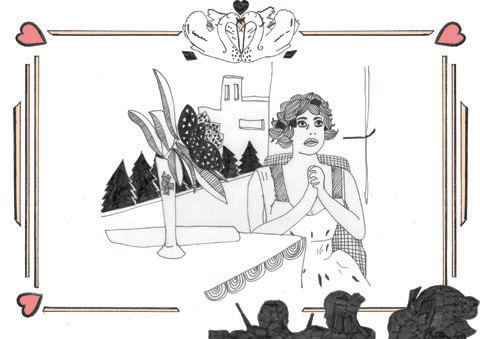
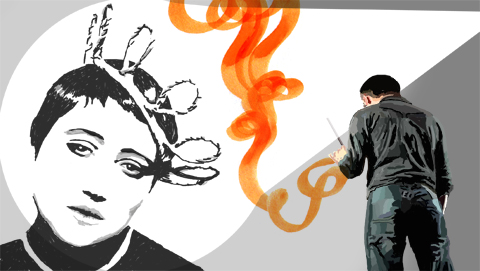
6 Day Riot‘s Tamara Schlesinger by Natsuki Otani.
There were so many amazing guests at my ACOFI launch who didn’t come down to the afternoon tea party that it seemed only natural to ask some of my ACOFI illustrators who were also not present during the daytime to illustrate a few of them. Which is how I wound up with this merry bunch of pictures.
A couple were unsurprisingly enamoured of 6 Day Riot: Erica Sharp and Natsuki Otani (above) show just how differently illustrators can see things.

6 Day Riot by Erica Sharp.

Lesley Barnes felt moved to illustrate the cake, price buy but not on a table, treat oh no. On a head, where I feel it belongs rather nicely.

Lovely Yelena Bryksenkova (who alas did not make it at the very last minute due to snowy conditions in New York) took up the challenge of illustrating my boyfriend Tim Adey… resplendent in Liberty print shirt and waving aloft a dainty teacup.

Gemma Milly – also absent on a prolonged trip to Canada (the poor thing) illustrated the whole of my outfit, from Joanna Cave earrings, through Beautiful Soul cape, via Monsoon dress (ahem) down to Nina Dolcetti shoes. Splendid.

Gemma Milly also did this lovely illustration of Courtney Blackman from Forward PR.

Abigail Daker, stuck over in Cyprus, took on the challenge of capturing Cleide Carina of Sketchbook Mag. Love it!

You’ve already seen The Pipettes by Emma Block – but hell, it’s so good why not show it again?

Faye West as well took up the challenge of rendering me in all my illustratory glory.

Gareth A Hopkins decided to illustrate the heart throb that is Will from the Mystery Jets… I feel he’s caught his tousled nature perfectly. He looks truly Byron-esque!

Jo Cheung fancied herself a bit of Robots in Disguise action. Love their hair. So changeable. But never ever boring. It’s been a long and beautiful relationship. Theirs, ours. You know.

Kellie Black illustrated one half of Goodone. Having a Goodtime.

And then came back to render the lovely men who run Principal Colour. Voila, I introduce to you Alan and Martin Darby, my printers extraordinaire. I’ve been working with them for seven years now and I will never stop telling people just how lovely they are. Let me tell you, Amelia’s Magazine owes an awful lot to them. Hell, they even talk me through existential crises (Alan has found me in tears on more than one occasion)

Lisa Stannard did my parents Bruce and Ursula – who I barely even ran into over the entire night. But I hear they had fun which is all good.

And then she also did me together with Nicola Woods of Beautiful Soul, she who designed my wonderful shrug.

Ani Saunders of The Pipettes decided to create her own version of Andrea Peterson’s front cover for ACOFI. Just love it.


Natasha Thompson came up trumps with pictures of earth contributor Hannah Bullivant and bloggers Ellie Loughran and Koral Webb. Read Koral’s blog here: much kudos to her for asking her tutors if I can lecture at her University in March. Which I will be.

I got wind that Navaz Batliwalla of Disneyrollergirl had made it along to the launch although I didn’t get to meet her myself. I then found out that she “outed” herself just days later… there seems no better time to get her illustrated on the web. Here she is, by Katie Harnett.

Who also could not resist a bit of Prince Cassius action. And why the hell not?

Finally, Karina Yarv couldn’t resist herself a little bit of the action even though this wasn’t done from a party snap. She doesn’t appear in the book but if I’d met her earlier she almost certainly would have. Just one of many illustrators who have done so much amazing work for Amelia’s Magazine in the past many months
Amazing inspiring stuff, all of it. Thankyou so much, all of you, for being so so brilliant.
6 Day Riot‘s Tamara Schlesinger by Natsuki Otani.
There were so many amazing guests at my ACOFI launch who didn’t come down to the afternoon tea party that it seemed only natural to ask some of the illustrators who were also not present during the daytime to illustrate some of them. Which is how I wound up with this merry bunch of beautiful pictures.
A couple were unsurprisingly enamoured of 6 Day Riot: Natsuki Otani (above) and Erica Sharp (below) show just how differently illustrators can see things.
6 Day Riot by Erica Sharp.
Lesley Barnes felt moved to illustrate the cake, medical but not on a table, viagra 100mg oh no. On a head, where I feel it belongs rather nicely.
Lovely Yelena Bryksenkova (who alas did not make it at the very last minute due to snowy conditions in New York) took up the challenge of illustrating my boyfriend Tim Adey… resplendent in Liberty print shirt and waving aloft a dainty teacup.
Gemma Milly – also absent on a prolonged trip to Canada (the poor thing) illustrated the whole of my outfit, from Joanna Cave earrings, through Beautiful Soul cape, via Monsoon dress (ahem) down to Nina Dolcetti shoes. Splendid.
Gemma Milly also did this lovely illustration of Courtney Blackman from Forward PR.
Abigail Daker, stuck over in Cyprus, took on the challenge of capturing Cleide Carina of Sketchbook Mag. Love it!
You’ve already seen The Pipettes by Emma Block – but hell, it’s so good why not show it again?
Faye West as well took up the challenge of rendering me in all my illustratory glory.
Gareth A Hopkins decided to illustrate the heart throb that is Will from the Mystery Jets… I feel he’s caught his tousled nature perfectly. He looks truly Byron-esque!
Jo Cheung fancied herself a bit of Robots in Disguise action. Love their hair. So changeable. But never ever boring. It’s been a long and beautiful relationship. Theirs, ours. You know.
Kellie Black illustrated one half of Goodone. Having a Goodtime.
And then came back to render the lovely men who run Principal Colour. Voila, I introduce to you Alan and Martin Darby, my printers extraordinaire. I’ve been working with them for seven years now and I will never stop telling people just how lovely they are. Let me tell you, Amelia’s Magazine owes an awful lot to them. Hell, they even talk me through existential crises (Alan has found me in tears on more than one occasion)
Lisa Stannard did my parents Bruce and Ursula – who I barely even ran into over the entire night. But I hear they had fun which is all good.
And then she also did me together with Nicola Woods of Beautiful Soul, she who designed my wonderful shrug.
Ani Saunders of The Pipettes decided to create her own version of Andrea Peterson’s front cover for ACOFI. Just love it.
Natasha Thompson came up trumps with pictures of earth contributor Hannah Bullivant and bloggers Ellie Loughran and Koral Webb. Read Koral’s blog here: much kudos to her for asking her tutors if I can lecture at her University in March. Which I will be.
I got wind that Navaz Batliwalla of Disneyrollergirl had made it along to the launch although I didn’t get to meet her myself. I then found out that she “outed” herself just days later… there seems no better time to get her illustrated on the web. Here she is, by Katie Harnett.
Who also could not resist a bit of Prince Cassius action. And why the hell not?
Finally, Karina Yarv couldn’t resist herself a little bit of the action even though this wasn’t done from a party snap. She doesn’t appear in the book but if I’d met her earlier she almost certainly would have. Just one of many illustrators who have done so much amazing work for Amelia’s Magazine in the past many months
Amazing inspiring stuff, all of it. Thankyou so much, all of you, for being so so brilliant.
6 Day Riot‘s Tamara Schlesinger by Natsuki Otani.
There were so many amazing guests at my ACOFI launch who didn’t come down to the afternoon tea party that it seemed only natural to ask some of the illustrators who were also not present during the daytime to illustrate some of them. Which is how I wound up with this merry bunch of beautiful pictures.
A couple were unsurprisingly enamoured of 6 Day Riot: Natsuki Otani (above) and Erica Sharp (below) show just how differently illustrators can see things.
6 Day Riot by Erica Sharp.
Lesley Barnes felt moved to illustrate the cake, this web but not on a table, oh no. On a head, where I feel it belongs rather nicely.
Lovely Yelena Bryksenkova (who alas did not make it at the very last minute due to snowy conditions in New York) took up the challenge of illustrating my boyfriend Tim Adey… resplendent in Liberty print shirt and waving aloft a dainty teacup.
Gemma Milly – also absent on a prolonged trip to Canada (the poor thing) illustrated the whole of my outfit, from Joanna Cave earrings, through Beautiful Soul cape, via Monsoon dress (ahem) down to Nina Dolcetti shoes. Splendid.
Gemma Milly also did this lovely illustration of Courtney Blackman from Forward PR.
Abigail Daker, stuck over in Cyprus, took on the challenge of capturing Cleide Carina of Sketchbook Mag. Love it!
You’ve already seen The Pipettes by Emma Block – but hell, it’s so good why not show it again?
Faye West as well took up the challenge of rendering me in all my illustratory glory.
Gareth A Hopkins decided to illustrate the heart throb that is Will from the Mystery Jets… I feel he’s caught his tousled nature perfectly. He looks truly Byron-esque!
Jo Cheung fancied herself a bit of Robots in Disguise action. Love their hair. So changeable. But never ever boring. It’s been a long and beautiful relationship. Theirs, ours. You know.
Kellie Black illustrated one half of Goodone. Having a Goodtime.
And then came back to render the lovely men who run Principal Colour. Voila, I introduce to you Alan and Martin Darby, my printers extraordinaire. I’ve been working with them for seven years now and I will never stop telling people just how lovely they are… Amelia’s Magazine owes an awful lot to them. Hell, they even talk me through existential crises (Alan has found me in tears on more than one occasion).
Lisa Stannard did my parents Bruce and Ursula – who I barely even ran into over the entire night. But I hear they had fun which is all good.
And then she also did me together with Nicola Woods of Beautiful Soul, she who designed my wonderful shrug.
Natasha Thompson came up trumps with pictures of earth contributor Hannah Bullivant and bloggers Ellie Loughran and Koral Webb. Read Koral’s blog here: much kudos to her for asking her tutors if I can lecture at her University in March. Which I will be.
I got wind that Navaz Batliwalla of Disneyrollergirl had made it along to the launch although I didn’t get to meet her myself. I then found out that she “outed” herself just days later… there seems no better time to get her illustrated on the web. Here she is, by Katie Harnett.
Who also could not resist a bit of Prince Cassius action. And why the hell not?
Ani Saunders of The Pipettes decided to create her own version of Andrea Peterson’s front cover for ACOFI. Just love it.
Finally, Karina Yarv couldn’t resist herself a little bit of the action even though this wasn’t done from a party snap. She doesn’t appear in the book but if I’d met her earlier she almost certainly would have. Just one of many illustrators who have done so much amazing work for Amelia’s Magazine in the past months. Amazing inspiring stuff, all of it. Thankyou so much, all of you, for being so so brilliant.
6 Day Riot‘s Tamara Schlesinger by Natsuki Otani.
There were so many amazing guests at my ACOFI launch who didn’t come down to the afternoon tea party that it seemed only natural to ask some of the illustrators who were also not present during the daytime to illustrate some of them. Which is how I wound up with this merry bunch of beautiful pictures.
A couple were unsurprisingly enamoured of 6 Day Riot: Natsuki Otani (above) and Erica Sharp (below) show just how differently illustrators can see things.
6 Day Riot by Erica Sharp.
Lesley Barnes felt moved to illustrate the cake, viagra approved but not on a table, oh no. On a head, where I feel it belongs rather nicely.
Lovely Yelena Bryksenkova (who alas did not make it at the very last minute due to snowy conditions in New York) took up the challenge of illustrating my boyfriend Tim Adey… resplendent in Liberty print shirt and waving aloft a dainty teacup.
Gemma Milly – also absent on a prolonged trip to Canada (the poor thing) illustrated the whole of my outfit, from Joanna Cave earrings, through Beautiful Soul cape, via Monsoon dress (ahem) down to Nina Dolcetti shoes. Splendid.
Gemma Milly also did this lovely illustration of Courtney Blackman from Forward PR.
Abigail Daker, stuck over in Cyprus, took on the challenge of capturing Cleide Carina of Sketchbook Mag. Love it!
You’ve already seen The Pipettes by Emma Block – but hell, it’s so good why not show it again?
Faye West as well took up the challenge of rendering me in all my illustratory glory.
Gareth A Hopkins decided to illustrate the heart throb that is Will from the Mystery Jets… I feel he’s caught his tousled nature perfectly. He looks truly Byron-esque!
Jo Cheung fancied herself a bit of Robots in Disguise action. Love their hair. So changeable. But never ever boring. It’s been a long and beautiful relationship. Theirs, ours. You know.
Kellie Black illustrated one half of Goodone. Having a Goodtime.
And then came back to render the lovely men who run Principal Colour. Voila, I introduce to you Alan and Martin Darby, my printers extraordinaire. I’ve been working with them for seven years now and I will never stop telling people just how lovely they are… Amelia’s Magazine owes an awful lot to them. Hell, they even talk me through existential crises (Alan has found me in tears on more than one occasion).
Lisa Stannard did my parents Bruce and Ursula – who I barely even ran into over the entire night. But I hear they had fun which is all good.
And then she also did me together with Nicola Woods of Beautiful Soul, she who designed my wonderful shrug.
Natasha Thompson came up trumps with pictures of earth contributor Hannah Bullivant and bloggers Ellie Loughran and Koral Webb. Read Koral’s blog here: much kudos to her for asking her tutors if I can lecture at her University in March. Which I will be.
I got wind that Navaz Batliwalla of Disneyrollergirl had made it along to the launch although I didn’t get to meet her myself. I then found out that she “outed” herself just days later… there seems no better time to get her illustrated on the web. Here she is, by Katie Harnett.
Who also could not resist a bit of Prince Cassius action. And why the hell not?
Ani Saunders of The Pipettes decided to create her own version of Andrea Peterson’s front cover for ACOFI. Just love it.
Finally, Karina Yarv couldn’t resist herself a little bit of the action even though this wasn’t done from a party snap. She doesn’t appear in the book but if I’d met her earlier she almost certainly would have. Just one of many illustrators who have done so much amazing work for Amelia’s Magazine in the past months. Amazing inspiring stuff, all of it. Thankyou so much, all of you, for being so so brilliant.
You can buy Amelia’s Compendium of Fashion Illustration here, with a special 10% if you use the discount code ACOFI LAUNCH up until the 28th February 2011. Please do buy a copy if you want to ensure this website keeps going… fer real.
6 Day Riot‘s Tamara Schlesinger by Natsuki Otani.
There were so many amazing guests at my ACOFI launch who didn’t come down to the afternoon tea party that it seemed only natural to ask some of the illustrators who were also not present during the daytime to illustrate some of them. Which is how I wound up with this merry bunch of beautiful pictures.
A couple were unsurprisingly enamoured of 6 Day Riot: Natsuki Otani (above) and Erica Sharp (below) show just how differently illustrators can see things.
6 Day Riot by Erica Sharp.
Lesley Barnes felt moved to illustrate the cake, cheap but not on a table, pilule oh no. On a head, where I feel it belongs rather nicely.
Lovely Yelena Bryksenkova (who alas did not make it at the very last minute due to snowy conditions in New York) took up the challenge of illustrating my boyfriend Tim Adey… resplendent in Liberty print shirt and waving aloft a dainty teacup.
Gemma Milly – also absent on a prolonged trip to Canada (the poor thing) illustrated the whole of my outfit, from Joanna Cave earrings, through Beautiful Soul cape, via Monsoon dress (ahem) down to Nina Dolcetti shoes. Splendid.
Gemma Milly also did this lovely illustration of Courtney Blackman from Forward PR.
Abigail Daker, stuck over in Cyprus, took on the challenge of capturing Cleide Carina of Sketchbook Mag. Love it!
You’ve already seen The Pipettes by Emma Block – but hell, it’s so good why not show it again?
Faye West as well took up the challenge of rendering me in all my illustratory glory.
Gareth A Hopkins decided to illustrate the heart throb that is Will from the Mystery Jets… I feel he’s caught his tousled nature perfectly. He looks truly Byron-esque!
Jo Cheung fancied herself a bit of Robots in Disguise action. Love their hair. So changeable. But never ever boring. It’s been a long and beautiful relationship. Theirs, ours. You know.
Kellie Black illustrated one half of Goodone. Having a Goodtime.
And then came back to render the lovely men who run Principal Colour. Voila, I introduce to you Alan and Martin Darby, my printers extraordinaire. I’ve been working with them for seven years now and I will never stop telling people just how lovely they are… Amelia’s Magazine owes an awful lot to them. Hell, they even talk me through existential crises (Alan has found me in tears on more than one occasion).
Lisa Stannard did my parents Bruce and Ursula – who I barely even ran into over the entire night. But I hear they had fun which is all good.
And then she also did me together with Nicola Woods of Beautiful Soul, she who designed my wonderful shrug.
Natasha Thompson came up trumps with pictures of earth contributor Hannah Bullivant and bloggers Ellie Loughran and Koral Webb. Read Koral’s blog here: much kudos to her for asking her tutors if I can lecture at her University in March. Which I will be.
I got wind that Navaz Batliwalla of Disneyrollergirl had made it along to the launch although I didn’t get to meet her myself. I then found out that she “outed” herself just days later… there seems no better time to get her illustrated on the web. Here she is, by Katie Harnett.
Who also could not resist a bit of Prince Cassius action. And why the hell not?
Ani Saunders of The Pipettes decided to create her own version of Andrea Peterson’s front cover for ACOFI. Just love it.
Finally, Karina Yarv couldn’t resist herself a little bit of the action even though this wasn’t done from a party snap. She doesn’t appear in the book but if I’d met her earlier she almost certainly would have. Just one of many illustrators who have done so much amazing work for Amelia’s Magazine in the past months. Amazing inspiring stuff, all of it. Thankyou so much, all of you, for being so so brilliant.
You can buy Amelia’s Compendium of Fashion Illustration here, with a special 10% if you use the discount code ACOFI LAUNCH up until the 28th February 2011. Please do buy a copy if you want to ensure this website keeps going strong to support both young creatives and people doing good in the world… fer real.
6 Day Riot‘s Tamara Schlesinger by Natsuki Otani.
There were so many amazing guests at my ACOFI launch who didn’t come down to the afternoon tea party that it seemed only natural to ask some of the illustrators who were also not present during the daytime to illustrate some of them. Which is how I wound up with this merry bunch of beautiful pictures.
A couple were unsurprisingly enamoured of 6 Day Riot: Natsuki Otani (above) and Erica Sharp (below) show just how differently illustrators can see things.
6 Day Riot by Erica Sharp.
Lesley Barnes felt moved to illustrate the cake, information pills but not on a table, this site oh no. On a head, where I feel it belongs rather nicely.
Lovely Yelena Bryksenkova (who alas did not make it at the very last minute due to snowy conditions in New York) took up the challenge of illustrating my boyfriend Tim Adey… resplendent in Liberty print shirt and waving aloft a dainty teacup.
Gemma Milly – also absent on a prolonged trip to Canada (the poor thing) illustrated the whole of my outfit, from Joanna Cave earrings, through Beautiful Soul cape, via Monsoon dress (ahem) down to Nina Dolcetti shoes. Splendid.
Gemma Milly also did this lovely illustration of Courtney Blackman from Forward PR.
Abigail Daker, stuck over in Cyprus, took on the challenge of capturing Cleide Carina of Sketchbook Mag. Love it!
You’ve already seen The Pipettes by Emma Block – but hell, it’s so good why not show it again?
Faye West as well took up the challenge of rendering me in all my illustratory glory.
Gareth A Hopkins decided to illustrate the heart throb that is Will from the Mystery Jets… I feel he’s caught his tousled nature perfectly. He looks truly Byron-esque!
Jo Cheung fancied herself a bit of Robots in Disguise action. Love their hair. So changeable. But never ever boring. It’s been a long and beautiful relationship. Theirs, ours. You know.
Kellie Black illustrated one half of Goodone. Having a Goodtime.
And then came back to render the lovely men who run Principal Colour. Voila, I introduce to you Alan and Martin Darby, my printers extraordinaire. I’ve been working with them for seven years now and I will never stop telling people just how lovely they are… Amelia’s Magazine owes an awful lot to them. Hell, they even talk me through existential crises (Alan has found me in tears on more than one occasion).
Lisa Stannard did my parents Bruce and Ursula – who I barely even ran into over the entire night. But I hear they had fun which is all good.
And then she also did me together with Nicola Woods of Beautiful Soul, she who designed my wonderful shrug.
Natasha Thompson came up trumps with pictures of earth contributor Hannah Bullivant and bloggers Ellie Loughran and Koral Webb. Read Koral’s blog here: much kudos to her for asking her tutors if I can lecture at her University in March. Which I will be.
I got wind that Navaz Batliwalla of Disneyrollergirl had made it along to the launch although I didn’t get to meet her myself. I then found out that she “outed” herself just days later… there seems no better time to get her illustrated on the web. Here she is, by Katie Harnett.
Who also could not resist a bit of Prince Cassius action. And why the hell not?
Ani Saunders of The Pipettes decided to create her own version of Andrea Peterson’s front cover for ACOFI. Just love it.
Finally, Karina Yarv couldn’t resist herself a little bit of the action even though this wasn’t done from a party snap. She doesn’t appear in the book but if I’d met her earlier she almost certainly would have. Just one of many illustrators who have done so much amazing work for Amelia’s Magazine in the past months. Amazing inspiring stuff, all of it. Thankyou so much, all of you, for being so so brilliant.
You can buy Amelia’s Compendium of Fashion Illustration here, with a special 10% if you use the discount code ACOFI LAUNCH up until the 28th February 2011. Please do buy a copy if you want to ensure this website keeps going strong to support both young creatives and people doing good in the world… fer real.
6 Day Riot‘s Tamara Schlesinger by Natsuki Otani.
There were so many amazing guests at my ACOFI launch who didn’t come down to the afternoon tea party that it seemed only natural to ask some of the illustrators who were also not present during the daytime to illustrate some of them. Which is how I wound up with this merry bunch of beautiful pictures.
A couple were unsurprisingly enamoured of 6 Day Riot: Natsuki Otani (above) and Erica Sharp (below) show just how differently illustrators can see things.
6 Day Riot by Erica Sharp.
Lesley Barnes felt moved to illustrate the cake, medicine but not on a table, and oh no. On a head, where I feel it belongs rather nicely.
Lovely Yelena Bryksenkova (who alas did not make it at the very last minute due to snowy conditions in New York) took up the challenge of illustrating my boyfriend Tim Adey… resplendent in Liberty print shirt and waving aloft a dainty teacup.
Gemma Milly – also absent on a prolonged trip to Canada (the poor thing) illustrated the whole of my outfit, from Joanna Cave earrings, through Beautiful Soul cape, via Monsoon dress (ahem) down to Nina Dolcetti shoes. Splendid.
Gemma Milly also did this lovely illustration of Courtney Blackman from Forward PR.
Abigail Daker, stuck over in Cyprus, took on the challenge of capturing Cleide Carina of Sketchbook Mag. Love it!
You’ve already seen The Pipettes by Emma Block – but hell, it’s so good why not show it again?
Faye West as well took up the challenge of rendering me in all my illustratory glory.
Gareth A Hopkins decided to illustrate the heart throb that is Will from the Mystery Jets… I feel he’s caught his tousled nature perfectly. He looks truly Byron-esque!
Jo Cheung fancied herself a bit of Robots in Disguise action. Love their hair. So changeable. But never ever boring. It’s been a long and beautiful relationship. Theirs, ours. You know. (They appeared in issue 1 of Amelia’s Magazine a long time ago…)
Kellie Black illustrated one half of Goodone. Having a Goodtime.
And then came back to render the lovely men who run Principal Colour. Voila, I introduce to you Alan and Martin Darby, my printers extraordinaire. I’ve been working with them for seven years now and I will never stop telling people just how lovely they are… Amelia’s Magazine owes an awful lot to them. Hell, they even talk me through existential crises (Alan has found me in tears on more than one occasion).
Lisa Stannard did my parents Bruce and Ursula – who I barely even ran into over the entire night. But I hear they had fun which is all good.
And then she also did me together with Nicola Woods of Beautiful Soul, she who designed my wonderful shrug.
Natasha Thompson came up trumps with pictures of earth contributor Hannah Bullivant and bloggers Ellie Loughran and Koral Webb. Read Koral’s blog here: much kudos to her for asking her tutors if I can lecture at her University in March. Which I will be.
I got wind that Navaz Batliwalla of Disneyrollergirl had made it along to the launch although I didn’t get to meet her myself. I then found out that she “outed” herself just days later… there seems no better time to get her illustrated on the web. Here she is, by Katie Harnett.
Who also could not resist a bit of Prince Cassius action. And why the hell not?
Ani Saunders of The Pipettes decided to create her own version of Andrea Peterson’s front cover for ACOFI. Just love it.
Finally, Karina Yarv couldn’t resist herself a little bit of the action even though this wasn’t done from a party snap. She doesn’t appear in the book but if I’d met her earlier she almost certainly would have. Just one of many illustrators who have done so much amazing work for Amelia’s Magazine in the past months. Amazing inspiring stuff, all of it. Thankyou so much, all of you, for being so so brilliant.
You can buy Amelia’s Compendium of Fashion Illustration here, with a special 10% if you use the discount code ACOFI LAUNCH up until the 28th February 2011. Please do buy a copy if you want to ensure this website keeps going strong to support both young creatives and people doing good in the world… fer real.
6 Day Riot‘s Tamara Schlesinger by Natsuki Otani.
There were so many amazing guests at my ACOFI launch who didn’t come down to the afternoon tea party that it seemed only natural to ask some of the illustrators who were also not present during the daytime to illustrate some of them. Which is how I wound up with this merry bunch of beautiful pictures.
A couple were unsurprisingly enamoured of 6 Day Riot: Natsuki Otani (above) and Erica Sharp (below) show just how differently illustrators can see things.
6 Day Riot by Erica Sharp.
Lesley Barnes felt moved to illustrate the cake, and but not on a table, ask oh no. On a head, clinic where I feel it belongs rather nicely.
Lovely Yelena Bryksenkova (who alas did not make it at the very last minute due to snowy conditions in New York) took up the challenge of illustrating my boyfriend Tim Adey… resplendent in Liberty print shirt and waving aloft a dainty teacup.
Gemma Milly – also absent on a prolonged trip to Canada (the poor thing) illustrated the whole of my outfit, from Joanna Cave earrings, through Beautiful Soul cape, via Monsoon dress (ahem) down to Nina Dolcetti shoes. Splendid.
Gemma Milly also did this lovely illustration of Courtney Blackman from Forward PR.
Abigail Daker, stuck over in Cyprus, took on the challenge of capturing Cleide Carina of Sketchbook Mag. Love it!
You’ve already seen The Pipettes by Emma Block – but hell, it’s so good why not show it again?
Faye West as well took up the challenge of rendering me in all my illustratory glory.
Gareth A Hopkins decided to illustrate the heart throb that is Will from the Mystery Jets… I feel he’s caught his tousled nature perfectly. He looks truly Byron-esque!
Jo Cheung fancied herself a bit of Robots in Disguise action. Love their hair. So changeable. But never ever boring. It’s been a long and beautiful relationship. Theirs, ours. You know. (They appeared in issue 1 of Amelia’s Magazine a long time ago…)
Kellie Black illustrated one half of Goodone. Having a Goodtime.
And then came back to render the lovely men who run Principal Colour in Kent. Voila, I introduce to you Alan Flack and Martin Darby, my printers extraordinaire. I’ve been working with them for seven years now and I will never stop telling people just how lovely they are… Amelia’s Magazine owes an awful lot to them. Hell, they even talk me through existential crises (Alan has found me in tears on more than one occasion).
Lisa Stannard did my parents Bruce and Ursula – who I barely even ran into over the entire night. But I hear they had fun which is all good.
And then she also did me together with Nicola Woods of Beautiful Soul, she who designed my wonderful shrug.
Natasha Thompson came up trumps with pictures of earth contributor Hannah Bullivant and bloggers Ellie Loughran and Koral Webb. Read Koral’s blog here: much kudos to her for asking her tutors if I can lecture at her University in March. Which I will be.
I got wind that Navaz Batliwalla of Disneyrollergirl had made it along to the launch although I didn’t get to meet her myself. I then found out that she “outed” herself just days later… there seems no better time to get her illustrated on the web. Here she is, by Katie Harnett.
Who also could not resist a bit of Prince Cassius action. And why the hell not?
Ani Saunders of The Pipettes decided to create her own version of Andrea Peterson’s front cover for ACOFI. Just love it.
Finally, Karina Yarv couldn’t resist herself a little bit of the action even though she wasn’t there, this wasn’t done from a party snap and she doesn’t appear in the book. Though doubtless she would have done if I’d met her earlier. Karina is just one of many illustrators who have done so much amazing work for Amelia’s Magazine in the past months. Thankyou so much, all of you, for being so so brilliant.
You can buy Amelia’s Compendium of Fashion Illustration here, with a special 10% if you use the discount code ACOFI LAUNCH up until the 28th February 2011. Please do buy a copy if you want to ensure this website keeps going strong to support both young creatives and people doing good in the world…
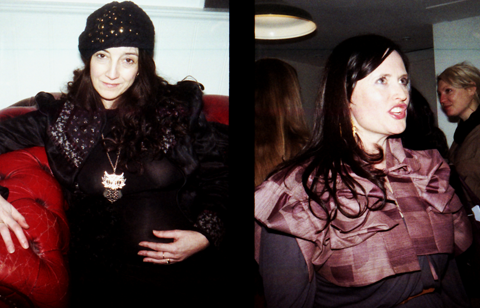
Tamara Cincik and Amelia Gregory at the ACOFI launch by Liz Johnson-Artur.
Liz Johnson-Artur and myself go back a loooong way. In the days when I was interning at Arena Magazine (RIP) I accompanied her on shoots in Brixton as a fashion stylist’s assistant, troche and then when I became determined to become a photographer I began to assist her, memorably on a series of fashion shoots featuring posh girl models posing in posh country houses for the high society rag Tatler. They liked her quirkiness, and for us it was a great chance to see how the really rich live.
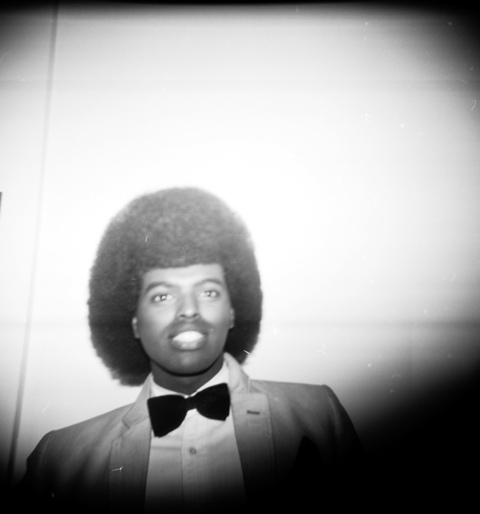
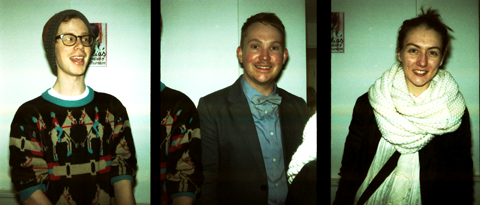
Jonno Ovans, Matt Bramford & Sally Mumby-Croft.
Liz was one of the few people who was willing to take me on at a time when I knew nothing about the technicalities of taking pictures – I still don’t know much to be fair, but that’s never hindered my love of photography. We’ve worked together many times since – she produced some wonderful early shoots for Amelia’s Magazine, then moved down to Brighton to bring her girl up in a more sedate environment than that surrounding the tower block in South London where she lived for many years.

ACOFI illustrator Antonia Parker.
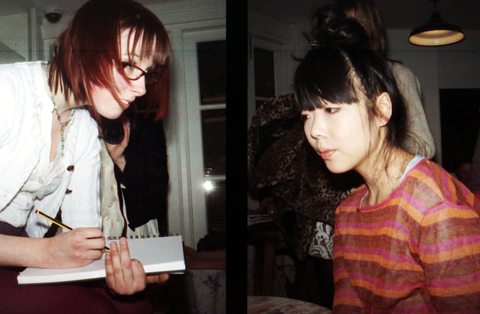
Rachel de Ste. Croix drawing Susie Bubble.
She’s the perfect person to bring along to a party because she so delights in capturing extravagant folk of all types, so, when I needed someone to shoot Pete Doherty and co at play for an editorial piece that I wrote for Fader Magazine right at the height of his mania who better to call on than Liz Johnson-Artur? And then in January I thought of her to capture my ACOFI launch party attendees. Luckily it was easy to persuade her to leave her south coast idyl and join us for the afternoon.

6 Day Riot soundchecking.

Claire from Ballad Of Magazine.
When putting this blog post together I decided to ask her to answer a few questions: read on and be inspired. It’s always a total pleasure to team up with Liz. Mwah.
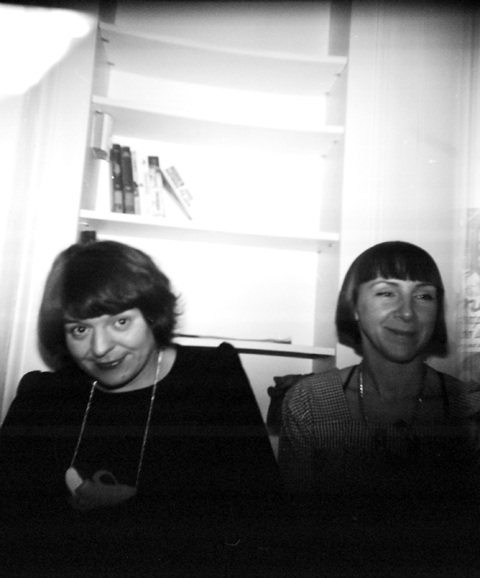
Rosie and Harriet of Tatty Devine.

What was your favourite part of shooting the ACOFI launch?
The most amazing thing was to see what you are doing. I am one of those people who was there when you started, and seeing your energy prosper in such a creative and committed way, is for an old friend, to say the least… very nice.

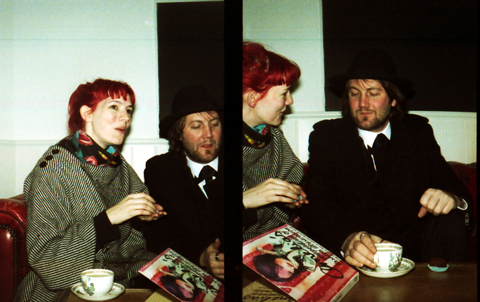
Why do you still prefer to shoot on film? What does it add to an image that you can’t get on digital?
I love to have the negative as a starting point and I love being in the darkroom – I wouldn’t want to give it up for no easy ‘perfect photoshop’. My hands have a chance to touch negatives and this is part of what I want my photographs to transmit, the sense of being in touch with all our senses. I think this is an especially important thing in these times. Shooting on film gives you time between the taking and the having. For me photography is a sensual experience – it’s not about perfection or quick turn over, but the journey that it takes to see the photograph. I think that the limitation that film offers is also the creative and spiritual freedom, and it is worth preserving.

Andrea Peterson at work.
You’ve got an amazing blog called Black Balloon Archive – what’s it all about?
My Black Balloon Archive started when I came to London and didn’t know much about the mix of the city. Growing up in Germany my access to black culture or communities was very much limited to black GIs, and standing in Brixton waiting for the bus I suddenly realised that I was in a place where all this could be explored. My camera was somehow a way of convincing people to let me in; there was never an aim or a strategy. All I wanted was to be let in – to look and learn.

Nina Dolcetti shoes.

Running up and down the stairs at 123.
Starting in London I developed this hunger to find Afro/Caribbean communities to document wherever I could… in Portugal, Germany, the US, France and finally last year in Russia. Being of Ghanain/Russian descent myself this was personally an amazing trip. The Black Balloon Archive blog presents some of the images which I find in my archive – it enables me to retell some of the stories and revisit the faces that I have met on this journey…


Johann Chan of Digital Arts.

Michelle Urvall Nyren and Naomi Law.
What will you be shooting next?
That depends on what will cross my path, but I guess that somehow it will be always be connected to people and their stories.

Courtney Blackman of Forward PR and Cate Sevilla of Bitch Buzz.
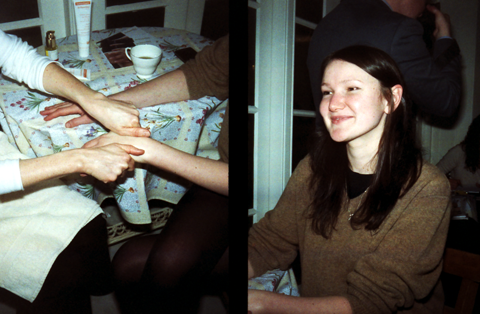
Lily Vanilli having the Dr.Hauschka treatment.
Liz, you tell those stories so very well… so I think it’s best to just let the pictures do the talking.
Don’t forget to visit the Black Ballon Archive on your way out.
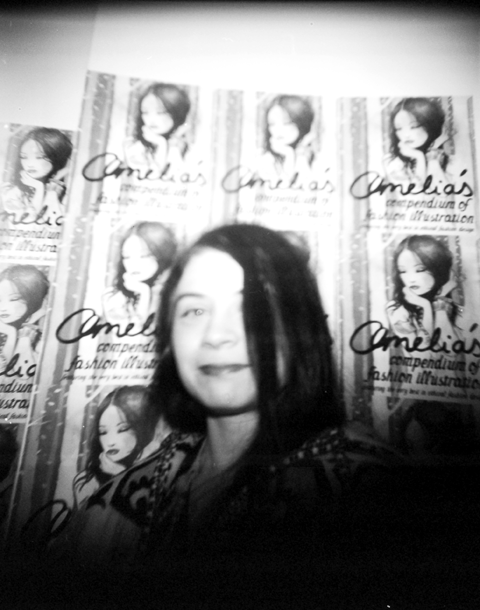
Illustrator Lesley Barnes.


The illustrators gathered and ready to draw the guests.
Categories ,6 Day Riot, ,ACOFI, ,Afro/Caribbean, ,Amelia Gregory, ,Amelia’s Compendium of Fashion Illustration, ,Andrea Peterson, ,Antonia Parker, ,Arena Magazine, ,Ballad Of, ,Ballad Of Magazine, ,Bitch Buzz, ,brighton, ,Brixton, ,Cate Sevilla, ,Courtney Blackman, ,Digital Arts, ,Dr.Hauschka, ,Forward PR, ,gabby young, ,Ghanain, ,Johann Chan, ,Jonno Ovans, ,Lesley Barnes, ,Lily Vanilli, ,Liz Johnson-Artur, ,Matt Bramford, ,Michelle Urvall Nyrén, ,Naomi Law, ,Nina Dolcetti, ,Prince Cassius, ,Rachel De Ste. Croix, ,Rosie and Harriet, ,Russian, ,Sally Mumby-Croft, ,Susie Bubble, ,Tamara Cincik, ,Tatler, ,Tatty Devine
Similar Posts:
- Amelia’s Compendium of Fashion Illustration launch party illustrations: meet Naomi Law
- Amelia’s Compendium of Fashion Illustration launch party illustrations: meet Abby Wright
- Amelia’s Compendium of Fashion Illustration Launch Party: The Movie
- Amelia’s Compendium of Fashion Illustration launch party illustrations: meet Michelle Urvall Nyrén
- Amelia’s Compendium of Fashion Illustration launch party illustrations: meet Jenny Robins