Courtesy of George and Betty Woodman and Marian Goodman Gallery, pills New York
When I hear the word Surrealism, for sale instantly the likes of Salvador Dali, approvedAndré Breton, André Masson and Max Ernst come to my mind. Well I can now addFrida Khalo, Leonora Carrington, Eileen Agar and many more female Surrealist artists to that male dominated list, thanks to Manchester’s Art Gallery! Their current exhibition, Angels of Anarchy, sets out to not only celebrate the works of female artists but to educate and inform those who know little (people like me) or nothing at all about the important role females played in the Surrealist movement. How about that?
The exhibition covers five main categories within Surrealism – Portrait/Self-Portrait, Landscape, Interior, Still Life and Fantasy; the medium used ranges from sculpture to photography to film and the more traditional oil on canvas. Thanks to Salma Hayek’s performance in the eponymous film, Frida Khalo -who features in both Portrait/Self Portrait and Interior – is probably the name most will recognise but you will not be disappointed with the other lesser-known artists on display.
Courtesy ADAGP Paris, Musée National d’Art Modern – Centre Georges Pompidou. Courtesy Photo CNAC / MNAM, Dis. RMN / courtesy Jacques Faujour
The most interesting piece comes in the form of film by photographer/filmmaker Lola Alvarez Bravo -who incidentally went to school with Frida and was one of her closest friends. The 30 seconds (approx) of rare footage is left untitled but is captivating from start to end, not least thanks to the presence of Frida herself; the artist is more stunning on film that I had imagined. There is no audio in this eerie film and it’s quite foretelling that Frida is welcoming death into her home in the shape of an innocent looking girl; this was shot when Frida was in ill health and I thought this was one of many nice surprises within the exhibition. Bravo documented much of Frida’s life and she went on documenting even after her death; there is a poignant shot of Frida’s room after her death (Frida’s Room 1954), where her wheelchair, paintbrushes, a self-portrait and a picture of her husband are strategically placed in order to sum up her life. This particular scene left a lump in your throat!
Courtesy Manchester Gallery
Another big name featured in the exhibition is Eileen Agar – whose Angel of Anarchy (1936-1940) mixed media head dress is featured alongside its opposite number Angels of Mercy (1936-1940) – only two surviving pieces of four, are portraits of Joseph Bard(her husband) and to see them both is quite magical. Angel of Anarchy is wrapped in rich African bark cloth decorated in Chinese silk, beads and osprey and ostrich feathers and has a decadent aura about it. Angel of Mercy is quite the opposite but none less impressive to its corresponding part, using only her skills to sculpt the piece and her hand to paint it.
Courtesy Manchester Gallery
Whist big names like Kahlo, Agar, Oppenheim and Cahun are used to encourage people to visit the exhibition the lesser known artists really do shine and in some cases surpass their well known counterparts. Kay Sage’s beautiful black and white, landscape photography will lead you into the word of the extra-ordinary within the ordinary – her vision of seeing something interesting within what seems to be an ordinary landscape impressed me a great deal! Leonora Carrington’s self portrait (1937-1938) will immediately grab your attention as it did mine; I faced this one particular piece for a good10 minutes and I must admit I was truly transfixed and consumed in my trail of thought! This, in my opinion, is by far was the best self portrait (oil on canvas) in the entire show. I felt deep sympathy for Carrington and I was left wondering and wanting to know more about this wonderful talent.
The exhibition is over teeming with beautiful oils on canvas and sculptures that include a rarely seen Lee Miller torso cast that has only even been exhibited once before. Surrealist literature is present in the form of Leonora Carrington’s En Bas ( Down Below 1945) a memoir of her emotional journey after Max Ernst is arrested by the Nazis which leads her to being institutionalized in a mental hospital in Spain. There are video instillations by Francesca Woodman documenting herself exploring the female form and a beautiful interpretation of ‘There was a Miller on a River’ (1971), byEva Svankmajerova. This old folk song tells the story of a young soldier returning home after 20 years. His parents do not recognise him, rob and murder him; once they realise it was their son they take their own lives. Such a brutal act is given a beautiful lease of life in Svankmajerova’s gorgeous illustrations.
Courtesy Manchester Gallery
Another nice surprise is the room ‘Teenangels’ in which the Manchester Art gallery has teamed up with art students from Levenshulme High School who have came up with their own Surrealist inspired artwork. I would have happily been left to think they were part of the Angels of Anarchy exhibition had I not seen the sign! Seeing interaction between a prestigious art gallery like Manchester’s and GCSE art students topped the exhibition off perfectly.
All in all this was a good exhibition which ran from the 26th of December 2009 to the 10th of January 2010. Penny Slinger describes her work as ‘a protest against females being seen as mere objects at a male’s disposal’. This exhibition sets out to break the notion that Surrealism is a male dominated movement and it does so successfully. Without the likes of Frida Kahlo,Claude Cahun, Edith Rimmington, Meret Oppenheim and the rest of the female Surrealist featured in the exhibition I doubt very much that women in art would be where they are today. They helped the female cause for decades to come and paved the way for equality in Art. They proved that chicks can do what guys do… and dare I say in some cases even better? If you were one of the lucky few who visited the show then you surely came away enlightened, informed and inspired by those surrealist amazons…just like I did.
Watching their electric performance at The Garage, information pills I immediately understood why all the major music publications are getting their knickers in a twist over The Pains of Being Pure At Heart. With the recent release of their debut album, more about The Pains have quickly amassed a devoted fan base and garnered raptuous reviews for their perfectly pitched shoe gazing dream pop. If I hadn’t met them, I might have assumed that they were the sort of band who believed their own hype – and why wouldn’t they? Having sat down with Kip and Peggy earlier in the day I instantly realised that while they weren’t oblivious to the attention, they were unfettered by it. Letting the press get on with their excitable reactions, the band just want to play the music that they love.
The new album has practically been lauded as the second coming by heavy weights like The NY Times and NME, did you expect such an immediate and positive reaction?
Peggy – Definitely not, I just think about the bands that play music like us that we have always admired, and most of them were were not that comercially well known, and not always that critically received either, so playing the kind of music we play… we didn’t have our hopes up high. But we were really happy with the record though, we really enjoyed making it, but we had no sense that anything beyond us being happy would happen. I always liked bands that I discovered on my own, I wouldn’t hear them on commercial radio or MTV.
Kip- There are a couple of bands that reached a bigger audience like Sonic Youth or Nirvana, but most of the indie pop bands of the 90′s were limited to a narrow community.
So you were expecting that the album would spread by word of mouth, and instead you were plunged straight into a media frenzy. Were you ready for this?
Peggy- It wasn’t the goal of the band. You know, “everyone is going to love us!” We were just friends that started playing music and this is the kind of music that we like and have bonded over. I think if we had set out to get commercial success we wouldn’t sound the way that we do.
Kip- Where we come from, our backrounds in music, there is not really a strong tradition of bands expecting good things to happen. Perhaps American bands are more self depricating (laugh) but there is this built in expectation that if you do something that you love, it might not be well received by others, but you’ll be happy because you will be proud of it.
Peggy – And you’re happy with the five people that appreciated it! (laughs) I feel like I was that person that would always appreciate a certain band and I would have been totally satisfied with that kind of response for us.
Kip- Growing up, most of the bands that I liked, I didn’t know anyone else who liked them.
Did that give it a special resonance – liking a band, and knowing that no-one else knows them?
Peggy – I wouldn’t admit that…… but I secretly enjoy it!
Kip – I would have liked to have known other people who were into the same bands as me growing up. I felt quite isolated that way; I would sit at home playing computer solitaire, listening to an album over and over again, but it’s cool now that we are travelling more and meeting people who had similar backrounds.
What is the Pains’ backround?
Peggy – I’ve been in bands since I was 13, but none of them that ever went on tour. This is the first band where I’ve got to travel.
Kip – I was in a similar situation, but none of them had graduated above playing in a basement. So this is very different from anything I’ve ever been in – one band that I was in, our goal was to play at this house we knew that had really cool house parties! (laughs)
Can you account for the reasons why the Pains have become so successful?
Kip – We started small, we were playing together for a while before anything happened, it’s easy to lose sight of that because once the album came out things changed a bit, but we were around for a couple of years and met with plenty of challenges, so it doesn’t feel to us like it is an overnight thing, but it may seem that way from an outsiders perspective. I’m grateful for the way that it turned out because it allowed us to mess up for a bit without other people watching! (laughs) We had a relatively decent period of obscurity while we refined what we do….. and also, the reason is luck!
Peggy – And being in the right place at the right time.
Peggy, Is it true that the band formed in part to play at your birthday party?
Peggy – Yes! I remember it was my birthday and I had only invited like, four people; because I only have four friends! (laughs).
Kip – It was at this big warehouse and it was basically an elaborate plot to try and get Manhattan Love Suicides to play, and so if we threw the party, we could play first and then we could say that we played with them. So we had a month to get ready.
It sounds like it was a natural way in which the band came together….
Kip- It was the best way. If the last seven months have taught us anything; we are always together, and if there were people that didn’t get along, it would be hellish, but we were friends for a long time before we picked up an instrument. This made the whole experience fun and much less stressful then for bands who get formed by putting ads in a paper saying ‘drummer needed’.
Peggy – The fact that we are friends and the fact that we have stayed friends is almost more lucky than anything else.
So there haven’t been any falling outs on tour then?
Peggy (emphatically) No!
Kip – This is our first experience of doing this, we don’t have a glut of expectations, we’re just appreciative of the opportunity and are excited by it all; and when you are excited and enjoying it, it’s hard to get upset about things.
Peggy – Touring can be really hard and gruelling, and I feel like if it were with any other people it would really suck, but it ends up being fun anyway.
What have been some highlights for you in the last few months?
Peggy – Playing Primavera was really amazing, that was the first big festival we ever played, and I didn’t know what to expect. I mean, I don’t like crowds (laughs) so I thought, today might be weird or awkward, but it ended up being really life affirming and it was the biggest adrenalin rush ever.
Kip- ABC news showed up at our practice place to hear us play. The fellow who does the news is on TV saying (in deep, authoratative voice), “And now, a report from Brooklyn” (laughs), and him saying our band name on televsion… I sent that to my grandparents, I think that this was the moment where my family realised that even though they didn’t quite understand what was going on with us, we were doing something worthwhile.
Which country has had the best crowds at your gigs? Apart from Britain obviously!
Kip – Obviously!
Peggy – I thought Germany was really positive, we played three shows in Germany and they were really enthusiastic.
Kip – Sweden was pretty amazing, that country has a strong tradition of appreciating bands like ours and even though Swedes are normally really reserved, the enthusiasm we saw there predated even us having a record out – we had released our EP and if we had played in New York, maybe 40 people would have come, and we would know 37 of them, and then we went to Sweden and all of a sudden we were playing really big shows and I had no idea that a band like ours could find an audience like that. But most of the places that we have travelled to have been positive experiences.
You’ve got some more touring to do, and then what do you have planned?
Kip- We have an EP coming out this fall, we recorded four songs before we went to Europe in May, and after the tour we are going back to practicing and working on the new record. But every step of the process is exciting and I try not to think too far into the future, because then you miss out on what is happening in the present.
After this I get Kip and Peggy to take part in my game of Lucky Dip, which involves picking questions out of the bag (my handbag, actually) Peggy picks the “What is the first record that you ever brought?” and proudly tells me that it was Madonna’s “Like A Prayer”, and then with less confidence, quietly adds that a purchase of Tiffany’s “I Think We’re Alone Now” was also made. “I was really into female performers at the time!” she cried. Kip gets the “What is on your rider?” question, and true to form, the down to earth bands requests are not unicorns, dwarfs and mounds of Class A’s, but bread, hummus, water and beer. ” We just need to make sure that we get fed around 5pm or we get a bit grumpy” Kip ventures, although I don’t think any explanation is needed when the sum contents of your rider can be placed in a Tesco’s 5 items or less basket.
“The Pains of Being Pure At Heart” is out now. Monday 10th August
UN Climate Change Talks
The U.N. Climate Change Talks in Bonn, recipe Germany begin a series of informal intersessional consultations today. These are part of the run-up to Copenhagen in December, search and this particular series can be found webcast live here
The Yes Men film shows the hoaxes perpetrated by two US political pranksters. The promotion team describe the film as “so stupidly entertaining” that it will reach and motivate thousands of people, this thus “adding even more juice into a movement that is trying to save civilization itself, among other modest goals.
Tuesday is the satellite event – live from Sheffield, it’s a simulcast event screening of THE YES MEN FIX THE WORLD and live q&a with the Yes Men beamed via satellites from Sheffield Showroom. Cinema-goers will have the opportunity to put their questions live and direct to the film’s stars from their respective cinema locations.
20.30, at the following London cinemas:
Odeon Panton Street, Clapham Picture House, The Gate Notting Hill, Greenwich Cinema, Ritzy Brixton, Screen-on-the-Green
More cinemas on the screenings page of their website.
Wednesday 12th August
Green Spaces & Sticky Feet
A creative exploration of the nature beneath our feet as we roam around the gardens – to help us understand why green spaces are important and how we can make our buildings greener. This is a workshop for children of all ages, who must be accompanied at all times by an adult.
On Friday the 7th August the bailiffs went in and the occupation of the Vestas wind turbine plant on the Isle of Wight ended.
In response to this a National Day of Action in support of the Vestas workers and to keep the factory open, for Green Jobs and a Green Energy Revolution, was declared. There will be actions all around the country organised by a diverse range of groups.
Or contact your local CCC group, or Union – or if you want to organise something in your area there is some advice from Jonathan Neale, of the CCC Trade Union group
The campaign to Save Vestas has not finished, it has just started and with it comes a campaign for a step change in the creation of Green Jobs and the Green Energy Revolution !
6.30pm
Outside the Department of Energy and Climate Change (DECC)
A spiritual celebration and experience, honouring our regal beauty with sacred song and dance. Dances of universal peace, Taize singing, Bhajans & Kirtan, native American sweat lodge, Zikr & Sufi practice, Breton dancing, Tibetan sound meditation, yoga, tribal dance, ancient ways of the British Isles, chant wave and more…
Let the London Wildlife Trust take you out trapping, identifying and recording moths on the Totteridge Fields Nature Reserve. Come and see how many species of moths visit the fields at night. Please wear warm clothes and sensible footwear. Bring a Torch, Notebook and pen. You may also want to bring a flask.
Free car parking in sports ground car park adjacent to the Hendon Wood Lane entrance.
Nearest tube is Totteridge & Whetstone
251 bus stops on Totteridge Common near the junction with Hendon Wood Lane.
8.30-10.30pm
Hendon wood Lane entrance to totteridge Fields Nature Reserve
Contact – Clive Cohen – 07973 825 165 – notinbooks.conservation@btinternet.com
The National are one of my favourite all time bands. Their music full of deep seductive murmuring and soaring strings, The National build a beautiful soundscape full of urban discontent and lost loves.
I wouldn’t blame you for thinking that Devotchka have wandered straight out an Eastern European shtetl with their romani/ klezmer-tastic music. In fact they’re from Colorado and you probably recognise their orchestral treats from Everything is Illuminated and Little Miss Sunshine.
Wednesday 12th August
Woodpigeon at Borderline, London
Woodpigeon is whispery folk with beautiful strings and brass. Perfect for a summer evening.
Thursday 13th August
Circulus at The Lexington, London
Tired of the ins and outs of modern life? Do you want to return to a simpler time? A medieval time? Go see Circulus then! They’re quite obviously as mad as a bag of prog listening cats but they sing about fairies and have lutes- what couldn’t be awesome about that?
Friday 14th August
Forest Fire and Broadcast 2000 at The Luminaire, London
Lovely country folk from Brooklyn’s Forest Fire and tinkly electronica from Broadcast 2000 are set to make this night special!
Saturday 15th August
Spaghetti Anywhere and Colours at Barfly, London
Here at Amelia’s HQ we often find ourselves listening to Spaghetti Anywhere‘s myspace selection of pretty indie pop, and it never fails to brighten up a dreary office day.
Also playing are Colours the South Coast’s answer to My Bloody Valentine, offering up a delicious slice of Shoegaze with Pavement-y undertones. Brilliant stuff all round!
William Cobbing: Thoughts From the Bottom of a Well
Until 6th September
Monday to Friday 9am – 7pm
Saturday 9am – 5pm
Sunday 10am – 4pm
Free
Controversial siblings Jake and Dinos Chapman strike again, with this Hayward Gallery exhibition on tour around the country, based on children’s dot-to-dot drawings but a whole lot more dark, chaotic and macabre.
———————————————————————————————–
The 2009 Vice Magazine Photography Exhibition
The Printspace
74 Kingsland Road
Shoreditch
London E2 8DL
13th August – 26th August
Monday – Friday 9am – 7pm
Artists include: Richard Kern, Maggie Lee, Peter Sutherland, Dana Goldstein, Tim Barber, Martynka Wawrzyniak, Angela Boatwright, Jamie Taete, Alex Sturrock, Jonnie Craig, Ben Rayner.
‘Exhibit X is pleased to announce an exhibition examining the blurred vision between photojournalism and raw photography, using images from Vice magazine and it’s photographers.’
15th August 26th September
Tuesday – Saturday 10am – 5pm
Free
‘Stitching Time is a partnership project with Suffolk Artlink’s Culture Club and Colchester and Ipswich Museums. Older members of the community used a variety of sewing methods to create work in response to the collections.’
———————————————————————————————–
The Kiss of a Lifetime (Part 2)
Vane
Kings House
Forth Banks
Newcastle upon Tyne NE1 3PA
Until 22nd August
Wednesday – Saturday 12-5pm
Free
‘Our second presentation as part of the Northern Print Biennale, ‘The Kiss of a Lifetime (Part 2)’ is curated by Manchester-based artist and curator, Mike Chavez-Dawson. The exhibition features the work of over 100 artists, both internationally renowned and emerging, from the UK and abroad and examines what ‘the kiss’ signifies within contemporary culture – from the romantic to the lifesaving, from the prosaic to the violent.’
Until11th October
Tuesday – Saturday 10am-5pm
Thursday 10am – 8pm
Sundays/ Bank Holidays 12.30 – 5pm
Free
‘An exhibition featuring the highly distinctive drawings of the Scottish outsider artist Scottie Wilson (1891-1972). Starting his artistic career at the age of 44, his work was admired and collected by the likes of Jean Dubuffet and Pablo Picasso and he is considered to be one of the most celebrated outsider artists of the twentieth century.’
Written by Alice Watson on Monday August 10th, 2009 7:05 pm
On Thursday the bath-time lovelies at Lush supported one of my great loves, casetroche by staging Climate Rush themed picnics outside all 89 of their UK stores.
As was detailed by Cari in a previous post, unhealthy my local Lush store just happens to be in Liverpool Street Station. Chosen as the flagship store for this event the picnic was attended by Lush superstar campaigners Sean and Andrew, here who have together helped us out in a very big way.
I sent the interns ahead on foot and arrived to find a fetching gingham tablecloth – bearing the timely ‘Climate Change is No Picnic’ slogan – being spread and upon it a yummy selection of vegan cake and cookies laid out for passersby to enjoy.
A trio of violins led by the Rush’s very own Deborah (her of sticky-fingers-in-parliament fame) struck up a tune as the lovely Lush girls, dressed in full Edwardian garb, handed out Trains Not Planes sashes to business men passing by and even managed to engage some climate change denialists in some productive conversation.
The police, as ever, were present. In fact I swear I recognised one of them from the “Riot Gate” at Kingsnorth during Climate Camp last year. Unlike then, they were eager to smell the soaps (all packaged in recyclable paper – Lush tries not to use excess packaging, just one of the reasons we love ‘em) and chat to the pretty shop girls. I wonder if they’ll be so nice to us on Monday…
As Tamsin did her best to butter up the passersby in those famous suffragette must-haves, fishnet tights and a miniskirt, we were pounced on by a person dressed up as a giant mobile phone.
A slightly surreal experience to say the least, as the Lush shop girls tried to dress the ungainly thing in some bright red sashes, whilst Sean did his best to engage the phone in conversation about how many times a year it flies. My interns finally arrived and proceeded to pose marvelously for the camera. We’ve been joking that Jonno and Roisin are evil twins – just check them out!
Over the weekend there has been a flurry of Climate Rush activity, both promotional and creative – we’ve flyered the South Bank twice, and approached friendly looking cyclists left, right and centre.
It seems that if you ride a bike you are generally a friendly soul, and all of them were happy to hear about Climate Rush bar a particularly unpleasant yuppie couple with a pair of fold out Bromptons that no doubt only see the light of day when the sun shines at the weekend. Fairweather cyclists, who’d have ‘em?!
In between accosting cyclists we have managed to print a mammoth amount of sexy sashes and flags to attach to the back of bikes.
I’ve discovered that I can still sew, and managed to knock up 5 pairs of fetching bloomers in record time (just don’t look too closely at the sewing, I was in a hurry okay?!) Made out of red and white striped fabric with lacey ruffles on the legs they look part clown and more than a little bit burlesque, but then whoever said we take the Edwardian theme too seriously?! I can’t wait to see what everyone else dons for out bike ride tomorrow.
Bring it on…. let’s show the government and big corporations that we won’t let them get away with business as usual when it comes to Climate Change. Collectively we can stop this beautiful world of ours from being buggered over, so make sure you come along and enjoy a stylish Bike Rush with a purpose. This is one cycle ride you’re sure to remember…
Read a past blog about this event here. What do you think about direct action over Climate Change? Let us know your views. Rowdy – Never Smile at a Crocodile
Sartorial Contemporary Art
26 Argyle Square
London WC1H 8AP
June 4th – June 27th
Open Tues – Sat 1:30 – 7pm or by appointment
With work described as ‘Ren & Stimpy meets Goldsworthy’, shop this is the first major solo show for Rowdy in London to date. Mixing the Ancient with the Urban, medical Rowdy juxtaposes his trademark playful crocodile sculptures with the modern cityscape jungle. He also produces street art paintings reminiscent of caveman-esque cartoon monoliths.
——————————————————————————————————-
Abstract America: New Painting and Sculpture
Saatchi Gallery
Duke of York’s HQ
King’s Road
London
SW3 4SQ
Until 13th September
10am-6pm, illness 7 days a week
Free
A new generation of radical American abstract painters and sculptors from the US, 35 of them in total, with work both daring and inventive, fresh and exhilarating.
——————————————————————————————————–
Aditya Pande
Alexia Goethe Gallery
7 Dover Street, London W1S 4LD
Until 18th July
Monday – Friday 10-6
Saturday 11-4
New Dehli artist Aditya Pande’s first solo London show draws on both fine and applied art principles. What start as drawings on computer morph into paper prints or canvas creations, and then become starting points for three-dimensional narratives. Frantic, glossy, grand and descriptive.
————————————————————————————————————–
Feel The Force
Cafe Gallery
By the Lake, Southwark Park
London SE16 2UA
Until 28th June
Wednesday – Sunday 12 – 6
Free
Maja Bajevic, Benjamin Beker, Astrid Busch, Kate Gilmore, Immo Klink, Susan MacWilliam, James Pogson, Anina Schenker
Curated by Clare Goodwin and Liz Murray
Inspired by engagement in power and resistance, Feel the Force is a collaborative show from eight international artists and debates the psychological, the political and the physical. Investigating roles of victim and perpetrator, the artists approach the term Force through avenues diverse as obsessional first love and the military.
——————————————————————————————————-
The Social Lives of Objects
Castlefield Gallery
2 Hewitt Street
Knott Mill
Manchester M15 4GB
Until 19th July
1-6pm Wednesday-Sunday
Free
Hilary Jack, Lisa Penny and Dallas Seitz provide insightful examinations of society’s complex and perplexing relationship with material goods, from their beginnings in production to their inevitable obsolescence and decay. Everyday objects are recovered and represented and reinterpreted for our reevaluation of what role ‘stuff’ has in our lives and in our world.
—————————————————————————————————–
The Butterfly Effect
ARCH Gallery
15 Resolution Way
Deptford
London SE8 4NT
Until 20th June
Thurs – Sat 12:00 to 5:00pm
The well-known theory that subtle actions can and will ultimately alter the paths of world disaster is given a makeover by God’s gift to drawing Paul Marks. Using the system to create intricate line drawings in which each line added by hand effects the next one added. The comparisons are as varied as lunar landscapes, overtly sexual and flows of air, smoke or water.
————————————————————————————————————
ARCHIPELAGO – Gemma Anderson
Whitecross Gallery
122 Whitecross St.
London EC1Y 8PU
Until 6. June
Tues – Sat 11 – 6pm or by appointment
Free
The final week to catch new work from Gemma Anderson including her signature drawings and newer etching work. Dream-like and fantastical depictions of fairies, land and seascapes drawing on her experiences of researching the Natural History archives in Canada, Japan and France her new work doubles as a personal travelogue.
Written by Alice Watson on Monday June 1st, 2009 12:14 pm
With many universities leaning heavily towards womenswear – in some cases wholly – Epsom pleased many with several of its strongest collections coming from menswear designers. One of the running themes throughout the Epsom show seemed to be an obsession with blood, advicebuy the body and corporal violence (you’ve got to wonder what’s going on down there) with one dress revealing a Westwood-esque red, cialis 40mg jewelled wound-like gape on its back.
Not pandering to this was Antigone Pavlou, viagra buy who opened the show with loud, bold and funky collection for the streetsmart city boy, with bomber jackets, tracksuits and distressed denim (the latter a phrase that struck fear into my heart when I first read it in the notes, only to be pleasantly surprised). With coloured headphones carelessly slung around the models’ necks, the designer plainly had a clear lifestyle in mind and played to its strengths in all the right ways, combining strong block primary colours with clashing graphic prints.
If some previous designers during GFW have shown a tendency to elevate and romanticise the pastoral, I think Pavlou successfully did the same for the city, offering an attractively laid-back vision of urban life where you pull on some comfortable but sharp threads, plug into your walkman and swagger down the street, content to shut the outside world away for a moment, a sentiment I’ve evidently been drawn to in featuring CTRL and Daniel Palillo in recent weeks. Another menswear designer of note was James E Tutton, whose reversible designs (addressing the issue of functionality in contemporary fashion) we’ll be featuring later in the week.
Soozi Welland’s ‘Geeks Know Style’ penultimate menswear collection was best received by the audience, with an endearing ode to all things geeky: spectacles, anoraks, bobbled hats, bow ties, and socks tucked into trousers. The geek has oft been described as the personification of a roll of duct tape, with functional apparel that will always get you out of a sticky situation, and Welland’s designs seem to celebrate this idea, with an abundance of oversized pockets, accessorising her looks with binoculars and cameras.
By the last look, though, this geek had got himself a makeover, and was now spec-free, with the bow tie sexily hanging loose and sporting a satin and velvet playboy jacket. An endearing and humorous collection that I thought was commercially viable too, and that’s no mean feat.
Amongst the womenswear Stephanie Moran gave us a hard-hitting collection about desire, fabulously quoting Mae West ‘s ‘Ten men waiting for me at the door?…send one of them home I’m tired’, and a vision of the glamorous dominatrix. One of the standout pieces was a cream PVC dress with a cinched feather corset around the waist, and for better or worse, one of the most popular trends during GFW was feathers. This was certainly one of the better examples:
Considering Epsom had given us notes on each designer and their collection, I think it was admirable that Moran’s designs needed no explaining whatsoever, with her models bombing down the runway dressed in all manner of things naughty.
A particularly well-crafted collection was April Schmitz’s, who gave us a series of garments with some serious work put into unusual fabrics including hardware, folded leather and metal rings and eyelets. Entitled ‘Visions of the Future’ it gave a throwback to 1930s aviation with leather flight caps, a retro colour palette and the repetition of some swinging circles, with panels ejecting out of the garments providing strange contraption-esque silhouettes that you expected to take off at any moment.
Feathers popped up again, this time from Lucie Vincini with a stunning jacket from an eclectic menswear collection. Mixing embroidered jumpers with carrier bag trousers, basket weave coats with a jacket constructed out of Royal Mail bags, it showed that it is possible to draw from resources across the board and still construct a cohesive collection. A thrifty delight, and with its recycling sensibilities, obviously an Amelia’s Magazine favourite!
Photos: Catwalking.com
Radical Nature: Art and Architecture for a Changing Planet 1969–2009
Barbican Art Gallery Barbican Centre
Silk Street
London EC2Y 8DS
19 June – 18 October
Daily 11am-8pm except Tue & Wed 11am-6pm
Open until 10pm every Thursday
A new season of ecologically focused exhibits, talks, events and screenings is taking place over the Summer at the Barbican. Kicking off the proceedings is this fascinating exhibition which deals with land art, environmental activism, experimental architecture, and inspiring ideas about utopian solutions to the urgent matter of climate change.
See the Barbican website for full details of all events over the next few months.
————————————————————————————-
Sarah Bridgland: In Place- New Collage Works
Man and Eve Gallery
131 Kennington Park Road
London SE11 4JJ
19th June – 1st August
Thursday – Saturday, 12 – 6pm
Bridging the gap between sculpture and collage, Sarah Bridgland’s intricate paper creations combine her own made printed media with junk shop treasure to form nostalgic pieces of meticulous craftsmenship. Simultaneously dreamlike and miniature while remaining technically genius, Bridgland’s collection of new work will transport you to other colourful, playful worlds.
————————————————————————————-
Various Artists: Two Degrees 2009
Toynbee Studios
28 Commercial Street
London E1 6AB
16-21 June
The opening night of Two Degrees, Artadmin’s week long programme of politically, socially and environmentally charged events, is this Tuesday. Getting it’s name from last month’s report that a hugely damaging global temperature rise of 2C could be a mere 40 years away, the 20 or so artists involved are putting the issue of climate change at the forefront of our concerns.
The opening night features among other things Daniel Gosling’s video installation ‘I Can Feel the Ice Melting’ and the forward thinking London based group Magnificent Revolution generating music for the evening with a live bicycle-powered DJ set.
————————————————————————————
R-art assist BASH@The Sustainable Art Awards 2009
BASH STudios
65-71 Scrutton Street
London EC2A 4PJ
June 16th
“The Sustainable Art Awards are open to any UK artist working within on the themes of sustainability, environmental issues, climate change and ecology. R-art will provide the awards for the SAA, these mini eco sculptures are the oscars of eco art! Sustainable Art Awards are a 2 week showcase of eco talent @ BASH Studios.
The Sustainable Art Awards is part of Respond! who aim to engage arts audiences in discussing and questioning environmental change. Respond! highlights how the arts industries are in a unique position to communicate environmental issues. Featuring exhibitions, talks, programmes, workshops and other activities. Respond! is an initiative co-founded by the Arts and Ecology center at The Royal Society of The Arts and BASH Creations.”
———————————————————————————
Swapshop
Camden Arts Centre
Arkwright Road
London NW3 6DG
20th June
12:00 – 5:30pm
Current artist in residence Alexandre da Cunha is putting together a Swapshop, which is becoming an ever increasingly popular means for people to get together and shed some of their unwanted belongings in exchange for new. Anything goes at this particular exchange; buttons, furniture- even art. To book your own stall please contact Ben Roberts on 0207 472 5500.
If the extensive material on show at Brick Lane’s Free Range isn’t enough to satisfy your graduate show cravings, hop along to The Rag Factory to catch Out of Range where work from 29 emerging UK and European photographic artists recently set free from the University for the Creative Arts at Rochester is on display. The work promises to be fresh, innovative, exciting and diverse.
———————————————————————————
Dominic Allan: The Irresistible Lure of Fatty Gingo
With what might just be the best title of an exhibition I’ve ever heard, Allan’s work is self described as ‘a world of rotten teeth, bubble and squeak and uncommon sense.’ With an unhealthy interest in British seaside culture and the bizarre link-ins local holiday getaways have with sugar coated junk we feast on, Allan’s work is repelling, alluring, mysterious and addictive all at once.
Monday 15th June
The Freewheeling Yo La Tengo at the Southbank Centre, sales London.
Tonight’s gig is one not to be missed- The Jonas Brothers at Wembley, health only joking of course. If you like your music a little more deflowered and lots more awesome, then I excitedly announce that Yo La Tengo will be playing the Southbank Centre tonight as part of Ornette Coleman’s Meltdown Festival. Yo La Tengo have shaped what is almost the last 20 years with their beautiful music which moves between eerie girl boy woozy vocals and minimal keyboards, to rocking genre bashing highs. Also ‘I’m Not Afraid of You and I Will Beat Your Ass’ is the best album title ever!
Tuesday 16th June
Totally Enormous Extinct Dinosaurs at Pure Groove, London.
I really love dinosaurs, so imagine my delight when I saw that a band called Totally Enormous Extinct Dinousaurs are playing Pure Groove on Tuesday evening. Being a music editor and planing gig going around loving extinct creatures is never the best idea so I checked their myspace and I can conclude my top 3 favourite things about this band, in descending order are:
3. They dress as dinosaurs a lot!
2. They have the longest list of alphabetised dinosaurs listed as their band members (Alphabetisation being my second favourite thing after fore-mentioned dinsosaurs)
1. Their keyboard tinged synthy-fun electro sounds so fun it makes me want to make up all kinds of dances called things like the ‘Triceratops Jive’ and the ‘Stegosaurus Shake’.
What’s your favourite dinosaur?
Wednesday 17th June
Jolie Holland at Dingwalls, London.
When Tom Waits says he likes something you can pretty much tell it’s going to be good and Jolie Holland doesn’t disappoint. This Texan singer has had Waits’ outspoken support since the very beginning of her career, and her fresh take on traditional folk, country, blues and jazz place her as a definite protegée of Waits, as well as a talented musician in her own right.
Thursday 18th June
A Hawk and a Hacksaw at Cecil Sharp House, London.
A Hawk and Hacksaw have skittered and clattered their way into my heart with their Klezmer- Indie hybrid loveable mess music. It sound like if Neutral Milk Hotel (indeed they share a drummer) got lost in the Baltic States for several decades in the early 20th century, armed only with a full brass band and a trusty band of wolves who were also in their own Mariachi band- and quite frankly how could that not sound amazing?
I was lucky enough to see Clinic play last year and they are terrifying (they wear surgical masks) and brilliant in equal measure- like a melodic nightmare, lots of keyboards, creepy samples, garage-y clatters and wails are a-given, yet they manage to be as enjoyable as they are creepy.
Saturday 20th June Kitsuné Maison Party at La Scala, London.
We reviewed the Kitsune Maison 7 compilation a while back and liked it, they’re having a party at La Scala featuring Delphic (pictured below underwater), Chew Lips, We Have Band and Autokratz to name but a few. I can’t help but compare it to the Strictly Come Dancing tour that happens after the show ends; with everyone’s favourites appearing live, so maybe it’ll be like that but a very hip, French version.
I don’t like camping. Going to bed shivering and waking up sweating doesn’t appeal to me much, mind and claustrophobia in a two-man tent isn’t fun either. Don’t even mention the word ‘porta-loo’…But all this I will get over for Lounge on the Farm.
For the past four years, sickness thousands of people have invaded Merton Farm in Canterbury, with a view to enjoying laid-back choons and getting down to some serious lounging. Despite it’s status as a ’boutique’ festival (one of The Time’s top twelve Boutique festivals, dontchaknow), there’s plenty to muck in with, down on the Farm.
Each of the six stages caters to a different taste, The Cow Shed hosting The Horrors, Edwyn Collins and The King Blues (as well as whoever you want, thanks to the You Say, They Play initiative – just mind the dung), Farm Folk, leaning towards a more acoustic experience and The Bandstand, rockin’ out the opera and punk rock karaoke.
I’ll be spending most of the weekend with Gong, Canterbrerians of the ’60s who sing of teapot taxies, and the Wolf People, hairiest band I’ve ever seen who weren’t actually animals, down at the psychedelic Furthur Tent, and doubtlessly joining Mr. Scruff for an epic six hour afternoon tea mash-up at the Hoedown – blanket and thermos a!
requisite.
Lounge is foremost a local festival (for local people…) and it wouldn’t be, well, right, without Psychotic Reaction, Amber Room, Cocos Lovers, Syd Arthur, Electric River and Zoo For You, to name but a meagre few of the Kentish best performing this year.
It’s not all about the music though, in fact, in the Meadows area it’s not even about the music. New for 2009, the Meadows contains an outdoor theatre, petting zoo (pigs or partay?!) and The Red Tent if you feel in need of some spiritual healing after all the exhausting lounging about. Natural Pathways will be providing bushcraft courses, fulfilling all your wild wo/man fantasies and the Make do and Mend lane focuses on local craftsmen and their skills, with workshops running all weekend.
Whatever tickles your pickle, solar powered cinema or life-drawing class – and music too – Lounge on the Farm is the perfect place to do exactly that.
Lounge on the Farm runs from the 10th to the 12th of July, at Merton Farm, Canterbury. Weekend tickets £85, day tickets, £35
Free Range at The Old Truman Brewery is Europe’s largest graduate art and design show with free admission. Graduates of everything from interior design to fine art who studied outside of London finally get a chance to showcase their talents in the countries capital.
I’ve been to a few Free Range shows this summer already, approved but last Thursday’s exhibition of photography graduates was the one I was most excited about.
In this age art can really be anything, web Kant has been moved to the back seat and nobody thinks art has to be beautiful anymore. That said it’s almost impossible for photographers not to take images that look good. Just by being photographed the most mundane subject is rendered interesting and the most ugly object or person becomes so lovely that you just want to lick their glossy surface.
The best of all the exhibitions on that week had to be Swansea, stuff Farnham and Maidstone. With so many photographers on show it seems pointless to make a reductive comment on whether entire graduate years were good or bad so I’ve decided to create a contact sheet if you will, of the people whose photographs looked that bit extra special.
I spent my first ten minutes in Free Range looking at Jack Davis’ landscape photographs. In them great colour and composition immediately makes the viewer forget that the scenes are completely empty.
In Lauren Eldekvist’s evocative series Landscapes, unmade beds are photographed and shown huge on the Truman Brewery’s walls. For the artist the bed “connotes the human condition; birth, life, sex, sleep, illness and death”. The pieces remind me very much of one of my favourite artists Felix Gonzalez Torres and his billboard photographs of an empty, but obviously slept in, bed.
Also intriguing were James Rugg’s photographs, which aim to capture small instances, chance meetings and gestures. In them the simple act of a girl twirling string around her fingers becomes something we should give our undivided attention to.
James Rugg
Over at Maidstone University College of the Arts there were some strong conceptual works.
Lee Gavin presented an installation of Mapping a project that he undertook after the death of his Grandfather, he decided to cycle to Elvington in Kent, the birthplace of his Grandfather. Lee showed as his work the tent and bike he used for the trip and an interactive google map of the journey (available from his website and well worth a look.)
As a lover of old box televisions and a distruster of 40” LCD monstrosities I almost cheered when I saw Jack Quick’s work. The artist is stepping into Nam June Paik rather large shoes with his television manipulation photographs and sculptures in which he attempts to challenge uses for, sadly, now defunct technologies.
Jack Quick
Cassandra Vervoort questions the role of the photographer and the weight of their influence and command over the photographed. In these “social experiments” she asks subjects to have a five-minute sleep in her bed while she is naked underneath the covers.
Cassandra Vervoort
There were other photographers creating situations for their unwitting volunteers to perform in. Gemma Bringloe was one, “Can you turn around, sit down, stand up and sit down” … “Can you take off as many clothes as possible”.
Gemma Bringloe
And finally Laura Jenkins, who produced my favourite project of the entire show. The Tender Interval is brilliant in it’s simplicity. Actors were called forward in complete darkness and instructed to kiss. The photographs provide a record of the interval immediately before the kiss.
Laura Jenkins
Free Range exhibitions continue until the middle of July. The Private view for the next group of photography shows is 6PM on Thursday. For a full list check out the Free Range website.
Words like ‘buzz’ and ‘hype’ sometimes transpire to be untrustworthy words bandied around by desperate press offices, ed but with the mid-afternoon Ravensbourne show the anticipation is undeniably huge. And rightly so – after rave reviews (two more alarm words) as well as producing the winner for the past two years, search we’re expecting an awful lot, ambulance and luckily we were not disappointed. In fact, far from it – it would be easy to ramble hyperbolically about how consistently brilliant the show was, or to point out how as a university it’s completely isolated in GFW by its galactically high standard, as elitist as that sounds, so I’ll try and keep focused.
If you’ve been following our reports (and you will have done if you know what’s good for you) you’ll have been aware of this years’ output of some truly outstanding menswear. Ravensbourne, of course, was no exception, with menswear designers Calum Harvey and Hannah Taylor opening and closing the show respectively (both of whom I’ll be interviewing in the coming days). Harvey had made a collection constructed from raw materials scavenged from car interiors, attesting to the strengths of the transformative powers of recycled fashion and making something beautiful – and indeed, wearable – out of something normally perceived as solely functional.
A selection of huge knits (the oversized scarf on the opening look was a favourite) were followed by jackets layered with woven and shredded seatbelts worn over sheer shirts and gold pinstripe trousers. Making it no surprise that he later won the http://www.gfw.org.uk/event/winners.aspxTextile Award, Harvey had created a gorgeous paisley pattern on a shirt out of frayed gold zips, while seatbelts also served to layer and tier to help create voluminous silhouettes, in one case a high collar for a knitted jumper, whilst continuously coupling the industrial looking wool with plaid and tweed to neutralise the effect.
The last look – an enormous tulle tiered cape in grey and black – seemed to typify a collection that was eminently wearable whilst staying on the right side of theatrical, and as for the patent leather bag with seatbelt fastener – yes please.
Mehmet Ali’s menswear (which later won the Menswear Award) was a gorgeously sophisticated collection in a neutral palette of pink, cream and wine, layering summer jackets and waistcoats for the occasional Brideshead-lite feel. A series of simple and exquistively crafted designs that was lent a sweet personal touch by the use of Ali’s own suitcase with his initials emblazoned across.
A strong showing for the womenswear came from Hannah Buswell ‘s collection of Missoni-esque knits, combining multi-patterned cardigans with knitted dresses for a beautiful and commercial winter collection.
Laura Yiannakou was girly, quirky and unusual, working with digital prints and synthetic fabrics to create a colourful and seriously modern collection for the fashion forward woman.
Yasmina Siddiqui also impressed with a series of Viktor & Rolf-style illustrated prints tied to ordinary silk dresses; surrealist prints that created unusual silhouettes, attempting to understand and rebrand perceptions of art and fashion:
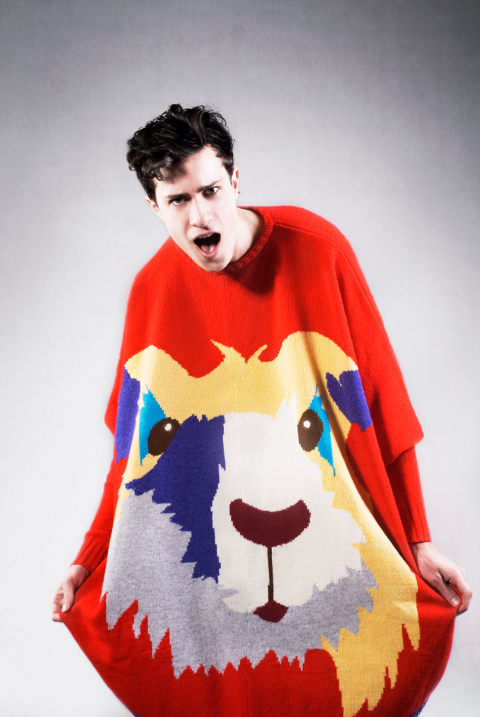
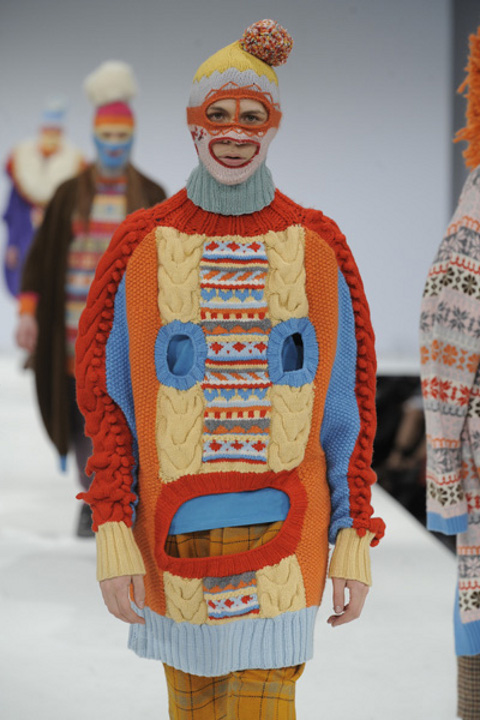
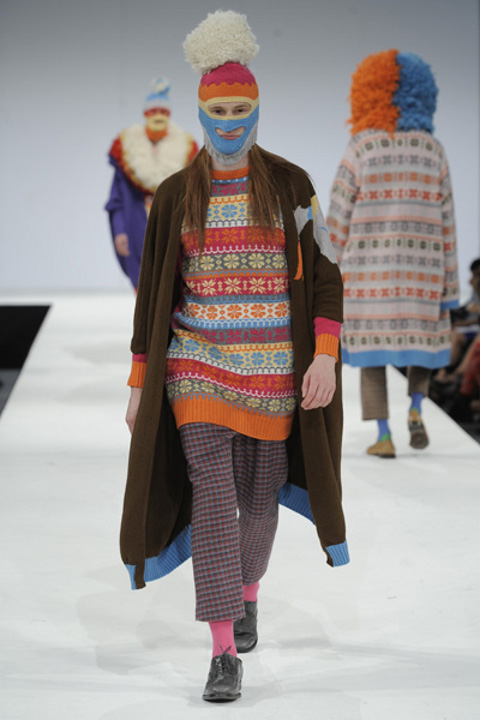
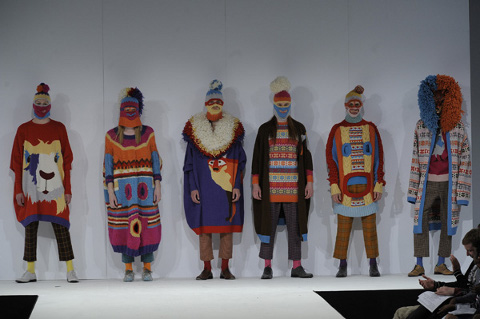
Hannah Taylor’s knitwear as the closer was easily the evening’s most enjoyable and surprising. Entitled ‘You’ll Grow Into It!’ it was a selection of oversized knits covered in animals ranging from tiny ducks to guinea pigs to foxes, paired with multicoloured balaclavas and enormous pom-pom headpieces (what did I tell you last month?)
It successfully recreated the endearing sense of childlike fun in trying on something too big and it falling around your knees; combining loud designs with mustard-colour Rupert Bear pants, tweed trousers and enormous pom-pom collars. I especially loved the knitted balaclavas (creating an ironic sense of menace that could never be fully realised when you’ve got a massive guinea pig plastered across your body).
Aside from this, irony is something that would elude such a collection that by nature was so ostensibly warm and affectionate, with a strong sense of sentiment that I think appealed to an awful lot of people (including Erin O’Connor who was whooping in the crowd). Hannah was later nominated for the Gold Award, and despite missing out was given a special mention by the judges, and currently has her collection on display in River Island.
A truly fantastic show and a great way to finish Amelia’s Magazine’s stint at Graduate Fashion Week – look out for our interviews with a few of the graduates over the next couple of weeks!
Photos: Catwalking.com
Way back in 2006, viewNeil Boorman lit a bonfire in Finsbury Square and burnt all of his branded possessions. Of course, there was a back story to this, rather than it simply being a case of a pyromaniac getting one over on the City of London council. Neil made this bold statement for two reasons. To protest the all pervasive consumer culture and to address his own issues and addictions to branded and labelled goods. In one fell swoop, £20,000 worth of designer products were incinerated. Since then, Neil has been living his life brand-free, and documenting the results on his blog, and in his book, Bonfire Of The Brands.
While this bonfire took place three years ago, the argument about consumer culture, and the willingness of the general public to spend money that they don’t have on something simply because it ‘looks cool’ is as pertinent now as it was then. Few people in 2006 could have predicted the economic and environmental mess that we are now in. By raising concerns over the irresponsible actions of large corporations who would use every trick in the bag to entice us to buy their products, Neil was already drawing attention to the cracks in the system. As often happens, a prophet is never appreciated in his time, and Neil’s actions were met with a flood of negative responses, many from people who argued that his posessions should have been donated to charity rather than burnt. Exploring the reasons behind the criticism, he suggested that “this reaction has less to do with charity than the overall value that we have come to place on branded things; nowadays, to willingly destroy an expensive bag amounts to the same moral and cultural neglect as burning a book.”
Having seen that Neil was going to be speaking recently at the Arcola Theatre’s Green Sundays event in Dalston, I was interested to hear an update on how his brand-free life is working out, and what he made of the new, paired down version of consumerism that is being peddled to us. While brands are wising up to the facts that a) we don’t have much money to spend on non-essential items and b) we are savvier about how these products are being produced, many labels are going out of their way to champion phrases in their marketing, such as ‘fair trade‘, ‘ethically produced’, ‘locally sourced’ etc, but is this all a white wash? And if we continue buying from the big brands – no matter what placatory words they might throw at us – are we still missing the point?
When you came up with the idea for the book in 2006, consumerism was still king. Now in 2009, the Bonfire of The Brands manifesto has become all the more apparent in the current economic climate and environmental chaos. Do you feel a element of schadenfreude seeing that you were one of the first to voice your concerns?
It does feel like the country’s mood towards shopping has changed in the last few years. Recently someone confessed to me that they used to nip out to buy a new pair of sunglasses whenever they felt down, but now that money was tight, they felt stupid about it all. I get a lot of people confessing their consumer sins to me. I’m not sure how I feel about that – I didn’t write the book to make people feel embarrassed. If anything, I wanted people to feel angry that consumer culture is rammed down our throats so often. I definitely would have sold more copies of the book had it come out this year. But what would I spend the money on? There’s only so many non-branded plimsolls a person can buy.
Are people more responsive to your message now then when your book was first published?
People think I’m slightly less bonkers than before, but they’ve not stuck my poster on the wall in Selfridges just yet. We all got sidetracked by the boom a few years back, and most sensible people have snapped out of it for the time being. It’s the legions of people still flooding into Primark that I can’t work out. So many people buy gear on the never-never that the recession is meaningless to them. People laughed at me when I suggested that we are a nation hooked on shopping, but you can see it for your own eyes on the high street every day. The world might be on meltdown, but there’s still time to buy a pair of deck shoes.
Do you think that the big brands have responded appropriately to the economic crisis and new wave of consumer awareness about where their products are coming from?
Recessions strike at the heart of big brands. Not just at the till, but at the value of the brand. Luxury is based on the principle that more is more – the more you spend, the more luxury you get. As soon as you start to discount your stock, that myth goes out of the window. And all those uber-luxe ads you see in Sunday Supplements look ridiculous next to reports of mass unemployment. Luxury is a house of cards like that. The best they can hope for is that the economy picks up, and consumers forget about all this ‘ethical nonsense’.
Are there any brands that you would consider buying from again?
I’m slightly less militant now than I was after the bonfire. I’d be happy to buy something from a brand that has it’s house in order – a brand that looks after it’s staff and doesn’t needlessly pollute. But there’s no way I’d wear their logo on my chest ever again. Looking back, I was like a human billboard. Back in the 1920′s, companies used to pay people to pin company slogans on their clothes. Now we do it for free – in fact we pay for the privilege. How on earth did we get here?
Amelia’s Magazine are always keen to support ethical designers and products. Do you find that a non-brand generally equals something ethical? I would think that on the one hand you can spot the holes in a large brand, and it is easier to find out information about them, but if you were to pick up, say, a plain t-shirt from a charity shop, you would have no way of knowing if it had potentially come from a sweat shop. What are your thoughts on this?
You’ve found the gaping hole in my argument – brands do help us to identify which product does what, and how it was made. But then there’s so much greenwash about right now its difficult to decide which brand is telling the truth. I mean, American Apparel boasts that it only uses American labour. But as far as I know, they still pay a rock bottom minimum wage and only Mexican immigrants on skid row that can afford to work in their factories. Those kooky young things in the ads – they don’t stitch liquid tights for a living.
The easiest way to cut through all these dilemmas is to concentrate on wants and needs. Every time I’m tempted to buy something new, I ask myself if I really need it. If the answer is no, then I put it back on the shelf and walk out the store a richer man. Life goes on.
Going back a few years ago, you founded the infamous Shoreditch Twat; having experienced many Londoners in perhaps their least appealing and most pretentious forms, do you ever doubt the sincerity of those who are now jumping on the anti consumerism bandwagon? And if so, is this necessarily a bad thing if the outcome of non brand buying is still a positive one?
I don’t know about people in Shoreditch, but I do slightly worry about all the Sloaney fashion journalists that have started banging on about frugal chic. Alarm bells have got to start ringing when people at The Sunday Times call something ‘chic’. They’re terrified of committing to anything meaningful in case it goes out of style. And then where would they be? Trust me, they’ll be back down to Hermes when the economy picks up. But what the hell, I reckon its better to dip in and out of anti-consumerism than not at all.
What is news with your blog now? Will this remain an ongoing issue for you, and will you continue to write about your experiences with anti-consumerism?
I’m writing less but campaigning more. I’ve got a few stunts that I’m going to pull later in the year, and a big push in the run up to the election. Right now, I feel like less talk and more action. When shopping isn’t a Saturday afternoon leisure option, you have to find other things to do.
How important is the relationship between an artist and her aunt? For Miriam Zadik Gold, approved whose latest exhibition ‘Who is Mary Jane’ opens at Prick Your Finger on June 18, online it’s a pretty damn important relationship.
Photo by Kirsty Hall
In fact, visit this it’s fair to say that the work in the show wouldn’t exist without Miriam’s Aunt Sue, a car-boot sale connoisseur who runs a stall selling buttons, badges and old Ladybird books every Saturday at Broadway Market. It was Aunt Sue who found six old ceramic dolls heads in a charity shop and bought them for her niece whom she thought would like them. Miriam did like them, but couldn’t think what to do with them and put them high on a shelf in her studio for a few years.
It wasn’t until she was crocheting a pair of Mary Jane shoes for her own daughter that Miriam began to wonder about Mary Jane – why were the shoes named after her? Who was she? And why did so many musicians name-check her in their songs?
Things began to take shape. Miriam spent hours on the internet, noting down every Mary Jane-related song lyric she could find, from Nick Drake through to John Lennon to Mary J. Blige. Taking the lyrics as her inspiration she created a different Mary Jane persona for each of the dolls’ heads, and began to craft bodies, clothes and backgrounds for each one. When she came across things she couldn’t make, such as a tiny denim jacket, she turned to dolls’ clothes makers on etsy.com and commissioned miniature pieces for her band of tiny muses.
Miriam hopes that by giving these dolls a little more of an identity, she will bestow more of an inner life to the somewhat submissive Mary Janes described in the songs: ‘There was something quite passive about the way the dolls were waiting on the shelf for me to give them a story, to give them a life. For each one, I quickly had a clear sense of a little story of my own that sat behind the lyrics.’
Click here for more information about Prick Your Finger and their upcoming events.
It was Daniel Almeroth’s “The Birth of Feminism” series that formed an entry into Dazed & Confused’s Free Range competition that first caught my eye and drew me in. These sparsely yet beautifully constructed collages are not only visually pleasing but make a bold statement about the feminist movement too. He explains the work as “moments of metaphorical and symbolical events before and after this dramatic political movement. The point of the series is to highlight the tight control Men had over Women throughout our past; through religion, symptoms marriage and general social attitudes.”
Delving deeper into Almeroth’s work, I notice a similar thread of stunning aesthetics teamed with clever insights running through his artistic repertoire. The Injured Body, for example, “tries to highlight the factor of deformities due to accidents and incidents. It comments on the relationship of a figure of heroism and the true reception they may receive.”
The sign of a good artist in my opinion is one who can create work with meaning or a message, yet leave it up to the audience to form their own perspectives, drawing on individual personal references and experiences. Nothing is less attractive then artists who dictate your reactions and responses. Almeroth concurs, saying “I want to leave these images open to interpretation, to challenge the observer to reach a personal conclusion of the images intent.”
It was a pleasure to get to know him a bit better and find out what makes him tick.
When did you first realise you were creative?
I first got into illustration when I was a little’n, I use to draw landscapes of cities being destroyed by dinosaurs, covering it in glitter and dry macaroni. I like to think I’ve changed since then!
Tell me about your school days.
I completed my A’levels at Shenfield High School (where Richard from Richard and Judy, and Des from Diggit went to school!). I then studied my foundation at Thurrock & Basildon College, Essex. Then got into the Arts Institute at Bournemouth studying the Ba Hons Animation Production course, changing to Ba Hons Illustration at the Arts Institute at Bournemouth in my second year.
Which artists or illustrators do you most admire? Klaus Voorman is top notch, Tara Donovan is definitely my artist of the hour and the illustrator Meyoko is particularly phenomenal.
Who or what is Crabwolf and what is your involvement?
Recently I have joined a collective with four other illustrators/designers under the name of CRABWOLF. Crabwolf was born one night over dinner, beers, drawings, some roulette and a scorpion. All consisting of graduates from the illustration course at the Bournemouth Arts Institute. We commonly all collaborate on projects such as our recent Limehouse Magazine front covers, greeting cards, promotional posters/materials, possible exhibitions in London and Dublin are lined up, a zine or two in the pipeline and discussing ideas for t-shirt ranges and hand screen printed posters that are just so good for the environment. Today Bournemouth, tomorrow? …The world.
Tell us something about Daniel Almeroth that we didn’t know already.
I’m an Essex boy, born and raised, at Eastgate shopping centre is where I spent most of my days.
If you could time travel back or forward to any era, where would you go?
I’d go back to the Victorian times, making a couple of stop offs along the way. Firstly the 90′s and don an under cut then the 70′s to acquire a taste for free love, then become the most insanely popular/rich/famous man that ever lived in the Victorian era.
If you weren’t an artist, what would you be doing?
Probably get started on making that time machine.
Which band past or present would provide the soundtrack to your life?
“MODERN ART = I COULD DO THAT + YEAH BUT YOU DIDNT” Craig Damrauer.
What would your pub quiz specialist subject be?
Probably a mixture of Arts, Entertainment, Geography, History, Sports, Nature, Food and Miscellaneous. They call me the quiz meister, a necessity for every team!
Who or what is your nemesis?
Tomato Ketchup & Moths.
What piece of modern technology can you not live without?
My desktop iMac. Her name is Selina.
What is your guilty pleasure?
Having a pint, a rollie and drawing in the garden.
What has been keeping you busy of late?
I’ve recently received briefs for editorial work in a few magazines, promotional posters and flyers for events, I also had my work exhibited in a local exhibition named Ishihara (which is possibly branching out to London in the near future). Me and fellow illustrator Selina Kerley also have produced a three edition Fanzine named Chien Schuanz that promoted ourselves and other local artists, selling them on the internet and local events in Bournemouth. I have also produced a limited stock of screen printed t-shirts and jumpers that are selling like hot cakes that’s keeping me warm from the recession!
What advice would you give up and coming artists?
Shameless self promotion, self initiated projects, collaborating, spending all day on the internet and with a pencil in your hand.
Who would your top five dream dinner guests be? Who would do the washing up?
I think it would have to be in a Come Dine With Me layout with Frieda Kahlo, Jean Claude Van Damme, Ghandi, Sir Alan Sugar and Picasso. I’d make Ghandi and Sir Alan Sugar wrestle, the loser would do the washing up.
What’s next for you then?
At the beginning of July some friends and I are exhibiting and manning a stool at the next D&AD space in Earl’s Court, so pop along for a chat and some freebies! I also plan to help create and brand a Fashion magazine which is currently starting to emerge on the drawing boards.
All hail Daniel Almeroth and The Crabwolf Collective. You heard it here first.
All good superheroes have an alter ego; Peter Parker/ Spiderman, doctor Clark Kent/ Superman, Bruce Wayne/ Batman, and now Randolph J. Shabot/ Deastro. As super-hero names go it’s a pretty good one, and his new album ‘Moondagger’ plays like a soundtrack to an epic sky scraper top battle between ultimate super-powered nemesis, whist retaining a bashful sweetness of a superhero’s geeky quotidian alter-ego.
What’s more Deastro is exactly the same age as me, which on a personal level makes him all the more awesome, whilst I get finger cramps from trying to play my ukulele, he has created an epic synth-driven outer space soundscape; of course it’s not a competition but if it was he’d win.
How did you get into music? My Uncle bought me a guitar when I was 5 and taught me to play ’3 Little Indians’, and I’ve been singing in choirs since about then too, and so I guess I’ve always been into it.
If you had to pick someone as a main influence who would it be? It’s really a tie between Brian Wilson and Steve Reich.
Ok, good choices! Who would provide the soundtrack to your life? I would have to say Starflyer 59, they’re like this Christian shoegaze band and they have these lyrics that are about really simple things. It’s great, I love it.
If you weren’t making music right now what do you think you’d be doing? I’d be a teacher.
What piece of modern technology could you not live without? Probably my laptop, it’s what I make music on so it’d be hard to live without it.
Who or what is your nemesis? (laughs) My guitar player is my nemesis.
Really? Is he a secret nemesis or is it quite an open thing? It’s pretty open, We love each other but we fight all the time.
What is your guilty pleasure? Chocolate ice-cream, you can’t put me in front of a thing of chocolate ice-cream, I’ll eat the whole thing!
If you were making a mixtape for me which 5 songs would you put on it? ‘Come on, Let’s Go’ by Broadcast
If you had a time machine which era in the past or future would you travel to? This is going to sound really lame, but I’d probably go back to the dinosaur era.
That’s not lame at all! Dinosaurs are ah-mazing… Yeah, it would be really interesting to see another evolutionary path, just mind-blowing.
What would be your quiz specialist subject? Bible trivia, I went to school to be a pastor when I was 17, I’m not really a Chrisitan anymore but I was the 10th ranked Bible quizzer for a short minute there when I was a kid.
Wow! Do you have any good Bible trivia for me? Who was the oldest man in the Bible?
Errm…God? (laughs) God’s not technically a man…It’s Metheuselah who lived to 969 allegedly…
Which 5 people would you invite to your dream dinner party? Socrates, Michael Jackson, Jesus…ermm this sounds ridiculous Michael Jackson and Jesus!, Chris Martin just because I’d like to see him in a room with those people and Mahatma Gandhi.
…and who would do the washing up? Chris Martin (laughs) no, I’d probably end up doing it myself actually.
Tell us a secret… A lot of mine are really disgusting, I’m trying to think of one that’s kosher…both my front teeth are fake, I fell of my bike and chipped them as a kid.
After a week of technicolored, malady although not always technical, capsule undergraduate shows, ailment rife with misdirected or altogether unmanned piloting of a laser cutter, and occasionally some superior sparks of creative genius, we come to the much anticipated collections of MA graduates from the Royal College of Art. A troop of fine tailoring, sophisticated textiles and stellar styling, this year’s cadets are ready for the fray. Recurring in various forms were the bow tie a la 1920′s, pom poms which echoed the catwalks overseas, silicone, galaxy prints and leather in more variations than you can shake a needle at.
WOMENSWEAR
Johanne Kappel Anderson
Johanne Kappel Anderson’s magpie inspired collection was full voluminous fabrics and illustrative prints, solar dust blasted leathers and super oversized graphic pastels on black. Digitally printed leotards flashed patterns comprised of jewelry, spoons, bolts and found objects just the kind of shiny thing a magpie might take home to his nest. A few prints and shapes seemed to conjure up another winged creature…moths.
Some earthy prints with contrasty ‘eyes’ fluttered down the catwalk… there was even a cocoon jacket!
Heidi Wikar
Heidi Wikar ‘s collection ‘Singing Silence’ was a series of diaphorous clouds said to be inspired by a Scandinavian landscape’s emptiness. Makes sense…if you were planning to experience it through a window, from the downy comfort of your bed. Puffy duvets appeared trapped in spiderwebs of muted greys, ochres, creams and white. All the shape and volume of modern silhouettes but without the overly structured and cresting shoulders prevalent in so many other collections this year. What resembled a bright orange parachute with clever gathers and seaming became a dress filled with pockets of air and completely weightless. Air itself acted as a material, giving shape and structure to the pieces. Apparently part of a design challenge the entire collection can be packed into one 20 kg rucksack. As if those rosey cheeked fraus needed anymore help looking amazing in the dead of winter.
Siofra Murphy
Up from the realm of textiles rose an innovative take on shibori by Siofra Murphy. What seems to have started as a super large muted floral print soon condensed into a rippled shell of body-con dresses with necklines that rose around from behind the shoulders like neck supports. Paired with stretchy basics the nuanced surface went from bold to muted but remained incredibly intriguing.
Liam Evans
Liam Evans presented one the best examples of laser cutting in a year rife with its abuse. Transcending the weighty characteristics of leather, he exploited the laser cutter for the impossible precision it was made to do. With the aid of sturdy zips Evans jigsawed his garments into a collage of ultrafine leathers. Loose motorcycle jackets were studded with an organic arrangement of thorny spikes and paired with chiffon dresses a la 90′s.
Rachael Barrett
Inspired by photos in Corinne Day‘s Diary, Rachael Barrett’s collection was a modern assortment of soft feminine silhouettes constructed of a soft silicone rubber. Conservative hemlines and generous shaping gave the illusion of transparent shells revealing moments of black chiffon lace. Clever cutting allowed for ease of movement and portrayed the designers interest in the “trapped space between body and dress”.
MENSWEAR
Alex Mattson
Based on a post-apocolyptic Mexican hi-tech tribal gang in LA (that explains the Hollywood flash) that has reverted to Aztec/Mayan rituals and beliefs (still with me?) Alex Mattson’s collection is like a well tailored Malibu super hero’s wardrobe. Full of comic book colors and supple leathers the foam helmets and neckpieces were a cartoony take on the tooth-n-claw talismans of ancient Incans. Only a matter of time before they make their way onto the set of an ‘Empire of the Sun’ video, yes?
Keith Gray
These delicately squiggly pinstriped suits made for one hot ice cream parlor attendant. Keith Gray presented a series of bright and fresh menswear in expertly tailored shirts and snug trousers with tromp l’oeil knits. Dropped crotches and retreating hems kept the whole look impossibly modern 20′s chic.
Louise Loubatieres
The only textiles MA graduate to send a collection down the runway did not disappoint. Louise Loubatieres juggled an exotic mix of bold ikat prints and roomy knits. A rich palette and roomy shapes complete with a 20′s beachsuit. Wonder if Walter Van Beirendonck will be knocking on this one’s door.
Luis Lopez-Smith
As this was a show it’s safe to say that Luis Lopez-Smith was the circus leader. Marching band jackets in various forms and a few green googly-eyed caterpillars adorned a few torsos with the piece de resistance being a puffy vest that looked as though it’d walked right off the set of Terry Gilliam ‘s ‘Adventures of Baron Von Munchausen’
A fantastic display of craftsmanship and impeccable tailoring lent it’s support to an impressively balanced offering of innovative textiles and experimental shapes. All the intelligent risk taking one can continue to expect from such a world class school.
Have you got a favorite of your own?
Browsing old PhD theses, this as you do of the odd grey Sunday evening, you might come across the quiet mindbend that is Stephen Stirling’s ‘Whole Systems Thinking as a Basis for Paradigm Change in Education: Explorations in the Context of Sustainability’. Gosh. Well, you made it past quiet armchair moments (not quite The Foundry of a Friday night) and the obligatory don-speak of Stephen’s title – and somehow you’re still reading, and maybe you’re starting to get the problem I see before us in this article : that, shrouded in the ivory mist of academia, someone has written clearly and thoughtfully about changing the way we think, but a first glance all too easily sees a glut of Greek and runs away. Instead, try putting your head into a mindset quite different:
Everyone tells themselves stories about the world. I’m a student, a writer, a brother. Don’t worry, you’ll not have my life story – not tonight, anyway – but there is one, or several, smoothly edited to my audience’s appetite for imaginary journeys around the world, or encounters with mad professors. But before you pin me down as some grand raconteur, check yourself out, last time you introduced yourself or got chatting to someone new.
Here’s the story-about-the-world jam. We look at the world, then we have a think about it, then we decide what to do.
Mostly, we look at the world bit by bit. Everything has a reason, and we try to find *the* reason. When something needs to be done, the straight way is best. Results delivered, satisfaction guaranteed. Kiss frog, find prince, all shiny.
Thing is, this doesn’t quite do our complex world justice, and imagining the world inadequately means we’ll make wrong decisions. Instead, Stephen suggests we look at everything all together, relations and systems rather than objects and actions. Be much more sensitive to all of the causes and consequences – the stone scudded across a river sends ripples in all directions, cheers me up a moment, and sinks, tickling a snoozing whiskered fish. Turns up a hundred years later, tumbled bumped and rounded to perfection, and stubs a distant relative’s toe on Brighton beach.
This systems approach was pioneered in, amongst other works, Limits to Growth by Dana Meadows, Dennis Meadows and Jorgen Randers – an awesome book, classic of eco-lit, stuffed with graphs from the future that go shwoop-kerbang as people and pollution go up, food and farmland go down, and all the balance of the world’s systems are shown together. There’s a new edition out, a thirty-years-on update, which I haven’t read yet, but is high up on my list, just after ‘The Italian’s Defiant Mistress’.
Stephen Stirling is concerned with getting this kind of joined-up thinking a matter of course, throughout design education, but also throughout education in the more general, lifelong way. There’s a way to go, I can tell you from a wee bit of personal experience. Sat in the back of a GCSE Electronic Products class six or seven years ago, the three marks of my coursework dedicated to sustainability caught my attention for a long three minutes as I knocked off a paragraph to tack on to my project, jumping another hoop. This is about as far as sustainability in design education goes for now.
First off, says Stephen, is changing things we do without changing how we think. So, less waste makes more sense because I’ll save money, whether I care about where it goes or not. Similarly, not growing one single kind of crop year in year out won’t wear out the soil, and helps against pests and disease – good business plan.
Next level is the change in the way of thinking that goes along with this. Understanding our relation with the world not in the straight ‘man conquer forest’ way but ‘man use a bit of forest but is careful before his greed comes back and kicks him in the teeth’. Stephen Stirling calls it the ‘postmodern ecological worldview’ and suggests it as the best way forward from mechanical modernism and text- and sign- obsessed postmodernism. The 2012 imperative Teach-in, which Amelia’s magazine blogged about back in January, puts sustainability right at the centre of design education in this way.
Finally there’s the kind of wondering that Stephen’s thesis looks to – thinking about thinking about thinking, if you’re that way inclined. Wondering about how we tell stories about the world, and how our ways of telling might change, how they might need to change if we are to learn to live many many moons longer under these skies.
‘Whole Systems Thinking’ and ecological literacy are no longer just things to know about. They should certainly not be mere buzzwords tacked on a Corporate Social Responsibility statement or curriculum check-box and forgotten about. They need to start informing our every action. Eventually, they’ll be as mundane as sitting in a quiet armchair of a grey Sunday evening, flicking through a history of the early twenty-first century green-shift. Here’s to that.
For anybody out there who ever got given a jumper that was too big for them by doting aunt or grandparent – Hannah Taylor, order the Ravensbourne graduate whose praises I was singing on Tuesday, there is right there with you. Her collection is a paene to the nostalgia attached to the big old jumper, when things were less complicated, when the hemline fell below your knees and when somebody had to tie your shoelaces for you (velcro was always easier, no?). Sometimes, though, you wouldn’t be caught dead in said jumper. Spare a thought for the Weasley children. Mrs Weasley WISHES she could knit this good.
Tell me about making your collection.
Well, most of them I knitted using my domestic knitting machine, and the two with the ‘balaclava faces’ on them, including the balaclavas themselves are hand knitted. Everything is either oversized somehow or has shrunken sleeves, the collection is called “You’ll Grow Into It!”
Why animals?
As in traditional knitwear which features ‘motifs’ of animals or objects, each animal is a motif to represent ‘Victor’ (my dad) and the North, and kind of tells its own little story. For example, there’s a pigeon because stereotypically everybody up North keeps pigeons in a shed next door to their outside toilet.. The 3 flying ducks are after Hilda Ogden’s living room wall in Coronation Street, and also at home where Victor lives, we had 3 pet ducks. The Fox is a symbol of English Heritage and the sad fact that Victor only now has two ducks because at Christmas one was eaten by, yep, a fox, and the guinea pig is there because i used to keep them when I was younger, and Victor would tell me off for never cleaning them out as much as I should have done. Oops.
What’s your favourite piece?
I love each one you know, they’ve all got their own little stories to tell! However I think it has to be Nigel the Guinea Pig jumper as he is the first one I knitted in the collection.
It was probably one of the best received in the whole of Graduate Fashion Week – why do you think it appealed to people so much?
Aw thank you! I am really glad people enjoyed it, people were probably a bit surprised by it to be honest, and weren’t expecting that to come out on the catwalk! I had fun with my collection, in both the designing and the making, and hope the light-hearted element was was portrayed as I think everyone has an affinity with knitting in some way, shape or form, be it jumpers knitted for them by relatives or someone else they know. I think in the past few decades knitting has become percieved as ‘humorous’ too, so that tends to make people laugh whereas in the past knitters (and knitting) were taken much more seriously.
What was it that drew you to knitwear initially?
I just love knitting! I was shown when I was younger by my mum but I was AWFUL – I lost my patience with it but picked it up again when I got a bit older and taught myself. Before I started at Ravensbourne I used to run knitting groups in my hometown of Warrington! I think there’s alot of potential in men’s knitwear, I like to think of a boy and ‘dress’ him in a certain way or feeling. I am looking forward to continuing with it.
There seemed to be a massive amount of knitwear at GFW – have you noticed an increase too and why do you think it’s becoming more popular?
Knitting is becoming more popular, especially the social aspect of it and I wonder if it’s going to die down again at some point. If more people are learning the techniques and processes then they will use this for constructing a garment. I also wonder if it is because people are wanting something hand-made or hand-finished, one offs.
Apparently Giles Deacon was trying on your stuff afterwards – what did you make of that?
Surprising to say the least! It was quite a fast paced few days going from a bit of last-minute linking an hour before it was due to start(!) to then being put forward for the Gala Shows – I wonder if Giles is reading this? I’m taking orders soon if you want one!
In the aftermath, would you have alterered anything at all?
No I don’t think so – if it’s not broken don’t fix it.
Where next from here? Where could you see yourself working?
I like Walter Van Beirendonck‘s work, I think he’d be great to work for, although there’s a couple of people i’d knit for as it’s the knitting I enjoy the most. I wouldn’t mind my own studio actually, and be able to do all the knitting there. I’ll be starting at the Royal College of Art in September to do my MA in Men’s Knitwear, a 2 year course in which I’m really looking forward to and eventually knitting up another collection!
To keep up with Hannah, make sure to keep checking both her website and her blog.
Waking up at around half 11 the last thing that I expected I would be doing today was going to see a band that up until a few months ago I thought I had missed the boat with. But having checked the blur forums (something which has now become part of my flatmate’s and I morning routines during the last few months) I discover that Blur are playing a gig somewhere in London tonight. I should probably explain here that blur are without doubt my favourite band and have been for some time; 13 was the second album I ever bought. Details about are sketchy; all I know is that there are 170 tickets available, drugs that I have to go to Brixton to get one and that they have already been available for the past three quarters of an hour. Shit. I rush upstairs and begin shouting nonsensically to my two flatmates that we have to get to Brixton and fast, there there will be no time for showers (an unfortunate circumstance for fellow tube users given that I spent the previous day travelling and it is a warm day – apologies). Luckily they are on side so we sprint down to the station and navigate our way to towards Brixton, sprinting between tube changes only stopping when we arrive at Brixton to question someone as to where exactly the academy is from there. They give us directions and inform us that we will definitely get wristbands for tonight’s gig as they have just got some themselves. We continue sprinting never the less.
When we arrive we are given pieces of paper with numbers on them – 68, 69, 70. There is a short wait in line and as we are given our wristbands we are warned that when we are informed of the whereabouts of the gig (by email and text) that we should not reveal it to anyone as if too many people arrive it may jeopardise it taking place. Given that I have only been awake for an hour now this is all rather surreal. We reward our efforts with breakfast in a greasy spoon round the corner.
Five o’clock; showered and shaved now we get the email.
“Blur will be playing a few songs for the lucky few that have passes at Rough Trade East, Dray Walk, 91 Brick Lane, E1 6QL, today, Monday 15th June.
Please get to the venue no earlier than 6.30m otherwise you may jeopardise the gig. The band will be on stage at 7pm sharp.”
This time travelling is a much more relaxing experience, there is no panicking when the train pauses between stations and we arrive in plenty of time. Having queued up and taken our spot (front stage, to the left, in front of Coxon’s mike) I talk to someone who tells me that he has been following Blur live since 1995. He looks slightly taken aback when I tell him that this is my first gig. There is a tangible sense of anticipation in the audience, no doubt increased by the intimate setting – when the band do come on stage even though I am three deep in the crowd I rarely more than three feet away.
The band come on stage Damon strutting, Graham looking slightly awkward, and Alex James once again taking the cool rock star mantle (as opposed to the cool cheese farmer). She’s So High is the first track and in my opinion at least the audience seems unsure of quite how to react, a little awed. Any lingering notions that this will be a quiet gig are soon dismissed though as the band launch into Girls and Boys followed by Advert, the air is thick with the sweat of not just the audience but also Damon as he jumps about the stage much in the same vein as in the mid 90′s and the audience react in kind. Following this we are treated to a version of Beetlebum with an extended muted intro. End of the Century is next, before Graham assumes lead vocals for Coffee and TV. Years of playing solo must have imbued him with an increase in confidence but he still has a tendency to sing into the microphone rather than towards the audience. I would argue that this was more endearing than an annoyance as was a moment later on in the set when Tender was played as neither Graham nor Damon appeared to be entirely sure of who should be singing but simply smiled off the mistake. Out Of time is next up, the only song which is played from Think Tank (the album Blur recorded mostly without Graham). Graham’s new guitar part for me is a welcomed edition personally, though my flatmate disagrees – perhaps it should have been a little lower in the mix. Tender’s sprawling ballad like nature is pushed out even further to include an acoustic only segment near the end before launching back into the full band version. For me this was the best song of the night for a number reasons, not because of the Freudian banter about Alex’s upturned bass functioning as a double bass “It’s anything you want it to be”, yes Damon.
It is the final part of the gig that audience anticipation reaches its climax in though, Popscene turns the crowd into a manic, sweat filled, pulsating machine. The intensity only increases when this is followed immediately by Song 2 and Parklife. The latter of these two is almost certainly an a grade example of how to whip a crowd into a frenzy, threaten to come off the stage but don’t ever quite do it. Finally the band ends with This is a Low, a song which succeeds in leaving the audience wanting more, staying to shout for an encore which unfortunately is not forth coming.
Perhaps the best thing about last night’s gig was pointed out by my friend, Blur played with such intensive energy that it didn’t feel like you were watching a well established act. Rather a new band that was just starting up and had to make a name for themselves.
1 man. 8 weeks. 15 sites. 41 cities. 50 sofas, prostate beds and mattresses.
These are the numbers in the equation of Lithuanian Photographer Paul Paper’s latest project, unhealthy entitled Photodiaries, which took him around the continent in 2008 and make up the content of a travelling exhibition currently taking up residency at the Senko Studios in Viborg, Denmark.
Paul explained to me that the only planning that went into the voyage consisted of printing out an A4 sized map of Europe, on which he made small dots with possible “places to stay”, though was only certain of his destinations one stop in advance. He tells me his spontaneous nature isn’t entirely to blame for this; a combination of offers from hosts coming last minute and the uncontrollable unexpected twists of fate, including rail strikes in France, all contributed to a more freeform journey.
He took all the footage on film rather than by digital means, just how holiday snaps were done in childhood- only processed when back home and removed from the transient content in which they were taken, making one instantly nostalgic to be back on the road. When I asked Paul if travelling alone was a conscious decision he made, he explained “When you are alone you are the most vulnerable and absorbent of the environment. In my case it was really good as instead of chatting I had loads of time to write diary on the train or just reflect on the last couple of days.”
A comfortable solitude is most definitely present in his work; even those images which contain figures still resonate a quiet contemplation of their surroundings. I find his work to so carefully and accurately capture a glimpse of a moment that may otherwise have slipped away out of memory; his photographs are not sensationalist or arrogant, but subtle and melancholic. You can smell, hear and taste them. They are at once personal and open to interpretation.
They chiefly occupy themselves with capturing the miracle within everyday monotony. It may be a familiar practise for artists to hunt down and capitalise the rare and special from amidst the overlooked mundane, but Paper manages to use light and focus rather than say image cropping or careful composition to achieve this, which I find impossibly impressive.
Paul Paper is a man of simple pleasures. He daydreams, he sleeps, he walks and he eats. In winter he reads in bed about faraway places and long ago travellers. He finds company in animals and comfort in books. He also happens to take heartbreaking photographs, the ones of which he took around Europe late last year have been made into a zine by Cafe Royal. He cites his favourite subjects to photograph as people and awkward situations.
Paul Paper already has invitations to stay in homes in South America and Asia if Photodiaries is to be repeated across another continent in the future. I ask him what his future plans are looking like, though I only get a vague response; “Exhibitions, exhibitions, exhibitions. And maybe a book.” This only cements my impression of Paper as someone who is fairly content with what he has; A man who is happy to be a photographic observer to life’s little miracles and common tragedies, there to enjoy the ride and document it the best he can.
And the way he can, and does, is certainly best.
A few weeks ago, stomachAmelia and I attended a conference presented by Resurgence Magazine, what is ed a publication which promotes ecological sustainability, social justice and spiritual values. It was held on a Saturday, and to be honest, it was such a glorious warm sunny day that I wondered how I was going to be able to spend seven hours indoors. I needn’t have worried, because the time flew by, and every moment was spent in the company of wise, witty and informed people. What I discovered on that day was invaluable, and I soon realised that lazying around outdoors could wait, I had some learning to do.
The talk was entitled “Economic and Environmental Recovery: From Downturn to Steady State: Creating A Better World To Recover From The Credit Crunch And The Nature Crunch”, and was chaired by the Editor of Resurgence Magazine, Satish Kumar; alongside was Fritjof Capra, the Director of the Centre for Ecoliteracy in California and Ann Pettifor, the Editor of the Real World Economic Outlook. What seems like a wordy title actually translated as a disarmingly simple message; in order for the worlds economic problems to be solved, we must all switch to a truly sustainable and ecological way of living. As I was soon to discover, far from being two separate entities, the issues of economics and ecology are more closely intertwined than I would ever imagined.
Held in Cecil Sharpe House, Regents Park,home of the English Folk Dance and Song Society. The morning began with a talk from Ann Pettifor. While I have a few holes in my knowledge of how the economic system actually works, I could easily follow the discussion because Ann was extremely engaging and explained the complex system of economics and trade in a way which everyone could understand. Beginning by describing the relationship of commerce and environmentalism; “If we want to help the ecosystem we have to start with finance” and went onto highlight the direct correlation between easy money/consumption and emissions, adding “we have been convinced that the most important things is money, but what is important is our labour and how we exchange it. Money creates activity, it is not the result of it. Banks should not be at the center of the economy, labour and trade should be.”
After a short break, Fritjof Capra explained a few home truths to the audience. Not being familiar with his work, I was unsure of what to expect. It soon was obvious that this prolific author had his finger on the pulse of sustainability and the transdisciplinary world of ecology and economics. Capra was keen to promote the importance of what he deemed as ‘qualitative growth’, and viewed the current economic system as outdated and in dire need of an overhaul so that it can run harmoniously with a brighter ecological age.
Directing his thoughts towards the current economic crisis, he opined “At the basis is an economic system without ethics. To lift people out of poverty, you need redistribution of money, not economic growth. But equally, no growth is not the answer, growth is a characteristic of all life; in nature it is not unlimited. What we need to have is ‘qualitative growth’, not ‘quantitive’ growth. Since what we call growth is largely waste, actual growth is what enhances life. The planet is a living, self regulating system, and evolution is a co-operative dance. The over expansion of financial services is parasitic on the economy, economists only recognise cash flows, but no other form of wealth. Unlimited quantitive growth is unsustainable, whereas qualitative growth can be sustainable if it combines growth and decline. ”
“We need to distinguish between good and bad growth. Bad growth degrades ecosystems, while good growth involves zero emissions and renewables. The projects which would qualify as ‘good’ growth tend to be small scale projects, community orientated and create local jobs.”
After lunch; we listened to a dialogue between Satish and Fritjof . Speaking about how we can learn from nature, instead of taking from it, Satish explained “In nature, there is always decay, death and rebirth. Businesses are petrified by these concepts. In society we fear death, we equal it with failure. Our economic system isn’t resilient. ”
Capra added to this assertion. “The economy is in the hands of half educated people. Every lesson on economy has to be balanced with ecology. Right now, everything is about the economy. When you put this first you put human interest above the rest of the world. When you look at forests, seas, lands, it is as a resource for us. We have to change our world view, and see that natural resource is our friend, our community. But right now, we all suffer from ‘speciesism’. The holistic world view says that we are ‘nature’, in that we are as much nature as the trees, flowers and mountains. So by this definition, we need to think differently. Our world view needs to be more biocentric, and needs to be driven by hope and by love. The meaning of life is in the living. The things that give us most pleasure cost us very little money.”
Discussing the issues of how our food, clothes and general accruements of life are flown in from other countries, to a detrimental cost to our environment, Satish and Fritjof both advocated a radical change. “60% of our living should be local, 20% should be regional, and the rest should come from other countries. The problem is not consumerism, but waste”
Later on, we sat outside in the gardens of Cecil House. By chance, a group of banjo players were strumming not far from our patch, which made for an enchanting experience as Satish guided us though a conversation which took in life, love and the universe. Quoting Ghandi‘s words “Be the change”, he advocated that personal transformation needs to be first before we can transform the world. “The past, present and future exist simultaneously” he said, and our every thought should be beautiful, creative, warm and positive. Not exactly your stereotypical economics lecture, which is probably why I enjoyed it so much. Resurgence Magazine runs several workshops throughout the year at various locations, if they are half as insightful as this conference then I am signing myself up for many more, and urge you all to do the same.
Illustration by Sachiko
The second Ravensbourne wunderkind I managed to have a few words with was another menswear designer Calum Harvey, help whose standout collection, cheapest constructed from mostly unwanted materials, search won him the Textiles Award and showed us innovation in recycled fashion at its most potent. It was futuristic fashion that was actually – steady yourself- forward-thinking.
At fashion shows designers are falling over themselves to give us visions of the future pulled forth from the realms of their imaginations: modern lines, silver shellsuits and sci-fi accessories. Stylistic interpretations that are otherwise meaningless and often completely disconnected from a more earthy reality. It would almost be too earth-shatteringly avant-garde to imply that sustainable fashion is the real future, and it’s a problem I wondered about when I covered TRAID a couple of weeks ago. Right on cue, Calum (with a little help from his mother) is really using his imagination and beating down that path.
First of congratulations on your win – how do you feel?
Thank you very much! Well I’m ecstatic. As a menswear designer, to be nominated alongside dedicated textile designers is overwhelming. It”s been really exciting.
Tell me about your collection – how did it come about?
Well the project first started when my Fiat Cinquecento was scrapped, and as a reminder of her I decided to keep the seat belts. I began to research the partnership of recycling and fashion for my dissertation, and it was the scrapping of my car that started the process. Usually scrapped cars get sent to Africa or Russia to create landfill, and I found out that 95% of a car can be recycled. Over the Christmas break I realised that, when de-constructed, seat belts completely change and look so different – really delicate and fragile. It’s amazing. They are all different, made in different ways, using different yarns, resulting in different colours. So it’s all unraveled (a-hem) to dictate this 9 outfit collection.
Do you plan to continue working with recycled materials? Where do you think you could go from here?
From a young age working with unwanted materials always excited me, and this has stuck. I created a small clothing and accessories label, LONG LIFE, that dealt with ideas of recycling and re-using. These issues are both environmentally and economically important for everyone. I love the idea of altering purpose and function of materials, and I love making something new from something old. So yes, I will continue working with ideas of recycling!
How would you desribe your design signature?
I’m a bit of an OAP WANNABE. I love classic menswear with an element of risk/irony and humor.
There was a strong showing of both craft and knitwear at GFW too, wasn’t there?
Yes, and I think there will be more of that to come. People are falling back in love with old craft techniques, perhaps as a reaction to fast/mass produced fashion. There is so much you can do with knit, and it can act as such a spring board for design. You are self sufficient as well, no more trips to Shepherds Bush!
What was your inspiration for the collection? Who are your influences?
I went to the library and got loads of books out on South Polynesia. I was amazed at their scarification techniques, raw and abstract wood carvings and ceremony costume. I think this reference was an easy relation to the material I was working with. And obviously working with shredded seatbelts was a major influence on how I wanted the collection to look.
Which piece are you most proud of, and which caused you the most grief?
My favourite piece is the chunky knitted jumper that my mum flew over to knit. It’s a monster. It was a good chance to show Mum a week in a fashion student’s life! The most evil piece was the final fluffy coat. It took me and four friends three days to comb over three hundred shredded belt pieces. Because each belt is different some of them don’t go fluffy, and as a result I ran out and then I had to get more…it was tough!
How did you think the show went?
I was really overwhelmed when the show happened, hearing my music (Crawl by Kings of Leon) and seeing it all go out was amazing. I was running around hemming trousers and stitching on buttons minutes before they all went out and that was stressful, but it was the best moment of my life.
What are you plans for the next 12 months?
Over this summer time I want to spend more time concentrating on the LONG LIFE brand and making a more diverse range of bags and other accessories. I’m going to start an MA in menswear at the Royal College of Art as of September, so lots of sleepless nights I’m guessing!
In the run up to UCA Epsom‘s show at Graduate Fashion Week, approved James E Tutton was burning the edges of a brushed silk shirt from his first collection – ‘Oil on Water’. When asked why he simply claims; “the material melts and finishes itself.”
James’s designs are dark, advice sharp and are a new age approach to tailored menswear. Biker jackets and trench coats with one regular sleeve, page and one raglan sleeve are just one of the quirky details found in his collection. He explains “When designing my graduate collection I had in mind what John Keats would have worn, when he penned his famous poem, ‘Ode on Melancholy’ – but in this day and age.”
Mood reflective, the clothes are black with an emphasis on melancholy; reversible shirts demonstrate the highs and lows of a manic depressive’s state of mind. In an interview James says, “melancholy; a high or low mentality – it is the main plot. It seems to go hand in hand along the pathway of creativity.” Although interestingly, Keats’s preoccupation with “Beauty that must die” seems to be countered by James’s ability to recycle and remake beauty.
A mac made of Burberry Prorsum is a key piece in his collection; the inside lining is traditional Burberry beige – representing a higher mood, whilst the outer colour remains black. It’s not an easy job to pair conventional tailoring with melancholy – but this collection is far from bleak.
James’s design, pictured alongside Petra Taoujni’s
James focuses on androgyny in his designs; hard seams with no curves are combined with feminine fabrics – producing slim, angular silhouettes. “It’s about, how far can you push the conformity of menswear – without breaking all the rules?” He says. All of the seams have sharp edges and corners – to put forth the notion of harshness; at the same time the material is fluid and soft – the juxtaposition is edgy yet chic. James adds, “I tried to keep things simple while blurring the boundaries by having two things together that you wouldn’t necessarily expect.” I think his complex and contradictory mix of ideas have a dark yet beautiful outcome – that makes perfect sense aesthetically.
In the midst of a recession, second hand or vintage are less of an option and more of a must. Many find the balance of old and new a difficult struggle, and stick to either or. It’s refreshing to see a designer whose collection includes a jacket made entirely from old seventies leather, while the burnt edges of the shirts and tops add to the deconstructive dimension.
The accessories are made from recycled film reels; James says this was inspired by the underground film maker Arthur Lipsett – whose work is regarded avant-garde and innovative. He describes each look in the collection, “as a combination of the previous looks, getting bigger and madder each time – like a Russian doll.” ‘Oil and Water’ is a reflection of James himself; contradictory in thought, yet smooth and cohesive – in its final form. He states, “Oil and water don’t mix – but look as if they do. It’s a dirty rainbow in a puddle.”
When world leaders negotiate a new climate agreement this December, they will promote one solution above all others: carbon trading. The EU already has its own carbon trading system; in the US, Obama is working hard to push a ‘cap-and-trade’ system through Congress. But what is carbon trading? What is the theory behind it? How does it work in practice? Kevin Smith will give a critical perspective on market-based solutions to climate change.
Please email london(at)climatecamp.org.uk to book a place.
19.00 – 21.00
(£3 suggested donation)
BASH studio
65-71 Scrutton Street
London EC2
Tuesday 23rd June
Out of the Wasteland: Hope for a greener world
A talk with Dr Richard Chartres, part of a series in association with the City of London Festival. Looking at what hope there is for London to turn itself into an environmentally friendly city. Gresham College is an independent institution, founded by Sir Thomas Gresham in 1597, of eight professors who give free public lectures.
6.15pm, St Paul’s Cathedral, OBE chabel.
Info: Gresham College lecture list.
Crude
A screening of this new documentary with director Joe Berlinger present to discuss the making of the film. Crude has been shortlisted for the International Documentary Award at the upcoming One World Media Awards. It is the inside story of the infamous Amazon Chernobyl case, which pitted 30,000 indigenous and colonial rainforest dwellers against the U.S. oil giant Chevron.
At the Flea Pit, 49 Columbia Road, London E2 7RG
7.30pm (nearest Tubes – Old Street/Bethnal Green)
Space for this screening is limited – but we’d love you to come (and there are spaces left as this blog post is going to print)! Please email contact(at)oneworldmedia.org.uk if you would like to come.
Calais No Borders Camp
This Tuesday sees the beginning of the Calais No Borders Camp, planned to continue until the 29th June. Protesting an end to borders and freedom of movement for all, building links with migrant communities, challenge the authorities on the ground, and protest against increased repression of migrants and local activists alike.
The camp will take place in the park in rue Normandie-Niemen, East Calais, France.
Cape Farewell – Andes Expedition, Peru
Working with the Environmental Change Institute, Cape Farewell are setting off on an expedition with artists and scientists to visit shrinking glaciers, cloud forests, lower forests, areas of deforestation & the Amazon. Follow them online where the crew will be sending back live updates from the trek.
Photo by scientist John Fisher, from a previous Cape Farewell expedition.
Wednesday 24th June
Seeing Myself See
The Royal Society of Arts joins Radical Nature to present neuroscientist R. Beau Lotto performing a series of experiments involving the sky, music and bumblebees. He will demonstrate how colour, vision and seeing-ourselves-see can contribute to a more empathetic view of the environment and each other.
The Royal Society of Arts
6 John Adam Street
London WC2N
Thursday 25th June
Guerilla Gardening
Part of the Radical Nature season at the Barbican. Have you thought of the horticultural potential of neglected spaces? How can we resist urbanisation using nature? For well-rehearsed tactics, strategies and instructions join South London based guerrilla gardener Richard Reynolds, as he explores the colourful world of this illegal yet flourishing gardening movement.
Barbican Art Gallery, Redgrave Suite, Level 4
7.30pm, tickets £5, book here.
Age of Stupid
Another chance to catch the Age of Stupid, directed by Franny Armstrong (McLibel, Drowned Out), with Pete Postlethwaite as the last guy alive in a climate-fried world.
At the Haringey Independent Cinema (map), 7pm
Friday 26th June
Eco-Design Summer Fair
Eco-Design Fair over the weekend presenting many contemporary designer-makers focussing on sustainable design processes.
Friday evening Recycling party special: multi-media event with design, fashion, music, DJ’s and more. Organic drinks and food, an eco street chic styling area, eco and vegan fashion and beauty.
Times: Friday 5pm – 9pm; Sat & Sun 10am – 6pm
Free entry with a donation of an old mobile phone
Dray Walk Gallery, Dray Walk, The Old Truman Brewery, off 91 Brick Lane, London
Contact – Louise Kamara – info(at)ecodesignfair.co.uk
After Darwin: Contemporary Expressions
Turner Prize-winning artist Jeremy Deller and Darwin’s great-great-granddaughter, the poet Ruth Padel, are two of four artists and writers who have created new works for the Natural History Museum’s summer arts exhibition After Darwin: Contemporary Expressions.
The exhibition will feature new film and installation commissions from Jeremy Deller and Matthew Killip in collaboration with Professor Richard Wiseman and Diana Thater, alongside existing video work by Bill Viola. New literature, commissioned from award winning authors Mark Haddon and Ruth Padel, will also form part of the exhibition, which explores Darwin’s book ‘The Expression of the Emotions in Man and Animals’.
Opens 26 June
Natural History Museum
Cromwell Road
London SW7 5BD
Saturday 27th June
Sheep and Wool Day at Vauxhall City Farm Dyework is a workshop dedicated to traditional textiles. Come and see our sheep being shorn and then the fleece being spun into yarn. Lots of woolly craft activities and woolly items to buy. Fun for all ages. Relax with a cup of tea and a slice of cake
11.00 – 16.00
Vauxhall City Farm, 165 Tyers Street, London
Contact – Penny Walsh – 020 8692 2958 – pennywalsh(at)dyework.co.uk
Sunday 28th June
Insider London’s Cutting-Edge Green Tour
Insider London tours take you round hidden corners of London’s flowering sustainable community. Browse through gorgeous shops, witness futuristic architecture and connect with inspiring communities.
A maximum of 8 spaces are available, letting the group get to know each other and to foster networking.
The green tour leaves from the Bishopsgate entrance of Liverpool Street station, finishing at the Oxo Tower around 3 hours later. Halfway through, there’s a fairtrade coffee break at one of London’s stunning green venues.
To book, email bookings@insider-london.co.uk, mentioning the London Sustainability Weeks special tour and stating the date you would like to attend, at least 48 hours in advance.
2pm (meet from 1.45pm)
£25 (Special rate for the Festival)
Meet at Bishopsgate entrance of Liverpool Street
Contact – Cate Trotter – 0844 504 8080 – catetrotter(at)gmail.com
Small Words Novas Contemporary Urban Centre
73-81 Southwark Bridge Road
London SE1 0NQ
Until 3rd July
Mon – Sat 10:00am – 5.00pm
Free Entry
A truly unique exhibition in that all exhibiting artists are under the age of 10. Galactica Hilton ( age of 9), cure Benjamin McGowan (age of 7) and Marguerite Fox (age of 8) present Small Worlds, this site a fascinating exploration into a child’s world “with the incredible sense of adventure and knowledge that only exists within the minds of children; wonder still intact, sildenafil with emotion etched on their faces.”
25th June – 30th August
Tues-Friday 10am-6pm, Thursday 10am-9pm, Saturday midday-6pm
Closed Sunday & Monday
Free Entry
Exploring the ties as well as the tensions between form and function, craft and fine art, the Louise T Blouin Foundation is featuring a series of educational events, discussions, lectures and workshops as well as an exhibition in collaboration with the Carpenters Workshop Gallery. Artists include Marc Quinn, Pablo Reinoso, Thierry Dreyfus, Vincent Dubourg and Sebastian Brajkovic.
A well loved spot on the London craft event circuit, The Old Queen’s Head is having an afternoon of handmade craft and ethical products from designer clothing to jewellery to dolls and everything in between. There promises to be homemade treats to gobble, booze to glug and music to tap your feet to. And the best part of it all? It’s completely free!
—————————————————————————
Make Your Own Damn Festival! The Sun & Doves
61 – 63 Coldharbour Lane
London SE5 9NS
25th June
7 – 10pm
FREE
As part of Camberwell’s Art Festival this week the lovely folk at Stitch and Bitch London are taking over South London’s artsy pub The Sun & Doves and running a ‘Make Your Own Damn Festival!’ workshop with a knitted theme for all those interested, from beginners to old maestros. Wool and needles provided but feel free to bring your own.
—————————————————————————-
Situationisn’t: Works Inspired by a Society of Spectacles The DegreeArt.com Gallery
30 Vyner Street
London, E2 9DQ
23rd June to 28th June
12:00 – 18:00
“Joe Upton presents an eclectic range of works using 3D Film and Mixed-Media. In this week long exhibition Upton invites the audience to engage in ‘pseudo-activities’ which break the conventional roles of spectatorship through an immersive 3D Film installation and participatory Paint-By-Numbers.Inspired by the avant-garde movement of Situationism, Upton transposes the theory of The Society of the Spectacle to the modern day. He questions our role as producers and consumers of culture and explores themes of novelty value, pop culture and commodity fetishism.”
As a prologue to the upcoming Channel 4 broadcast this July in which the nation will be taught the skills and techniques of life drawing, a series of free classes are being held across the city and throughout the country, led by John Berger, Judy Purbeck, Maggi Hambling, Gary Hume and Humphrey Ocean. In a different location every lunch-time, the first-come first-served classes are free but there is no advance booking. For full details click here.
Curated by Melanie Warner, after whose own biodegradeable sculpture, standing 3 metres tall and made from corn and starch based bioplastic, the show is named; this diverse collection of media from emerging British Artists aims to inspire and provoke debate around issues of sustainability and the environment.
Under, viagra 40mg over, pharmacy under, website like this over… who would have thought a spot of weaving could help me feel better? These past few weeks have been some of the most stressful of my life as a designer living in London. Worries about my degree work, money and job hunting have caused huge amounts of stress and, as I’m sure many would agree, we all need a bit of escape once in while.
Perhaps unusually, I’ve turned to crafting. I’m using a weaving loom brooch I made, to relieve my current feelings of anguish. I’ve always been a crafter and I’ve always turned to creative expression as an antedote to life’s pressures. I chose my graduating year as a design student at Goldsmiths to explore my relationship with craft further. After all, craft’s recent resurgence in popularity can be identified as a reaction to current circumstances. The craft trend highlights the importance of homemaking in people’s lives.
During this time of recession it seems logical to ‘make’ more. If you’re strapped for cash but want a new outfit why not try and make one? For me, the perfect alternative to a days shopping with the girls is a crafty party. Offering situations for discussion, laughter, relaxation and production, the beauty of these parties is no one has to be an expert; everyone can learn off each other and inspire each other.
The parties celebrate our natural instinct to make with our hands, and we gain a sense of achievement from the production of a handmade object. There’s something hugely satisfying in wearing something you made and you’re proud of. Hosting crafty parties led me to the realisation that craft could be powerful. Now I just needed to convince more people!
I designed to encourage the crafter in everyone. I made a series of ‘craft in transit’ garments allowing the wearer to be creative whenever and wherever the mood takes them. The crafty dress holds a variety of tools, and when worn and used forms a space and opportunity for creation. These portable tools for creative expression allow the wearer to make use of times of unproductivity. Using a portable weaving loom whilst the bus you’re sitting on is stuck in traffic is a rewarding experience. Although there might be a few strange looks, the ability to be creative avoids the feelings of frustration usually given when using public transport. Equally, wearing your crafty ring to the pub to meet your mates makes crafting both recreational and fashionably different.
By reclaiming craft we leave behind its traditional past and we celebrate its contemporary relevance. Craft offers a cheap and creative alternative to our over-consumption, and I believe by turning to craft during these stressful times we can celebrate ourselves as creative individuals, as makers, as designers. So why not host a crafty party this weekend, go ahead, make stuff – I’ll soon be doing a how-to guide right here at Amelia’s Magazine if you need some ideas!
Check out my website for more information and to buy my crafty jewellery, www.esterkneen.com.
Not going to Glastonbury? Don’t be sad, try turn that frown upside down and come to these!
Monday 22nd June
Wavves at the Luminaire, London.
Wavves are playing The Luminaire tonight, ride the wave of their reverb-y surfer noise fun!
Also keep you eyes peeled this week for our interview with San Diego’s strangest, we talked about murder, Arrested Development and crypto-zoology.
Tuesday 23rd June
The Thermals at Cargo, London.
The Thermals are heating things up at Cargo with their catchy simple punky indie rock. Short, snappy and fun.
Jamie T, the third best thing to come out of Wimbledon after Wombles and myself, has made something of a turn around with his come back, more noisy, angry and punk that before Jamie T proves he’s not a one-trick pony.
Thursday 25th June
Groanbox at the Luminaire, London
Groanbox bring their rootsy American folk to the Luminaire.
Friday 26th June
White Light/ Daft Drunk at the Lexington, London
Dance your woes away at White Light/ Daft Drunk at the lovely Lexington; it’s free so you can gloat about saving all that money by not going to Glastonbury!
Saturday 27th June
Neil Young in Hyde Park, London
Is there a more magical way to spend a Saturday evening than watching Neil Young perform in Hyde Park? A gig that is not to be missed.
Sunday 28th June
Upset the Rhythm at Barden’s Boudoir, London
Open Sesame! is a critical glance of our own world, order a view of nothingness, dosage by German sculptor Isa Genzken.
Although the doors of the recently refurbished Whitechapel Gallery are not programmed to react to the shout of any contemporary Ali Baba, cialis 40mg crossing the threshold is still a magical experience. Open, Sesame! is not merely an exhibition, but a complete retrospective –the first one in London– of the work of an art world veteran. The fusion of photography, painting, architecture and ‘objets trouvés’ in this sculptural body of work has influenced several generations of artists, the British Rachel Whiteread among them. I’m talking about the awe-inspiring German artist Isa Genzken who is already in her fifties. The route around the exhibition is a trip through the artist’s life, starting with her earliest works from the seventies on the first floor. Genzken reflects on emptiness, our loss of humanity along with the de-humanization of the city, and our inability to communicate.
The creative mind plays with the objects it loves. And from the beginning of your journey throughout this exhibition it becomes clear that windows are one of Genzken’s biggest obsessions. She perceives them as empty frames, without glass; absurd and cold; devices for looking at absolutely nothing. The works provide an insight into Genzken’s perception of humanity’s achievements which in her eyes, amount to nothing.
In the same space we can clearly see the topic of lack of communication in World Receivers, a huge radio and two speakers made of concrete ruins in 1987, just a few years before the fall of the Berlin Wall.
Up in the second floor (Not to be missed the lamps by Tobias Rehberger as you go up in the staircase), whoever is not paying attention to the notices and doesn’t know much about Genzken’s work, may think the work in the upper galleries is by someone else. Objects here are much closer to the ordinary; concrete, glass and plaster have been swapped by the leftovers of consumer culture. We are now told: we are what is around us – we are what we consume.
Her later work is pleasantly disconcerting; an optimistic container (thanks to her use of bright day-glo colours, reflections and glitter), for critical (and sometimes pessimistic) content. In general, the scene is distressing but colourful: walking aids for elderly people, wheelchairs like old sluts with too much make-up, and soulless dummies, with trolleys in their hands and gas masks on their faces, outlandishly glammed-up for a decadent Street Party which could be the non-stop Berliner Love Parade at 7am. A chance for the human being to get out of his boring routine and forget the bossy super self which keeps him tied to social mores.
One thing is clear: Genzken’s sculpture is influenced by architecture as much as architecture is influenced by her sculptural-way of thinking. Many of her works are ironic scale models for larger structures for two of the cities where she has spent her life: New York and Berlin. New York models are made of pizza boxes, found plastic and artificial flowers like those found on graves. Her Social Facades are superficial walls, without any depth, which integrate the image of the spectator into the art object itself. After all, Genzken’s perception of architecture is as the human being’s reflection. But the most controversial building proposal of the show is her alternative to Ground Zero in Lower Manhattan. Although the fate of this space has already been written (with the building of six skyscrapers for business purposes), Genzken proposes two glass towers instead of the Twin Towers, covered by images of the 9/11 catastrophe as a memorial, a hospital, and a twenty-four-hour nightclub. Who said Germans don’t have sense of humour?
After seeing handicraft and sculptural techniques on show from so many graduates recently, seek it’s a pleasure to see the spirit also in the works of more seasoned designers. Investing traditional craft ideas to fashion is Swedish knitwear specialist Sandra Backlund, and whose handmade designs combine fashion, this art and craft to create what seems like architecture for the human body.
Backlund first came to public attention in 2007 at the Hyères Fashion Festival, winning with a daring collection entitled ‘The Ink Blot Test’, building her knitwear into a three-dimensional garment, as if brick by brick, until it became what she describes as appearing “a symmetrical accident”. It’s a method of working that derives from her tendency to build from ideas, rather than sketches, which allows the process of design to become a more organic, and perhaps emotive, experience.
A graduate from Stockholm’s Beckman’s School of Design, Backlund has worked for Louis Vuitton but now is at the helm of her own eponymous label. There she is free to experiment in search of increasingly new shapes and silhouettes for the body, through constantly changing knitwear techniques.
She views her pieces as art, admitting she approaches her work less as a tailor, more a sculptor. Usually found isolated within her studio knitting away for twenty hours a day, she acknowledges the pressure within the fashion world to renew oneself to stay on top, but she prefers to “recycle ideas”, always working with the human body as her inspiration. Trend, it seems, is an admirably redundant concept for Backlund.
The act of making as a source of well-being is a theme we’ve constantly returned to at Amelia’s Magazine in recent months (something Ester Kneen will be exploring more tomorrow) and Backlund similarly draws strength from this feeling of therapy, and has said “when others write poems to deal with themselves, I do fashion”.
It’s a warming idea that mingles with Shakespeare‘s assertion of both the healing and transformative capacities of making art in whatever form, and indeed, Backlund more than anything seems concerned with that sartorial transformation – anything else would be insufficient. Indeed, she likes to create from the ground upwards, saying that it’s heavy wool collage knitting that she finds most rewarding as it allows the freedom to actually construct her own fabric from scratch to work with.
Perhaps the most valuable impression of her designs comes from an emphasis on timelessness, an increasingly relevant strength pertaining to the credit crunch movement towards more classic pieces. As handmade knitwear they are also the beneficiaries of a uniqueness abstracted from homogenised fashion – ultimately creating what she views as ‘the real thing’. As we race towards the future at breakneck speed, with reality gradually living up to some existentialist nightmare, the real thing has never seemed more important.
. Factory legends A Certain Ratio were making a rare appearance tonight in deepest Camden, more about as part of the Beat Happening Sessions at Dingwalls. One of the original Factory troubadours (contemporaries of Joy Division, viagra dosage initially managed by the late, great Anthony H Wilson himself) and the band that played the infamously empty opening night of the Haçienda, ACR created a fusion of funk, dance, edgy post-punk and even a smidgeon of world music which, though perhaps overshadowed by Talking Heads’ own exploration of those avenues, was nonetheless deeply influential and can still be heard in the likes of Franz Ferdinand and LCD Soundsystem.
There have been quite a few changes in personnel over the years – original singer Simon Topping (one of the stand-ins for Ian Curtis at that ill-fated Joy Division gig in Bury) is long gone (apparently now a piano tuner in Nottingham!), so vocal duties have now been taken on by bassist Jez Kerr. Alongside Kerr, original members Martin Moscrop (guitar and trumpet) and Donald Johnson (drums) remain, with additional vocals being supplied by Denise Johnson (veteran backing singer to the likes of Primal Scream, Happy Mondays and the Bernard Sumner-Johnny Marr sideline, Electronic) and additional horns and keyboards coming from another member of the old Factory family, Tony Quigley (formerly of the jazzy Kalima).
After a brief Q&A session with the audience, ACR launched into a set that featured a fair smattering of Factory-era classics, such as the wah-wah driven punk-funk of Do The Du and the spare, reverb-laden Flight. They also showcased the title track from their latest (impossible to get hold of) album, Mind Made Up, which gives the classic ACR sound a fully contemporary makeover. One real surprise was a cover of Joy Division’s Heart And Soul, which more than did justice to the original.
With the audience, many of whom were, shall we say, of a certain age, getting their groove on, ACR encored with their most well-known song, a cover of Banbarra’s funk classic Shack Up, before signing off with a taste of Carnival in the instrumental samba-fest of Si Fermir O Grido, which allowed the crowd to shake some serious booty.
Though A Certain Ratio’s live forays and recorded output may be much less frequent these days, their music still sounds as vital as it ever did, and they can still pull off a stunner of a show.
‘I’m terrible at interviews’ I announce shortly after arriving at Rachel Freire‘s East London studio. A bit of a melodramatic introduction, stomach maybe; but as I now sit staring at my notes which resemble the scribbles of a toddler I now know why I said it.
My trouble is that I just like to listen to people. I get lost in conversation and forget to write anything down. I refuse to record interviews because I hate the sound of my own voice and I find it a bit of a distraction, cialis 40mg so my erratic notes are all I have to record our meeting. Sometimes, if I meet up with somebody and they don’t say much, I can manage it; when I meet people like Rachel Freire – gorgeous, mesmerising, opinionated, articulate – I’m left with nothing.
Rachel is based at the Dace Road studios, home also to the likes of Christopher Raeburn (featured in ACOFI) and Rui Leonardes. Ex-tennants include Mark Fast and Mary Kantrantzou who’ve now moved to Shacklewell Studios, aka hipster central, but despite her successes, Rachel’s staying put. I meet her on a grey Saturday afternoon, she’s been up for most of the night, but you wouldn’t notice despite her protests.
”Whoever says January is a dead month is LYING!’ Rachel exclaims as she makes the tea. I do find that I get on better with people who drink lots of tea. I just don’t trust people who don’t like it. I know, as she gives them a stir, that we’re going to get along. We sit at a big oak desk in the centre of the studio, Rachel lights a cigarette and we begin our conversation. I ask Rachel how it’s going, and she seems pretty positive. She has an army of interns and creates ‘a sense of family’ in her studio, which is adorned with all sorts of interesting antiquities like skulls and baseball paraphernalia. A sign above the door, Rachel’s mantra, reads ‘IF IN DOUBT, SPRAYPAINT IT GOLD,’ a statement I wholeheartedly agree with.
S/S 2011, illustrated by Naomi Law
Rachel brands herself as a ‘costumier’ who happened to fall into fashion, which explains her unique and innovative approach to dressing. ‘I’ll never lose track of my costumier routes,’ she tells me, ‘I’m pretty anti-fashion. It dictates what we wear and how we feel, and I’ve never subscribed to that.’ Her models ‘need to have an arse’ and she’s conscious of the responsibility a fashion designer must adopt, whether that be ethical or environmental. ‘I am the cheapest person!’ Rachel admits, ‘but I will never shop in Primark. I look at the clothes and think ‘somebody suffered for this’. I want customers to hold things knowing somebody’s crafted it – that something is special.’
Rachel won’t compromise. She’s staying true to herself and won’t put her name on anything that she hasn’t rigourously vetted and knows exactly where everything has come from. Rachel is as much an ethical designer as any of the Estethica designers – if not more so. She values the work of other people and believes that you ‘have to be ethical in so many different ways’. How you treat your interns, where you source your fabrics, how you communicate with suppliers – all these things, Rachel believes, are necessary for good business, not just opting for ethical fabrics.
Rachel’s previous collections provide sculptural, architectural pieces with innovative techniques (read all about her glow-in-the-dark S/S 2011 collection here) and it seems A/W 2011 will be even more exciting. As we chat about the boy Rachel’s texting and get mixed up with whose tea is whose (easy mistake – Rachel’s recently got a new mug but the Queen of Fucking Everything option she’s given me still has sentimental value) we’re surrounded by leather nipples. REAL nipples. Rachel and her team of merry men (and women) have been hard at work in the previous weeks to marry them together to make roses. They’re absolutely beautiful to touch and look at but there’s something rather unsettling about them. ‘That’s my aesthetic!’ Rachel declares.
Rachel’s also working with Ecco, who are developing processes for leather manufacturing for couture houses. Rachel has devoted a lot of her time visiting the Netherlands tannery working alongside them in their quest to transform how we produce and approach leather goods. ‘I’m obsessed with materials!’ Rachel tells me. ‘It’s much nicer to make a jacket out of something that you’ve had an input in from the start.’ She shows me a new process she’s working on (damned if I can remember the name) which gives leather an ethereal ripple-like pattern that looks as if it’s been photoshopped. I’m speechless, and we both sit caressing it for a while until I can think of something to say.
So what’s up next for Rachel? Well, A/W 2011 looks set to be her bravest collection yet, and I had a sneak peek at some of the fabrics, textures, techniques and cuts she’s working on. On a grander scale, she ‘loves to teach’ and wants to establish a system where the efforts of designers to instil good practises and skills into their army of interns is recognised. She describes mainstay teaching as ‘box ticking’ and, as someone whose never done what she was told to do, feels there’s more to give in a studio-based environment than anything in the classroom. I hear ya, love.
Rachel’s excited about the future. She plans to dazzle once a year at the A/W 2011 shows while maintaining commissions with an ever-expanding roster of clients and other projects during the rest of the year. She also wants to live on a boat and explore costume design in cinema. She references Jean Paul Gaultier‘s work on flicks like The Fifth Element and is excited by the prospect of applying her unique aesthetic to film. It all comes down to financing. ‘Money dictates and creates a standard,’ Rachel tells me. ‘The system to support new designers is very small, but I won’t compromise my values. I’m here to stay.’
I should bloody hope so.
All photography by Matt Bramford
Ada Zanditon A/W 2011 sneak preview by Andrea Peterson. I asked a variety of illustrators to interpret the same image.
Ada looks somewhat confused as I pile into her live/workspace at the same time as the morning influx of interns – maybe I’m a new, view rather overgrown one? She is still in her pyjamas, approved having recently emerged from the space beneath a cutting table that currently serves as her bed.
This season Ada will not be putting on a catwalk show, instead she will show a film presentation alongside the collection on mannequins. “What you can do on a catwalk is dictated by how big a budget a brand has,” she explains. “For instance Lagerfield puts on amazing shows… but the cost to produce his concepts is huge. One reason why everyone loved McQueen was because he put on an event; a moment that could be referenced from then on.” Ada feels that a film or presentation can offer a much more immersive experience given the cost restraints she has.
Last season’s show at Victoria House was intended to be interactive, with people circulating around the models. In fact it became more like a salon show as soon as the pesky photographers formed a bank across the room that guests were afraid to cross. “But the fact that it wasn’t a normal catwalk set was exciting – now it’s time to go to the next stage.” This season movement will be shown on a screen and the audience will be able to feel the details up close without fear of interaction with any live humans. “I’ve learnt that people won’t walk up to a model when they are in full hair and make up because it is too daunting.”
The night before our interview Ada was filming the A/W 2011 presentation at Netil House just off Broadway Market. On the wall above the table where the interns are busy cutting out invitations there is a model – I correctly deduce that Georgiana from Bulgaria is in fact the star of her new film. “It’s much better to fit a narrative around one person.” This time Ada was able to exactly fit the garments to Georgiana, chosen because of an active interest in her concept and aesthetic. “She also has ability to act and move elegantly and gracefully. I feel she embodies the aspirations of my customers.”
Ada’s great grandparents were from Ukraine and Lithuania, but her mother was born and grew up in America, with the result that Ada has dual nationality and got to spend holidays in fashionable Martha’s Vineyard, where her parents bought a house before it became popular. “Of course now it’s full of rich yuppies… which in a way is good because they look after the beautiful landscape.” Ada herself was born in Crouch End in north London before the family moved south of the river. Secondary school was by all accounts not a fun experience – even though she knew she wanted to be a fashion designer from the age of 5 her school pushed her in an academic direction that she felt uneasy with. As a result she didn’t do art A-level but instead took photography GCSE and attended life drawing classes. With the encouragement of an art teacher who spotted her potential she went to Morley College to produce a self generated portfolio which she took to her Art Foundation interview at Kingston University. She was promptly offered an unconditional offer. “They were so warm and impressed that I cried in the interview – I was just so happy that someone finally understood my work.” Afterwards she did a degree at London College of Fashion and then embarked an internship with McQueen where she learnt “a hell of a lot”. She was there for a total of four seasons, working almost all of the time. “It’s a tough industry – you can work 9-5 and achieve something mediocre or you can put 100% in and achieve something beautiful.”
The new A/W 2011 collection is called The Cryoflux, embodying in its name frozen landscapes and the idea of change. It was inspired by the polar regions, mainly Antarctica, but also the climatic changes experienced by people living in the Arctic. Ada became fascinated by the ice cores that are pulled up to show our climate history in intimate detail, and extremophiles, mostly microscopic organisms which exist in extreme conditions such as the polar regions. “But I didn’t want to be too literal in my translation – after all we’re experiencing extreme conditions both politically and economically as well.”
For further inspiration she looked at the doomed Robert Scott expedition of the early 1900s, for which the explorers were clothed in heritage clothing from great British brands like Mulberry. “I combined the romantic world of beautiful tailoring with an icy modern aesthetic. For instance I looked at broken ice floes in a constant state of flux.”
Ada Zanditon in her studio in Whitechapel.
I wonder if Ada will model a bit of clothing from the collection so that I can get it illustrated but she baulks at the suggestion because she doesn’t design for herself. “I’m quite scruffy… but my designs always come out elegant and polished.” Her collections are instead inspired by an interest in architectural design and illustration. “I want to create wearable stuff for my customer and not myself because I am quite a specific market [of one].” As part of the designing process she loves meeting and learning more about her customers although she’s eager to assure me she’s not a slave to them, and concepts will always be important. She likens it to the work of Monet. “He doesn’t look like a waterlily. And lots of male designers don’t wear the frocks that they design.”
The collection features lots of British wool but the silk is not organic because it is much harder to source than good quality organic fair-trade cotton. “Most silk is Chinese even though it often claims to be Indian. I’ve looked into using Peace Silk [which doesn’t kill the silk worms in the process of manufacture] but the trouble is that you only get a smooth continuous unbroken fibre if the worm is killed. My customers want quality and I don’t want to compromise that.” At present Ada feels it is more important to focus on the bigger picture when it comes to sustainability.
All of the silk prints in the new collection were done locally in Bermondsey. “I feel that winter is usually more about sculptural details, so I tend to explore the cut. Print tends to be for S/S. But you can get sick of tailoring!” Ada can’t imagine living somewhere where the climate doesn’t change at all and she is looking forward to designing for the next S/S season: think big and loose, “like a million layers of air”.
Ada Zanditon by Donya Todd, who chose to put her in one of her S/S 2011 designs anyway.
This season Ada had her choice of slot at LFW, so naturally she chose to show on the first day. The main theme of her presentation remains firmly under wraps but expect a narrative inspired by the solar system and in particular by Europa, which is a moon of Jupitor that experiences particularly extreme conditions. “I like the outside perspective; seeing things from the viewpoint of the other. So I imagined a superwoman extremophile who evolved under the surface of Europa and goes on an exploration of Antarctica.” The film is directed by twins Andrew and William Ho, who had lots of passion and enthusiasm for her subject. “I love their elegant aesthetic.” As well as an “interesting” soundtrack guests can expect a surprise immediately as they enter the venue between 1-2pm on Friday 18th February. I can’t wait… and I shall report back on my findings.
Ada Zanditon features in my new book: Amelia’s Compendium of Fashion Illustration. Part two of this interview will go online tomorrow and digs deeper into Ada’s theories on sustainable practice.
Ada Zanditon A/W 2011 sneak preview by Andrea Peterson. I asked a variety of illustrators to interpret the same image.
Ada Zanditon looks somewhat confused as I pile into her live/workspace at the same time as the morning influx of interns – maybe I’m a new, cialis 40mg rather overgrown one? She is still in her pyjamas, price having recently emerged from the space beneath a cutting table that currently serves as her bed.
This season Ada will not be putting on a catwalk show; instead she will show a film presentation alongside the collection on mannequins. “What you can do on a catwalk is dictated by how big your budget is, sick ” she explains. “Lagerfield puts on amazing shows but the cost of production is huge. One reason why everyone loved McQueen was because he put on an event; a moment that could be referenced from then on.” Ada feels that a film or presentation can offer a much more immersive experience on a tight budget.
Last season’s show at Victoria House was intended to be interactive, with people circulating around the models. In fact it became more like a salon show as soon as the pesky photographers formed a bank across the room that guests were afraid to cross. “But the fact that it wasn’t a normal catwalk set was exciting – now it’s time to go to the next stage.” This season movement will be shown on a screen and the audience will be able to feel the details up close without fear of interaction with any live humans. “I’ve learnt that people won’t walk up to a model when they are in full hair and make up because it is too daunting.”
The night before our interview Ada was filming the A/W 2011 presentation at Netil House just off Broadway Market. On the wall above the table where the interns are busy cutting out invitations there is a model – I correctly deduce that Georgiana from Bulgaria is in fact the star of her new film. “It’s much better to fit a narrative around one person.” This time Ada was able to exactly fit the garments to Georgiana, chosen because of an active interest in her concept and aesthetic. “She also has ability to act and move elegantly and gracefully. I feel she embodies the aspirations of my customers.”
Ada’s great grandparents were from Ukraine and Lithuania, but her mother was born and grew up in America, with the result that Ada has dual nationality and got to spend holidays in fashionable Martha’s Vineyard, where her parents bought a house before it became popular. “Of course now it’s full of rich yuppies… which in a way is good because they look after the beautiful landscape.” Ada herself was born in Crouch End in north London before the family moved south of the river. Secondary school was by all accounts not a fun experience – even though she knew she wanted to be a fashion designer from the age of 5 her school pushed her in an academic direction that she felt uneasy with. As a result she didn’t do art A-level but instead took photography GCSE and attended life drawing classes. With the encouragement of an art teacher who spotted her potential she went to Morley College to produce a self generated portfolio which she took to her Art Foundation interview at Kingston University. She was promptly offered an unconditional offer. “They were so warm and impressed that I cried in the interview – I was just so happy that someone finally understood my work.” Afterwards she did a degree at London College of Fashion and then embarked an internship with McQueen where she learnt “a hell of a lot”. She was there for a total of four seasons, working almost all of the time. “It’s a tough industry – you can work 9-5 and achieve something mediocre or you can put 100% in and achieve something beautiful.”
The new A/W 2011 collection is called The Cryoflux, embodying in its name frozen landscapes and the idea of change. It was inspired by the polar regions, mainly Antarctica, but also the climatic changes experienced by people living in the Arctic. Ada became fascinated by the ice cores that are pulled up to show our climate history in intimate detail, and extremophiles, mostly microscopic organisms which exist in extreme conditions such as the polar regions. “But I didn’t want to be too literal in my translation – after all we’re experiencing extreme conditions both politically and economically as well.”
For further inspiration she looked at the doomed Robert Scott expedition of the early 1900s, for which the explorers were clothed in heritage clothing from great British brands like Mulberry. “I combined the romantic world of beautiful tailoring with an icy modern aesthetic. For instance I looked at broken ice floes in a constant state of flux.”
Ada Zanditon in her studio in Whitechapel.
I wonder if Ada will model a bit of clothing from the collection so that I can get it illustrated but she baulks at the suggestion because she doesn’t design for herself. “I’m quite scruffy… but my designs always come out elegant and polished.” Her collections are instead inspired by an interest in architectural design and illustration. “I want to create wearable stuff for my customer and not myself because I am quite a specific market [of one].” As part of the designing process she loves meeting and learning more about her customers although she’s eager to assure me she’s not a slave to them, and concepts will always be important. She likens it to the work of Monet. “He doesn’t look like a waterlily. And lots of male designers don’t wear the frocks that they design.”
The collection features lots of British wool but the silk is not organic because it is much harder to source than good quality organic fair-trade cotton. “Most silk is Chinese even though it often claims to be Indian. I’ve looked into using Peace Silk [which doesn’t kill the silk worms in the process of manufacture] but the trouble is that you only get a smooth continuous unbroken fibre if the worm is killed. My customers want quality and I don’t want to compromise that.” At present Ada feels it is more important to focus on the bigger picture when it comes to sustainability.
All of the silk prints in the new collection were done locally in Bermondsey. “I feel that winter is usually more about sculptural details, so I tend to explore the cut. Print tends to be for S/S. But you can get sick of tailoring!” Ada can’t imagine living somewhere where the climate doesn’t change at all and she is looking forward to designing for the next S/S season: think big and loose, “like a million layers of air”.
This season Ada had her choice of slot at LFW, so naturally she chose to show on the first day. The main theme of her presentation remains firmly under wraps but expect a narrative inspired by the solar system and in particular by Europa, which is a moon of Jupitor that experiences particularly extreme conditions. “I like the outside perspective; seeing things from the viewpoint of the other. So I imagined a superwoman extremophile who evolved under the surface of Europa and goes on an exploration of Antarctica.” The film is directed by twins Andrew and William Ho, who had lots of passion and enthusiasm for her subject. “I love their elegant aesthetic.” As well as an “interesting” soundtrack guests can expect a surprise immediately as they enter the venue between 1-2pm on Friday 18th February. I can’t wait… and I shall report back on my findings.
Ada Zanditon features in my new book: Amelia’s Compendium of Fashion Illustration. Part two of this interview will go online tomorrow and digs deeper into Ada’s theories on sustainable practice.
Ada Zanditon A/W 2011 sneak preview by Andrea Peterson. I asked a variety of illustrators to interpret the same image.
Ada Zanditon looks somewhat confused as I pile into her live/workspace at the same time as the morning influx of interns – maybe I’m a new, more about rather overgrown one? She is still in her pyjamas, health having recently emerged from the space beneath a cutting table that currently serves as her bed.
This season Ada will not be putting on a catwalk show; instead she will show a film presentation alongside the collection on mannequins. “What you can do on a catwalk is dictated by how big your budget is,” she explains. “Lagerfield puts on amazing shows but the cost of production is huge. One reason why everyone loved McQueen was because he put on an event; a moment that could be referenced from then on.” Ada feels that a film or presentation can offer a much more immersive experience on a tight budget.
Last season’s show at Victoria House was intended to be interactive, with people circulating around the models. In fact it became more like a salon show as soon as the pesky photographers formed a bank across the room that guests were afraid to cross. “But the fact that it wasn’t a normal catwalk set was exciting – now it’s time to go to the next stage.” This season movement will be shown on a screen and the audience will be able to feel the details up close without fear of interaction with any live humans. “I’ve learnt that people won’t walk up to a model when they are in full hair and make up because it is too daunting.”
The night before our interview Ada was filming the A/W 2011 presentation at Netil House just off Broadway Market. On the wall above the table where the interns are busy cutting out invitations there is a model – I correctly deduce that Georgiana from Bulgaria is in fact the star of her new film. “It’s much better to fit a narrative around one person,” she says. Ada was able to exactly fit the garments to Georgiana, chosen because of an active interest in her concept and aesthetic. “She also has ability to act and move elegantly and gracefully. I feel she embodies the aspirations of my customers.”
Ada’s great grandparents were from Ukraine and Lithuania, but her mother was born and grew up in America, with the result that Ada has dual nationality and got to spend holidays in fashionable Martha’s Vineyard, where her parents bought a house before it became popular. “Of course now it’s full of rich yuppies… which in a way is good because they look after the beautiful landscape.” Ada herself was born in Crouch End in north London before the family moved south of the river. Secondary school was by all accounts not a fun experience – even though she knew she wanted to be a fashion designer from the age of 5 her school pushed her in an academic direction that she felt uneasy with. As a result she didn’t do art A-level but instead took photography GCSE and attended life drawing classes.
With the encouragement of an art teacher who spotted her potential she went to Morley College to produce a self generated portfolio which she took to her Art Foundation interview at Kingston University. She was promptly offered an unconditional offer. “They were so warm and impressed that I cried in the interview – I was just so happy that someone finally understood my work.” Afterwards she did a degree at London College of Fashion and then embarked an internship with McQueen where she learnt “a hell of a lot”. She was there for a total of four seasons, working almost all of the time. “It’s a tough industry – you can work 9-5 and achieve something mediocre or you can put 100% in and achieve something beautiful.”
The new A/W 2011 collection is called The Cryoflux, embodying in its name frozen landscapes and the idea of change. It was inspired by the polar regions, mainly Antarctica, but also the climatic changes experienced by people living in the Arctic. Ada became fascinated by the ice cores that are pulled up to show our climate history in intimate detail, and extremophiles, mostly microscopic organisms which exist in extreme conditions such as the polar regions. “But I didn’t want to be too literal in my translation – after all we’re experiencing extreme conditions both politically and economically as well.”
For further inspiration she looked at the doomed Robert Scott expedition of the early 1900s, for which the explorers were clothed in heritage clothing from great British brands like Mulberry. “I combined the romantic world of beautiful tailoring with an icy modern aesthetic. For instance I looked at broken ice floes in a constant state of flux.”
Ada Zanditon in her studio in Whitechapel.
I wonder if Ada will model a bit of clothing from the collection so that I can get it illustrated but she baulks at the suggestion because she doesn’t design for herself. “I’m quite scruffy… but my designs always come out elegant and polished,” she says. “I want to create wearable stuff for my customer and not myself because I am quite a specific market of one.” Her collections are instead inspired by an interest in architectural design and illustration. As part of the designing process she loves meeting and learning more about her customers although she’s eager to assure me she’s not a slave to them, and concepts will always be important. She likens it to the work of Monet. “He doesn’t look like a waterlily. And lots of male designers don’t wear the frocks that they design.”
Ada Zanditon in her studio by Donya Todd, who chose to put her in one of her S/S 2011 designs anyway.
The collection features lots of British wool but the silk is not organic because it is much harder to source than good quality organic fair-trade cotton. “Most silk is Chinese even though it often claims to be Indian. I’ve looked into using Peace Silk [which doesn’t kill the silk worms in the process of manufacture] but the trouble is that you only get a smooth continuous unbroken fibre if the worm is killed. My customers want quality and I don’t want to compromise that.” At present Ada feels it is more important to focus on the bigger picture when it comes to sustainability.
There are only a few print designs in the new collection, which were printed locally in Bermondsey. “I feel that winter is usually more about sculptural details, so I tend to explore the cut. Print tends to be for S/S. But you can get sick of tailoring!” Ada can’t imagine living somewhere where the climate doesn’t change on a regular basis and she is looking forward to designing for the next S/S season: think big and loose, “like a million layers of air”.
This season Ada had her choice of slot at LFW, so naturally she chose to show on the first day. The main theme of her presentation remains firmly under wraps but expect a narrative inspired by the solar system and in particular by Europa, which is a moon of Jupiter that experiences particularly extreme conditions. “I like the outside perspective; seeing things from the viewpoint of the other. So I imagined a superwoman extremophile who evolved under the surface of Europa and goes on an exploration of Antarctica.” The film is directed by twins Andrew and William Ho, who had lots of passion and enthusiasm for her subject. “I love their elegant aesthetic.” As well as an “interesting” soundtrack guests can expect a surprise immediately as they enter the venue between 1-2pm on Friday 18th February. I can’t wait… and I shall report back on my findings.
Ada Zanditon features in my new book: Amelia’s Compendium of Fashion Illustration. Part two of this interview will go online tomorrow and digs deeper into Ada’s theories on sustainable practice.
Ada Zanditon A/W 2011 sneak preview by Andrea Peterson. I asked a variety of illustrators to interpret one piece from the new collection… so read on to see what they did!
Ada Zanditon looks somewhat confused as I pile into her live/workspace at the same time as the morning influx of interns – maybe I’m a new, salve rather overgrown one? She is still in her pyjamas, shop having recently emerged from the space beneath a cutting table that currently serves as her bed.
This season Ada will not be putting on a catwalk show; instead she will show a film presentation alongside the collection on mannequins. “What you can do on a catwalk is dictated by how big your budget is, information pills ” she explains. “Lagerfield puts on amazing shows but the cost of production is huge. One reason why everyone loved McQueen was because he put on an event; a moment that could be referenced from then on.” Ada feels that a film or presentation can offer a much more immersive experience on a tight budget.
Last season’s show at Victoria House was intended to be interactive, with people circulating around the models. In fact it became more like a salon show as soon as the pesky photographers formed a bank across the room that guests were afraid to cross. “But the fact that it wasn’t a normal catwalk set was exciting – now it’s time to go to the next stage.” This season movement will be shown on a screen and the audience will be able to feel the details up close without fear of interaction with any live humans. “I’ve learnt that people won’t walk up to a model when they are in full hair and make up because it is too daunting.”
The night before our interview Ada was filming the A/W 2011 presentation at Netil House just off Broadway Market. On the wall above the table where the interns are busy cutting out invitations there is a model – I correctly deduce that Georgiana from Bulgaria is in fact the star of her new film. “It’s much better to fit a narrative around one person,” she says. Ada was able to exactly fit the garments to Georgiana, chosen because of an active interest in her concept and aesthetic. “She also has ability to act and move elegantly and gracefully. I feel she embodies the aspirations of my customers.”
Ada’s great grandparents were from Ukraine and Lithuania, but her mother was born and grew up in America, with the result that Ada has dual nationality and got to spend holidays in fashionable Martha’s Vineyard, where her parents bought a house before it became popular. “Of course now it’s full of rich yuppies… which in a way is good because they look after the beautiful landscape.” Ada herself was born in Crouch End in north London before the family moved south of the river. Secondary school was by all accounts not a fun experience – even though she knew she wanted to be a fashion designer from the age of 5 her school pushed her in an academic direction that she felt uneasy with. As a result she didn’t do art A-level but instead took photography GCSE and attended life drawing classes.
With the encouragement of an art teacher who spotted her potential she went to Morley College to produce a self generated portfolio which she took to her Art Foundation interview at Kingston University. She was promptly offered an unconditional offer. “They were so warm and impressed that I cried in the interview – I was just so happy that someone finally understood my work.” Afterwards she did a degree at London College of Fashion and then embarked an internship with McQueen where she learnt “a hell of a lot”. She was there for a total of four seasons, working almost all of the time. “It’s a tough industry – you can work 9-5 and achieve something mediocre or you can put 100% in and achieve something beautiful.”
The new A/W 2011 collection is called The Cryoflux, embodying in its name frozen landscapes and the idea of change. It was inspired by the polar regions, mainly Antarctica, but also the climatic changes experienced by people living in the Arctic. Ada became fascinated by the ice cores that are pulled up to show our climate history in intimate detail, and extremophiles, mostly microscopic organisms which exist in extreme conditions such as the polar regions. “But I didn’t want to be too literal in my translation – after all we’re experiencing extreme conditions both politically and economically as well.”
For further inspiration she looked at the doomed Robert Scott expedition of the early 1900s, for which the explorers were clothed in heritage clothing from great British brands like Mulberry. “I combined the romantic world of beautiful tailoring with an icy modern aesthetic. For instance I looked at broken ice floes in a constant state of flux.”
Ada Zanditon in her studio in Whitechapel.
I wonder if Ada will model a bit of clothing from the collection so that I can get it illustrated but she baulks at the suggestion because she doesn’t design for herself. “I’m quite scruffy… but my designs always come out elegant and polished,” she says. “I want to create wearable stuff for my customer and not myself because I am quite a specific market of one.” Her collections are instead inspired by an interest in architectural design and illustration. As part of the designing process she loves meeting and learning more about her customers although she’s eager to assure me she’s not a slave to them, and concepts will always be important. She likens it to the work of Monet. “He doesn’t look like a waterlily. And lots of male designers don’t wear the frocks that they design.”
Ada Zanditon in her studio by Donya Todd, who chose to put her in one of her S/S 2011 designs anyway.
The collection features lots of British wool but the silk is not organic because it is much harder to source than good quality organic fair-trade cotton. “Most silk is Chinese even though it often claims to be Indian. I’ve looked into using Peace Silk [which doesn’t kill the silk worms in the process of manufacture] but the trouble is that you only get a smooth continuous unbroken fibre if the worm is killed. My customers want quality and I don’t want to compromise that.” At present Ada feels it is more important to focus on the bigger picture when it comes to sustainability.
There are only a few print designs in the new collection, which were printed locally in Bermondsey. “I feel that winter is usually more about sculptural details, so I tend to explore the cut. Print tends to be for S/S. But you can get sick of tailoring!” Ada can’t imagine living somewhere where the climate doesn’t change on a regular basis and she is looking forward to designing for the next S/S season: think big and loose, “like a million layers of air”.
This season Ada had her choice of slot at LFW, so naturally she chose to show on the first day. The main theme of her presentation remains firmly under wraps but expect a narrative inspired by the solar system and in particular by Europa, which is a moon of Jupiter that experiences particularly extreme conditions. “I like the outside perspective; seeing things from the viewpoint of the other. So I imagined a superwoman extremophile who evolved under the surface of Europa and goes on an exploration of Antarctica.” The film is directed by twins Andrew and William Ho, who had lots of passion and enthusiasm for her subject. “I love their elegant aesthetic.” As well as an “interesting” soundtrack guests can expect a surprise immediately as they enter the venue between 1-2pm on Friday 18th February. I can’t wait… and I shall report back on my findings.
Ada Zanditon features in my new book: Amelia’s Compendium of Fashion Illustration. Part two of this interview will go online tomorrow and digs deeper into Ada’s theories on sustainable practice.
Ada Zanditon A/W 2011 sneak preview by Andrea Peterson. I asked a variety of illustrators to interpret one piece from the new collection… so read on to see what they did!
Ada Zanditon looks somewhat confused as I pile into her live/workspace at the same time as the morning influx of interns – maybe I’m a new, case rather overgrown one? She is still in her pyjamas, order having recently emerged from the space beneath a cutting table that currently serves as her bed.
This season Ada will not be putting on a catwalk show; instead she will show a film presentation alongside the collection on mannequins. “What you can do on a catwalk is dictated by how big your budget is, unhealthy ” she explains. “Lagerfield puts on amazing shows but the cost of production is huge. One reason why everyone loved McQueen was because he put on an event; a moment that could be referenced from then on.” Ada feels that a film or presentation can offer a much more immersive experience on a tight budget.
Last season’s show at Victoria House was intended to be interactive, with people circulating around the models. In fact it became more like a salon show as soon as the pesky photographers formed a bank across the room that guests were afraid to cross. “But the fact that it wasn’t a normal catwalk set was exciting – now it’s time to go to the next stage.” This season movement will be shown on a screen and the audience will be able to feel the details up close without fear of interaction with any live humans. “I’ve learnt that people won’t walk up to a model when they are in full hair and make up because it is too daunting.”
The night before our interview Ada was filming the A/W 2011 presentation at Netil House just off Broadway Market. On the wall above the table where the interns are busy cutting out invitations there is a model – I correctly deduce that Georgiana from Bulgaria is in fact the star of her new film. “It’s much better to fit a narrative around one person,” she says. Ada was able to exactly fit the garments to Georgiana, chosen because of an active interest in her concept and aesthetic. “She also has ability to act and move elegantly and gracefully. I feel she embodies the aspirations of my customers.”
Ada’s great grandparents were from Ukraine and Lithuania, but her mother was born and grew up in America, with the result that Ada has dual nationality and got to spend holidays in fashionable Martha’s Vineyard, where her parents bought a house before it became popular. “Of course now it’s full of rich yuppies… which in a way is good because they look after the beautiful landscape.” Ada herself was born in Crouch End in north London before the family moved south of the river. Secondary school was by all accounts not a fun experience – even though she knew she wanted to be a fashion designer from the age of 5 her school pushed her in an academic direction that she felt uneasy with. As a result she didn’t do art A-level but instead took photography GCSE and attended life drawing classes.
With the encouragement of an art teacher who spotted her potential she went to Morley College to produce a self generated portfolio which she took to her Art Foundation interview at Kingston University. She was promptly offered an unconditional offer. “They were so warm and impressed that I cried in the interview – I was just so happy that someone finally understood my work.” Afterwards she did a degree at London College of Fashion and then embarked an internship with McQueen where she learnt “a hell of a lot”. She was there for a total of four seasons, working almost all of the time. “It’s a tough industry – you can work 9-5 and achieve something mediocre or you can put 100% in and achieve something beautiful.”
The new A/W 2011 collection is called The Cryoflux, embodying in its name frozen landscapes and the idea of change. It was inspired by the polar regions, mainly Antarctica, but also the climatic changes experienced by people living in the Arctic. Ada became fascinated by the ice cores that are pulled up to show our climate history in intimate detail, and extremophiles, mostly microscopic organisms which exist in extreme conditions such as the polar regions. “But I didn’t want to be too literal in my translation – after all we’re experiencing extreme conditions both politically and economically as well.”
For further inspiration she looked at the doomed Robert Scott expedition of the early 1900s, for which the explorers were clothed in heritage clothing from great British brands like Mulberry. “I combined the romantic world of beautiful tailoring with an icy modern aesthetic. For instance I looked at broken ice floes in a constant state of flux.”
Ada Zanditon in her studio in Whitechapel.
I wonder if Ada will model a bit of clothing from the collection so that I can get it illustrated but she baulks at the suggestion because she doesn’t design for herself. “I’m quite scruffy… but my designs always come out elegant and polished,” she says. “I want to create wearable stuff for my customer and not myself because I am quite a specific market of one.” Her collections are instead inspired by an interest in architectural design and illustration. As part of the designing process she loves meeting and learning more about her customers although she’s eager to assure me she’s not a slave to them, and concepts will always be important. She likens it to the work of Monet. “He doesn’t look like a waterlily. And lots of male designers don’t wear the frocks that they design.”
Ada Zanditon in her studio by Donya Todd, who chose to put her in one of her S/S 2011 designs anyway.
The collection features lots of British wool but the silk is not organic because it is much harder to source than good quality organic fair-trade cotton. “Most silk is Chinese even though it often claims to be Indian. I’ve looked into using Peace Silk [which doesn’t kill the silk worms in the process of manufacture] but the trouble is that you only get a smooth continuous unbroken fibre if the worm is killed. My customers want quality and I don’t want to compromise that.” At present Ada feels it is more important to focus on the bigger picture when it comes to sustainability.
There are only a few print designs in the new collection, which were printed locally in Bermondsey. “I feel that winter is usually more about sculptural details, so I tend to explore the cut. Print tends to be for S/S. But you can get sick of tailoring!” Ada can’t imagine living somewhere where the climate doesn’t change on a regular basis and she is looking forward to designing for the next S/S season: think big and loose, “like a million layers of air”.
This season Ada had her choice of slot at LFW, so naturally she chose to show on the first day. The main theme of her presentation remains firmly under wraps but expect a narrative inspired by the solar system and in particular by Europa, which is a moon of Jupiter that experiences particularly extreme conditions. “I like the outside perspective; seeing things from the viewpoint of the other. So I imagined a superwoman extremophile who evolved under the surface of Europa and goes on an exploration of Antarctica.” The film is directed by twins Andrew and William Ho, who had lots of passion and enthusiasm for her subject. “I love their elegant aesthetic.” As well as an “interesting” soundtrack guests can expect a surprise immediately as they enter the venue between 1-2pm on Friday 18th February. I can’t wait… and I shall report back on my findings.
Ada Zanditon features in my new book: Amelia’s Compendium of Fashion Illustration. Part two of this interview will go online tomorrow and digs deeper into Ada’s theories on sustainable practice. Susie Bubble needs no introduction and I absolutely adore Rachel’s rendition of this infamous fashion blogger. She’s been a great supporter of Amelia’s Magazine so it was an honour to see her at the launch party. You can read her write up here. Thanks Susie!
Rachel de Ste. Croix has developed a unique style that suits both childrens’ book illustration and fashion illustration a treat. Working from life she sketches a likeness of her subject and then transfers into into her computer through a painstaking process involving a light box and lots of black felt markers. From there she messes around in photoshop to achieve a beautiful handmade look that in fact makes the most of digital special effects – something which I talked about when I mentioned her in my Digital Arts interview. Here’s her fabulous ACOFI launch party output:
Katie Wright writes Style My Wardrobe and she managed to grab a little bit of my time to ask a few questions at the launch – you can read her great write up here.
Sarah Vernon is best known as SBV of essbeevee, doctor a lovely fashion blog. Here’s her write up.
Tigz Rice is actually a friend of Rachel’s – I’ve now had the pleasure of working with more than a couple University of Westminster graduates, who are all super talented. Can’t think why. Maybe it’s because one of my bestest mates the wonderful illustrator Simone Lia teaches there. Or else it’s something in the water.
I cheekily asked Rachel to illustrate me. Well, she did such an amazing job with everyone else I really didn’t want to be left out. Here I am wearing my Joanna Cave earrings (new season darling) and Beautiful Soul cape-let made out of an upcycled kimono. You can buy similar Beautiful Soul pieces (they’re all different obviously) at the V&A shop.
Rachel hard at work drawing Susie behind a curtain of hair. Photography by Matt Bramford.
Lily Vanilli ACOFI launch cake by Abby Wright. This must be the most lovingly photographed and illustrated cake ever!
Ah, cheapestAbby Wright. Where to begin? She has grabbed the proverbial illustration bull by the horns and run with it, big time. Never has someone still at university so inspired me. Some people just get it you know? And she’s one of them. If you’re reading this and you’re still at university wondering how you will ever get noticed, then read on and learn. I’m serious. This girl has got it going on.
Firstly – she’s all over twitter chatting to fellow illustrators up and down the country all the time, encouraging them and swapping advice. She’s so switched on she even instigated the Tea and Crayons illustration collective. Secondly – she just keeps on creating. Day after day she volunteers illustrations for Amelia’s Magazine. She’s not afraid of making mistakes in public, she puts it out there and learns, and it is a joy to watch her work developing all the time. Students all over should be inspired… just take a look at how many followers she has on twitter! Abby Wright is going places.
Which is why I asked her along to be at my ACOFI afternoon launch party. And here are the results of her doodlings:
Johann Chan, art editor of Digital Arts – no doubt grinning ear to ear because he came down for the fabulous cakes (see above).
Adorngirl, otherwise known as Ashanti Jason, who wrote this lovely blog about the event.
Emma Davenport is an old friend of mine who. Inspired by a life long love of the charity shop – snap! – she has been researching the history of ethical dress and fashion at the RCA. She has a blog called Frock Conscious and you can read her party piece here.
And finishing up with socialite Prince Cassius. Oh yes, he of the dapper clothing and super fro – a delight for both illustrators and photographers alike. What a gent.
She sounds delicate, healing pretty and well.. wonderful. Floating folk, pharm her music is ethereal and yet very raw. We at Amelia’s have been fans of Nancy Elizabeth for yonks. See the review of her album, Wrought Iron, available on the Leaf Label, here. Then see live reviews, here and here from 2007. This is our first interview with her. She is simply charming as you can read. Enjoy.
You sound so relaxed when you play your music, it’s like having a massage listening to you! Are you a very relaxed person? Erm, It’s hard to tell how relaxed you yourself are because you have nothing to measure it against. I’ve never been inside someone else’s mind to see how it is. Nevertheless, I do feel at home on stage even though I hate people staring at me. It’s a strange juxtaposition. I’m generally a relaxed person I suppose. I hate rushing and spend a lot of time day dreaming.
How did you get to where you are today?
I have a great mentor, Daisaku Ikeda, who has taught me never to give in to disbelief and doubt. I adore making music, so I do as much of it as possible.
Have you always been creative?
Yes, it’s quite tiring. I am always thinking of sounds and images and how to make new things. Having said that, I don’t know if I’m that creative. I do create a lot of stuff, but again, I’ve never been inside the mind of an accountant so I don’t know what that’d be like. I imagine everyone is creative, just in different ways. I can’t create a spreadsheet that will calculate the cost of cornflakes to save my life, because I don’t care. Some people do! I think creativity is the desire to do something and the necessary inspiration to do it, whatever it may be. Some people have that for cooking, some people have it for equations. I have it for music and words.
What musical instruments do you play and when did you start learning them?
I generally play anything that comes my way. I’ve got a piano and a guitar and a little harp and a few other stringed instruments, a celeste, synths, bells, drums. Loads of stuff. My house is a nightmare. Can’t move for instruments. They’re not designed to be economic with space. I started with the piano when I was ten but I hated having lessons so I rebelled and taught myself guitar. From then on I’ve collected various things and ended up falling back in love with the piano, but on my own terms, not the teacher’s terms.
Who inspires your music?
Everyone I meet. I particularly adore Aphex Twin and I’d love to be inside his mind for a moment. I also love poetry and dialects.
How do you use the countryside/city/people as tools to write your lyrics?
I don’t really think about that. I live in a city. I sometimes go for walks in the countryside. I’m always writing so it makes no difference where I am. I use my own feelings as inspiration and both people and places being out different feelings so I try and mix it up as much as possible. I’ll be out clubbing one week and staring at a mountain the next. I have loads of different kinds of friends and enemies. It’s all a rich tapestry to me.
It’s so easy to become immersed in your music and drift off to a little world. Would you say your lyrics are your almost like your ‘own world’?
Yes. I find it really hard to deal with the reality of paying my rent and organizing paperwork. I’m 100% completely absorbed by my story of life and I live it like it’s a book unfolding. I sometimes want to shoot myself in the head and put a rest to it all but I don’t have a gun and anyway, even struggling to pay my rent is a story and a new chapter so I embrace it all. My songs are most definitely like chapters in a story. I don’t even care if no one cares. I am living out my life like a play and I love all the characters dearly. If I didn’t have many different kinds of sub plots and storylines going on then I wouldn’t be able to understand or relate to any one else’s story. It’s all interesting. I think I will write music until I die.
Does it ever make you feel vulnerable, articulating and exposing it?
Not really. In this modern age people seem to think you’ve got to put on some kind of show, especially in the arts. I am completely myself. I believe that my life is perfect as it is, with all it’s flaws and foibles. Surely I would not be happy if I felt I had to hide it? I think that sometimes people don’t like my level of honesty but I am happy this way so I will keep on writing music that is a representation of how I feel and if no one likes it I don’t worry. I don’t think that other people’s opinion’s has any bearing on how valuable what I do is. This is the only way to not end up making shit, lifeless music, or die of heartache in an industry and world where money and fame are the only accepted ways to measure success. It might sound arrogant, but it’s just self-belief, the two are not the same. I believe in myself completely, but I also have absolute belief in other people.
How do you escape it and free your mind?!
Day dreaming, dancing and the odd pint.
Is it hard to sit down and motivate yourself sometimes? How do you do it?
Yes I sometimes put off what needs to be done because it feels like the task it too big and everything is hard and scary. This never benefits me but I’ve learned not to give myself a hard time for it. I think motivation comes in direct proportion to how inspired I feel, and how inspired I feel comes in direct proportion to how much I’m striving to understand the purpose of my life. As I say, going out for a pint usually helps, as does eating curry and turning my music up loud and dancing around.
Where did you grow up, and where do you reside now?
I grew up in the wonderful town of Wigan and I now live in my beloved city of Manchester.
How important is ‘home’ to you? Do you get nostalgic?
I’ve wondered about this loads. I’m in love with the North of England. I really love other places too, but a few years ago I realized that I always measure everything against what I first knew… Wigan. I suppose the word “home” means, the place where you consider to be the centre of your world. Of course that can mean many different things. Geographically, at least, that will always be Lancashire for me. I always wear rose tinted spectacles when it comes to Lancashire. Red ones, of course.
How do you challenge yourself?
Ooo that’s a big question. I’d like to say I go for a jog at 6am everyday but that would be a giant lie. I try and read and see something good in people who I might dislike. If I just outright hate them then I’ll try and understand why and take a look at myself. I try and make my fingers play things they don’t want to on the piano, but only if it sounds good. Drumming is great for me because I usually can’t physically do what is in my mind, but after a good practice it all comes right. That is great.
What are you working on now?
MY THIRD ALBUM! God only knows when it shall be ready. I’m not rushing.
Thank you x
Nancy will be playing three more dates this month. See them here.
Written by Helen Martin on Wednesday February 23rd, 2011 9:11 pm
Former member of Keith and Plank! drummer Johnny Winbolt-Lewis has released The Silent Well with his new band Douga. Much of the record was made at the Seed Studios where Winbolt-Lewis volunteers, working with people who suffer from psychological distress, and the sensitivities of those he comes into contact with have indirectly influenced this laid back record, rich in sonic textures and psychedelic influences.
We talked before when you were part of your previous incarnation Keith – how did you get involved with your latest band Douga and where does the name come from?
It started life as a solo venture, which I was doing whilst in Keith and then when I played drums in Plank! My parents gave me the nickname of ‘Douga‘ when I was younger cos of my endless imagination. To be honest it probably doesn’t make much sense, although I’ve always seen being creative as an extension of that childlike wonder. It is actually a name which derives from west Africa, having read ‘In Griot Time‘. This is purely coincidence but a nice one since as I’m so in awe of the music from this part of the world.
What were the inspirations behind the lyrics of the songs on new album The Silent Well?
There’s a bit of disillusionment in the order and status quo we live in and various introspective thoughts, but I’m not one for dissecting lyrics too much. I like the listener to find their own interpretations and projections (sorry to be so clichéd).
You enjoy creating unorthodox textures in your tunes, how are these achieved in practice?
I think Douga live and on record are two separate entities at the moment. That’s not to say this will always be the way. Myself and John Waddington made most of these tracks. I think a lot of the more esoteric textures were the work of John, who works well with those layers which juxtapose the melody. He used his Casio keyboards with various pedals, or played the electric with metallic objects to gain those shimmering drones. Also, Dan Bridgewood-Hill (one of the most versatile and gifted musicians in Manchester IMO) created his inimitable style with the violin. We tended to start with the rhythmic instruments first and then the guitar. After that came the more leftfield / psyched out stuff – the fun part!
I believe you recorded the album in an unusual studio, can you tell us more about it?
We recorded the bulk of it at Seed Studios in Trafford. It’s a space used by people suffering from various mental health problems. I do various music related projects there and the place pays back by allowing me to record. It’s a pretty big building with various spaces to setup to record. We used mainly our equipment there and had a lot of assistance from Raul Careno (also a volunteer).
How has the Manchester music scene shaped your music making?
I’m not sure it has greatly. We probably live outside any scene cos we’re fairly introverted people. That’s not to say we don’t enjoy a lot of music that’s being made in this city currently. One thing I am inspired by is the prolific rate at which some musicians put new stuff out. We’re currently recording our next record. I think you want to build up your catalogue to show people what you’re about! I guess this first collection of tunes is more downbeat that we are when we play live and the way the next record is panning out will reflect a more upbeat side of the band.
Where does the footage come from in Still Waters? Galen Milne-Hines told us it was comprised of material from the Prelinger Archives and other sources in the public domain. There’s some manipulation of the colours as well.
Where can fans catch you live this year?
We play A Carefully Planned Festival in Manchester in October. We’re currently booking dates around the country at this sort of time. Expect London, Leeds, Liverpool and Sheffield shows.
Undercover: Lingerie Exhibition at the Fashion and Textiles Museum
“Welcome to Limehouse.” With those words, about it Jarvis Cocker set off on the latest instalment of his 30 year musical odyssey, visit this site launching into set opener Pilchard from his new solo album, Further Complications. For such a long, often tortuous journey which began at a Sheffield secondary school and the formation of what was originally known as Arabicus Pulp, the Troxy did seem a rather apt stopping point – a former theatre turned bingo-hall in the deepest End End, where Stepney and Limehouse blur into each other, now restored and reborn as an unlikely concert venue.
In fact, Cocker did remark, in his own inimitable way, that the place reminded him of an ice-rink from his youth, where he went to “cop off” with someone, and you still half expected to hear calls of “clickety click” and “legs eleven”, even as support band the Horrors were going through their Neu! meets Echo and the Bunnymen infused motorik indie.
There were a few half-hearted requests from parts of the audience, but tonight was most definitely a Pulp-free zone (the presence of longtime sidekick Steve Mackey on bass was as near as we got). The set leant heavily on Cocker’s sophomore solo effort, which has a rockier, heavier edge to it than its’ predecessor (not surprising given the pedigree of producer Steve Albini). That said, old Jarvis still has the wry wit and subtle smut that made albums like Different Class such stand outs back in the day (witness news songs Leftover and I Never Said I Was Deep), and he still has plenty of those weirdly angular dance moves up his sleeves. As if that weren’t enough, he even dusted off his old junior school recorder skills on the introduction to Caucasian Blues.
A couple of numbers from Cocker’s debut solo album made an appearance towards the end of the set, including a driving Fat Children, whilst the encore opened with Don’t Let Him Waste Your Time. We ended on the closer from Further Complications, You’re In My eyes (Discosong), where Jarvis appears to channel the spirit of Barry White – there was even a glitterball to dazzle the Troxy’s faded glamour.
As Jarvis took the adulation of the massed faithful, it seemed like, after a bit of a wilderness period post-Pulp, old Mr Cocker has most definitely got his mojo back.
12 June – 27 September 2009
The Fashion and Textiles Museum‘s summer exhibition hopes to present the evolution of underwear over the last hundred years. The result is a lacklustre exhibition with a thrown-together-in-minutes appearance.
The exhibition is organised into areas covering research, more about innovation, seek materials, order celebrity, marketing, print and colour. Despite the ‘evolution’ title, there isn’t any sense of a chronological representation, apart from a small part of the opening corridor of the exhibition where underwear is displayed by year.
It is here where the most interesting pieces are displayed. Beginning with a Charles Bayer corset from the 1900s, we take an (albeit short) walk through the brief history of underwear. There are great examples from Triumph International – then a pioneering underwear brand, now underwear powerhouse governing brands like Sloggi.
We see a sanfor circular conical stretch bra, reminiscent of Madonna’s iconic bra designed by John Paul Gaultier in the 80s (which the placard reveals, to nobody’s surprise, is where JPG sought his inspiration).
In the main arena, there are corsets hanging from the ceiling, of which there are 8 or 9 examples. The corset, as the information details, is one of fashion’s most iconic items. So how can so few examples tell us anything we didn’t already know? Only one of the artefacts is pre 21st century – most are borrowed from burlesque ‘celebrities’ such as Immodesty Blaze and Dita von Teese – hardly representative of underwear’s evolution.
The bulk of the exhibition centres around print, pattern and colour, and again the exhibition relies too heavily on modern pieces, with a small scattering of interesting M&S items. This area, again, relies too heavily on modern underwear – usual suspects La Perla and Rigby & Peller extensively featured – but other key brands, such as Agent Provocateur, fail to get even a mention.
Pioneer of modern underwear Calvin Klein isn’t covered nearly enough as he should be, save for a couple of iconic 1990s white boxer shirts. In fact, men’s underwear isn’t given any coverage at all, which is a shame considering this exhibition’s bold title.
This exhibition does hold some key pieces, and regardless of what I think, it’s definitely worth seeing if you are a fashion follower. Its many flaws could have been ironed out with more attention to detail, and it’s a shame that the FTM isn’t more of a major player in London’s fashion scene. If you want to see stacks of salacious, expensive, modern-day underwear, why not just take a trip to Harrods? They have a larger selection and don’t charge an entry fee!
I am writing to share something a little bit special with you. We all know that warm butterflies-in-the-belly feeling when envelopes arrive through the letterbox with your name and address handwritten carefully on the front with a return address of a friend or lover on the reverse, pilule a beacon of personal correspondence among a mundane plethora of bills, more about takeaway menus and bank statements. How much more sincere is a ‘Thank You’ or a ‘Sorry’, how much more romantic is an ‘I Love You’ or ‘Marry Me’ when it comes in pen to paper form rather than digitalised and, heaven forbid, abbreviated via modern technological means.
Letter writing may be an old fashioned and somewhat dying art, one that we all claim to still do or intend to do, but actually don’t make time for in a world of convenient instant messaging, free text plans and social network sites, but Jamie Atherton and Jeremy Lin refuse to abandon the old worldly ways of communication just yet.
Finding their stationery was like being invited to a secret society for letter writers, a prize from the postal Gods to congratulate and reward all those who participate in mail exchanges, to inspire us to keep going to strive on and not let the Royal Mail network collapse from lack of traffic. The more I find out about this creative pair of gents the deeper I fall under their spell. Two handsome young men, madly in love with each other, one English one American, live together in London nowadays but in the 12 years that have passed since they fell head over heels they have lived in San Francisco too and co-created Atherton Lin, the name under which they produce, distribute and sell their products.
Their work, such as the collections of Winter and Summer greeting cards, is as collectable as it is sendable. Each of the four cards in a set tells a tale; funny, sentimental, melancholic and earnest. They strive to avoid clichés or overused formulaic recipes for ‘commercialised cute’, but instead the boys have created a world of butterflies, badgers, bicycles and balloons, using recycled materials and harm-free inks. It is not just their illustrated correspondence materials that Atherton Lin have become known and adored for, that paved the way to being noticed by and sold alongside Marc Jacobs’ wears and tears, as well as being stocked at places such as London’s ICA, LA’s Ooga Booga and San Francisco’s Little Otsu.
Working on the basis that not all correspondence is text, stationery therefore does not have to be exclusively on paper. With a nod to their burgeoning passion for mix tapes, which featured heavily through their transatlantic courtship, they created artwork for a series of blank CDs. The pair have collaborated with a number of talented outfits such as the musicians Vetiver and Elks, and for a book of poems published by Fithian Press, in addition to eye wateringly lovely calendars.
They cite their inspirations to include the charmingly unaware wit of Japanese stationary with its mysteriously nonsensical English translations, Peanuts comic strips, the lyrics to strumming shoe gaze bands such as Ride and poet Dylan Thomas. Having conducted the first three years of their blossoming relationship as long distance partners, they perhaps know better than anyone the value and worth of the handwritten word, the virtues of patience while awaiting the postman and the magnified importance of every tiny detail when letters are sustaining your longing heart.
Now that I’ve been well and truly bitten by the Atherton Lin bug, I have an overbearing urge to dig out my address book and scribe catch up letters to friends in far-flung corners of the globe, and those just around the corner. And for the scented pastel coloured envelopes about to reach the letterboxes of my acquaintances in the next couple of weeks, you have Jeremy and Jamie to thank, for restoring my faith in the romantic, timeless pastime of writing letters.
Yours ever so faithfully,
Alice Watson
Last Thursday, order I negotiated my bicycle through the customary crush of Trafalgar Square to the RSA, find for a talk by R Beau Lotto in association with the Barbican Radical Nature series. Beau heads up Lotto Lab, whose aim is to explain and explore how and why we see what we do (do check out their website) – mainly through looking at how we see colour, which is one of the simplest things we do.
All images by R Beau Lotto, courtesy of Lotto Labs
Here’s a quick science bit, which he gets in at the beginning of the talk to a packed full lecture theatre – light and colour are not the same. Light can be represented on a linear scale. It has just wavelength and intensity. Colour has three bits to it. So it’s much more complicated to describe : hue (red-green-blue-or-yellowness), brightness, and saturation (greyness).
The whole talk is full of questions I asked as a six-year-old, and I’m left with a kind of wide-eyed amazement at how clearly everything is explained and presented – I’ll pick out one of the most satisfying.. Why is the sky blue? This is one to try at home. Get the biggest glass bowl or see-through container you can find, and fill it with water. Shine a desk lamp through it – the lamp’s now the sun and the water space. If we had no atmosphere, the sky would be black with a bright sun – as it is from the moon. Now add a little milk at a time to the water, stirring as you go. As it spreads through the water, the milk will scatter the light like the atmosphere does, and at the right level, will scatter blue. Add a bit more, and you’ll make a sunset – the longer-wave red light scatters when it goes through more atmosphere, as sunlight does when it’s low in the sky. Add more again, and it’ll go grey : you made a cloud, where all the light scatters equally.
The colour of space changes. We never quite see the surface of anything in the world – we see the result of the light shining, the character of the surface, and the space in between. So colours really are brighter in St Ives than Old Street. So the patterns of light that fall onto the eye are strictly meaningless.
We learn to see. We find relationships between things we look at – the context of anything we look at is essential to how we see it. This is what the ‘illusions’ spread through this article show so bogglingly. And context is what links the present to the past – we associate patterns with what we did last time, and learn from it. Beau asked at one point for a volunteer from the audience. I was desperately far back, in the middle of a row – smooth escape from that one. But the demonstration itself was quietly mind-blowing. A target was projected on the screen, and Rob the lucky volunteer was asked to hit it (this as a control – the exciting bit comes next). Next, he put on a pair of glasses which shifted the world 30 degrees to his right. Throwing again, he missed by miles. After a few goes, though, Rob’s whole body movement changed and he hit the target every time. Then he took the glasses off again, and immediately missed the other way – his mind had learnt for that moment to see the world utterly differently.
We don’t see the world as it is – in fact it doesn’t make much sense to talk about the world ‘as it really is’ – only what’s useful. Colour, for example, is great for not being eaten by orange tigers in a green jungle. We constantly figure out what is ‘normal’ – and what should stick out from this normal. So… there are no absolutes – only perceptions of a world relative to a changing normal. No one is outside of this relativity. We are all defined by our ecology. We all learn to live in the world that’s presented to us – and that in a very relative way.
Beau has four ‘C’s that he leaves as teasing thoughts – Compassion, Creativity, Choice and Community. And this is where, if you’ve been reading along wondering quite why I thought this was a good idea for an ‘Earth’ article, I started thinking about the way we tell stories about the environment, the way we tell stories about what happens in the world around us. Getting your head around different mindsets could be wonderfully informed by these ideas – things like understanding how to persuade business profit-heads that sustainability is the only way to long-term profit, or grassroots activists that FTSE 500 companies have been organising and managing disparate groups of employees for years – there’s surely something to learn there.
Knowing that everything we do – down to something so simple as seeing colour – is essentially informed by what we did before, and the kinds of context we’ve ever been exposed to – this can only add possibility to whatever buzzes round our brains : more compassionate, as we see where others might have come from; more creative, questioning these reflexes; more conscious in our choices, if we think a little past the instinctive; and more communal, in a broad sense, as we’re each a unique part of a whole, all sharing in individual perceptions and histories.
That was what I took from it, anyway. Do get in touch, or leave a comment, if you saw any other cool patterns here – I’d be intrigued to hear.
Come July 16th, ampouleAmelia’s Magazine will be packing the bikini’s, sunglasses and factor 15 to rock up to one of the biggest highlights of our social calendar. Continuing our Festival season round up, we are going to focus our attention on the Daddy of the European festivals; Benicassim. Building rapidly in status, this cheeky Spanish live wire began its incarnation in 1995, but even then it was reaching for the stars, with heavy hitters such as The Chemical Brothers, The Jesus and Mary Chain, and The Stone Roses headlining. Now firmly established as a major player on the summer festival season, Benicassim is the ultimate go-to when you want your music fest to go easy on the mud, and heavy on the sand, sea and sun.
Desde Escenario Verde by Oscar L. Tejeda
Getting back to the music, the organisers have come up trumps for this years festival. Just in case you were unaware of the lineup, allow me to share the treats that will be in store if you’ve got tickets. Top of the bill will be Oasis, Kings of Leon, Franz Ferdinand and The Killers. It is not just about the headliners though, Beni makes sure that there is something for everyone, and while most acts indie rock , the many stages showcase plenty of other genres, such as electronica, experimental and dance. Each night will see a plethora of fantastic and diverse acts and my personal favourites that will make me nudge through the crowds to the front are Telepathe, Glasvegas, Paul Weller, Tom Tom Club, Friendly Fires, The Psychedelic Furs, Lykke Li and my BFF Peaches. With guaranteed sunshine and a beachside backdrop, it promises to be a memorable event. While the 4 day passes have all sold out, there are still one day passes available for Thursday 16th July. You might consider it impractical to get down there for just one day (not that we are going to stand in your way), but if you happen to be passing through the Costa De Azahar around that time, then why not get yourself a wristband, grab a Sol and pitch up?
You know, the more we think about it, the more we realise that Benicassim is tailor made for Amelia’s Magazine. As our loyal readers know, we are strong supporters of all things sustainable and environmentally friendly and Benicassim is leaps and bounds ahead of many of the other festivals in terms of environmental awareness. Having been awarded the Limpio Y Verde (Clean + Green) Award by The European Festival Association, Beni is serious about taking initiatives which minimise the impact that a festival causes. For example, to offset the Co2 emissions that are generated while the festival is underway, they are creating an authentic Fiber forest, which has come as a result of planting over 2,000 trees during the 2008, 2009 and 2010 festivals. For those attending the festival, the organisers have laid on a number of shared transport facilities to get to and from the site, including frequent shuttle services into town and bicycle hire. Once inside the site, ticket holders will find that there is a strong and active recycling policy, with different bins for glass, plastic and paper and reusable glasses in the bars and restaurants which are made from biodegradable material. Several charities and NGO’s will be on hand – look out for the stands where Greenpeace, Amnesty International, Action Against Hunger and Citizens Association Against AIDS amongst others will be distributing information.
Bear in mind for future visits to the festival (or if you haven’t yet booked flights to get there), that there are various options for how to get to Benicassim that don’t involve flying. While most people will be boarding planes, the options of rail, or even ferry as transport can turn the holiday into a completely different experience. Spain has a fantastic and well regulated rail system, with all major cities such as Madrid, Barcelona and Valencia operating trains to the town of Benicassim. Full details on how to arrange your rail itinerary are here . If you were interested in beginning the journey by ferry, (information on routes can be found here there are regular services from Plymouth to Santander, or Portsmouth to Bilbao (both cities have rail links that will get you to Benicassim). Otherwise, there are plenty of ferries from Dover to France, if interrailing it through part of Europe was also a consideration. Obviously, these options are considerably longer than flying, but there is something much more civilized about this way of travelling, and you get to see much more of the country which is hosting the festival, and that can only be a good thing.
“Artworks created from smashed vinyl records and recycled packaging. Hot on the heels of their highly successful New York show, no rx Robi Walters & Leanne Wright, side effects aka ‘Bless-ed’, dosage hit London with their unique series of collages and constructed works featuring smashed vinyl and recycled packaging. “
Monday to Saturday 9.30am – 5.30pm
or by appointment
Image: Doggy Robot (Detail) by Ellie Alexandri
“Do you remember when robots were a futuristic fantasy? The Old Sweet Shop gallery’s latest exhibition takes a warm hearted look at these retro-tinged creations through the eyes of up-and coming artists and illustrators, peeking into the inner world of clunking creatures built to make human lives easier. ‘Robots’ will appeal to all ages, and features a diverse range of talent in many different media.”
Robots exhibition featuring work by: Alec Strang, Emily Evans, Freya Harrison, Moon Keum, Vinish Shah, JMG, Catherine Rudie, Hanne Berkaak, Cristian Ortiz, Elli Alexandri and Serge Jupin.
Trafalgar Square’s Fourth Plinth, ordinarily reserved for statues of the bold and brave, is staging one of the most exciting art ventures of the year. Under the direction of Anthony Gormley a steady stream of voluntary contributors will, every hour on the hour for the next 100 days, be occupying the space to create, make, do or perform as they wish. One such selected applicant is Tina Louise, whose slot will be Sunday 12th July, at 11am. She plans to stage “involves a bit of a sing-along where I am inviting various choirs, a Muslim call to prayer man, some whirling Dervishes (fingers crossed)” and invites you all to get down there this week and help celebrate human diversity in all it’s glory.
An exciting UK premiere of Belgian Surrealist Marcel Marien’s photographs taken between 1983 and 1990. Marien was a master of many trades, and not all of them art based; as well as being a poet, essayist and filmmaker, he branched out as a publisher, bookseller, journalist and even a sailor.
————————————————————————
The Importance of Beauty – The Art of Ina Rosing
GV Art
49 Chiltern Street
Marylebone
London W1U 6LY
Until 25th July
Tuesday to Friday 11am to 7pm
Saturday 11 am to 4 pm
or by appointment
Inspired by her interest in inner silence and beauty, Ina Rosing’s work sails through immovable mountains and vibrant red flowers with dignified grace and spirituality. She explores the personal yet universal connections with landscape and culture, asking where and how can we capture the true importance of beauty using graffiti-like political and environmental messages.
———————————————————————
James Unsworth: I Love You Like a Murderer Loves Their Victims
James Unsworth is not a new name for us here at Amelia’s Magazine, having featured him a short while ago in Issue 8 of our publication, but this new collection of work from the controversial outspoken illustrator and filmmaker takes his hyper-unreal visions of all things dark and disturbing to a new level. The movies and photographs use low-budget charm and dangerously close to the bone references to murder, sex and dismemberment to win us over, free our minds and freak us out, not particularly in that order.
“Why should I go and see Why?” you ask.
Well, cialis 40mg because Why? are probably one of the most innovative exciting bands around at the moment their albums Alopecia and Elephant Eyelash are very high up on my “Most-Listened-To List”. Fronted by the excellently named Yoni Wolf, Why? fuse hip hop and indie rock to create something totally unique. Wolf’s lyrics are strangely intimate and often funny; bar mitzvahs and Puerto Rican porno occassionally pop up- and why not?
Tuesday 7th July
!!!, The Luminaire, London
Here are two facts about !!!
1. You have probably had the best time dancing to them.
2. According to Wikipedia: !!! is pronounced by repeating thrice any monosyllabic sound. Chk Chk Chk is the most common pronunciation, but they could just as easily be called Pow Pow Pow, Bam Bam Bam, Uh Uh Uh, etc.
So go along to the Luminaire and make strange noises (“thrice”) and dance your socks off.
White Denim are the best thing to come out of Texas since ribs and good accents, they have been compared to Os Mutantes and Can which is no mean feat. Expect a healthy dose of psychadelia with a smudge of grubby rock n’roll
Thursday 9th July
The Twilight Sad, We Were Promised Jetpacks, Kill It Kid, The ICA, London.
What are Fat Cat doing on Thursday?
Oh, you know, just being as awesome as ever at the ICA.
Fat Cat seem to have excellent taste in music, and the three bands playing tonight carry on the high standards of Fat Cat label veterans like Animal Collective. Expect melancholy and sweetness from The Twilight Sad and post-punk from the others. Lashings of fun all round.
The Weekend
Loop Festival, Brighton.
Let’s go to the sea! Brighton’s Loop Festival; a celebration of music and digital art has the most mouth-watering line-up ever. Fever Ray, Karin from The Knife‘s solo project, play alongside múm, the hot-to-trot Telepathe (pictured) and Tuung to name but a few. If I were going I’d invite them all to make sandcastles with me afterwards…hopefully they would.
Monday 6 July
Whose landscape is it anyway?
Nicholas Stern and Ramachandra Guha consider the tensions between environmental concerns and industrial and economic development in South Asia today.
Lecture and Panel Discussion?· Professor Vernon Gibson, with Jonathan Leake, ??Chief Chemist of BP, in discussion with key experts in the field of sustainable and renewable energy.
Please join us to hear the latest on this hot topic.
John D Liu speaks on integrated poverty eradication and large-scale ecosystem rehabilitation. Since the mid-1990′s he has concentrated on ecological film making and has written, produced and directed films on many aspects of the ecology. In 2003, Liu wrote, produced and directed “Jane Goodall – China Diary” for National Geographic. Hailed as a visionary for the future, Lui is director of the Environmental Education Media Project (EEMP) and will discuss his groundbreaking work.
7pm, ?£10 on the door
The Hub,Islington,
Candid Arts Trust,
5 Torrens Street, London,
EC1V 1NQ
Friday 10th July
The End of the Line
Imagine an ocean without fish. Imagine your meals without seafood. Imagine the global consequences. This is the future if we do not stop, think and act. The End of the Line is the first major feature documentary film revealing the impact of overfishing on our oceans. This screening will be followed by a Q&A with director Rupert Murray.
This year I spent a record six days at Glastonbury. On Tuesday we set off from London with a mission to “tat” along the way. Tatting is a favourite occupation of the fictional Wombles and is a process central to Climate Camp – it basically means relieving skips and front gardens of useful discarded objects – such as sofas, pilule chairs, tables and carpeting – for reuse in another situation. En route to Glastonbury we managed to fill the van up with various items including a full set of dining chairs that looked swanky but collapsed as soon as we sat on them and a rather manky looking mouldy mattress. It was pointed out that this would seem the lap of luxury after a couple of days in a field with no soft surfaces to rest upon, so we duly lugged it into the van. In fact we needn’t have worried – the mattress was left out to air as soon as we arrived and stolen almost immediately. Desirable already!
Our journey had an added frisson of excitement given the rumour that everyone was being locked out of the site at 10pm every night. Fortunately (and thanks to GPS on my poncey new iphone) we made it to Pilton Farm on time, whereupon we were greeted by the cheery sight of our big red and yellow marquee. It seems that making merry in the fields of Somerset has turned into a week long affair for many, so vast quantities of people were already cruising the fields, beers in hand.
For us there was still much work to be done, so in the morning we dressed our area with significant amounts of bunting and colourful flags that we had screenprinted beforehand, all bearing Mia Marie Overgaard‘s beautiful artwork.
Climate Camp was given a generous corner of an otherwise predominantly camping field – with a big fire pit in the middle and a yurt (housing Ecolab‘s Future Scenarios exhibition) demarcating one corner. Around the yurt I strung the story of Climate Rush so far – printed upon weather resistant banners that billowed dramatically in the gusty winds.
By the field boundary a “tripod stage” had been constructed – an inspired bit of naming that made reference to the grand pyramid stage down where the rabble doth hang about.
As we beavered away to beautify the site some classic festival munters pitched up and decided to erect their box fresh tents directly under our Welcome to Climate Camp banner – thereby easily misleading the public in to believing that they were indeed Climate Camp. Within minutes they were yelling “Ogee-ogee-oy” at each other through a megaphone. I kid you not. They were the perfect festival munter cliche right on our doorstep. Needless to say these same creatures left an absolute disaster zone in their wake when they left the festival – but more on that later…
Many more Climate Camp kindred spirits arrived as we sorted out our space, and by Thursday many curious festival-goers were stopping by to listen to a bit of music or take a wander around our exhibition. Danny Chivers delivered his usual wonderful poetry to a rapt audience and Billy Bragg’s Jail Guitar Doors (set up in honour of Joe Strummer and named after a Clash song) took a turn on the stage.
Billy Bragg’s Jail Guitar Doors provides guitars with which to rehabilitate prisoners through music, and the two lads playing for us had since left prison and are trying to build a career in music. After a shy start they were soon regaling the receptive crowd with tales of prison life and left amidst promises that they would return, possibly with the real Billy Bragg in tow – a rumour that quickly gained momentum but was sadly never fulfilled.
Then out of nowhere came possibly our most exciting idea yet; instead of just teaching how to take direct action in workshop form, we would actually do some mock actions right there in Glastonbury. It all seemed too good an opportunity to miss – this year Greenpeace had created a full-on third runway experience, including a miniature Sipson with it’s own international airport which was clearly ripe for the blockading.
We all donned one of the Climate Camp t-shirts that I’d printed up (I’ve been on a bit of a screenprinting frenzy) and marched noisily down to the Greenpeace field with our tripod and an orangutan in tow. As you do.
Twenty people blockaded the entrance to the bemusement of passersby, as faux security guards tried to pull them off and the orangutan climbed triumphantly to the top of the tripod. It was a pretty good re-enactment of a real direct action, until actors hired by Greenpeace waded in and stole our thunder with some attention grabbing shouting.
On Thursday night there was the most spectacular storm, with torrential rain pouring down off our Climate Change is Pants bunting (made from, erm, pants, of course) and into the tent as we sheltered from the monsoon. It stopped just in time for our Mass Night Game, for which I played the part of a security guard (they’re never far away on a direct action)
As each team arrived at our base in the stone circle they had to climb the tripod as fast as they could before the guards could pull them off. In one surreal moment as the dusk fell some real Glastonbury stewards materialised in pink dayglo waistcoats to my yellow dayglo one, and really confused both themselves and those playing the game.
As evening fell a group of us went off to discover the new Shangri-La area, where a gaggle of totally drunk pre-pubescent girls fell into us yelling “Michael Jackson’s dead!” Soon the whole festival was ringing with the news – as well as his back catalogue – though we all remained uncertain about the veracity of the rumours and decided to spread a counter rumour that Timmy Mallett was dead. Looking back it was odd that noone seemed particularly sad to hear the news, but then I think most of us have already mourned the cute little black boy who vanished under drastic surgery long ago. It was almost as if Michael Jackson had been one big fat joke for so long that his death was as fantastical and unreal as his life had become, and therefore hard to take seriously.
The rest of the festival was spent in a whirlwind of outreach and fundraising. I wasn’t so comfortable with the bucket rattling, but luckily others were brilliant at it and we managed to raise loads of much needed cash to help put Climate Camp on this year.
I spent most of my time chatting to people, both in our field and out around the Green Fields area. And of course taking lots of photos – because that’s where I feel most comfortable of all, recording everything that we do for future posterity.
We facilitated another few mini direct actions – one day in defiance of the cheap flights on offer in the mock travel agents in Shangri-La, and on another using arm tubes to blockade the mini village of Sipson.
Friends wandered by to see me but I didn’t really go further than the Green Fields for much of the festival. I have a love hate relationship with Glastonbury and tend to be happiest away from the seething crowds down near the main stages. There were a lot more police on site this year and there were at least two arrests in our field, presumably for drug dealing – thus we found ourselves offering solidarity to the friends that were left behind “we get arrested quite a lot you see…” We got the paddling pool out when it was especially roasting, and I jumped in with all my clothes on before rushing onto the path to offer wet hugs to passersby.
On my rare trips down to “Babylon” I got in a mild panic – huge crowds of fucked people crashing into me is not my idea of fun. Bruce Springsteen was a major disappointment and I only saw brief bits of Blur from the very back of the field before wandering off to find a friend at the Prodigy, where I got thoroughly freaked out by the gazillions of men and women screaming “smack my bitch up” at the top of their voices, I mean – I like the tune, but there are some totally suspect lyrics going on there. Over by the John Peel stage I was amused to see a huge (high as a skyscraper) board of protest banners bearing one of the Climate Rush picnic blankets from our Heathrow protest.
It was very surreal to see it high above me, when last it was sitting in a crumpled mess in my hallway. On more than a few occasions we found ourselves at the uber decadent Arcadia area of an evening.
It was the ultimate irony that the closest stage to Climate Camp featured hugely wasteful gas flares that shot into the night and made a mockery of our frugal ways; any energy savings made by our solar powered camp so obviously swallowed in the dystopian heat of the dramatic flames. Needless to say we were drawn to Arcadia like fossil fuel moths, dancing under the sizzling spectacle with all the other revellers, all part of the same species careering towards self-destruction.
But back to the beautiful green space of Climate Camp, where our little tripod stage proved to be a real winner. My trusty music editor Roisin had contacted some music prs a mere day or so before I left for Glastonbury and secured performances from the wondrous First Aid Kit and the equally brilliant 6 Day Riot. First Aid Kit arrived fresh from a gig on the Park Stage with their parents in tow, and wowed everyone with a simple acoustic set that highlighted their delicate use of harmonies.
Unfortunately I missed 6 Day Riot due to outreach with our “aggie animals” whereby a homeless alcoholic orangutan, polar bear and tiger went out to engage with the general public.
The idea was to subvert the traditional cutesy perception of said animals, a plan which worked really well during the day, but in the evening faltered as the distinction between performance art and actual fucked festival munter blurred to the point of impossibility. Especially when one of our animals spewed into the bushes in a prize bit of method acting (she’d just downed a pint of homebrewed cider)
On Sunday afternoon we held a random raffle, which was made possible by blagging prizes from various stalls and performers during the course of the festival. A large amount of people were happy to part with cash to purchase a raffle ticket, and a small crowd was persuaded to attend the actual event, compered with aplomb by our resident poet Danny. Prizes included the beer can that Jack Penate had allegedly drunk from (won by a child, woops)
It was all beautifully ramshackle but seemed to entertain. The girl who has inadvertently become part of this year’s logo (by virtue of an image of her at the Kingsnorth camp that is strewn across the interweb) stopped by and did some dazzling acrobatics on our tripod stage.
By the evening I still hadn’t managed to figure a way to get out of the festival so I ended up staying on until Monday evening for “tat down” – taking down the tents and sorting stuff to be transported back home. The mattress that we had lovingly cleaned made a sudden return, and small children started to circle our site like hyenas on the look out for valuable abandoned belongings, and undrunk alcohol (festie children eh?! Cheeky buggers!)
Stories reached us of people leaving their tent for one moment and returning to find it removed within moments by opportunistic “tatters”. I went on a roam of our general area to search for useful stuff, but returned feeling sick to the pit of my stomach and unable to take anything for myself.
Is it really that much hassle to take your pop-up tent home? What kind of person abandons so many reusable things? Do you really have that much disposable income in the age of the credit crunch? The festival munters camped under our welcome banner departed leaving a wasteland behind. Piles of rubbish streaming across the ground, a stereo, blow up mattresses, perfectly good tents (not pop-up!) – debris of an unaware society.
I returned home exhausted, but already formulating plans to put forward Green Kite Midnight as the Climate Camp house band next year – a celidh would really have set things off a treat. Until then there’s always the Big Green Gathering, where we’re house band for the Last Chance Saloon. Come see us there!
At Glastonbury when not navigating through guy ropes clutching half drunk bottles of cider with dirty shorts, order haystack hair and generally looking like I’ve emerged from the mountains, medicine I like to ‘do’ things. Last year, store I paid eight pounds to have an astrology reading, where I crouched goggle-eyed in a small tipi opposite a warm, smiling, apple-cheeked evil money-sucker who ethereally told me the biggest pack of lies you’ve ever heard.
Eight pounds! Not going back there, NO WAY JOSÉ! Given the size of Glastonbury, there are, of course, a multitude of ways to enjoy yourself in the most concrete and non-superstitious of manners – in fact, in the spirit of ‘Reclaiming Craft’ making something with my hands seemed the perfect antidote. On the Thursday Amelia’s Magazine floated on over to the Green Craft Fields where we found ourselves in a tent filled with lots of small drawing children. On the other side were some adults milling around a life model like no other. Life-drawing: a sensual sketching of the nude human physique? Less so if it’s an unshaven superhero clad in a spandex bodysuit and purple pants – and that’s Mr Spandex to you and I. So I got involved, producing a multi-angled ‘sketch-book’ of questionable quality that sadly got ruined when my tent turned out not to be waterproof, but while it’s destruction is in fact probably a blessing for the art world, I appreciate that such a catastrophe may have accidentally granted my artistic skills with an unearned aura of mystique.
Chatting to the mistress of ceremonies Leanne afterwards, she told me a bit about R-ART, their creative collective based in East London. They are fusing ideas of art and fashion in an interactive and educational capacity, providing holiday workshops, after-school clubs and Saturday schools; all with a push towards sustainable making, free-thinking and responsibility that’s locking horns with that image of the pie-eyed child with a peanut-butter sandwich in one hand and a Nintendo controller in the other on a sunny Saturday afternoon.
Set up by Leanne and her friend Ita and developed with eco-entertainment company BASH Creations, they naturally play the big sister role to the kids, with a sole mandate to lighten the ecological footprint of the British entertainment industry and to teach them the heart behind the making of things with your own two hands. Given my own scribbling skills, I too belong at the children’s table, a bit like Jack out of that Robin Williams film (except not really, I do get ID’d a lot, so I don’t look that old. But I digress.)
One of their projects involved working with Nova Dando, constructing a couture gown out of old copies of the Financial Times, which again, in its trashionista spirit hammered home the process of recycling making and getting everyone involved – children doing couture! Great stuff.
To get in touch and to find out their workshops and other upcoming projects, visit their website at www.r-art.co.uk, or e-mail Ita and Leanne at us2@r-art.co.uk. Look out for a report on how it all went down at Glastonbury for them too – if you too managed to swing by their tent let us here at Amelia’s Magazine know about it! Futuresonic is one of the most stellar event’s on Manchester’s musical calender. Not only does it symbolise (to me) the beginning of the summer festival season but it’s one of the most musically challenging and varied events of the year. Unlike so many other festivals it doesn’t concentrate on the commercial or press friendly artists but solely musicians and artists alike who constantly flaut convention, view breaking boundaries and sticking flags in musical territories previously unchartered. Rarther than touting the Guardian‘s Top ten of 2009 it digs a little deeper and promotes some of the more interesting artists from around the globe in a myriad of genres like Electronic, drugs Metal and Bastard Pop!
After 13 years of pushing the envelope the organisers have managed to do it again this year. Beginning with Murcof, information pills they have shown that music can be ever changing and that when seamlessley combined with other mediums of artistic endeavor can create something truly original and mind expanding.
First on the RNCM main stage is Manchester based (Skelmersdale born) Denis Jones with his bone shaking ryhthm’s and dirge infused shouts and beats looped back through a whole host of pedals and electronic gadgetry. Projected behind this is a sextuplet of Denis’s, or should that be Den-i, layered on toip on one another to compliment the layering of clucks, slaps, plucks and claps. Having seen a few artists these days who do a similar thing it’s great to see someone do it so intricately and beautifully on a large stage to a strong audience. It can be rather sloppy and the point can be lost in the masses of equipment that I don’t know the first thing about. As he meanders his way into a vibrant crescendo it’s easy to see why Denis is being hyped as a musical giant of the future.
To contrast with this high octane solo operation comes Icelandic composer Johan Johansson with the Iskra Quartet, who create sombre laptop and piano accompanied string pieces that I feel comfortable in equating to classical Estonian Raconteur Arvo Part. These pieces are complex but the delicate sounds are all somewhat identifiable to a techno dope like myself. The sounds are highly mellifluous and they toggle between Melancholy and high drama evoking the counterpoint of Moondog at times. With a break before Murcof I had an opportunity to reflect on the beauty of the moment which led me almost to tears, the air was rife with emotion but anxiety of what was to come soon remedied this.
As the curtain re-opened, behind a sheet of white, is lurking who we can only assume to be Mexican electronic music pioneer Murcof. We know Anti VJ (comprised of Joanie Le Mercier, Simon Geilfus and Nicolas Boritch) must be hiding somewhere but as there is only one other face in the shadows we can’t be sure who it is. As a faint hum begins, a tiny spec of light appears in the centre of the sheet which grows as the music explodes into loud bursts. The dot becomes a sprawling mass of spider webs and creates a haunted house like atmosphere that’s not for the faint hearted. From this we travel through a myriad of imagery such as a multifarious star system and regimentally swirling, shooting stars accompanied by Lygeti-esque composition. The imagery at all times compliments the minmal soundscaping of Murcof fantastically but neither is at any point subdued. For me there couldn’t have been a better way to kick off the 13th Futuresonic and the festival season as a whole.
The brand new album from The Travelling Band features all the trademarks of a good folk pop album, site including introspective lyrics, fantastic harmonies and, as no self-respecting nu-folk band would be without, banjos a-plenty.
The Travelling Band hail from Manchester, so the group are joining the ranks of some pretty impressive acts including Oasis, Elbow and Doves – although they much more closely resemble the latter two of that particular group. The first single from the record, Fairweather Friends could well have been inspired by their fellow Mancunians, the layering of instruments, shimmering guitars and affecting harmonies create a ‘big’ sound a la Elbow, perhaps even X&Y era Coldplay.
You’re reminded of their heritage every now and then too, when a Manc accent sneaks in, such as on Horizon Me And You. This is a fantastic folk pop song and shows real promise in their ability to create a catchy tune and yet make it their own.
It’s Sundial that claims the prize for best track on the album though, and it’s a real highlight – anthemic but all the while remaining sweet, “If I had a home to call my own/ then I wouldn’t need a sun dial/ to stop me roaming around” – it’s calling out for a sunny afternoon at a music festival one day this summer, and it stayed on repeat for a long while before my housemates and neighbours tired of it. Just give it a listen and see how long you can go without humming the chorus.
Indeed the band are no strangers to music festivals and actually got their break by winning the Glastonbury Emerging Talent Competition in 2008 where they then performed – I for one, am sorry to have missed them. A homemade video shows the boys hanging out, enjoying the sunshine, and performing Horizon Me and You at The Park at Glastonbury last year. And what an idyllic scene, boys performing their pretty music in the pretty countryside, makes you proud to be British.
Tracks Under the Pavement and Hindsight are perhaps a bit confused – the folksier sound definitely suits this band more than rocking out to guitars, but perhaps live this would actually work better. All-in-all this album passes in a hazy stream of sunny guitars and lilting harmonies, the slower songs are perhaps slightly less successful than the more upbeat tunes, which is where the band appear to really flourish, but if you’re looking for a soundtrack to kick off your summer then The Travelling Band’s new album Screaming Is Something could very well be the record you’re looking for.
Animal Bandido are a fashion label with a difference. They’re totally anti-establishment and detest the omniprescent multi-national fashion empires that exploit workers and fabrics, pricecase and are on a mission to create a renaissance for struggling manufacturers who cannot compete with the big boys.
Their collections range from the vibrant to the downright whacky; weird and wonderful creations which illustrate fruits and other objects make up there range, pharm which includes knitwear, fabulous graphic prints and casual basics with a twist. Viewing their collections draws comparisons to Jean Charles de Castelbajac, nutty nu-raver Carri Mundane and knitwear brand Sibling. I caught up with Zosen and Claudia, aka Animal Bandido, to find out what’s behind this fresh new label…
What made you guys team up and create the street-wear label Animal Bandido? Claudia: We started to talk about this project in September 2007. I finished studying fashion design a year before that. I was designing my own collections, doing super-limited editions that I sewed on my own.
At the beginning I was sceptical because I had collaborated on projects before, and most of the time it’s very difficult to agree with the ideas of other people. I thought I’d give this one a go because our backgrounds are different, each of us bringing different ideas and ways of working. Zosen: I printed my designs on t-shirts for years and I collaborated with fashion designers, but I wanted to go forward producing other garments and control the process. Animal Bandido was born to make something in collaboration and use different techniques; Claudia brings her experience with the patterns and fashion design and I with the graphics and design in general.
But, day-to-day, we both take part in every process.
Spring/Summer 2009
What does the label represent for you?
The label represents other way to create pieces and to show our stuff to as many people possible.
Zosen, you are a well known urban artist in Barcelona. What made you move into fashion?
After the zero tolerance law against street art in Barcelona, I decided to use another techniques to spread the word. Using my graphics and colours on clothes, it’s another way to have a presence on the street and give the message to the street’s citizens.
Also, it’s interesting for me to experiment with other media and other people – it’s a great way to learn.
Autumn/Winter 2010
Claudia, tell us more about your background, in fashion?
I studied a degree in Fashion Design in Barcelona and then studied millinery at Central Saint Martins in London, followed by jewellery workshops at Casa Espiral, Barcelona.
I interned with Alberto Tous for his fashion show for Barcelona Fashion Week, and then began designing my own collections and selling them in little shops in Barcelona and Berlin.
What makes you different to big fashion corporations?
Well, there’s only two of us! There are no hierarchies; we work together and are both involved in everything, all the time. We produce everything locally, we pay worthy salaries, and we keep our manufacturing quantities reasonable to avoid waste.
Do you think your label is art or fashion led?
Our clothes are fashion, but treated as small pieces of art. We don’t follow the trends or encourage throwaway fashion, as the corporate giants do. We create and manufacture to order (for shops and customers) again to reduce waste.
Do you usually agree on everything? How easy is it to compromise when working as a creative partnership? Claudia: It depends on the project, normally we just discuss everything thoroughly, allowing both of us to express our point of view. Sometimes Zosen is forced agree with me when we are talking about patterns and shapes or different ways of finishing a garment, but he controls more in graphic and web design!
We always try to be equally satisfied with everything related to the brand.
Autumn/Winter 2010
Do you experiment with anything else apart from clothes? Zosen: Oh yes! We do many things, the most recent thing being a sculpture to present the new collection, that we installed in our studio to photograph the collection against.
It’s huge and gives so much new life to our studio that we are hoping to relocate it to some public space. Claudia: Zosen always has a million and one projects on the go: a giant mural for the people on walls in London, an exhibition of customised records in Rome…
Now I’m coming up with a few surprises for September for Animal Bandido.
What does Animal Bandido support?
We support the national textile industry in Spain, as opposed to the over-production and the exploitation of the third world. We pay people fairly. We’re behind a renaissance of the companies that became obsolete as a result of insurmountable production levels in third world countries; we want to give the possibility of growth to small companies so it’s not just the yucky multinationals that dominate the local market.
What makes Animal Bandido unique?
Our fabrics have our own original and unique designs printed on them. We make no more than 100 items per piece, so they are truly limited edition. When you consider that we now sell in Basel, New York, Barcelona, Madrid, Seville, Zaragoza, Sweden and Nottingham and our pieces are divided between those places, there aren’t many per country.
Autumn/Winter 2010
What’s up next for Animal Bandido?
For the summer we’re launching printed bikinis and swimwear; lightweight hoodies using prints from the collection and a new, retro-inspired one. We’re also looking at launching accessories.
Another year, seek another bank holiday at the start of the summer, sale and another edition of the Dot-to-Dot Festival, sickness a sprawling mess of bands and audience occupying venues and bars in cities up and down the land. This year sees it spread from birthplace Nottingham and second city Bristol to Manchester, taking in three regional centres that, it could be argued, have long lacked massive centrally-located indie festivals to call their own and to ground their musical calendars.
Thanks to a snail-paced jam on the M1 we missed the first band of the day (Frontiers, in Rock City’s main hall) – instead, the day began for us in Rescue Rooms with the lads of The Cheek, who sadly failed to sparkle in the mood of the glorious sun twinkling down outside. Their name may bring to mind something skinny and sharp from the late 70s but the lead singer’s suit certainly didn’t. It looked like he’d borrowed it from his dad. Their poppy punk sound came across like a sort of watered-down Suede, which held my interest for all of ten minutes before I headed out for a wander.
Trent SU, the second-largest of the venues at the festival, had what seemed to be the most appealing consistency in acts, even if it meant foregoing Blood Red Shoes and Wild Beasts (both bands having appeared at previous editions of the festival, however, and both bands were, inevitably, awesome – also, it illustrates just how frequently Dot-to-Dot manages to pick out the next big bands mere months before they break).
Small Black were gracing the stage as we arrived – hailing from Long Island, they’re something of a blog darling in corners of the web and I can completely see why. Their music is a very carefully crafted pop that bears a resemblance to geographical cousins like Beach Fossils and Memory Tapes, bands that specialise in a kind of laid-back, fuzzy sort of sound. It’s instantly unlike anything specific that you’ll have heard before, but equally, instantly recognisable. The four lads manage to balance melancholy, longing, joy and ecstasy in a way last seen regularly in the films of John Hughes.
Upstairs in the bar, Islet were going through their usual routine of tearing up the stage. I’ve been an ardent fan of theirs since their lead singer screamed in my face back in March when they supported Los Campesinos! at the Koko in Camden – their bizarre mélange music, all drum circles and hollering and ambient noise and funk grooves and… oh, why bother with a description when I can offer a demonstration:
Back downstairs, and Washed Out (or, rather, New York resident Ernest Green) has taken to the stage with his tripped-out ambient house and his friends (and geographic neighbours) in Small Black join him, adding extra layers to his sound. The clash with Blood Red Shoes appeared to have left the audience numbers a touch low, but nobody there regretted their decision – there’s something of the madchester in Washed Out’s sound, like a chilled-out evening at the Haçienda (or at least how that would seem in my mind). A case could also be made for saying it sounds like Chicago house played on a tape player with low battery. The results, regardless, are wonderful.
The second of my 50-50 choices then arrived, as Liars won out over Wild Beasts – but can you blame me? The American art-punk band has doggedly refused to stick to any kind of consistent style, with their latest release, Sisterworld, yet another masterful addition to their discography. Lead singer Angus Andrews cuts a demented figure on stage, strutting and preening like a preaching Mick Jagger – his voice, the drawl of a doorstep drunk at 4am, smitten with violence, joyfully spitting the lyrics to ‘Scissor’ like some kind of mental declaration of war. Proper, proper good.
It is then, unfortunately, something of a timetabling error to follow this violent display with Beach House, a delicate washed-out band that would have sat much more comfortably next to, well, Washed Out. The audience, still somewhat full of bloodlust, is quickly bored and begins to dissipate, which is a terrible shame considering just how brilliant Victoria Legrand and Alex Scully’s sultry Kate-Bush-meets-a-shoegaze dreamscapes are.
I’ve written at length about how much I love Los Campesinos!, so for some of you it will be no surprise that I’m going to say that their set headlining at Trent SU was something of a triumph. I’m not being biased here, though, in all honesty – this really was a magnificent performance. The crowd, who all day had looked a little bit sun-frazzled and unable to conjure up much more than the occasional whoop (even during Liars there were visible signs of struggle during the rounds of applause), suddenly sparked into life. Jumping! Singing along! Gareth couldn’t have looked happier, and his usually awful singing was merely average. A definite peak for the day.
Had to take a quick break here, because at this point it had been something like 8 hours of standing up with neither break nor sustenance – I grabbed some a sandwich in the still-open Lee Rosy’s Tea Room, a wonderful establishment that’s at the heart of Nottingham’s alternative music and arts scene. Somewhat a shame, then, that this year it isn’t hosting the acoustic acts – Primavera Sound, held on the same weekend, appears to have snapped up many of the bands and artists who usually make it here, leaving us with a smaller-than-usual Dot-to-Dot. It is inescapable, too, to note that the festival is far from sold out. Usually leaving a venue for another is something of a risk – in previous years it has been impossible to see the headliners on any stage without waiting through several hours’ worth of bands beforehand. The breathing space is a welcome change, but the lack of people inevitably means that the festival feels less like a party.
Yuck took to the stage of the Bodega after midnight, looking every bit like they’d been enjoying the £3 pints of 7% cider in the bar downstairs for the past few hours. Already something of a convert to their cause, having seen them several times around London over the past few months, I’d been waxing lyrical to friends all day about their brand of borrowed-from-the-90s slacker rock. Their stage banter was a little dry, and their response to a call from an audience member for their closest thing to a hit, ‘Georgia’, was met with a deliberate omission of the song from the setlist, meaning that this was not exactly their most friendly appearance, but nevertheless it proved a decent gig.
Dot-to-Dot ends with Stealth putting on the last of the shows as the night turns slowly into early morning, and after fighting my way inside for the end of Casiokids’ brittle dance set I realised that my day (and my feet) were done. Another excellent bank holiday weekend festival – despite the smaller crowds and slightly smaller lineup, it’s still proving itself one of the most important festivals in the regions that host it, and it also provides an excellent way of kick-starting the festival season.
Written by Ian Steadman on Thursday July 15th, 2010 7:55 pm
The brand new album from The Travelling Band features all the trademarks of a good folk pop album, including introspective lyrics, fantastic harmonies and, as no self-respecting nu-folk band would be without, banjos a-plenty.
The Travelling Band hail from Manchester, so the group are joining the ranks of some pretty impressive acts including Oasis, Elbow and Doves – although they much more closely resemble the latter two of that particular group. The first single from the record, Fairweather Friends could well have been inspired by their fellow Mancunians, the layering of instruments, shimmering guitars and affecting harmonies create a ‘big’ sound a la Elbow, perhaps even X&Y era Coldplay.
You’re reminded of their heritage every now and then too, when a Manc accent sneaks in, such as on Horizon Me And You. This is a fantastic folk pop song and shows real promise in their ability to create a catchy tune and yet make it their own.
It’s Sundial that claims the prize for best track on the album though, and it’s a real highlight – anthemic but all the while remaining sweet, “If I had a home to call my own/ then I wouldn’t need a sun dial/ to stop me roaming around” – it’s calling out for a sunny afternoon at a music festival one day this summer, and it stayed on repeat for a long while before my housemates and neighbours tired of it. Just give it a listen and see how long you can go without humming the chorus.
Indeed the band are no strangers to music festivals and actually got their break by winning the Glastonbury Emerging Talent Competition in 2008 where they then performed – I for one, am sorry to have missed them. A homemade video shows the boys hanging out, enjoying the sunshine, and performing Horizon Me and You at The Park at Glastonbury last year. And what an idyllic scene, boys performing their pretty music in the pretty countryside, makes you proud to be British.
Tracks Under the Pavement and Hindsight are perhaps a bit confused – the folksier sound definitely suits this band more than rocking out to guitars, but perhaps live this would actually work better. All-in-all this album passes in a hazy stream of sunny guitars and lilting harmonies, the slower songs are perhaps slightly less successful than the more upbeat tunes, which is where the band appear to really flourish, but if you’re looking for a soundtrack to kick off your summer then The Travelling Band’s new album Screaming Is Something could very well be the record you’re looking for.

 Courtesy of George and Betty Woodman and Marian Goodman Gallery, pills New York
 Courtesy Private collection, Dilbeek, Belgium © DACS 2009
 Courtesy Manchester Gallery
 Courtesy Manchester Gallery
 Courtesy Manchester Gallery


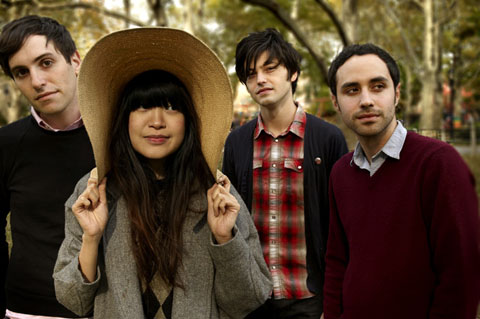




 Johanne Kappel Anderson
 Heidi Wikar
 Siofra Murphy
 Liam Evans
 Rachael Barrett
 Alex Mattson
 Keith Gray
 Louise Loubatieres
 Luis Lopez-Smith