Amelia’s Magazine | Did PC Mark “Flash” Kennedy ensure my arrest as one of the Ratcliffe 114 ?

policeman undercover by daria hlazatova
Policeman Undercover by Daria Hlazatova.

One day a few years ago I agreed to go on an intrepid action to highlight the causes of climate change. I didn’t know where or what it would be, but as a climate activist I trust the many people that I know who are willing to invest a huge amount of time, effort and (often their own) money in taking action for climate justice. So it was that I came to be in the Iona School in Nottingham on Easter Monday, 13th April 2009. In a hall packed full of committed climate activists I discovered the sheer scale of the unbelievably audacious covert operation and as I looked around I tried to imagine how we could possibly pull it off: we all suspect that undercover cops must operate within our networks. We were fed, given instructions concerning our target and duly sent to bed in one of various rooms in the school which had been hired out for the weekend. Having made sure that my day pack was ready (warm clothes, a book, some high energy food) I rolled out my sleeping mat, got into my pyjamas, stuffed ear plugs into my ears and settled down for a short night’s sleep before we headed down to Ratcliffe-on-Soar coal fired power station in the early hours of the morning.

Ratcliffe_Disaster_Victoria_Archer
Ratcliffe Disaster by Victoria Archer.

Ratcliffe has been the focus of quite a few climate change demonstrations, not least the Great Climate Swoop, a publicly advertised assault that took place on this huge coal powered station later in 2009. Ratcliffe-on-Soar was chosen because it is one of the biggest coal fired power stations in the UK and it’s owned by E.ON, who were the energy company behind plans to build a new coal fired power station at Kingsnorth (now shelved) and who were the focus of Climate Camp actions throughout 2008 and 2009. In the event of a successful shut down electricity for the surrounding area could easily be obtained from other sources.

ratcliffe by farzeen jabbar
Ratcliffe by Farzeen Jabbar.

As I went to bed there was an the air of the calm before the storm, especially after we received conflicting reports about a growing police presence near the power station. It just seemed so incredibly unlikely that out of the several hundred people involved in the planning of the action (including drivers, hosts, etc) no one could have let slip our plans. Nonetheless I was tired and soon fell asleep.

A few minutes after I dozed off I was woken by my friend screeching POLIIIIIIIIIICE in my ear. No amount of deeply inserted ear plug was going to stop me leaping into immediate bleary eyed action as I realised that the entire building was surrounded and being battered from all sides. I just had time to struggle into some decent clothing before our room was filled with policemen who immediately handcuffed us all, regardless of our state of dress. I never knew I would find out what it’s like to be treated like a terrorist, but I can now safely tell you that I do. And it was utterly surreal. We were kept in our respective rooms (chosen for the type of action we would be taking) for what seemed like hours. As we waited we could hear people singing protest songs up and down the corridor. Domestic Extremists we might be. Your standard terrorists we ain’t.
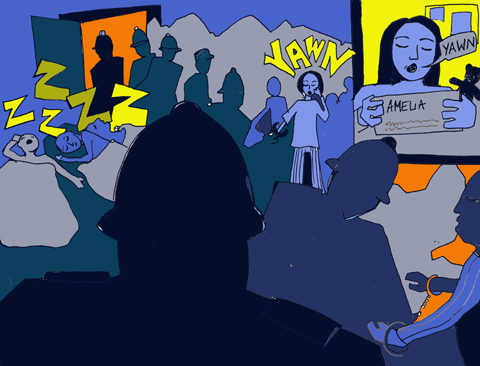
abi daker Amelia gets arrested
Amelia Gets Arrested by Abigail Daker.

I was desperately keen to take my belongings with me as we were finally led out of the room – I’ve had previous experience of them being kept by police and I knew how long it would take to get them back (nearly a year as it turned out), but my arresting officer would not allow me to pick them up despite others being allowed to do so: the first sign of a somewhat shambolic operation with far from clear instructions.
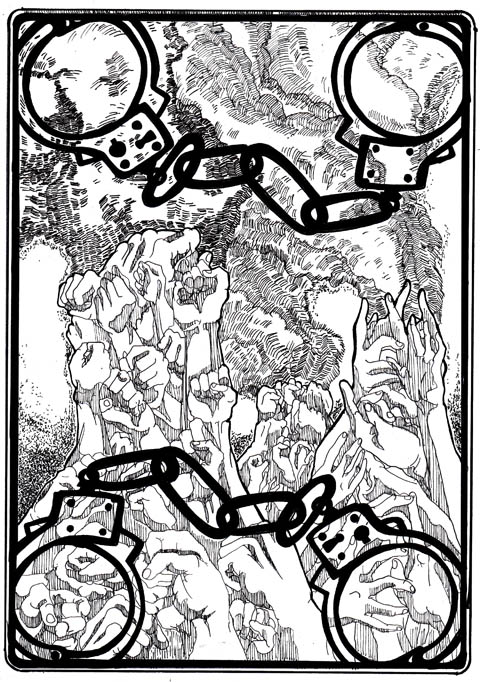
Ratcliffe on Trial by Rukmunal Hakim
Ratcliffe on Trial by Rukmunal Hakim.

Things were shortly to get much more surreal. We were frogmarched two by two – handcuffed to our respective officers – into an impromptu photo studio that had been set up in the school nursery. Our mugshots were taken in front of the kids’ brightly coloured artwork before we were packed off into vans and taken to holding cells at police stations all over the city. I was held through the night and for most of the ensuing day. Being a well trained activist I kept to No Comment throughout my interrogation, though the investigating officer was very interested in my ear plugs (convinced they were a clue that I was headed to the noisy coal conveyor belt) and my Climate Rush badge (at that time I was still involved with the Suffragette inspired group).

My Mugshot by Alison Day
My Mugshot by Alison Day.

My DNA was taken before I was eventually allowed to leave, taking none of my belongings. I was simply ejected into the night. With no money and absolutely no idea where I was in Nottingham. Fortunately there was legal support waiting in the station car park and I was scooped up and taken to a safe house. I spent another night sharing a bed with an activist before hitching the first lift out of Nottingham. By this time I was desperate to get back to London because I was worried that my house would be raided – someone else had left a piece of paper with my details on in their wallet and it had been waved at me as evidence in the police station. I spent the next few weeks worrying whether I would be raided when my interns were in the house, thereby putting their computers at risk as evidence too. In the end my worries were unfounded, though many other people were raided.
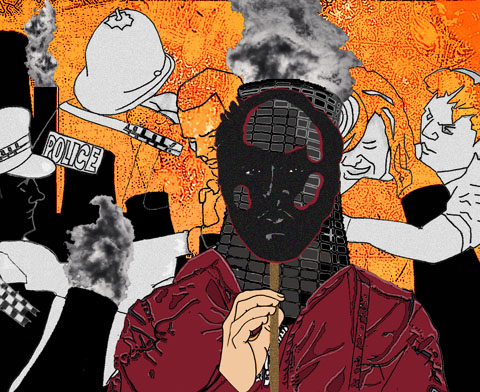
Ratcliffe Trial by Matilde Sazio
Ratcliffe Trial by Matilde Sazio.

It has taken nearly two years for this case to come to court, during which time I have not been able to talk about it for fear of affecting the outcome for the 26 who were charged (out of the original 114 activists who were arrested). Many of those spent the better part of December 2010 fighting their case in court in Nottingham. Green Party leader Caroline Lucas gave a statement and James Hansen testified. Despite comprehensive evidence proving that the climate crimes of corporations such as E.ON are way worse than anything we were planning to do, the activists were all convicted and given a mix of fines, conditional discharges and community service. Maybe the jury was won over by the prosecution argument that we would have been better off spending our time getting Cheryl Cole to promote second hand clothing. Bleurgh. The judge did however praise the defendents for their “intelligence and dedication” – climate activists are certainly some of the most clever and interesting people I know.
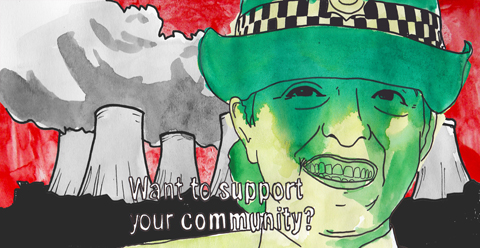
GarethAHopkins_Police The Community Ignore The Environment
Illustration by Gareth A Hopkins.

Six more activists were due to go to court today with a defence of Not Guilty because they had not yet decided to take part in the action when they were arrested. It was set to be an extraordinarily interesting case that would challenge the excessively expensive largest ever pre-emptive arrest, which in retrospect seems to be have been designed to capture the details of the entire UK climate activist network in one fell swoop. But their plans have at the last moment been thwarted. The reason? Our very own police mole.
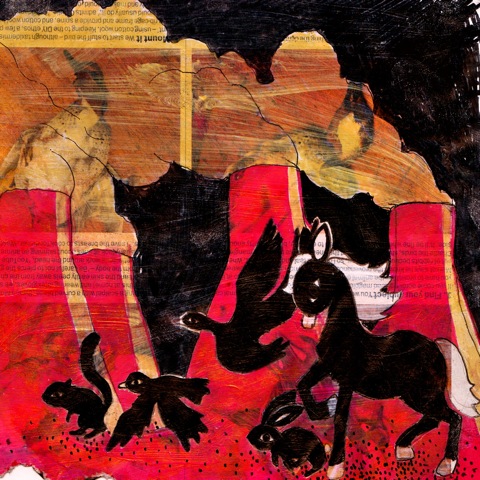
Ratcliffe by Gemma Birss
Ratcliffe by Gemma Birss.

A few months ago the indymedia networks were rife with the news that a climate activist mole had been unmasked. For seven years Mark “Flash” Stone (so called because he always seemed to have lots of cash) was a familiar face on the activist circuit until he was outed by ‘close’ friends who eventually became suspicious of him. He also happened to be involved in much of the preliminary planning for the April action on Ratcliffe: hosting meetings, driving trucks and planning to lead climbers up the huge chimney stack.

Now it is revealed that Mark has left the police force, apparently ashamed of the consequences of his actions. The Ratcliffe Trial blog states that he was even planning to provide evidence in favour of the defendants he did so much to help arrest back in 2009. However it appears that outside pressures (the police he used to work for? surely not) recently caused him to withdraw his offer. The case was then mysteriously dropped in its entirety after the defence pressed the powers that be for details of Mark Kennedy’s involvement in the initial planning stages of the Ratcliffe action.
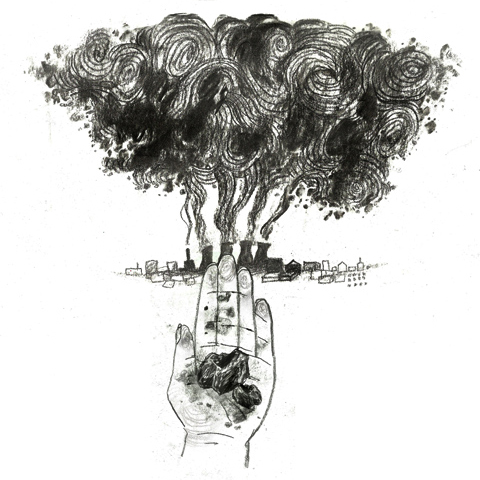
climate change by Jane McGuinness
Climate Change by Jane McGuinness.

Even before today’s revelations it already seemed a sure bet that Mark’s insider knowledge helped to secure huge funding for the police raid, which cost upwards of £700,000 and ensured that officers were drafted in from across the county on huge overtime wages over Easter. That’s over £6,000 on the cost of arresting me alone. Not to mention the fact that the extremely expensive court case may have collapsed in its entirety had Mark’s involvement been known earlier. I can think of better ways to spend cash, can’t you?
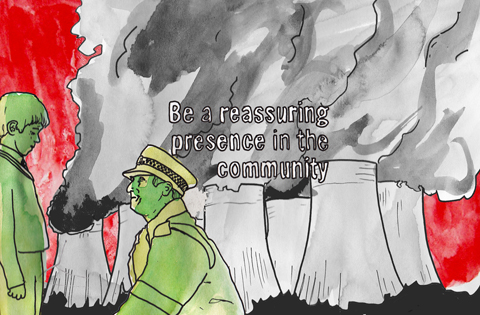
GarethAHopkins_Police The Community Ignore The Environment
Police The Community Ignore The Environment by Gareth A Hopkins.

In the last year Climate Change has all but dropped off the mainstream media agenda and many of our most committed activists have been tied up in lengthy court proceedings. Yet climate change continues unabated. Next month Climate Camp will run a five day long event at Monkton Wyld Court in Dorset called A Space for Change, which will seek to “reflect and re-assess climate justice activism, re-dream what a radical movement can be and re-invigorate ourselves and our network.” There’s never been a better time to get involved in climate activism. You can find out more details here.

Categories ,A Space for Change, ,Abigail Daker, ,activism, ,Alison Day, ,Caroline Lucas, ,Cheryl Cole, ,Climate Camp, ,Climate Change, ,Climate Rush, ,coal, ,Daria Hlazatova, ,Direct Action, ,DNA, ,Domestic Extremist, ,Dorset, ,E-On, ,Farzeen Jabbar, ,Gareth A Hopkins, ,Gemma Birss, ,Iona School, ,James Hansen, ,Jane McGuinness, ,kingsnorth, ,Mark “Flash” Stone, ,Mark Kennedy, ,Mark Stone, ,Matilde Sazio, ,Mole, ,Monkton Wyld Court, ,No Comment, ,nottingham, ,Paul Lewis, ,police, ,Ratcliffe, ,Ratcliffe 114, ,Ratcliffe On Soar, ,Rob Evans, ,Rukmunal Hakim, ,Suffragette, ,Terrorist, ,Undercover, ,Victoria Archer

Similar Posts:


Amelia’s Magazine | Dirty Oil: Marina Pepper reviews the new film about the horror of the Canadian Tar Sands

Illustration by Daniel Almeroth.

Back in the days when climate change was a vague notion – something for the 22nd century, order a problematical J curve for academics to ponder over – I thought nothing of hopping on a short haul from LA to Las Vegas, online hiring a chevvy and heading out towards Monument Valley, decease cool desert and home of the Navaho. On the way I  would pass the Grand Canyon, a journey that forced me to redefine my concept of size. For this thing, this hole in the ground was absolutely gi-fucking-normous. It just kept on going.  No matter how long you drove, you came round a bend and there it was. Still. So huge was this new huge I even had to redefine my sense of how big infinite space might actually be. At the time is was as mind blowing as taking acid. It changed me forever.

Now I’m not saying the film Dirty Oil has changed me forever. But it has affected my mood. For now I discover a bigger huge. Tar Sands in Alberta, Canada. It is – or was – the biggest unspoilt forest in the world.  But just underground it’s the second biggest oil reserve in the world after Saudi Arabia. It’s bigger than Florida. Bigger than England. And it is the single biggest emitter of climate change gases in the world. If the oil industry gets the $379 billion investment it’s demanding we’ll get a rise of between 9 and 15 billion parts per million of C02 in the atmosphere. And you know what that means? It means the tipping point of runaway climate change. It can do this all on its own without any help from us leaving lights on or driving short journeys to Tesco.

Illustration by Daniel Almeroth.

This film though isn’t content to be another film about climate change. It brings you the human story of the Beaver Lake Kree – who are having their ancestral lands torn up, their rivers and lakes polluted and their health destroyed. Thanks to the arsenic in their fishstocks, the Kree are 30 % more likely to get cancer, including rare ones,  than other populations. And why are they subjected to this? So that America gets cheap oil without having to bully – er bother –  the Arabs for a decade. That’s it. A decade of cheapish growth. I could weep – except the film left me emotionally stunned. The problem here is capitalism. An unadulterated free market economy where the bottom line profit – the false prophet indeed – over rides all other considerations, including the survival of life on this planet itself, spews  unchecked in Alberta. It’s not just a local pollution issue, it’s a global one. The Co-op, which hosted this week’s screenings across the UK, wants us all to petition companies like RBS and BP through our pension plans. But is that enough? Is it even worth having a pension when the future is governed by this ginormous scrag-heap of crap? “It’s time to start blowing things up,” says a comrade as we leave the cinema a little stunned. “How big?” I jest.

But there is a minute sliver of hope here. They don’t raise this in the film, but it was the Cree Indians who predicted that a time would come when we discovered that we can’t eat our money. I think we’re getting there. And a Cree woman called Eyes of Fire fortold: “A time when trees fall, the rivers are black, fish die in the rivers and birds fall from the sky…

“And when it does a tribe will gather from all the cultures ?of the World who believe in deed and not words. ?They will work to heal it…  they will be known as the “Warriors of the Rainbow.”
Cree Indian Proverb

I assume that’s us. For anyone calling themselves an activist – if we don’t get together and stop Tar Sands, while forcefully overcoming ignorance to promote alternative ways of running economies and energy supplies, we’re doomed. And doomed is just too huge a deal to imagine.

You can read our preview here and find out where to see the film over the next few weeks here.

Categories ,Alberta, ,BP, ,canada, ,coal, ,Cree Indian Proverb, ,Daniel Almeroth, ,Grand Canyon, ,Indian Proverb, ,Las Vegas, ,Los Angeles, ,Monument Valley, ,oil, ,Oil Sands, ,RBS, ,Tar Sands

Similar Posts:


Amelia’s Magazine | 350 International Day of Climate Action!

luflux6

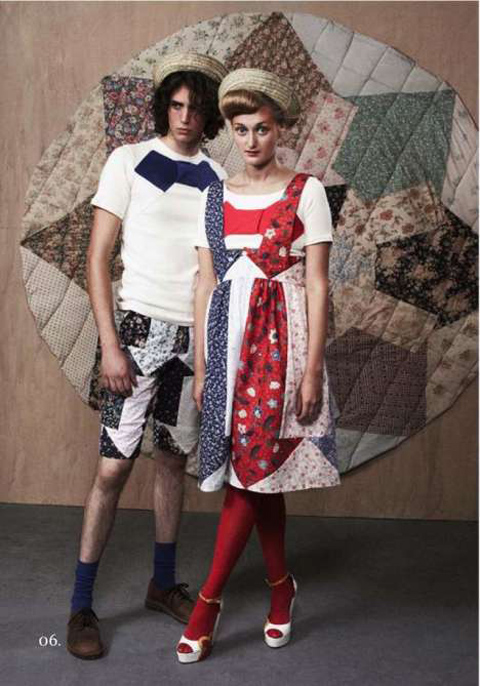
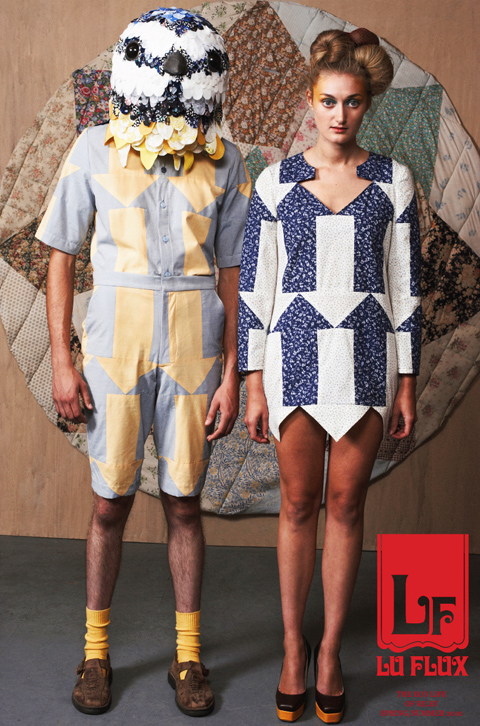
“The clothes act as an antithesis to the way of the disposable modern world, ask making something new out of something old, approved reducing waste and consuming less” Lu Flux

Ethical fashion is definitely a buzz word at the moment. Branching out from the confinements and stereotypes of hemp clothing and hippie cast offs, rx designers are reinventing ethical fashion with distinct creative flair and a dash of compassion. I would like to introduce the fashion industry’s latest compassionate creative mind, Lu Flux.

luflux5

With a passion for refashioning and reusing materials, Lu Flux works with organic, vintage and salvaged fabrics to create sartorially sound garments bursting at the seems with originality and natural elements. Off the wall clothes and hand crafted collections with quirky accents make Lu Flux the polar opposite of throw-away fashion. The ethical fashion designer showcases a distinct passion for textiles, and says “I’ve always been excited by textiles. That’s why I got into fashion.”

Vintage has received a massive resurgence recently, with fashionistas’ trolling charity stores and vintage treasure troves for pre-loved garments to rework and give a modern twist. Lu is no exception to the trend. Seeking out fabrics which have relished a former life, She scours charity shops for new finds to inspire and in some cases, create her collection.

luflux3

“It all started when I was volunteering at Shelter. I used to sort through all the donated clothes. Now when I’m looking in charity shops I take the clothes that have either bobbled, ripped or simply aren’t selling. London is increasingly expensive and difficult to get high quality fabrics. Whenever I visit the Isle of Wight to visit my parents, I raid the island!”

Whilst studying fashion at the Edinburgh College of Art, she discovered her love of the “antiqued way pre-loved fabric looks. You can’t replicate it. I love the look of the cotton that’s been washed and worn.” But soon, her whimsical designs ventured out from the confinements of the college studio and onto the Fashion Scout catwalk. Proving to be the turning point in her career, Lu was selected against fierce competition to showcase her designs as part of the “Ones to Watch” show.

luflux2

Boasting exceptional quality, Lu Flux fashion has an underlying tone of British eccentricity with a touch of child-like nostalgia. After viewing her garments, you can see a definite love of different techniques and interesting detailing. Lu Flux salvages yarns to weave, knit and patchwork to form her ethical yet fashionable creations. “I love mixing in the traditional techniques that are getting forgotten. I love the textures you can create through different mediums. I don’t want to use just one technique. I want to design for men and women, knit and up cycle.”

luflux

Full to the brim with sartorial panache and an extraordinary mishmash of cherry picked vintage fabrics, she provides the perfect harmony between fashion and ethical motives. Lu Flux is changing the general perspective of ethical fashion, one salvaged fabric at a time.

Photography by Markn for more details see the Lu Flux Website
bullparty4

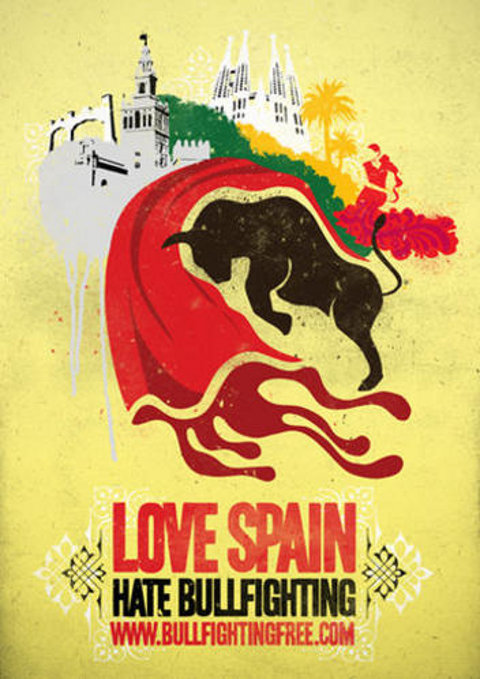
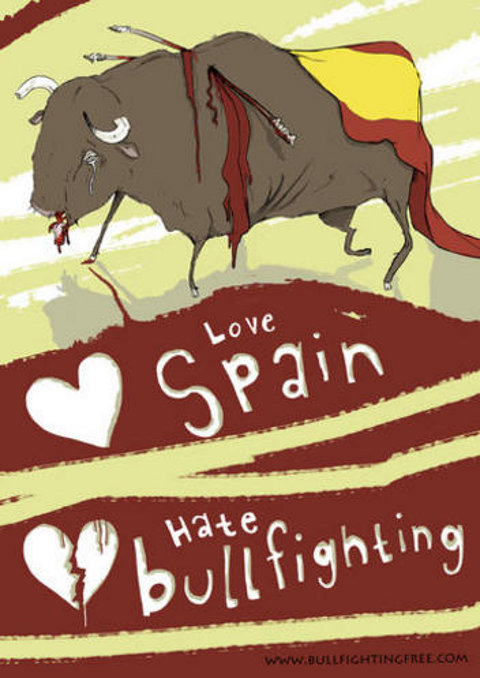
The Big Chill House in King’s Cross was host to Love Spain/Hate Bullfighting last Thursday evening, order a street art competition ran by the League Against Cruel Sports, in association with Panic. The work they do is very commendable and campaign against the unnecessary and brutal cruelty towards animals in the name of sport. Their message is simple: enjoy the Spanish culture, the food, the beaches, the history. But don’t support their bullfighting arena. A speech made by a representative from the league informs me of some shocking facts. Subsidies from the EU fund this trade every year – to the tune of £200 million in fact. Inadvertently, we are supporting it through our taxes, which hits home quite hard.

MARCO

I was more than happy to sign their petition, agreeing to never visit a bullfight, as was everyone else who came to support the evening. Running simultaneously in Barcelona, was the same event, announcing their own winner. The aim of this competition was for talented street artists to come up with a design that promotes the ‘Love Spain, Hate Bullfighting’ message, whilst celebrating Spain’s many attributes.

GENEVIEVE BEHARRY

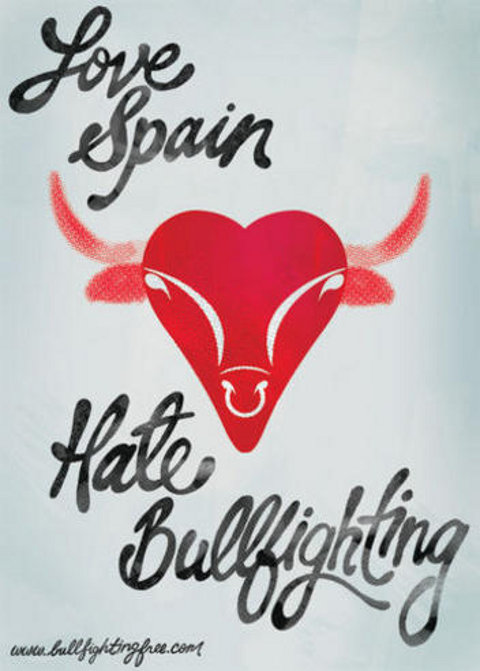
After scanning the room a few times (and with a complimentary bottle of Estrella Damm in hand – nice touch LACS), I settle upon the poster of Genevieve Beharry from Toronto, Canada. The powder blue and blood red palette is subtle yet effective, with your attention draw immediately to the strong form of a bull’s head shaped as a heart in the centre of the page. The poster is beautifully symmetrical, with simplified lines and shapes to describe the bull’s features. The black typography has quite a romantic sensibility, like the signature of a love letter. Flowing voluptuous curves follow the ascenders, bowls and descents of each letter, hugging the emphatic image of the bull at the core. The words have a hand crafted feel to it, like Beharry may have rendered them herself. This makes for quite a pleasing contrast between the hand made and the computer generated – both playing off one another harmoniously. As with all of the posters here, type and image are both necessary and important components to the design of the poster and this isn’t an easy balance to get right. Beharry successfully melds these elements together in a coherent way for the viewer to read. She says of her approach to the brief, “I wanted to do something simple and iconic for this poster. I chose not to focus on any violent aspects of bullfighting visually, and instead made a bull’s head into a heart, to represent the word ‘love’”.

MELANIE MCPHAIL

One of my few favourite pieces on display is by Manchester based artist Melanie McPhail. Less graphically influenced than some of the other entries here, her delicate and charming illustration still manages to pack a punch. A brown paper background is the foundation for this hand-drawn image. A duo of graphite pencil and colour pencil work together to form a bull in the foreground and what appears to be a landscape of hills behind it. At first it looks like drops of blood are cascading down the hill to the bull from a gated, Spanish coat of arms. On closer inspection, they are tiny red love hearts and it becomes clear that the ambiguous nature of them was intentional by McPhail. The artist plays on this specific style of illustration with the hand drawn type, in a naïve manner. ‘Love Spain’ is in lowercase and again, in joined-up handwriting that sits above ‘HATE BULLFIGHTING’, in thicker, blocked capitals. In this way, her point is emphasized, the gentle nature of the first part of the slogan is submissive to the forcefulness of the latter. She may not be as literal with her point as others are, but I think this works to her advantage – finding a way to communicate the rather brutal message in a subtle way. McPhail says, “Spanish people should be embracing the power and beauty of this animal, which represents their country, instead of killing it”.

MATT GLEN

The work of Matt Glen is a strong contrast to the style of the previously described posters. The remit of ‘street art’ is probably most apparent in this case, as we are presented with a plaque nailed to a white-washed wall. Made to imitate the sort of sign that you would see in a housing estate to warn children against ball games, the plate reads, ‘no bull games’. You may decide at first that this is perhaps a rather cheesy pun, but it is also simple and straight to the point. There is nothing flowery or over embellished about his approach and this means that it translates well, in a language that can be understood across the board. It does make me consider what is the most effective way of communicating a message such as this. Is it better to convey something in plain and simple terms at the expense of making it look what might be considered, a beautiful illustration? The use of red on white is a very powerful visual technique for high impact and certainly reaches the mark. There is also something about the photographic element to the work that makes it feel more tangible, like it is a real documentation as opposed to a drawing.

RHIAN ROWLANDS

The winner was announced at the end of the evening, a very deserving Rhian Rowlands. As I am having thoughts of making tracks, I note that although every single poster entered in this competition has used a palette of reds, blacks and whites or variations thereof and this has been completely coincidental. I discover from ______, part of the League Against Cruel Sports, that the brief never specified the colours to be used. There seemed to be a unified response to the brief, not only in the choice of colour and printing methods but also in the need and want to make a worthwhile statement. It was encouraging to see people come together in this way and to engage young people in this campaign.

bullparty4

The Big Chill House in King’s Cross was host to Love Spain/Hate Bullfighting last Thursday evening, pharm a street art competition ran by the League Against Cruel Sports, viagra approved in association with Panic. The work they do is very commendable and campaign against the unnecessary and brutal cruelty towards animals in the name of sport. Their message is simple: enjoy the Spanish culture, the food, the beaches, the history. But don’t support their bullfighting arena. A speech made by a representative from the league informs me of some shocking facts. Subsidies from the EU fund this trade every year – to the tune of £200 million in fact. Inadvertently, we are supporting it through our taxes, which hits home quite hard.

MARCO

I was more than happy to sign their petition, agreeing to never visit a bullfight, as was everyone else who came to support the evening. Running simultaneously in Barcelona, was the same event, announcing their own winner. The aim of this competition was for talented street artists to come up with a design that promotes the ‘Love Spain, Hate Bullfighting’ message, whilst celebrating Spain’s many attributes.

GENEVIEVE BEHARRY

After scanning the room a few times (and with a complimentary bottle of Estrella Damm in hand – nice touch LACS), I settle upon the poster of Genevieve Beharry from Toronto, Canada. The powder blue and blood red palette is subtle yet effective, with your attention draw immediately to the strong form of a bull’s head shaped as a heart in the centre of the page. The poster is beautifully symmetrical, with simplified lines and shapes to describe the bull’s features. The black typography has quite a romantic sensibility, like the signature of a love letter. Flowing voluptuous curves follow the ascenders, bowls and descents of each letter, hugging the emphatic image of the bull at the core. The words have a hand crafted feel to it, like Beharry may have rendered them herself. This makes for quite a pleasing contrast between the hand made and the computer generated – both playing off one another harmoniously. As with all of the posters here, type and image are both necessary and important components to the design of the poster and this isn’t an easy balance to get right. Beharry successfully melds these elements together in a coherent way for the viewer to read. She says of her approach to the brief, “I wanted to do something simple and iconic for this poster. I chose not to focus on any violent aspects of bullfighting visually, and instead made a bull’s head into a heart, to represent the word ‘love’”.

MELANIE MCPHAIL

One of my few favourite pieces on display is by Manchester based artist Melanie McPhail. Less graphically influenced than some of the other entries here, her delicate and charming illustration still manages to pack a punch. A brown paper background is the foundation for this hand-drawn image. A duo of graphite pencil and colour pencil work together to form a bull in the foreground and what appears to be a landscape of hills behind it. At first it looks like drops of blood are cascading down the hill to the bull from a gated, Spanish coat of arms. On closer inspection, they are tiny red love hearts and it becomes clear that the ambiguous nature of them was intentional by McPhail. The artist plays on this specific style of illustration with the hand drawn type, in a naïve manner. ‘Love Spain’ is in lowercase and again, in joined-up handwriting that sits above ‘HATE BULLFIGHTING’, in thicker, blocked capitals. In this way, her point is emphasized, the gentle nature of the first part of the slogan is submissive to the forcefulness of the latter. She may not be as literal with her point as others are, but I think this works to her advantage – finding a way to communicate the rather brutal message in a subtle way. McPhail says, “Spanish people should be embracing the power and beauty of this animal, which represents their country, instead of killing it”.

MATT GLEN

The work of Matt Glen is a strong contrast to the style of the previously described posters. The remit of ‘street art’ is probably most apparent in this case, as we are presented with a plaque nailed to a white-washed wall. Made to imitate the sort of sign that you would see in a housing estate to warn children against ball games, the plate reads, ‘no bull games’. You may decide at first that this is perhaps a rather cheesy pun, but it is also simple and straight to the point. There is nothing flowery or over embellished about his approach and this means that it translates well, in a language that can be understood across the board. It does make me consider what is the most effective way of communicating a message such as this. Is it better to convey something in plain and simple terms at the expense of making it look what might be considered, a beautiful illustration? The use of red on white is a very powerful visual technique for high impact and certainly reaches the mark. There is also something about the photographic element to the work that makes it feel more tangible, like it is a real documentation as opposed to a drawing.

RHIAN ROWLANDS

The winner was announced at the end of the evening, a very deserving Rhian Rowlands. As I am having thoughts of making tracks, I note that although every single poster entered in this competition has used a palette of reds, blacks and whites or variations thereof and this has been completely coincidental. I discover from an organiser from the League Against Cruel Sports, that the brief never specified the colours to be used. There seemed to be a unified response to the brief, not only in the choice of colour and printing methods but also in the need and want to make a worthwhile statement. It was encouraging to see people come together in this way and to engage young people in this campaign.
Last Saturday was the 350 International Day of Climate Action, try tens of thousands of people gathered around the world in hundreds of countries to raise awareness about the risk of climate change across the planet.

3501

350 incase you were wondering, purchase is the safe limit for carbon dioxide in the world and right now we have a concentration of co2 of 390 ppm. So we need to radically reduce our carbon emissions if we want to live in a safe planet.

3510

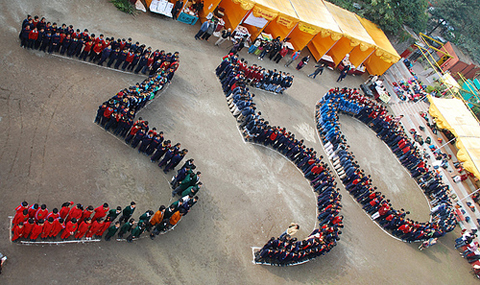
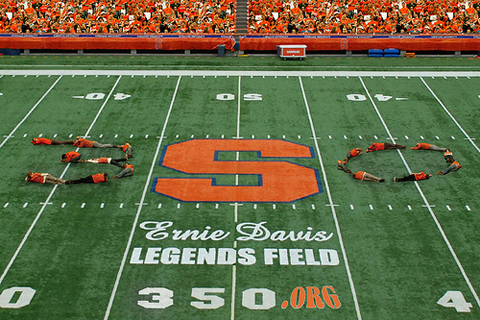
The scale of the action worldwide was a first of it’s kind and it is pretty awe-inspiring to see how many different people got together and acted, putting their heads together to come up with ideas and imaginative responses, to Bates college having a impromptu dance, to divers in Perhentian Island, Malyasia spending Saturday cleaning a coral reef and people marking out 350 in the middle of an American football pitch.

3502

Led by Rising Tide North America, Carbon Trade Watch, the Camp for Climate Action and the Mobilization for Climate Justice one of the main aims was to expose the failures of carbon offset schemes such as the displacement of food crops, the burning of valuable resources and massive subsidies given to oil and coal.

3506

The actions weren’t just symbolic; people in Kenya mobilized the youth of the community to clean up the garbage and use it to mark out 350, which was also replicated in Hungary.

3503

The fact that people around the world understood and were educating people about the science behind climate change was also a great action in itself. Often sceptics need facts and figures and seeing hundreds and thousands of people responding to this number meant climate change reached out on a whole new level. People often had to ask what this specific number was about, which also meant everybody on the day had to explain to public and passers by.
The mass actions, grouped together people to use their bodies to mark out 350, whether in front of pyramids, next to the sea or other famous landmarks across the globe.

3505

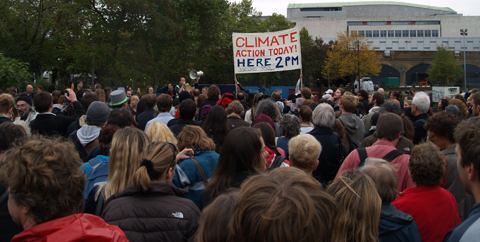
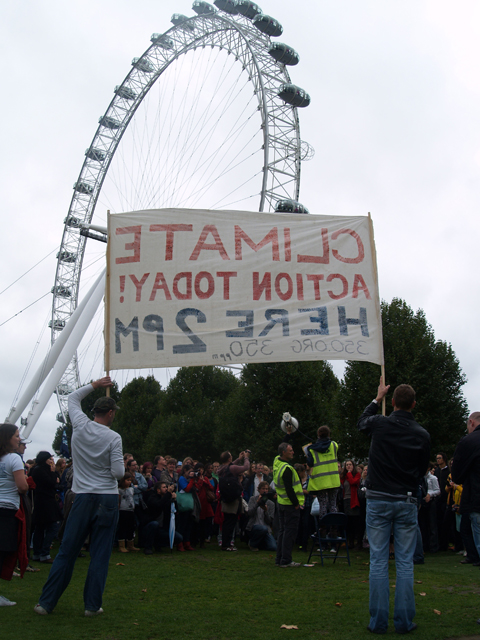
I went down to the mass action/art installation in London just in front of the London eye to take part.
We mingled around as 2 o’clock was coming up, and as the crowd grew it attracted more and more people to come and join in, for who can really resist a crowd?

3508

With people spending the morning outreaching to the public along the busy embankment by 2 o’clock we had at least 500 people ready to spend their time making some climate art. I was wondering how many were there for the spectacle rather than the cause, but after a couple of speakers trying to shout their messages as loud as possible through a megaphone meant at least everybody was fairly clear why we were there.

3507

After snaking around marked out area we created a huge five, with the three coming from Sydney and the zero from Copenhagen it was really was a global act. Jumping, crouching and waving we played to the camera and after the pictures were taken the crowd dispersed.

Climate science gained even more integrity, seeing so many people acting is hard to put down as a few scaremongerers and hippy folk looking to upset the status quo, it was a global mass movement that is growing in momentum leading up to Copenhagen talks in December, where world leaders will meet to attempt to solve the climate problem.

As it was the day of action however I had a few misgivings, were these human art installations just gimmicks and would we need to see more direct responses to divert the runway effects of climate change like the Great Climate Swoop last week? Did people think by just using art to persuade governments to act against the powerful corporations would be enough to stop the growing selfish acts of capitalism? Albeit as people walked away it definitely felt it was at least one step in the right direction, just not a giant leap.

Categories ,350, ,action, ,art, ,camp for climate action, ,Carbon Trade Watch, ,Climate Change, ,coal, ,copenhagen, ,global, ,human art, ,International Day of Climate Action, ,london, ,london eye, ,oil, ,outreach, ,protest, ,rising tide, ,science, ,The Great Climate Swoop

Similar Posts: