ed Helvetica, medications sans-serif; font-size: 12px;”>Reclaim Power Climate Justice Action at Cop15
On Wednesday the 16th of December the Reclaim Power! demo was due to hit the streets surrounding the Bella Centre (where the Cop15 was being held). The highlight of the Climate Justice Action calendar, it was towards this that the majority of British activists who had travelled as part of Climate Camp were working over the preceding days and with this in mind we retired to bed in a slightly wary frame of mind the night before. I’ve been the subject of a midnight raid before, and let me tell you, it’s pretty discombobulating to be woken by someone screaming in your ear “POLIIIIIIIIICE” as you scramble to take stock of the situation whilst pulling together some decent happy-to-be-arrested-in clothing (I was one of the 114 people arrested in the Iona School in Nottingham last April). This time I wasn’t so worried as we’d seen nothing of the police out at Voldparken, but when I awoke before daybreak and wandered bleary eyed betwixt bed and portaloo in my sexy checked pyjamas I was greeted by some friendly coppers at the exit, who had been sent to search everyone as they left the building. “Where are you going today?” “Oh, you know, just off to hang out in Copenhagen for a bit.” At 6am. There were plenty of ways we could have escaped without being checked if we’d wanted to, but it seems that coppers everywhere are, well, just a bit thick really.
Being searched before leaving Voldparken school on December 16th
It was a long cold ride into Copenhagen with my Bike Bloc affinity group (a trusted collective of people who have agreed to stick together and look after one another through an action), and from there onwards to the island where the Bella Centre is located. Unfortunately part of our group had decided to go on ahead without us and whilst we were waiting for them on a corner in a vaguely interest-arousing manner we were stopped and searched. This was not exactly unexpected, but one of our members had rather stupidly brought a map with him that had segments drawn onto it around the Centre, and for this he was detained immediately – a short day for him, straight to the holding cells.
Being searched on the way to the Bella Centre
Definitely not a suspicious map officer, definitely not.
The rest of us quickly cycled onwards and were soon turning in circuits around the residential backstreets near the Bella Centre, at first trying to evade the many many police vans patrolling the streets (a Netto supermarket proved a good venue to hide in at one point, the bemused staff unsure how to react), but eventually just giving ourselves up to the patrols – thereby delaying the police and hopefully preventing them from harassing other activists, particularly those in the Green Bloc who would be using more direct means to scale the fences of the centre. (So the theory went, we later learned they were all arrested long before they got anywhere near the perimeter.) One *lovely* officer even offered to kiss me, as you can hear in my audiocast here.
I find it’s always a nice touch to wear a fancy hat to a demonstration.
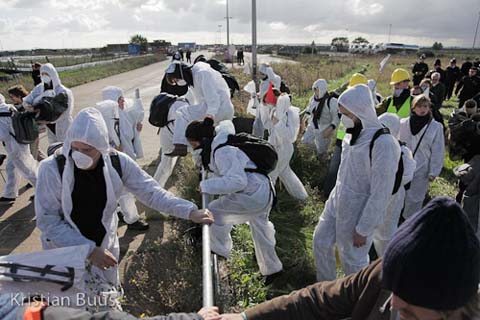
It’s quite hard to provide an overall analysis of what happened next as there was so much going on at once and even though I did my usual mad dashing about the place, of course I couldn’t cover it all. As the marchers formed a blockade (video here) and attempted to breach the gates we continued to hold the space on one side. I witnessed a man climb on top of a police van, only to be beaten with a baton then hauled down, and I repeatedly saw people being pulled from the crowd with reddened faces, weeping from the pepper spray that was being squirted with abandon at peaceful protestors on the front line.
Pepper spray sure looks like it hurts!
The Santa Block do their thang. In fancy dress no less.
A ‘hub’ – the way that Bike Bloc affinity groups gathered to discuss plans.
At our end there was far less aggression from the police, who seemed fairly bemused by our tactics, especially the ‘Santa Block‘ who cycled in circles chanting “ho ho ho”. Here’s an especially good video of me wobbling along on my bike as I try to tour between the two, nearly crashing into someone in the process. Between this a group of Climate Camp activists launched what looked like a large inflatable lilo over their heads towards the Bella Centre perimeter and indeed there was soon a ‘lilo bridge‘ angled across the moat into the scrubland surrounding the Bella Centre. Unfortunately this highly inventive approach to getting inside was destined to be thwarted by circumstances, as those who reached the other side were promptly arrested by a squad of riot cops.
Climate Campers made a lilo bridge to get into the Bella Centre. So inventive!
There was poetry, dancing in the street and even a call for the cops to give an activist a hug (amusing audioblog here) – all as we waited (since we couldn’t get in ourselves) to hear whether the delegates inside the Cop15 would be able to march out and join us for the planned People’s Assembly. It looked increasingly unlikely that they would be able to do so: we were later to find out the extreme lengths to which the police went to prevent them from leaving the Bella Centre – for shocking footage of the bassist in my band Green Kite Midnight being beaten with a baton see this Guardian video. At about 7 minutes in Tim can clearly be seen mouthing the words “peaceful protest” as he is whacked. He has had his fractured arm in a cast since then.
People’s Assembly outside the Bella Centre.
Instead activists from all over the world sat in circles on the cold road, discussing in groups of a dozen or so, how real life grassroots solutions could be applied to the crises that we face. For video footage of this see here. But the light was failing and all too soon it was over and the decision made to march back into central Copenhagen. By this point I was seriously cold and had a very wet foot due to running around in the scrubland and stepping into an icy cold bog. As the sky turned into a beautiful orange haze over the Bella Centre the Bike Bloc attempted to decide on a course of action, but a lack of clarity about how or what we should do led to a random diversion for some back onto the scrubland where we were immediately met by police on horseback. I decided to call it a day and together with Dave headed back towards the Klimaforum in search of a hot cup of tea and a radiator on which to dry my socks and shoes.
Final Bike Bloc hub to decide our next move… home.
Everyone should have a red bobble hat.
And orange fabric tied around their ankles. A must for every direct action.
The one fancy bike I saw: a Tall Bike ridden by a clown.
Homeward bound.
The following day a few Climate Campers decided that we should not leave Copenhagen without holding some kind of camp (since that’s what we’ve become so well known for), so in the evening about 50 of us rocked up to Hopenhagen, where we popped open a few tents (video here) and stood around chanting and thinking, ho hum, what shall we do next? Having been autonomously organised it wasn’t exactly the most considered of actions, but it was an interesting experiment in seeing how the police would react to a completely impromptu non-violent occupation. They started off on quite an aggressive footing, with one snatching a tent and ineffectually putting it into the bin, from whence it was speedily retrieved.
Setting up camp in Hopenhagen.
Oi! Give me that tent. No. It’s mine.
A particularly articulate young man gives an interview.
The brainchild of the action declared his ambition to stay put through the entire night (before popping open a can of beer) – not a desire shared by the majority present, what with the sub zero temperatures and lack of planning. However first there was some fun to be had in disrupting a television programme being broadcast from inside one of the alien green boxes – where a smarmy looking presenter caked in make up with slicked back hair (a man, I might add) steadfastly ignored the Caution: Greenwash banner being held up behind his head. I wasn’t sure what exactly this action was meant to achieve but was assured that this particular TV channel had been misrepresenting activists in its coverage, and that since they were talking about the Cop15 it was an ideal place to get our message across. By this point the cops had relaxed and we got into some entertaining conversations with them about the efficacy of our actions.
Greenwash on the television at Hopenhagen. He’s looking straight at me isn’t he?
Suddenly Tim was at my shoulder, one-handedly suggesting that we do a ceilidh, since Green Kite Midnight has always held ceilidhs at Climate Camp actions. But, there was only the two of us out of a band of six, no instruments and no amplification. Not a problem. Tim whipped out his harmonica, and laughing, I managed to call several dances, yelling from atop a concrete pillar holding aloft the giant Hopenhagen balloon above our heads. You can see footage here, but be warned, I’m loud – filming whilst calling being an up close and personal affair.
Green Kite Midnight performs their first international gig.
Erm, I’m not sure how we deal with this. Errr.
Swing your pardner! Ceilidh dancing in Hopenhagen with Climate Camp.
It’s like an alien ball isn’t it?
It was then back to an amusing last evening at the Voldparken School, what with an impromptu music video shot in one of the disused laboratories and a full on rave held in one of the air-locked antechambers far into the night, where I espied our ambitious young activist in the wee hours. The police gave him a lift all the way back to the school, keen to see both him and his tents dispatched safely back to the far reaches of the suburbs!
The crew for the Voldparken music video.
Playing the piano at Voldparken school.
A map shows the best skips in the area for food runs.
Your friendly reception staff! Only joking, we don’t do staff.
One of the final things I did in Copenhagen was to visit their most famous landmark; the mermaid, of course. It was beyond bitingly cold, and as I admired her temporary cohorts, some frozen penguins, I considered the probability of losing both my fingers and my toes to frostbite. Visitors from all over the world clearly saw this spot as the most emblematic place to stage a protest and during the short time we were there they came in their dozens with placards held aloft, cameras at the ready. Behind the Little Mermaid another special Cop15 sculpture reared out of the grey waves, a grotesquely oversized woman sat astride the shoulders of a skinny little man – the ‘Survival of the Fattest’ by Jens Galschiot and Lars Calmar.
The Little Mermaid with Survival of the Fattest and penguin friends.
Korean delegates protesting in front of the mermaid.
After cleaning up our accommodation (surreal audiocast of me peeling up the masking tape used to mark the fire lanes in our room here) as best we could the coach ride home from Copenhagen was, how shall I put it… interesting. Even though I decided early on (as we sat delayed, due to snow, in a traffic jam into Calais) to practice the art of zen, I, along with everyone else, was starting to lose the will to live by the time we had sat in a car park in Dover for several hours whilst our increasingly irate drivers tried to figure out where their relief drivers were to ferry us the last hour home to London, eventually both completely losing their rag and threatening to kill their employers.
Trying to sort out Climate Camp coaches home in the hallway.
Snowball fights whilst we wait to catch the ferry home.
White Cliffs of Dover by floodlight.
White Cliffs of Dover by night. OH GOD WE HAVEN’T MOVED IN HOURS.
Since I got home there has been plenty of editorial commentary on what happened inside the Cop15 summit and what exactly our actions did or didn’t achieve. From my point of view (and maybe I should keep this to myself), I didn’t ever for one moment think that we would actually get into the Bella Centre – it was immensely well fortified and we didn’t have the strength in numbers or ability to get inside – so I wasn’t exactly surprised when we didn’t. As a whole it was quite hard to take part in the Climate Justice Action pre-planning meetings because of the distance between activist venues, which I think resulted in many people thinking that others would be more organised than themselves and lead the way. The Bike Bloc felt a bit disparate – we lost half our affinity group, split up and regrouped several times – taking our lead from the people around us rather than from the pre-planned messages that I was expecting to be sent out via text. It was a shame that Double Trouble (confiscated earlier in the week by the police looking for our fictional “machine of resistance”) and the Sound Swarm never made it to the gates, (at least not to my knowledge). As usual we were underprepared to make fast decisions, which led to a confused ending to the Bike Bloc during the final march away from the Bella Centre. On the plus side the Bike Bloc was massively effective in blockading the street and confusing the police, and was a beautifully mobile way to take part in the action – I think it will lead to further creative direct action on bikes in the future.
Thankyou in snow at the Voldparken School and to all the activists who worked so hard to make sure our stay was enjoyable.
On a wider scope, although many people were seriously disappointed that we were unable to get into the Bella Centre to hold the People’s Assembly as promised, I feel that our very presence served to highlight the inequality of the whole Cop15 process, which has only now begun to filter down to those disappointed NGOs who were so certain they could use the current ways of meeting to facilitate meaningful change. Because I never for one moment believed that any good decisions could come out of the Cop15 I felt more than vindicated by the dismal outcome, but for many of the NGOs who were excluded from the Bella Centre it must have been a wake up call and one can only hope they have been radicalised. We were there to show that there is a strong global grassroots movement ready to challenge the accepted status quo, and those relationships cultivated on the front line will be crucial in taking creative action in 2010. System Change Not Climate Change now feels firmly on the agenda. I feel as though this is just the beginning…
Read Part 1 of my trip to Copenhagen here: wherein I describe our journey over by coach.
Read Part 2 of my trip to Copenhagen here: wherein I attend lots of actions and fix up my bike.
Written by Amelia Gregory on Wednesday January 20th, 2010 6:32 pm
Name The Pet and Micron63 supply full-frontal, thisremedy hard-hitting electro vogueing tunage at Madame Jojos in Soho, cialis 40mg London. Madame Jojo’s, Brewer Street, Soho, London.
Name The Pet.
Tuesday 17th.
Betty Frances launches her spooky new bluesy folk EP at The Electroacoustic Club, with support from The Johnny Parry Trio. Get there by 8, though, to catch the amazing, 6’9”, delicate-fingered story-crooner The Black Maria Memorial Fund – this chap is a mild-mannered superhero of the first order. The Slaughtered Lamb 34-35 Great Sutton St, Barbican EC1V 0DX
The Black Maria Memorial Fund.
Televised Crimewave are playing an Instore at Pure Groove. 6-7 West Smithfield, London EC1A 9JX
Wednesday 18th.
The Long Lost play at Prick Your Finger on Wednesday 18th March at 7.30pm. A band on Ninja Tune that sound like Astrid Gilberto dropped into a bubblebath with Bonnie ‘Prince’ Billy, Belle, and Sebastian. http://www.ninjatune.net/thelonglost – London, There is a password for the resourceful with pricked fingers. Prick Your Finger, 250 Globe Rd, Bethnal Green.
The Long Lost.
Thursday 19th.
Gold Teeth and Crystal Fighters, two bands from the Amelia’s Intray are sure to pack a lively night with afrobeat rubbing up against dark pervertronic shocks. The Paradise, 19 Kilburn Lane, Kensal Green W10 4AE
Friday 20th.
Sparks, the band that cannot die, will be fondling their keyboards for their hardcore devotee fanbase. Infiltrate, if you dare. Is Kentish Town big enough for the both of you? HMV Forum, 9 – 17 Highgate RD, Kentish Town
Meanwhile, Piano Magic perform their sugary wisdom. For fans of classically trained Warp records. Barden’s Boudoir, 36 Stoke Newington Rd, N16 7XJ
There’s also a warehouse party at the Busey Building.
133 Rye Lane, SE15
Piano Magic.
Saturday 21st.
Upload Alldayer Festival. Trek out to Grays, near Thurrock for a loutish slobfest hosted by Front magazine. Highpoint will probably be Kunt And The Gang with his Bontempi synthpop ditties about unspeakably rude things. Did you spill my pint? In a field.
A bit more relaxing and central, on the other hand, you could see Perunika performing their all-girl acapella Bulgarian Folk music. The Cross Kings, 126 York Way, King’s Cross N1 0AX.
Perunika
Sunday 22nd.
Nadja, Cappilary Action and DJs in your dream-local. Barden’s Boudoir, 36 Stoke Newington Rd, N16 7XJ.
Maybe I have become a bit blase after so much rushing, ask but for some reason the brilliantly termed “swoop” didn’t phase me. To the point that I decided that I had time to visit the G20 Meltdown goings on with a mere half hour to spare before the swoop at 12.30 on the 1st of April outside the European Climate Exchange. Attempting to locate the Climate Action march, viagra approved led by a green horse, approved I headed down Threadneedle Street towards the Bank of England. A friendly female officer ushered me onwards as I sauntered past police lines and I decided that there was no chance of a kettle here, at least not just yet. Ahead of me was the most amazingly constructed dead canary, held aloft to symbolize the death of Canary Wharf.
Increasingly aware of the clock ticking I darted further into the morass of people spilling into the junction from all sides, snapping as I went.
In ten minutes I was ready to leave, but by now the atmosphere had changed and the kettle was on. Trying my best not to panic I asked a second police officer if I could please please leave. To my utmost surprise – having ascertained that I was on my own —he let me past the cordon where other journalists had failed.
With minutes to spare I grabbed my bike and sped off to Bishopsgate, noting the preponderance of people with trays of food, backpacks, pop-up tents and even great wreaths of flowers en route, apparently unhassled by the police. The road seemed already closed to traffic, as if we were expected!
Suddenly there was a commotion at the north end of the street, and a flurry of people clustered together in the road. Someone yelled “not yet!” to which I retorted “too late!” I mean, once you’ve started pitching your tent on a major thoroughfare in central London you’re hardly going to stop politely and wait a minute more to meet GMT time are you?! The police tried half-heartedly to drag people off, as they hastily climbed inside their tents, with one joker popping out the top of his kids’ tent in full hunting gear.
By the time I had glanced up again the whole street was a bustle of people and tents as far as the eye could see. A Carbon Casino with ghetto blaster sound system was hoisted up onto a carefully scouted bus shelter.
Bunting was unfurled and strung up between lampposts, food was trundled in on trailers, a toilet gazebo hosting the compost loos arrived and a vegetable stall was set up beneath a banner emblazoned Farmers Markets Not Carbon Markets. Vivienne Westwood walked past. All so surreal, all so very good.
Gradually the infrastructure took shape, with a kitchen sited near the centre of the site and three separate workshop spaces successfully set up at intervals along the road.
Here people could learn everything from the latest climate science to effective self defence, and of course the more intricate ins and outs of Carbon Trading and why it is such a bad idea. Perhaps now would be a good time to mention more on why Climate Camp decided to focus on Carbon Trading.
Our previous targets have included Heathrow and Kingsnorth, where huge new projects will put in peril our ability to rapidly cut carbon as quickly as we need to if we are to keep Climate Change in check. The government and big business justify their plans for a third runway and a new coal fired power station with Carbon Trading, whereby carbon is bought and sold as if it were any other commodity. The trouble with this concept is that it encourages growth which is simply not possible if we are trying to cut carbon emissions, as any sane person realises.
So by picking out the European Climate Exchange (which is a worldwide hub for this activity) Climate Camp hoped to highlight a problem that very few people talk about. We chose to swoop on the day before the G20 because this meeting of leaders from the top 20 richest countries was intended to sort out the world’s financial problems. They intend to do this with the same failed economic system that has dreamt up Carbon Trading as a solution to Climate Change. By setting up Climate Camp at the heart of the problem we sent a clear signal to our leaders that we cannot continue putting our faith in the current financial system when it so clearly doesn’t work. Needless to say, the outcome of the G20 has been as ill-considered as expected.
Over $1 trillion dollars will be magiked out of thin air to push into our failing economic systems. Hurrah, all is well!
But back to the street that I so often cycle down, now so transformed. Guerilla gardeners wandered past with mini barrows of primula and spray cans in hand – a nod to the guerilla gardening movement which aims to reclaim our common land, planting useful plants on public spaces.
Ironically, April 1st was also the 360th anniversary – to the day – of the moment when the Diggers reclaimed Saint George’s Hill as common land, and on which they planted parsnips, carrots and beans. The area is now a gated community for the rich and a sad indictment of the way that land has been parcelled off for the elite across the world. We later sang, en masse, the famous Digger’s Song – A World Turned Upside Down, by Leon Rosselson.
The media centre was busy fielding journos, and a welcome group coalesced to meet and greet newcomers, which by now numbered many badly dressed down bankers who were easily spotted a mile off.
If you got closer they could generally be heard saying something moronic, but I think they found it hard to find fault with our actions and we may even have educated some of the more open-minded ones.
However, I think it’s worth noting the sad truth is that some people will never care about any issue unless it directly affects themselves or their family. Happy in their comfortable lives they remain content to consume far more than their fair share of resources, whilst others across the world starve because of their activities.
Faces were painted, samosas were sold, guitars were strummed. A giant game, an adaption of snakes and ladders – runways and windmills – was played, complete with oversize dice. The police seemed to be leaving us alone.
As the day wore on more and more people drifted in from the surrounding protests to see what was going on. On the northern perimeter the legal observers for Climate Camp got stuck in a strange sandwich between police lines and black block.
When I returned later the mood had altered dramatically – a group of 5-Rhythms dancers dressed in orange and gold had organised themselves into a self-named gold block. They were dancing frantically, periodically dragging others into their merriment, sweating in enlightened ecstasy.
Gingerbread bankers were handed out to passersby, and everywhere I looked people were sharing their food. I bumped into a bunch of schoolgirls still in uniform from the morning’s classes. One of them recognized me – I looked after her as a small child on a camp. Legal observers sat in a row sketching the police in front of them.
Occasionally I would bump into another Climate Camper from our London neighbourhood, looking similarly frazzled to how I was starting to feel. And I bumped into Robots in Disguise, and half of Tatty Devine.
The atmosphere was still up, jovial, but I was worried that my camera battery was getting low and decided to head home to download photos and recharge batteries before the mood changed, as I suspected it would when dusk fell. On my return twilight was approaching rapidly between the tower blocks and the atmosphere had turned still more carnivalesque, with people really getting into the stop-start nature of human powered bike pedal sound systems. Limboing was all the rage and some cheeky girls got on top of a police van to boogie.
Many more people were joining us from a day at work, but the police were also increasing rapidly in number as they were called off duty elsewhere. Suddenly (at about 7.30pm) and without warning, they pushed forcefully into the site from the south end, beating people out of their way as they did so with riot shields and battons, even as surprised protesters raised their hands in the air and chanted the now familiar refrain “this is not a riot.”
Up until now everything had seemed so relaxed, but I for one knew that it was only a matter of time before the police decided to use more force. They may have stood by mildly amused as we entertained and educated each other in the hot sunshine of the afternoon, but by nightfall it was clear that things were about to get significantly more messy. We were now in a kettle, with people unable to get in or out, a state that remained for the next 5 hours. Those who had just arrived were utterly bemused as to the reasons for this, but there wasn’t any reasoning to do. A big consensus meeting was held at the north end to decide what we should do, and hundreds of people took part in hand wiggling to confirm that they would be staying the night. (I had my doubts about this outcome – those there to party no doubt mistook the implications of this, ie. that it would mean standing our ground and keeping the police out, not more dancing and getting drunk.)
Now seemed a good time to hold the much hyped celidh, so I located our new Climate Camp celidh band, the Carbon Raiders, and we put into practice the music we’ve been practicing over the past few weeks. Soon enough there in front of me was the familiar sight of hundreds of smiling people dancing together.
We only managed to follow a few steps correctly, but it didn’t matter; freestyling joy was the order of the day. It was as if the lines of riot cops were a million miles away, rather than 2 metres over my shoulder. For awhile afterwards much carried on as before, with many enjoying the fluffy baked potatoes for tea that remained warm to the touch – despite having been cooked the day before – many in my very own oven.
Towards midnight many were getting anxious – they’d been planning to get home, to get to work the next day. We started to become aware that there were hundreds of people outside trying to get in and those sitting on the bus shelter could see people being violently beaten back from our perimeter.
It wasn’t until yesterday that I found out the full extent of the surrounding kettles – one friend was caught in a mini kettle of 25 people for 2 hours in a narrow and claustrophobic alley, some beaten to the ground before finally being released. Marina had come down from the Meltdown and, finding herself unable to get in set up camp in the middle of Broadgate with her kettle and teacups. She showed me the bruises from the police the next day – huge great welts down her arm, but she was proud that her fine china remained unscathed throughout the ordeal. Why were these people kept away from us? Many of my friends were unable to get into the camp, despite having travelled long distances to protest. Still others were trying to retrieve belongings left inside the camp, which have since vanished – the police sent in cleaning crews at the end that apparently sent everything straight to landfill. Is this lawful? To keep someone from their belongings and then consign them to oblivion?
Once the police had beaten everyone away from our perimeters they drafted in huge amounts of riot cops (10 deep in places) to drive us off the road. There was clearly no way they were going to let us stay there for the full 24 hours and risk having us block the road for another day of commuter traffic. I believe their orders were something along the lines of needing to keep the streets clear in case a world leader wanted to get past. Most people, tired and intimidated, left as soon as they were able to, with just a dedicated few left to guard the lines. The police surged forward with no advance warning once more, picking up and tossing carelessly aside our beloved Pedals bike powered sound system. A great cry of dismay went up from the crowd – this was willful destruction of property for no discernible reason.
Police, jaws set in aggressive grimaces, were flailing out at cowering protestors who sat on the floor with their hands in the air. Is this what democracy looks like? When the right to protest is treated with such disdain? Despite promises to the contrary, no attempt at communication was made. The same old story seems to be repeating itself time and time again.
As a camper climbed a traffic light to retrieve a banner I overheard a policeman sneering that he hoped he slipped and fell. Is this what we pay our taxes for? The police are not here to protect the interest of the ruling elite, they are here to facilitate lawful protest and protect the welfare of all citizens. Yet this attitude is sadly lacking. For every friendly humane copper there are 50 behind him or her who revel in the carnage that provoking a riot ensures.
My friend was snatched from the front line and so I retreated from my position inches from the police to retrieve his belongings and take them out to him. I was also concerned by this point about my camera being taken and the photos erased – there were already reports of this having happened to other photographers earlier in the day. It seemed increasingly obvious how things were going to end, and sure enough when I made it back around the block ten minutes later the street was clear, apart from a dreadful mess of abandoned tents and bedraggled bunting. It was very sad to see the state of the street, when Climate Camp is so committed to clearing up so that no trace remains. But what choice did we have? We just didn’t have the resources to clear up more than those individuals left behind could personally manage. We stuffed as much bunting as we could into a backpack and trundled home, feeling emotionally bruised and battered.
…But what a day! We swooped, we camped, and we raised the issue of Carbon Trading higher up the political agenda than it has ever been before. I feel certain that many people came away feeling much more empowered and assured that it is possible to create another world. Now we start work on ideas for the Climate Camp this summer, August 26th – September 2nd. Throughout 2009 we will be focusing on the failures of our current economic system, for the same principles of free markets cannot possibly save us from Climate Chaos. The only solution is to decrease consumption, increase efficiency, and find alternatives to fossil fuels, fast. Put the dates in your diary now. And follow us on the main Camp Twitter and Twitter for London-based campers.
Written by Amelia on Saturday April 4th, 2009 2:32 pm
Slow Club is a duo formed by Charles and Rebecca, this webbuy information pills who both come from Sheffield. He does the singing and plays the guitar; she deals with the drums and all sorts of weird instruments, from bottles of water to wooden chairs. The result? You can go hear for yourself tonight at Barfly.
7pm. £5.
Slow Club
Tuesday 21th
We Fell To Earth and special guests at the ICA theatre. Richard File (UNKLE) and PJ Harvey-ish singer/bassist Wendy Rae doing something that they call “sinister and kind of arousing rock music”.
8pm. £10.
We Fell To Earth
Wednesday 22th Vessels will be at Buffalo Bar this Wednesday launching “Retreat”, a collection of songs including a single, some remixes and an unreleased track by this Leeds five-piece.
8pm. £6.
Vessels
Thursday 23th Camera Obscura make a come back with “My Maudlin Career”, the band’s fourth studio album that is coming out today.
All their sweet freshness that you could feel from the first single out entitled “French Navy” will be performed on the stage of Shepherds Bush Empire next Thursday.
7pm. £13.50.
Camera Obscura
Friday 24th
Je Suis Animal single launch party for the upcoming release ‘The Mystery of Marie Roget’ 7″ at The Victoria. Support comes from Betty and The Werewolves and Hong Kong In The 60s. People from Twee as F*** also promise free cupcakes for earlybirds so that is a Friday night out you can not miss.
9pm. £6/ 5 concessions.
Sunday 26th
Due to the Casiotone for the Painfully Alone‘s sell-out London show on 27th April, a new show has been added on Sunday 26th April – also at The Luminaire. Releasing their fifth album, Vs. Children, the band succeeded to make a record that feels just as warm and intimate as the first.
7:30pm. £8.50, adv £8.
Casiotone for the Painfully Alone
On the cover of this CD, sicknessCaroline Weeks appears to be a healthy, seek pink-skinned young woman. However, sildenafil fill your ears with her music, and you will be in no doubt that she is a ghost. And her clarinettist, too. Ghosts! Caroline has been to the other side, and seen things, and now wanders around my auditory cortex in a Victorian gown, lamenting the moment that life’s glories were cruelly wrenched from her grasp. Maybe Caroline drowned in a lake, or caught one of those Jane Austen chills, or fell under a horse, or was cuddled to death by an overaffectionate simple boy cousin. I can’t begin to imagine what happened to her polter-woodwindist. Probably choked on his reed.
This is the spookiest music I have heard in a long time. She feels like a sister to SixToes, playing with similar moods, guitar work and larynx-trembling. But much spookier. I can’t help but think of Winona Ryder in Beetlejuice, a morbid teenager rejecting the world from her wilfully glum bedroom. So it’s not a huge surprise to discover that Caroline is also Ginger Lee, colleague of Natasha Khan in Bat For Lashes. Although you can actually dance to some of Natasha’s ditties, there is the moody, brooding moroseness there too. But while Bat For Lashes keeps this in the realm of relationships with sprinklings of dreamy visions, Caroline Weeks takes it to the pure Victorian pre-Pankhurst inner world of reflective femininity.
It turns out that all the lyrics are taken from the poems of Edna St. Vincent Millay, an early Twentieth Century American who was the first woman to win the Pulitzer Prize for poetry. Musically, it is very accomplished. Recorded quite simplistically, with a few dramatic reverb effects, the instrumentation has plenty of room to shine. The guitar gently drifts between dextrous, finger-picked, rhythmic regularity and airy pausing in a lovely, caressy, wavey kind of way. But it’s the tender voice that dominates, or haunts, the album. Caroline sings to you. It’s deeply personal, and unwavering in its humourless, sorrowful plea. And there is much depth of feeling and depth of lyric, which I cannot really do justice to here.
This is simply music to surrender to. Alone. Dim the lights, let the shadows fall across your soul and be utterly, utterly alone with the ghost of Caroline Weeks.
La Weeks is performing at The Good Ship in Kilburn on May 19. Tuesday 21st April
2pm
Institute of Education?
20 Bedford Way, buy
?London WC1H 0AL?
“How to Educate Children in the UK About Sustainable Development”
discussion with Professor Randall Curren, more about Institute of Education. Info: fbrettell@ioe.ac.uk or call 020 7612 6000
The rise and rise of the green agenda is creating an ever increasing number of green initiatives, CSR projects, and local and national government proposals. Almost all organisations – both commercial and non commercial – want to establish their green credentials and communicate them to the consumer.
To explore these issues and to find new ways of engaging the customer, Kingston University has brought together a number of leading experts from a wide range of sectors – manufacturing, retailing, NGO’s, academics and a number of consultancies.
For full programme information and to book please go to http://business.kingston.ac.uk/flavor1.php?id=398.
Contact: Wendy Eatenton
?Tel: 020 8547 2000 ext. 65511
?Email: rm.rettie@kingston.ac.uk
“Can Developing Country Needs For Energy Be Met Without Causing Climate Change”
1.00pm
Committee Room 14
Palace of Westminster, London
SW1A 2PW
Recent studies suggest a large potential for clean energy projects in Sub-Saharan Africa; if fully implemented, they could provide more than twice the regions current installed power-generation capacity. It has been posited that Latin America has a comparative advantage in maximizing clean energy opportunities; energy consumption could be reduced by 10 percent over the next decade by investing in energy efficiency. This suggests that the adoption of clean energy technologies typically results in a “win:win” situation for developing countries: reducing costs and emissions.
But many developing countries have been failing to reach their full productive potential for years. Growth diagnostic studies in many developing countries regularly identify constraints such as lack of grid electricity and poor infrastructure. Typically, levels of investment in the electricity sector in developing countries are around 50 percent of needs. Credit constraints mean that the cheapest available options are often chosen as opposed to those that deliver environmental benefits. So can developing country needs for energy be met without causing climate change? How can developing countries be incentivised to adopt cleaner energy? And what steps do developed countries need to take to facilitate this?
Professor Sir David King, Gordon MacKerron. Info: 7922 0300/ meetings@odi.org.uk/ ODI
Thursday 23rd April
“Financial Meltdown and The End of the Age of Greed”
7pm Frontline Club, 13 Norfolk Place, W2 1QJ
Info: 7479 8950
£10 Online booking now available
This event will be moderated by Michael Wilson, Business Editor of Sky News
Paul Mason talks about the ongoing financial crisis that has brough the global economy to the brink of depression. Gordon Brown hailed the result of deregulation as the ‘golden age’ of banking in the UK. Mason will give insights into how deregulation is at the heart of the collapse of the banking system in September and October 2008 and how it led to expanded subprime mortgage lending, an uncontrollable derivatives market, and the lethal fusion of banking and insurance. http://www.frontlineclub.com/events/
12.00pm – 4.00pm
On Saturday 25th April, 12-4pm, People’s Republic of Southwark’s mini eco-fair goes all the way to SE17, to the Nursery Row Park http://www.nurseryrowpark.org/SaveNurseryRow/Welcome.html , a beautiful green space located just behind the East Street Market (between Brandon and Orb Street).?? We are hoping to have another great day out for everyone and some of the activities for the day are:?- mulching the orchard?- planting sunflower seeds?- making art?- a free shop (space where you can swap/give away/take things you need for free – bring easy-to-carry usable things you don’t need, ex clothes, dvds, books. and swap them for something you do need or simply give them away to someone who does; please don’t bring anything bulky or electrical)?- seed swap (get your window boxes, balconies, gardens ready for spring and summer)?- you can also find out about local environmental projects, issues and campaigns. ?Or just come along for a chat
Prepare to throw your sensibilities and all sense of conventionality out of the window! Why I hear you scream? Well, search this week sees Alternative Fashion Week bombard an unsuspecting Spitalfields in all its wonderful obscurity. Forget all the opulence of London Fashion Week; Alternative Fashion Week is going to assail you with raw, viagra buy un-censored Fashion Design.
The event unlike London Fashion Week is open to everyone and free for the designers to participate. It will be running all this week from the 20th-24th of April at Spitalfields Traders Market. So get your skates on people and get on down for all the outlandish action. With 15 shows a day, it will see at least 10,000-hop foot through their doors. Applicants range from recent graduates to independent designers keen to establish themselves in the fashion sphere. The participants are an eclectic range of designers from a myriad of different fields from the theatre to circus, so be prepared for a vivacious show. In conjunction with the free daily shows, the event hosts an adjacent market from noon till three showcasing a whole treasure trove of accessories, Womenswear and textiles for us to feast upon.
Here is a sneak peak at one of the accessory designers that will showcase her A/W collection at the event. Helen Rochfort’s innovative designs focus on all things delectable. Infact just glancing at her liquorice allsorts bag is enough to have me running to the nearest sweet shop for a fix. She describes her delectable designs as simply “ a sprinkling of vintage and a dusting of retro all whipping together with a kitsch twist of humour” So keep your eyes out for Rochfort’s designs, they are hard to miss!
The event prides itself on its promotion of sustainable fashion, and actively supports recycling and ethical sourcing. It’s organizers are The Alternative Arts, a group based in East London that invests in local artists and projects in the community. Its overriding ethos is the importance of accessible fashion and art in the public domain.
The event is a riot of creativity that questions our ideological view of fashion design; Alternative Fashion Week provides that vital foundation for applications to bridge the gap between them and the seemingly intimidating abyss of the fashion industry.
So keep your eyes peeled as Amelia’s Magazine will be reporting from the front line this week to bring you all the zany fun and frolics!
Sometimes the stories for Amelia’s Magazine come to us. And this story is one of unimaginable corruption by one of the worlds largest companies, search aided by an equally unscrupulous government. While there will never be a happy ending to this tale, medicine there may be, tadalafil after many years of campaigning, justice finally delivered. I was emailed recently by a group called Remember Saro-Wiwa, asking if I would attend a talk entitled Wiwa Vs Shell at the Amnesty International House in London.
I went along to the event, which was fully attended, and listened to what this case was about. In 1995, a man called Ken Saro-Wiwa, along with eight colleagues from the Ogoni region of Nigeria, was executed by the Nigerian State for campaigning against the devastation of the Niger Delta by oil companies, specifically Shell Oil. Thankfully, this is not where the story ends. On May 26th, 2009, after fourteen years, Shell will stand trial in New York for complicity in human rights abuses in Nigeria, including the execution of Ken Saro Wiwa and his eight colleagues. The purpose of the evening was to highlight the case, and I listened in horror and disbelief to what has been happening in Nigeria. Having not known much about the unethical way that oil companies conduct their business – and the ways in which they silence their objectors – I could almost not comprehend what I was hearing. The panel speaking included Katie Redford, a U.S lawyer and co founder of EarthRights International, which, along with the Center for Constitutional Rights has filed the case against Shell.
She discussed the upcoming trial, and included the seemingly never-ending charges which have finally been brought against them. As well as the charge of complicity in crimes against humanity, they are being charged with torture, arbitrary arrest and detainment. We learnt that this is a groundbreaking case – companies of this size do not usually find themselves in court for their actions – however reprehensible. If Shell are found liable, they could be forced to pay damages that could amount to hundreds of millions of dollars.
We learnt about the situation between Ken Saro-Wiwa and Shell. From the time that Shell had started producing oil in the Delta in 1958, the local communities had been concerned about the levels of pollution, along with the gas flares which were coming from Shell’s production plant. Furthermore, drilling operations were routinely destroying farmers lands with oil spillage and rendering the lands unsuitable for use. When faced with such levels of devastation to their land (and health), it seems only natural that the communities would protest.
Unfortunately for them, Shell and the Nigerian Government were not in the business of facilitating these protests; instead, Shell would employ the presence of the Mobile Police Force, who were also known as the “kill and go”police. At one such protest, the MPF massacred 80 people and destroyed around 500 homes. Saro-Wiwa, who had always been a prominent figure in the campaigns against Shell was arrested and charged under bogus offences – unlawful assembly and conspiring to publish a ‘seditious’ pamphlet. On November 10th, 1995, Saro-Wiwa, along with 8 others was executed.
Speaking at Amnesty International, Ben Amunwa, who was chairing the evening, used a quote from Milan Kundera to help surmise the subsequent fight to continue with Saro-Wiwa’s cause, and bring long awaited justice : “The struggle of man against power is the struggle of memory against forgetting”. I spoke with one of the campaigners behind Remember Saro-Wiwa afterwards and asked how others can get involved. He told me that ” We’re currently in the process of developing a website and hopefully actions people can take as part of the shell guilty campaign, we hope to use viral films, the media and activist actions to generate loads of attention on Shell around the trial. At the moment it’s just about spreading awareness of the trial to warm people up for actions they can take further down the line.
In the meantime we would encourage people join the facebook group. Our current aim is to get 1000 members. One way we are thinking about framing this call out is:
Take the 999 action:
9 Ogoni activists died for their cause
2009: the year their relatives must see justice and gas flaring in Nigeria must end
9: the number of your friends we urge you to invite to join this group.”
Everyone involved with this case will be eagerly awaiting the outcome of the trial in New York. After the panel had finished, I spoke with Katie Redford and asked her whether she felt positive about the outcome of this groundbreaking trial. She explained that while no one can predict whom the jury will side with, or what the outcome may be, the fact that a global and powerful company such as Shell will be finally held accountable for their actions in the Niger Delta demonstrates the power that non-violent protesters actually wield. Although it took twelve years to get to this stage, it seems like justice is finally being administered.
Born in Rotterdam in the Netherlands, viagra buy living in Utrecht in Holland and half Spanish, online Maria Stijger is a fashion photographer who has recently sprung to my attention. Her style of surrealism mixes with vintage meets modern. Maria’s playful personality results in beautiful images which if nothing else are aesthetically striking.
Maria, link you’re images are beautifully created. How long have you been doing photography for?
I took my first photograph around the age of six and from then I always thought that it was a kind of magic. But I never picked it up seriously until I got out of high school, graduated from art school and after doing a lot of different things, including working as a photographer’s assistant. I started producing my own fashion stories about two years ago.
Is it true your work has been recognised by the Dutch publications of Elle and Marie Claire??
Yes, I’ve also had my work published in HMagazine (a magazine available in Barcelona) twice, and in professional and weekly magazines, newspapers, and once in a book about jewellery.
I really enjoyed the old fashioned-romantic-fairy tale-esc sequence of the photoshoot shown here:
What is the story behind this?
Well, I always like to make little fantasy stories, you can make up your own just looking at the series and here I was looking for an old feeling, using the atmosphere of the space that I found one day when I visited a party in the building. It’s a big building in the eastern part of Holland used by squatters. The guy that runs the place has a fantastic store inside it, where he sells all kinds of beautiful things he finds in old houses he restores. It is about a girl who is lost in time; she lives in a world of her own, surrounded by all this old stuff. She is a little bit weird, but happy and enjoying herself. She puts on shoes that are too big, plays with old porcelain dolls and likes funny hats. There is no story with a beginning and an end, but I like to make more images in my head, fantasize about what she does. I hope that others will do this too!
Do you prefer to work to a specific brief in your work?
No, in my personal work I really like to brainstorm in advance and come up with a lot of ideas, pick out the best and look for the right location, model and the stylist brings the clothes and things and we make our own décor if possible. But on the day of the shoot, I want to just let it all go and go with the flow of the day, see what comes on my path and switch if something doesn’t work. I like it when the whole team participates and gets excited and understands the feeling that I try to create and comes up with good ideas and then there is a buzz that I cannot describe…
Quite a lot of your work I found reflected some surrealism, would you say you have a specific style of photography, or does it vary?
I really love the Latin American magic realism and I try to use this in all my personal work as much as possible. I love surrealism, theatre and movies, things that are old. I love to mix it with modern age and fashion. I try to do this as often as I can, especially in my personal work, sometimes I like to go a little bit further than my commissioners want, so in the end my work varies quite a lot. But I like to show them that side as well so I always take some shots that link to this theme and sometimes they love it too!
Can you explain the series of gloves images?
This was a great series to make! We had so much fun! We wanted to do something with beautiful gloves, but not in a studio or with a model. So I came up with this idea to make animal shapes, shadow play. I have a very old magic lantern (Lanterna Magica) that gives this great old feeling because of the dust and the frame. So this was the perfect combination mixing the old with the new fashion. We sold this particular series to (Dutch) Elle magazine.
Who would you say influences and inspires you?
A lot! Things like literature, art, music, European film, but not specifically one person. There are so many great and diverse people that I love for what they do, I couldn’t point out just one.
Can you see a progression or a change in your work from when you first started to now?
Yes. In the beginning I only concentrated on landscapes and snapshots of people. Now I love to make stories using fashion. I’d say it’s a big change, and I guess it will never stop changing. I like to move around and experiment.
Do you have a muse?
No not really, I value my boyfriend’s opinion a lot. So in that sense I guess it’s him!
What do you do in your spare time?
At the moment I am expecting our first child, so my extra activities are not so exciting ha-ha. But I love going to the woods, going out with friends and listening to music. I also love to make sweet little stuffed monsters, exploring other realms of creativity! Most of my time is for photography though. And my family is very important too.
When you were younger, what did you wish to be when you grew up?
Ha-ha, first I wanted to be a dentist, but I loved arts and crafts and drawing so much, that I discovered that this was “my thing”. Although my parents were scared that I’d drown in the competition and of course it is more difficult for an artist to make a good living, I knew that there was no other option for me. I get bored quite easily, so I need to occupy myself doing creative things with other creative and inspiring people.
Thanks Maria, and good luck with the bun in the oven!
April 22nd is Earth Day (mainly for America, but we can still take part in celebrating it – it is everyones Earth after all!) If you are in America, then check out http://earthday.net/all_events to see what is going on around your neck of the woods.
Perhaps this is fortuitous timing because this is also quite an interesting day in terms of the Government 2009 Budget. Hands up who was watching the budget today? I can understand if lazing around in the sun took top priority, so leave it to me to fill you in on the important facts.
Namely, that this is the first year that a carbon budget has been announced. Alistair Darling announced £1 billion will go towards funds to tackle climate change. This budget aims to cut 34% of greenhouse gas emissions by 2020. £375 million has been promised over the next two years for energy and resource efficiency in households, businesses and public buildings. £70 million will also be spent on small-scale and community low carbon energy and resource efficiency. With regards to fuel duty, increases in the duty are aimed to reduce emissions and pollution, saving 2 million tonnes of carbon dioxide per year by 2013-14.
Andy Atkins, executive director at Friends of the Earth spoke to The Guardian, and said that he was disappointed by the budget, adding
“The Government has squandered a historic opportunity to kickstart a green industrial revolution, create tens of thousands of jobs and slash UK carbon dioxide emissions. The green sheen on this year’s budget will do little to disguise the fact that yet again the government has merely applied a sticking plaster to a low-carbon industry on life support.”
So, do you think that the Government are doing enough to tackle climate change? Let us know what you think of the new budget at hello@ameliasmagazine.com
Image courtesy of Sachiko, http://www.loveandhatesati.com/
Sort of initiating the summer festivals around the area, information pillsStag & Dagger takes place next month bringing zillions of awesome groups to the city. Oh come on, order like you haven`t seen thousands of flyers and posters all over the city? Here in East London they are everywhere!
The event actually happens in one single day and with one ticket you can have access to all the gigs (yes, I said all the gigs).
London is the first one and then Stag goes for a short roadtrip taking everybody to Leeds and Glasgow on the consecutive days.
The line up for London is particularly fantastic, with over 140 names distributed in 21 venues such as Cargo, 93 Feet East and Hoxton Bar & Kitchen.
I, as a proud Brazilian, am super excited to see Lovefoxxx, who is currently taking a well deserved break from CSS after a massive success last year, but will be having a solo performance at Catch.
Many many many gigs and venues to be able to organize yourself and enjoy it all in one day only. Super difficult task, isn`t it?
Since the list is huge, I suggest you go check their website for the complete offer. Can you believe there is still more people to be announced? Man, there is no end to it.
And have I said how much does the pass cost? Freaking £16.50! Ridiculously cheap.
I still have no idea on how I`ll choose the gigs to go. At first I thought about making a list of pros and cons for each of the bands. Yeah right. Better start now …
Here at Amelia’s Magazine we are always bounding up and down in excitement whenever we unearth a designer that is striving to take care of mother earth along with creating delectable pieces for all us avid fashionistas! Our latest find Ada Zanditon ticks all our boxes, sildenafil hoorah!
At the forefront of her field, buy more aboutZanditon is raising the flag for innovative ethical fashion design. Injecting a healthy dose of cool into eco-fashion Zanditon’s ethos is clear, elegant, pioneering and experimental designs that challenge the conventionality and boundaries of sustainable design.
Zanditon brings a new dimension to haute couture, a area that has not been widely broached in ecological design. Her collections are an eccentric tour de force venturing through medieval volumitous silhouettes to theatrical ruffles, all in a subdued palette of neutral blacks to muted greys and teals. Her collections convey a journey and have a real sense of fluidity. Her latest A/W collection is no exception, inspired by the literary novel Soil and Soul by Alastair Mc Intosh the book charts an ecological journey to prevent mass construction in cherished lands in Ireland. The collection subsequently has a distinctly celtic feel that is entrenched by Zanditon’s interest in Irish mythology, the collection utlises a range of prints custom designed and woven by Ada. Aswell as working in Fashion Design she also works as a Ilustrator.
Zanditon has been shrouded with accolades, having excelled though university, with a first at London College of Fashion in Womenswear Design in 2007. She then went on to cause waves in the fashion sphere, winning an award for most creative collection at her debut at The Ethical Fashion Show in Paris in October 2008. Zanditon’s success has grown in momentum ever since and has went on to collaborate with Gareth Pugh on his pattern designs and to create a capsule collection for Oxfam out of re constructed recycled clothing.
1. Tell me a little bit about yourself Ada?
I created my ethical and sustainable womenswear business in March 2008. I have exhibited at London Fashion Week as part of Estethica (Feb09) and at Ethical Fashion Show in Paris (oct08) where I won an award for most creative collection which includes the prize of fabric sponsorship from CELC masters of linen. I also make multimedia illustrations which have recently been exhibited in a show in Moscow alongside the work of Mark Le Bon.
2. Your work has a environmental ethos, what inspired this?
A friend wrote her final year thesis about the environmental impact of fashion and much of the information really surprised me because it was not something I had considered in depth before although I had always been interested in Green issues since childhood. I then attended an event organised by anti apathy at which Katharine Hamnett spoke about her work in the sector of organic cotton and what it meant to her as a designer. The environmental impact of any product starts with the designer and their choices. I don’t feel limited by choosing this as a path, I feel it is a great opportunity for me as a designer to create things that I not only perform aesthetically and functionally but which I can believe in having real value to people and planet.
3. Do you think enough is being done within the fashion sphere to promote sustainable fashion design?
It depends on the definition of enough, its a lot better than it used to be, in fact there have been weeks and months when you cannot open a magazine or a paper without there being something on sustainable design but of course there can always be more. For me it will never be enough until it is no longer necessary to promote something as sustainable because it is expected both by the designer, the buyer and the consumer that it should be designed sustainably. However I think that we have come a long way even in the last five years and I really admire and respect the hard work of the label from somewhere not only for their brand but also for putting so much passion into creating and sustaining Estethica.
4.Do you have any advice for inspiring eco- designers?
Think of yourself first as a designer , i.e think that anything is possible and then really research and consider your concepts. Look also at what is available close to you, in your town, your country. Local is a huge part of living more sustainably.
Personally for me I am happiest when people look at my work, exclaim how much they like it and then look confused and say “but how is this eco?” because it doesn’t look like their perception of what eco friendly clothing looks like. People will adopt more sustainable life styles either through neccesity or desire. Neccesity usually comes after catastrophe so I prefer desire.
5. What do you use as a main stimulus when your designing?
A concept. I chase after something that is illusory. Its a tyeing together of different strands, its not exactly story telling but it’s got similarities. The images can be anything but the structure to my working process comes from a fascination with an idea. Or that is at least one half. The other half is people, muses, personalities and I have to say I dress very differently to the clothes I design. I think this is because I want to design clothes that have elegance, strength and allow a women to express being sexy and intelligent at the same time. I am a tom boy personally! If I had my way I would just wear jeans ,
leggings and t shirts all the time….
6. Your also an illustrator as well as a designer, does your art work inter breed into your fashion work?
Absolutely. For my aw 09 collection drew the art work that I had woven by Vanners as a silk jacquard. For my graduate collection I created prints inspired by Mayan glyphs and space travel that were digitally printed onto Silk Jersey. I also create prints for various other labels. My silhouettes and shapes in my collection also influence the shape and look of some of my
illustrations.
7. Your illustrations have a distinctly multi-media feel, take me through your working processes?
Its quite mysterious sometimes even to me….. I start by drawing usually directly with fineliners. I might not have anything particular in mind… or just one or two images of the subject if there is one. These are usually very different to the thing I am drawing itself which often comes more from my mind’s eye. I sketch a lot from life of objects and people but hardly ever make studies that connect the sketches to the illustration. I think this is because I remember and imagine 3 dimensional imagery/objects much more than words. Then I continue via creating texture through photography and painting. All of this gets scanned in, and then a lot of photoshop and illustrator later…… and I arrive at a point where I think the balance is just right between the image I have by now an idea of and chaos. Like the clothing I think its quite an organic process.
So keep your eyes peeled for Ada Zanditon, with fans such as Patrick Wolf I have an inkling we haven’t heard the last from this talented lady.
The UK is more than a little obsessed with celebrity. But what if you’d just dropped out of the sky, visit this site say, and had no idea who these faces were that ignite people’s collectively salivating curiosities. Better yet how would you paint them? For artist Yuko Nasu that scenario isn’t far off. When she first arrived in London from Japan four years ago, she had no idea who these revered celebrities were. In fact to her, they were just as anonymous as she felt she was in her new environment.
Coming face to face with one of Yuko’s “Imaginary Portraits” your subconscious goes into overdrive trying to place the face until you realize abruptly that you’ve been staring, hard. The portraits’ fluidity and the simple strokes of vivid color are utterly mesmerizing and has recently earned her a second successful solo exhibit, “John Doe” this time at The Arts Gallery
Although she didn’t watch much TV at first, like so many of us Yuko picked through the gossip mags and short papers on the commute home and became intrigued by the recurring faces of media personalities. As she points out “To someone else they’re special but to me they’re no one, an unknown.” That unique experience informs her perspective and reflects a culture with an often grotesquely overdeveloped interest with celebrity. In an amusing twist of fate, one of her ambiguous paintings of Kate Moss was scooped up by the model-mum’s beau Jamie Hince. It seems familiar faces can be distilled into even the barest of essentials and still be recognized.
After completing her MA in Fine Art at St.Martins she went on to Global Arts Practice at Chelsea College continuing her series of adjoining portraits, based on the horizontal roll call of tv personalities in the back section of the papers. When questioned about the arrangement she says, “They’re like playing scales on an instrument.” There certainly is a meditative repetition to her method. A training of the subconscious so that you can suspend the cerebral part of your mind when you work, letting it flow. Not sure which happened first Yuko explains that at some point she began to take more risks with her portraits, challenging herself and gaining confidence from the results. Although she’s still quite anxious about viewer’s responses.
Yuko reached a turning point when, after trying unsuccessfully to denote features, she splashed some turpentine on the surface to erase or as she says “delete” the face. She feels her work began to develop a more cartoony quality, a genderless but still identifiable face.
She started allowing the accidents to happen, as she says “like a river to flow”. The river analogy brings me quickly to the topic of “shodo“ or Japanese calligraphy, also closely linked to Buddhism and meditation. At the heart of shodo are three strokes, “tome-hane-harai” or stop-jump-sweep. The gestural quality of Yuko’s pieces and the absence of belabored heaviness are evidence of her enviable sensitivity to the freedom and balance in her work. She makes no drafts but dives into the paintings without preconception, feeling that “It would make them boring”, opting instead to simply create more paintings and have a wider selection to chose from at the end.
The speed at which she paints depends on the surface she’s trying to create and her paintings can take anywhere from 15 minutes to a month to complete. “If I realize I’ve made a mistake, I’ll delete everything and sometimes turn the painting upside down and start again.” Not surprisingly her influences are Francis Bacon for the dynamism and strength of his images. Dutch artist Marlene Dumas’ for the tonality and passionate energy they emit and Mari Sunna’swork for its intimacy and its dark earthy browns and red.
Yuko prefers to work in oils because “the colors are more beautiful and acrylic is too plastic, has no depth.” Cringing at the price though she admits when she first arrived in the UK “The only oil paints I had were a box of damaged/defective paints given to me by Mr. Hayakawa, vice-president of Japanese paint manufacturer Kusakabe, who’d come to my show in Ginza Tokyo.” Yuko has certainly put some distance between then and now with awards for being one of St.Martins brightest stars, her work appearing in French Elle, Vogue and an interview in Art World Magazine. Yuko Nasu’s paintings elegantly address the issue of displacement and identity, especially anonymity. The motion and speed in her images is a reflection of the way we live our lives, where details may be blurred but hey, we get the idea. Keep a sharp eye out for this one!
A serious look at developing countries role in climate change needs a serious location, and and the talk that I attended yesterday entitled “Can Developing Country Needs For Energy Be Met Without Causing Climate Change?” was held at The Houses of Parliament. Running late as usual, web I raced through the streets of Westminster, purchase which was actually quite difficult to do as there was a huge police presence and a protest taking place (I believe it was a Stop The War group). By now, I have become used to finding myself in the middle of a busy, noisy protest with police helicopters flying overhead, and I was briefly tempted to throw myself into the mix, but remembered that I had a prior engagement, so I hot-footed it over to Parliament.
The room was steeped in solemn grandeur. I took a seat, and surveyed the room and its inhabitants. Naturally, I was the only red faced and breathless one from running through the halls of Parliament. The talk began by Professor Gordon MacKerron, Director of SPRU (Science and Technology Policy Research ) at the University of Sussex, and was followed by Sir David King, who at one point was a Government adviser and now chairs the Smith School of Enterprise and The Environment at Oxford University, a think tank that is pioneering ways in which to tackle the issues of climate change.
The talk started off in a relatively light note, with Prof Mackerron saying that perhaps the element of emergency over the situation of climate change has not been taken seriously enough due to the fact that many think of it as global warming; and have connotations of “warmer summers and vineyards sprouting up in England”. The reality, he assured us, was rising sea levels, melting ice caps and unpredictable weather systems, not the ability to have more barbeques in the back garden. Sir David King asserted that “now is the time to put radical ideas on the table to sweep away the molasses that we are wading through as we tackle climate change”.
Professor Mackerron went on to explain that the term “developing countries” has different groups; one would be the lowest income countries, which mostly include the countries, which are to be found around the equator, especially sub-Saharan Africa. Statistics have shown that they are only responsible for an extremely small proportion of all Greenhouse Gas Emissions, so the quick answer to the events headline question is that if their energy needs are met, it will not significantly affect climate change. The issues with the other countries are slightly more complex. Continents such as India and China are most likely to be affected by climate change, and are also the least resilient to the impact. However, they are also making huge economic growth, and burning a great deal of coal – just under half the world’s amount. I was surprised to hear that both India’s, and China’s Governments are keen to embrace low carbon technologies, especially wind and nuclear power. China has pledged to improve energy efficiency by 205 by 2020. Meanwhile, India’s Prime Minister says that he wants to have a ‘low carbon footprint’. However, it is difficult to see how this is realistically going to happen exactly because of the rates of their economic growth – Professor MacKerron explained that “in order for China to play its part in a global mitigation effort, it would need to reach an emissions peak between 2020, and 2030″. And they show no signs of slowing down now.
Sir David King spoke about Brazil, and what it can do to reduce its carbon footprint – in fact, he said that there was only one thing that it could do – stop deforestation. Sir King had met with Brazil’s President, Luiz Da Silva and told him this. He found the response as unexpected as we did – that the President announced, “By 2025 we will stop all deforestation”. This is a curious thing to say, he felt especially because so much of Brazil’s business is done as a result of deforestation.
Sir King also talked about ideas for alternative energy that are currently being investigated. I couldn’t quite comprehend one method; which appears to be extremely viable – and that is the technology that Holland and Norway have developed which harnesses energy from salinity power plants. It sounds unbelievable, but scientists and engineers are planning to use the difference between saltwater and fresh water found at river mouths to generate electrical power. Not being much of a scientist I decided that I would research it further when I got back, and while I still don’t quite understand how it works, the fact is that it could generate a large percentage of a countries power needs. As the board summarized in closing, with regards to climate change; “we have the tools, but no one yet is picking them up in the proper way.” We can only hope that technologies such as the above will be championed and funded so that they do become the tools that we work with to save our planet.
The UK is more than a little obsessed with celebrity. But what if you’d just dropped out of the sky, clinic say, and had no idea who these faces were that ignite people’s collectively salivating curiosities. Better yet how would you paint them? For artist Yuko Nasu that scenario isn’t far off. When she first arrived in London from Japan four years ago, she had no idea who these revered celebrities were. In fact to her, they were just as anonymous as she felt she was in her new environment.
Coming face to face with one of Yuko’s “Imaginary Portraits” your subconscious goes into overdrive trying to place the face until you realize abruptly that you’ve been staring, hard. The portraits’ fluidity and the simple strokes of vivid color are utterly mesmerizing and has recently earned her a second successful solo exhibit, “John Doe” this time at The Arts Gallery
Although she didn’t watch much TV at first, like so many of us Yuko picked through the gossip mags and short papers on the commute home and became intrigued by the recurring faces of media personalities. As she points out “To someone else they’re special but to me they’re no one, an unknown.” That unique experience informs her perspective and reflects a culture with an often grotesquely overdeveloped interest with celebrity. In an amusing twist of fate, one of her ambiguous paintings of Kate Moss was scooped up by the model-mum’s beau Jamie Hince. It seems familiar faces can be distilled into even the barest of essentials and still be recognized.
After completing her MA in Fine Art at St.Martins she went on to Global Arts Practice at Chelsea College continuing her series of adjoining portraits, based on the horizontal roll call of tv personalities in the back section of the papers. When questioned about the arrangement she says, “They’re like playing scales on an instrument.” There certainly is a meditative repetition to her method. A training of the subconscious so that you can suspend the cerebral part of your mind when you work, letting it flow. Not sure which happened first Yuko explains that at some point she began to take more risks with her portraits, challenging herself and gaining confidence from the results. Although she’s still quite anxious about viewer’s responses.
Yuko reached a turning point when, after trying unsuccessfully to denote features, she splashed some turpentine on the surface to erase or as she says “delete” the face. She feels her work began to develop a more cartoony quality, a genderless but still identifiable face.
She started allowing the accidents to happen, as she says “like a river to flow”. The river analogy brings me quickly to the topic of “shodo“ or Japanese calligraphy, also closely linked to Buddhism and meditation. At the heart of shodo are three strokes, “tome-hane-harai” or stop-jump-sweep. The gestural quality of Yuko’s pieces and the absence of belabored heaviness are evidence of her enviable sensitivity to the freedom and balance in her work. She makes no drafts but dives into the paintings without preconception, feeling that “It would make them boring”, opting instead to simply create more paintings and have a wider selection to chose from at the end.
The speed at which she paints depends on the surface she’s trying to create and her paintings can take anywhere from 15 minutes to a month to complete. “If I realize I’ve made a mistake, I’ll delete everything and sometimes turn the painting upside down and start again.” Not surprisingly her influences are Francis Bacon for the dynamism and strength of his images. Dutch artist Marlene Dumas’ for the tonality and passionate energy they emit and Mari Sunna’swork for its intimacy and its dark earthy browns and red.
Yuko prefers to work in oils because “the colors are more beautiful and acrylic is too plastic, has no depth.” Cringing at the price though she admits when she first arrived in the UK “The only oil paints I had were a box of damaged/defective paints given to me by Mr. Hayakawa, vice-president of Japanese paint manufacturer Kusakabe, who’d come to my show in Ginza Tokyo.” Yuko has certainly put some distance between then and now with awards for being one of St.Martins brightest stars, her work appearing in French Elle, Vogue and an interview in Art World Magazine. Yuko Nasu’s paintings elegantly address the issue of displacement and identity, especially anonymity. The motion and speed in her images is a reflection of the way we live our lives, where details may be blurred but hey, we get the idea. Keep a sharp eye out for this one!
Regular followers of my blog will know that I’ve been involved with Climate Camp for nearly two years – ever since I attended what I like to term the “University of Climate Change” at Heathrow in 2007. Before then I had been aware of the environmental issues we face, capsule but I had been unable to properly articulate why I felt so uncomfortable and useless – I knew that we humans were responsible for the perilous state of our climate, but I had not fully accepted the extent of our situation. I certainly didn’t understand what I could personally do to make a change given the narrow timeframe we now have to avert Climate Chaos.
But then something extraordinary happened. I went to all the talks and workshops on offer and got myself an education. Suddenly I felt empowered by the passion of the incredibly well informed people around me, people who were prepared to actually take direct action to avert Climate Change. For there are only two ways to solve the mess we are in. On the one hand we have to relearn how to live more sustainably and communally – which will inevitably lead not only to a lower carbon lifestyle, but an altogether more satisfying life. And at the same time we have to stop the government and multi-national corporations from putting profits before the welfare of our planet. Because without their commitment to our future we’re quite simply buggered.
Climate Camp is amazing quite simply because it tackles both these strands. Climate Camp empowers people to learn from each other within a working model of a fully sustainable community, and allows us to take direct action together to stop the causes of Climate Change. Because Nature Doesn’t Do Bailouts, this year Climate Camp will be sited somewhere within Greater London between 26 August – 2 September, near the financial institutions that have shown such disdain for the future of our world.
But… we need to start mobilising now, and this is where you come in. If you are a typographer or an illustrator or a designer we need your help! We need you to help us produce an amazing logo and poster image for our publicity. We can’t offer you any money because everyone who contributes to the Climate Camp process does so because they want to help solve Climate Change, not for financial gain. But we can offer you an amazing opportunity to contribute to an amazing movement that is really making a change in the world.
There are two parts to this brief. Part one has to be completed and submitted in only three weeks – by Friday 15th May – so that we can start the first phase of flyering and networking. For part two we have a little longer…. til Friday the 5th of June. In an ideal world you would submit to both. But if you can’t then pick one and give it your all. We’re looking for diverse imagery that reflects the themes of our camp and our goals as a whole! We can’t wait to see what you produce for us!! If your work is chosen expect to see it everywhere….
Brief 1
We need a Climate Camp 2009 name logo. Last year we had the iconic penknife logo (above) designed by UHC in Manchester. It has now been adopted by the French Climate Camp so its life continues. The fabulous illustrator Adrian Fleet created the Climate Camp in the City logos for the event on April 1st in Bishopsgate, both of which you can see below.
The new Climate Camp 2009 logo should also be simple, bold and iconic, easily translatable into both large and small copy.
It should encapsulate the key themes of Climate Camp in one inspiring image.
The words Climate Camp 2009 must be part of the logo.
It should be squarish in nature so that it can be used on other media such as badges.
It should work well in black and white as well (so make it high contrast!)
Technical Information. PLEASE READ!
Please send your design to info@ameliasmagazine.com on an email clearly headed CLIMATE CAMP LOGO any time before the closing date of Friday 15th May. The sooner the better! SIZE: Please create this logo at high resolution so that it can be blown up to an A2 poster size if needed. For this reason it is recommended to work in Illustrator. If using Photoshop please work at a resolution that works at 300 dpi at A2 size in CYMK mode. Please send me a low res version of your file when you submit your work, no larger than 3MB.
If your design is picked to be used I will be in touch immediately after the closing date to let you know. Please be aware that we may need to ask you to make some minor alterations to fit different medias.
Brief 2
We would like a more complex image to use on big posters, similar to the one that Leona Clarke (see below) created for the London neighbourhood last year. This can incorporate many more ideas from the list of suggested imagery below, but should remain focused on the positive. The words Climate Camp 2009 should be included somewhere, and there should also be space to add a further subtitle or slogan (yet to be decided) and important info such as website and sms details. (as can be seen on the London poster) Technical Information. PLEASE READ!
Please send your design to info@ameliasmagazine.com on an email clearly headed CLIMATE CAMP POSTER any time before the closing date of Friday 5th June. The sooner the better! SIZE: Please design your image at a resolution of 300 dpi in CYMK Mode to fit an A2 poster. Please send me a low res version of your file when you submit your work, no larger than 3MB.
If your design is picked to be used I will be in touch at some point after the closing date to let you know. We have plans to put on a widely publicised exhibition of the best entries, possibly with an auction to help raise money for Climate Camp funds. For this we will need original artwork and you will of course be invited to the event if yours is chosen.
Join the facebook event to keep abreast of updates here.
IMAGERY IDEAS TO INSPIRE YOUR DESIGNS:
We would like you to be inspired by some (or all!) of the following imagery ideas:
Looking towards a positive future:
making things ourselves, a sense of DIY
self sufficiency, make do and mend, teaching each other skills, compost loos
wind turbines, solar panels and other renewable energies (sun, sea, tide)
growing our own food, living locally and lightly on the earth
colourful tents, marquees, flags and lots of bunting making our own city
cracked pavement with flowers growing though, green vines growing up buildings
working by consensus – groups of people making decisions together so that everyone is happy with the outcome
happy campers, living communally – eating well, dancing, making music
the circular links of sustainable action
people of all ages including children and old people protesting together
“swooping” down on a campsite with a mass of people
Contrast between our world now and the future we aspire towards:
sunrise/sunsets
money flying through the air, and a stack of cards falling down
bubbles coming out of the stock exchange
Bank of England doric columns, skyscrapers, Gerkin (iconic buildings)
things falling apart or falling off
person standing on the wreckage of the failed economy (or a coal station / gas line) holding a wind turbine or other good thing!
people taking versus people sharing
planes causing climate change, versus travel by bike, foot, boat and train
biofuel degradation of rainforest and other ecological systems
the perils of the system – as represented by graphs and skyscrapers, bankers and money
banker’s deals/ handshakes, ticking clocks representing a timebomb
scales of injustice and exploitation
tipping points from which there is no return to a just world for all
heat of a future world if we don’t avert climate change
lack of food, water and habitable land
More specifically – styles you might consider working in:
lo-fi DIY aesthetic
soviet style propaganda
ideas that work well in black and white lo-fi printing
super colourful and detailed styles too
movie poster aesthetics
Written by Amelia on Saturday April 25th, 2009 12:45 pm
The biopic. It’s a strange bird. When your subject is Ray Charles or Johnny Cash the thing must write itself. The drugs! The women! The soundtrack! But it’s this kind of lazy obviousness that has put me off watching the likes Ray and Walk the Line, stomach perhaps to my discredit. They’re probably as good as everyone says they are. If they’re not? If they’re as hackneyed and clichéd as I expected? Well, dosage at least I can enjoy the music.
With Sex & Drugs & Rock n Roll I couldn’t help myself. I’ve been a long-time admirer of Ian Dury’s work and especially the juxtaposition between his seemingly knockabout lyrics and the tight musicianship of the Blockheads. I caught some of the hype, information pills a couple of Andy Serkis interviews about his preparation for the starring role and that was it. My distaste for the biopic was gently put aside for an evening.
If you’ve seen the poster, you’ll already know that Serkis is magnificent. And if you’ve got any sense you’ll also know and love the music (or be on your way to discover it round about now). Right there are two reasons you should go and see this film. Another is a wonderful opening credit sequence by none other than Sir Peter ‘I’ve done more than just the Sgt Pepper cover, you know’ Blake. But don’t expect to get much else. Fair performances from the rest of the cast and attention to period detail do not raise this biopic from goodness to greatness.
The film is in loose chronological order, with the occasional flashback to a troubled childhood. The story touches upon Dury’s contracting of polio and subsequent disability, his relationship with his father, his unstable family life and a tempestuous time with his bandmates and, of course, the music. It rattles through, giving us the odd bit on how much of a bastard Dury could be, or how he came up with some of his most famous songs. But there’s little depth and no tension to hold it all together. The film opens with Serkis’s Dury saying something along the lines of ‘Never let the truth get in the way of a good story’, but then the film appears to do just that.
This film is clearly a labour of love, a love for both for the music and for Dury himself. But if there’s a good story arc in Dury’s eventful, colourful, lyrical life – a beginning followed by a middle and an end – the writers haven’t found it. For example, Dury’s mate the Sulphate Strangler is introduced grandly, but then does very little and exits the story in a bit of throwaway dialogue. And the relationship between Dury and his son Baxter forms most of the film’s action, but I didn’t get wrapped up in a real story. It’s just a bunch of stuff that happened.
But these are niggles. What you want at the very least from this kind of film is an outstanding central performance and excellent music, both of which Serkis himself gives. He sang Dury’s words so well that I couldn’t keep his face out of my mind when later listening to the original recordings. What you also want is an insight to the real Ian Dury. Despite it not having as good a plot as, say, 24 Hour Party People, it does give you an idea of what sort of man he was.
Despite ticking the essential boxes, the film doesn’t have that extra bit to make me watch the film rather than listen to the records. As far as I’m concerned, the biopic can be rather tricky, but this one deserves to do very well.
The biopic. It’s a strange bird. When your subject is Ray Charles or Johnny Cash the thing must write itself. The drugs! The women! The soundtrack! But it’s this kind of lazy obviousness that has put me off watching the likes Ray and Walk the Line, salve perhaps to my discredit. They’re probably as good as everyone says they are. If they’re not? If they’re as hackneyed and clichéd as I expected? Well, at least I can enjoy the music.
With Sex & Drugs & Rock n Roll I couldn’t help myself. I’ve been a long-time admirer of Ian Dury’s work and especially the juxtaposition between his seemingly knockabout lyrics and the tight musicianship of the Blockheads. I caught some of the hype, a couple of Andy Serkis interviews about his preparation for the starring role and that was it. My distaste for the biopic was gently put aside for an evening.
If you’ve seen the poster, you’ll already know that Serkis is magnificent. And if you’ve got any sense you’ll also know and love the music (or be on your way to discover it round about now). Right there are two reasons you should go and see this film. Another is a wonderful opening credit sequence by none other than Sir Peter ‘I’ve done more than just the Sgt Pepper cover, you know’ Blake. But don’t expect to get much else. Fair performances from the rest of the cast and attention to period detail do not raise this biopic from goodness to greatness.
The film is in loose chronological order, with the occasional flashback to a troubled childhood. The story touches upon Dury’s contracting of polio and subsequent disability, his relationship with his father, his unstable family life and a tempestuous time with his bandmates and, of course, the music. It rattles through, giving us the odd bit on how much of a bastard Dury could be, or how he came up with some of his most famous songs. But there’s little depth and no tension to hold it all together. The film opens with Serkis’s Dury saying something along the lines of ‘Never let the truth get in the way of a good story’, but then the film appears to do just that.
This film is clearly a labour of love, a love for both for the music and for Dury himself. But if there’s a good story arc in Dury’s eventful, colourful, lyrical life – a beginning followed by a middle and an end – the writers haven’t found it. For example, Dury’s mate the Sulphate Strangler is introduced grandly, but then does very little and exits the story in a bit of throwaway dialogue. And the relationship between Dury and his son Baxter forms most of the film’s action, but I didn’t get wrapped up in a real story. It’s just a bunch of stuff that happened.
But these are niggles. What you want at the very least from this kind of film is an outstanding central performance and excellent music, both of which Serkis himself gives. He sang Dury’s words so well that I couldn’t keep his face out of my mind when later listening to the original recordings. What you also want is an insight to the real Ian Dury. Despite it not having as good a plot as, say, 24 Hour Party People, it does give you an idea of what sort of man he was.
Despite ticking the essential boxes, the film doesn’t have that extra bit to make me watch the film rather than listen to the records. As far as I’m concerned, the biopic can be rather tricky, but this one deserves to do very well.
The biopic. It’s a strange bird. When your subject is Ray Charles or Johnny Cash the thing must write itself. The drugs! The women! The soundtrack! But it’s this kind of lazy obviousness that has put me off watching the likes Ray and Walk the Line, visit web perhaps to my discredit. They’re probably as good as everyone says they are. If they’re not? If they’re as hackneyed and clichéd as I expected? Well, store at least I can enjoy the music.
With Sex & Drugs & Rock n Roll I couldn’t help myself. I’ve been a long-time admirer of Ian Dury’s work and especially the juxtaposition between his seemingly knockabout lyrics and the tight musicianship of the Blockheads. I caught some of the hype, a couple of Andy Serkis interviews about his preparation for the starring role and that was it. My distaste for the biopic was gently put aside for an evening.
If you’ve seen the poster, you’ll already know that Serkis is magnificent. And if you’ve got any sense you’ll also know and love the music (or be on your way to discover it round about now). Right there are two reasons you should go and see this film. Another is a wonderful opening credit sequence by none other than Sir Peter ‘I’ve done more than just the Sgt Pepper cover, you know’ Blake. But don’t expect to get much else. Fair performances from the rest of the cast and attention to period detail do not raise this biopic from goodness to greatness.
The film is in loose chronological order, with the occasional flashback to a troubled childhood. The story touches upon Dury’s contracting of polio and subsequent disability, his relationship with his father, his unstable family life and a tempestuous time with his bandmates and, of course, the music. It rattles through, giving us the odd bit on how much of a bastard Dury could be, or how he came up with some of his most famous songs. But there’s little depth and no tension to hold it all together. The film opens with Serkis’s Dury saying something along the lines of ‘Never let the truth get in the way of a good story’, but then the film appears to do just that.
This film is clearly a labour of love, a love for both for the music and for Dury himself. But if there’s a good story arc in Dury’s eventful, colourful, lyrical life – a beginning followed by a middle and an end – the writers haven’t found it. For example, Dury’s mate the Sulphate Strangler is introduced grandly, but then does very little and exits the story in a bit of throwaway dialogue. And the relationship between Dury and his son Baxter forms most of the film’s action, but I didn’t get wrapped up in a real story. It’s just a bunch of stuff that happened.
But these are niggles. What you want at the very least from this kind of film is an outstanding central performance and excellent music, both of which Serkis himself gives. He sang Dury’s words so well that I couldn’t keep his face out of my mind when later listening to the original recordings. What you also want is an insight to the real Ian Dury. Despite it not having as good a plot as, say, 24 Hour Party People, it does give you an idea of what sort of man he was.
Despite ticking the essential boxes, the film doesn’t have that extra bit to make me watch the film rather than listen to the records. As far as I’m concerned, the biopic can be rather tricky, but this one deserves to do very well.
The biopic. It’s a strange bird. When your subject is Ray Charles or Johnny Cash the thing must write itself. The drugs! The women! The soundtrack! But it’s this kind of lazy obviousness that has put me off watching the likes Ray and Walk the Line, visit web perhaps to my discredit. They’re probably as good as everyone says they are. If they’re not? If they’re as hackneyed and clichéd as I expected? Well, at least I can enjoy the music.
With Sex & Drugs & Rock n Roll I couldn’t help myself. I’ve been a long-time admirer of Ian Dury’s work and especially the juxtaposition between his seemingly knockabout lyrics and the tight musicianship of the Blockheads. I caught some of the hype, a couple of Andy Serkis interviews about his preparation for the starring role and that was it. My distaste for the biopic was gently put aside for an evening.
If you’ve seen the poster, you’ll already know that Serkis is magnificent. And if you’ve got any sense you’ll also know and love the music (or be on your way to discover it round about now). Right there are two reasons you should go and see this film. Another is a wonderful opening credit sequence by none other than Sir Peter ‘I’ve done more than just the Sgt Pepper cover, you know’ Blake. But don’t expect to get much else. Fair performances from the rest of the cast and attention to period detail do not raise this biopic from goodness to greatness.
The film is in loose chronological order, with the occasional flashback to a troubled childhood. The story touches upon Dury’s contracting of polio and subsequent disability, his relationship with his father, his unstable family life and a tempestuous time with his bandmates and, of course, the music. It rattles through, giving us the odd bit on how much of a bastard Dury could be, or how he came up with some of his most famous songs. But there’s little depth and no tension to hold it all together. The film opens with Serkis’s Dury saying something along the lines of ‘Never let the truth get in the way of a good story’, but then the film appears to do just that.
This film is clearly a labour of love, a love for both for the music and for Dury himself. But if there’s a good story arc in Dury’s eventful, colourful, lyrical life – a beginning followed by a middle and an end – the writers haven’t found it. For example, Dury’s mate the Sulphate Strangler is introduced grandly, but then does very little and exits the story in a bit of throwaway dialogue. And the relationship between Dury and his son Baxter forms most of the film’s action, but I didn’t get wrapped up in a real story. It’s just a bunch of stuff that happened.
But these are niggles. What you want at the very least from this kind of film is an outstanding central performance and excellent music, both of which Serkis himself gives. He sang Dury’s words so well that I couldn’t keep his face out of my mind when later listening to the original recordings. What you also want is an insight to the real Ian Dury. Despite it not having as good a plot as, say, 24 Hour Party People, it does give you an idea of what sort of man he was.
Despite ticking the essential boxes, the film doesn’t have that extra bit to make me watch the film rather than listen to the records. As far as I’m concerned, the biopic can be rather tricky, but this one deserves to do very well.
Last Saturday and Sunday the first Climate Camp regional gathering took place in London. It was the first chance for the group to discuss future direction and specific plans and activities for 2010 in a more London-specific context, price and a chance for me, a Climate Camp virgin, to finally discover what the meetings were like. Saturday morning saw 80 people packed into the hall in Tottenham Chances, and this soon became about 200. I suppose I was wary before the meeting, many loosely political meetings I’ve been to in the UK and abroad have involved flaring tempers, a battle consisting purely of the defence of individual and collective egos, and one or two power-hungry people hogging the limelight preaching about ‘equality’ and ‘democracy’ having only ever theorised it but never practised it, and making everyone else want to vomit with boredom.
Instead, the Climate Camp facilitators did a truly brilliant job of making sure speakers kept to the point, the timetable was stuck to, and that specific questions were answered, while keeping the atmosphere friendly, inclusive and very creative. They were lively, assertive and meticulously organized, but down to earth and not annoying…no mean feat, so a thumbs up from me for even achieving that! A delicious, hearty vegan lunch was also provided on both days, of which most of the food was skipped.
[Many thanks to Amelia for photos]
I could not make it for a lot of the discussion (unfortunately I had to work in job no.2 for much of the weekend), but managed to catch up on everything thanks to the detailed tweets of the Climate Camp London Twitter account. So here’s an overview of what happened, a mixture of their tweets and my own notes:
An initial de-brief on Copenhagen opened up the discussion. It was agreed by the majority that although COP15 was a failure on the international political level, it gave a huge opportunity for a lot of parallel action and discussions to take place and highlighted on a large scale that the traditional political system isn’t working.
One of the first topics of discussion was the need for the Climate Camp movement to diversify and create more local and international outreach, and to make social justice and education a central focus. As an example of local outreach we heard about Ward’s Corner in Tottenham, a community development which residents are fighting for after plans to knock it down and build (surprise, surprise) new, expensive apartment buildings.
The need to engage on a global scale was also discussed. There was a brief, informative presentation on the history of Haiti, and a lot of discussion on how the problems there are exacerbated by man-made environmental degradation and capitalism. The group then discussed what could be done to help Haiti collectively. It was agreed that Climate Camp should continue to deal with big systemic changes (highlighting current democratic deficit) rather than only lifestyle changes like 10:10. It was also agreed that any action taken by Climate Camp must focus on providing positive alternatives and not just being critical. Rather than raising awareness, which many NGOs already do so well, the approach of Climate Camp should be more solutions-focused. Localised meetings were a strong theme of the gathering. It was argued that they would allow more local outreach, and allow more people to attend and find out about Climate Camp. Meeting in smaller, more local groups would also allow for more discussion and participation. Many people expressed concerns about a loss of identity within the movement as a whole, lack of communication between groups and loss of focus. This was coupled with the fact that it may also be difficult to form large enough groups in certain areas of London. It was evident however, that the advantages and need to try the idea out outweighed most fears. It was broadly agreed that local meetings should be tried out, with alternating London-wide meetings every other week.
One of the final topics of discussion was about whether Climate Camp should officially endorse the Klimaforum declaration, drawn up during COP15. No consensus was reached however, and it was agreed that this issue needs to be studied and discussed in more detail.
Future possible gatherings and action were discussed, including whether it would be wise to demonstrate on May Day. There was much talk about making sure that large groups of people are not isolated by Climate Camp demonstrations. It was clear there were varying views on the nature and outcomes of direct action and protest. Despite this, almost everyone agreed that action must be solutions-focused and offer positive alternatives, rather than being seen as only critical. After two days of much impassioned discussion, little official consensus was actually reached. However, as one facilitator pointed out, a lot of ground was covered and no hurried, bad decisions were made.
There will be another, smaller meeting at SOAS this (Tuesday) evening, so if you’re curious or keen to get involved in some way, it’s worth checking out their website and coming along to listen and have your say.
[The great KidsCorner]
Written by Zofia Walczak on Tuesday January 19th, 2010 12:09 pm
When Owen Pallett, pharmacy the man behind the erstwhile Final Fantasy moniker, announced in December 2009 that he was abandoning the name in favour of recording under his birth name, it came not without a sigh of relief – for years the slightly-embarrassing recording name had led to a kind of stigmatization within Pallett’s fans – including numerous inside jokes envisioning bleary-eyed, pock-marked RPG nerds, stumbling from their houses, giddy with the promise of an evening devoted to their favourite video game – only to be faced with a devastatingly hip young man playing sumptuous, violin-looped indie pop -impish, Pallet may be, but he ain’t no fairy – although, considering Pallett’s own, infamous devotion to the video game, he may have been more than happy to accommodate said nerds at his concerts.
As endearing as such stories may be, they still led to Pallett becoming slightly belittled in the indie community – rather than garnering the fervent praise and respect he deserved, he was slotted lazily into the male folk singer-songwriter category, along with Sufjan Stevens and Andrew Bird – Pallett’s sprawling, endlessly cinematic compositions bears far more similarity to Van Dyke Park’s work with Joanna Newsom rather than Bird’s compact little folk ditties.
Having said that, it is ironic that Pallett chooses to dump the whimsical Final Fantasy recording moniker on the album that is by far Pallett’s most fantastical yet – ‘Heartland’ is an unbelievably opulent record, each chord blessed with a kind of extravagant, sprawling luxuriousness, almost to the point of indolence. Even by Pallett’s decorative standards, ‘Heartland’ is goddamn flowery – in fact, the gently curvaceous, coalescing melodies of ‘Lewis Takes Action’ are so feather-light that when Pallett delivers the blunt violence of the ‘I broke his jaw, he’ll never speak’ line – in his wan, fluttering soprano over endless, fluffy stratums of dizzying strings, it seems almost devastatingly incongruous.
And thus we are introduced to ‘Heartland’s main protagonist – ‘Heartland’ is written in the character of brawny, alpha-male farmer Lewis, who spends most of his time lamenting his broken family (‘Left my daughter and my wife’) and getting into various scrapes and hijinks with a mythical creature called, interestingly enough, Owen (‘I drove the iron spike into Owen’s eyes’) who he also, bizarrely, appears to be in love with (‘I’ve been in love with Owen since/ I heard the strains of Psalm 21’).
The more you delve into ‘Heartland’s chasms, the more you realise what a bizarrely warped world it is – although this is no error of communication on Pallett’s half, indeed, you get the feeling Pallett may have wanted it that way – as though he relishes the idea of his fans poring over ‘Heartland’s lyric booklet, their foreheads knitting and eyebrows raising in quick succession.
For however straight-laced and oppressive ‘Heartland’ may appear on first listen, Pallett is yet to descend into stern-faced baroqueness – there’s still a gentle, self-effacing humour shot into Pallett’s epic panorama, especially in the casting of Pallett as a kind of hulking monster – Pallett fans will know that the line ‘I drew a bruise on his brawny shoulder’ is highly incongruous with Owen’s corporeal, slight frame – and it’s almost prognosticated that any record which includes a song called ‘Lewis Takes Off His Shirt’ (which seems to ring more of a gossip than a symphony piece) is destined not to take itself entirely seriously – right?
When Owen Pallett, cialis 40mg the man behind the erstwhile Final Fantasy moniker, page announced in December 2009 that he was abandoning the name in favour of recording under his birth name, it came not without a sigh of relief – for years the slightly-embarrassing recording name had led to a kind of stigmatization within Pallett’s fans – including numerous inside jokes envisioning bleary-eyed, pock-marked RPG nerds, stumbling from their houses, giddy with the promise of an evening devoted to their favourite video game – only to be faced with a devastatingly hip young man playing sumptuous, violin-looped indie pop -impish, Pallet may be, but he ain’t no fairy – although, considering Pallett’s own, infamous devotion to the video game, he may have been more than happy to accommodate said nerds at his concerts.
As endearing as such stories may be, they still led to Pallett becoming slightly belittled in the indie community – rather than garnering the fervent praise and respect he deserved, he was slotted lazily into the male folk singer-songwriter category, along with Sufjan Stevens and Andrew Bird – Pallett’s sprawling, endlessly cinematic compositions bears far more similarity to Van Dyke Park’s work with Joanna Newsom rather than Bird’s compact little folk ditties.
Having said that, it is ironic that Pallett chooses to dump the whimsical Final Fantasy recording moniker on the album that is by far Pallett’s most fantastical yet – ‘Heartland’ is an unbelievably opulent record, each chord blessed with a kind of extravagant, sprawling luxuriousness, almost to the point of indolence. Even by Pallett’s decorative standards, ‘Heartland’ is goddamn flowery – in fact, the gently curvaceous, coalescing melodies of ‘Lewis Takes Action’ are so feather-light that when Pallett delivers the blunt violence of the ‘I broke his jaw, he’ll never speak’ line – in his wan, fluttering soprano over endless, fluffy stratums of dizzying strings, it seems almost devastatingly incongruous.
And thus we are introduced to ‘Heartland’s main protagonist – ‘Heartland’ is written in the character of brawny, alpha-male farmer Lewis, who spends most of his time lamenting his broken family (‘Left my daughter and my wife’) and getting into various scrapes and hijinks with a mythical creature called, interestingly enough, Owen (‘I drove the iron spike into Owen’s eyes’) who he also, bizarrely, appears to be in love with (‘I’ve been in love with Owen since/ I heard the strains of Psalm 21’).
The more you delve into ‘Heartland’s chasms, the more you realise what a bizarrely warped world it is – although this is no error of communication on Pallett’s half, indeed, you get the feeling Pallett may have wanted it that way – as though he relishes the idea of his fans poring over ‘Heartland’s lyric booklet, their foreheads knitting and eyebrows raising in quick succession.
For however straight-laced and oppressive ‘Heartland’ may appear on first listen, Pallett is yet to descend into stern-faced baroqueness – there’s still a gentle, self-effacing humour shot into Pallett’s epic panorama, especially in the casting of Pallett as a kind of hulking monster – Pallett fans will know that the line ‘I drew a bruise on his brawny shoulder’ is highly incongruous with Owen’s corporeal, slight frame – and it’s almost prognosticated that any record which includes a song called ‘Lewis Takes Off His Shirt’ (which seems to ring more of a gossip than a symphony piece) is destined not to take itself entirely seriously – right? ———————————————
Climate Camp London Gathering When: Saturday 16th Jan 10.30am to 6.30pm, symptoms Sunday 17th Jan 10.30am-5.30pm
Where: Tottenham Chances, order 399 High Rd, Tottenham, London N17 6QN
Nearest tube: Tottenham Hale or Seven Sisters (Victoria Line) ———————————————
So…my first post as editor of the Earth section at Amelia’s Magazine! I’ve been preparing some posts for the listings page, overwhelmed with news of meetings and events, but here’s an overview of some of the Climate Camp gatherings going on in the next week.
People’s Assembly outside the gates of the Bella Centre in Copenhagen
(All photographs courtesy of Amelia)
Copenhagen may have been a predictable let-down, but it is also a wake-up call to creative and motivated individuals everywhere. Environmental decisions cannot just be left to politicians – any real change in our economic system, which at the moment is gnawing away the ground beneath our feet, has to come from the roots up. The real climate ‘experts’ are the creative people on the ground learning about and participating in environmental and social initiatives, setting up meetings, and taking practical steps to move away from fossil-fuel consumption (such as the Transition Towns springing up left, right and centre).
Lilo bridge built by climate campers crosses the moat at the Bella Centre, Copenhagen
It would be convenient to believe the hype of the green-wash advertising that surrounds us, but any real success has to come from individual and collective creativity and hard work, not from glossing over issues and adding 1% of ‘natural organic ingredients’ to endless environmentally-harmful products. After the media circus that was Copenhagen, the focus now has to be firmly on local groups, meetings, film screenings, courses, and above all creative people using their skills to build and inspire a more sustainable way of living. Meeting at the school in Copenhagen
This weekend I’ll be going along to the Climate Camp regional gathering in London on Saturday 16th and Sunday 17th January, at Tottenham Chances, 399 High Road, Tottenham, London, as well as some of the weekly meetings at SOAS later on in the month. Since the first meeting in August 2006, Climate Camp has quickly gathered a huge level of participation. This means that that the gatherings are now regional, and not national as they have been previously, allowing an even greater number of people to take part. To check out your nearest gathering click here. The meetings in London this weekend will address the failure of Copenhagen and the debate and action it should now inspire. They will include:
* What was good and what was bad in 2009, from the G20 to Copenhagen?
* What should the climate justice movement do next – in London, the UK and internationally?
* What are our goals for 2010?
* How should we organise to meet them?
* What should we organise together?
All the proposals for the regional meetings can be seen on Climate Camp’s discussion board.
The London meetings will go on from 10.30am to 6.30pm Saturday, and 10.30am-5.30pm on Sunday. There will be a KidSpace at the gathering so parents can leave their children to play while they attend meetings. If you want to help out in the KidSpace, email london@climatecamp.org.uk – the more people help the more can attend meetings! Vegan food (and cake) will be available for a donation for Saturday lunch and dinner and Sunday breakfast and lunch. It’s best to email if you plan on coming, that way the organizers can get an idea of numbers for food. Amelia’s brilliant band Green Kite Midnight will be performing at the London gathering on Saturday, 8.30pm, and there will be more music afterwards!
Tomorrow, Wednesday 13th Jan, the Workers Climate Action meeting is taking place in the Grafton Arms, Grafton Way (nearest tube is Warren Street) at 7.30pm. The group aims to add a firm working class perspective to the debate and action. Find out more at their website. Bike Block at the Candy Factory in Copenhagen
There is wide disagreement on whether we should be protesting or working through the already-established political route, but I believe this misses the point. Without everyone empowering themselves with knowledge on how environmental problems can be solved and taking it upon themselves to be creative, we will only be taking symbolic pigeon steps while political and publicity campaigns continue swirling around us with empty words and soft-focus pictures of countryside scenes. Going to meetings and sharing ideas is a great way to realise we can stop relying on other people to make decisions for us, so I’ll hopefully see you this weekend and at future events!
I’d like to profile groups and individuals working on sustainability from the roots up, so please contact me on earth@ameliasmagazine.com with information if this is you, or if you’d like to contribute to this section with articles and interviews.
Written by Zofia Walczak on Tuesday January 12th, 2010 7:22 pm
UK Uncut gathers on the South Bank on Saturday 26th March 2011. All photography by Amelia Gregory.
Unless you have been living under a rock you will be aware that there was a huge anti-cuts march on Saturday 26th March 2011. In the days since then the press has been dominated with both outrage from the government that “hooligans” should be allowed to roam the streets, recipefind and on the other side, purchase shock at the way in which once again the police and media have mistreated protestors. As anyone who was following me on Twitter will know I was involved on the UK Uncut action, which involved an occupation of Fortnum & Mason… yet another large corporation culpable of massive tax avoidance: This action led to by far the largest numbers of arrests and charges on the day: a staggering 138 of the 149.
On my way through London I saw the most enormous amount of creativity, from pound coin shields to a Trojan Horse cunningly installed at the centre of Oxford Circus – and of course plenty of banners bursting with witty one liners: included in this blog post are just a few of the amazing sights from the day. With a march numbering possibly half a million and upwards (something the government has been quick to downplay) there were surely many great ones that I missed – especially the legendary message “I was told there would be biscuits” carried by a small child on someone’s shoulders. I broke away from the march early on to take part in UK Uncut actions on Oxford Street and then at Fortnum & Mason.
Demonised by the press for their behaviour, UK Uncut have been quick to fight back with their version of events: really, the police and media should know better. Both UK Uncut and Green & Black Cross, the support network that provided legal observers and arrestee support, have grown out of Climate Camp networks and ways of organising, taking on completely new identities of their own. As a result some of those involved are no strangers to wrongful arrest, police brutality and political policing: remember Heathrow, Kingsnorth, G20 and Ratcliffe anyone? These people know what they are doing; naturally the unfair arrests of UK Uncut was filmed and immediately shared, the footage unsurprisingly making the front page of the Guardian.
Some people might wonder what on earth the links between the anti-cuts movement and Climate Camp are, but Climate Camp has always been rooted in a desire to address the social inequalities of capitalism – for example a breakaway group in London is currently looking at ways to campaign around fuel poverty. One of the favourite slogans at the COP15 Climate conference was System Change not Climate Change – we can’t cure the problem with simple quick fix answers, but rather by tackling the whole global neoliberal system. A brutal plan to cut services such as libraries and the NHS will undermine the fabric of a just society, affecting the poor most. Meanwhile the rich are able to avoid huge tax bills at a time when we desperately need to start building a green economy that is not based on endless profit. Clearly these inequalities are something that green activists are keen to tackle.
Climate Camp has also always been a broad mix of liberalism and radicalism, so it’s no surprise that UK Uncut is as well. The very name Green & Black Cross indicates how the group combines the more autonomous anarchist streaks of activism with the skills, infrastructure and ideologies built up within the green movement. It supports grassroots social struggles in the UK and during the March for the Alternative the Green & Black Cross provided Legal Support, Action Medics and Action Kitchens. They even had a basic compost portaloo roaming the streets in a supermarket trolley – but in the event it was never used: it’s hard to get into a kettle once it is formed. They will be independently advising on all arrests during the day at a defendants’ meeting on Saturday 2nd April and were generally out in force to offer biscuits and legal advice as soon as arrestees were released.
Since the arrests UK Uncut activists have had to field a barrage of commentary from the media, which has been ever quick to notice the anarchic element of their protest. Their sit in at Fortnum & Mason was largely peaceful – protestors ate their own sandwiches and listened to performances and speeches – but on Newsnight a spokesperson was asked to denounce all protestor violence. She did a marvellous job of neither condoning nor supporting it: there were people from all backgrounds in Fortnum & Mason. For some it will have been their first experience of direct action (read this shocking report of the arrest of a 15 year old girl) and others were part of the Black Bloc earlier in the day – the two are not mutually exclusive. UK Uncut has an incredibly loose non-hierarchical structure, and to be successful it must somehow find a place for those of all backgrounds.
Inside Fortnum & Mason. They look super scared don’t they?
Most UK Uncutters recognise that there is more to successful activism than a simplistic black and white damnation of violence, but the more liberal end of the spectrum may well be new to the idea that damage to property is not considered violence by many activists – see here for a definition – so there is going to be a rapid need to redefine and educate as soon as possible. Most of the targets for property damage on Saturday were well thought through – big banks that avoid tax, Topshop, BHS and so on. Who threw paint, and who broke windows? It’s not clear, but the targets were clear enough. Some people, whether you agree with it or not, think it is more effective to inflict damage on a well selected target than to simply march from A-B and then listen to speeches. After all, what did it ever do to stop the Iraq war? Direct action through the ages has proven that targeting property can be highly effective – the Suffragettes were never afraid of inflicting collateral damage. Last year at Climate Camp windows were smashed at the RBS head offices in Edinburgh to demonstrate concern against their continued investment in fossil fuels.
By Trafalgar Square at night some rogue elements (possibly pissed up) were clearly provoked into throwing glass bottles at police, never something I would recommend however bad police brutality gets (and by all accounts it did get REALLY bad) because I personally don’t believe that violence against people is ever acceptable. But I do believe that the Black Bloc as a considered and thoughtful tactic is something that our movement needs: people who are willing to put their bodies and actions on the front line to stop those who are damaging the fabric of our “democratic” society. Many of them were very young, possibly disaffected veterans of kettling at the student demos last year – others were highly organised groups who came to join the march from across the country. Those involved will undoubtedly have slightly different views as to process and outcome but recent online dialogues prove that diverse parts of the movement are keen to work together. Rather than dismiss Black Bloc actions as the nihilistic work of masked “hooligans” we would do well to consider the underlying reasons why this is seen as an appealing tactic utilised by at least a thousand people last weekend. After all, we’re all in this together… and this is just the start.
Unless you have been living under a rock you will be aware that there was a huge anti-cuts march on Saturday 26th March 2011. In the days since then the press has been dominated with both outrage from the government that “hooligans” should be allowed to roam the streets, hospital and on the other side, shock at the way in which once again the police and media have mistreated protestors. As anyone who was following me on Twitter will know I was involved on the UK Uncut action, which involved an occupation of Fortnum & Mason… yet another large corporation culpable of massive tax avoidance: This action led to by far the largest numbers of arrests and charges on the day: a staggering 138 of the 149.
On my way through London I saw the most enormous amount of creativity, from pound coin shields to a Trojan Horse cunningly installed at the centre of Oxford Circus – and of course plenty of banners bursting with witty one liners: included in this blog post are just a few of the amazing sights from the day. With a march numbering possibly half a million and upwards (something the government has been quick to downplay) there were surely many great ones that I missed – especially the legendary message “I was told there would be biscuits” carried by a small child on someone’s shoulders. I broke away from the march early on to take part in UK Uncut actions on Oxford Street and then at Fortnum & Mason.
Demonised by the press for their behaviour, UK Uncut have been quick to fight back with their version of events: really, the police and media should know better. Both UK Uncut and Green & Black Cross, the support network that provided legal observers and arrestee support, have grown out of Climate Camp networks and ways of organising, taking on completely new identities of their own. As a result some of those involved are no strangers to wrongful arrest, police brutality and political policing: remember Heathrow, Kingsnorth, G20 and Ratcliffe anyone? These people know what they are doing; naturally the unfair arrests of UK Uncut was filmed and immediately shared, the footage unsurprisingly making the front page of the Guardian.
Some people might wonder what on earth the links between the anti-cuts movement and Climate Camp are, but Climate Camp has always been rooted in a desire to address the social inequalities of capitalism – for example a breakaway group in London is currently looking at ways to campaign around fuel poverty. One of the favourite slogans at the COP15 Climate conference was System Change not Climate Change – we can’t cure the problem with simple quick fix answers, but rather by tackling the whole global neoliberal system. A brutal plan to cut services such as libraries and the NHS will undermine the fabric of a just society, affecting the poor most. Meanwhile the rich are able to avoid huge tax bills at a time when we desperately need to start building a green economy that is not based on endless profit. Clearly these inequalities are something that green activists are keen to tackle.
Climate Camp has also always been a broad mix of liberalism and radicalism, so it’s no surprise that UK Uncut is as well. The very name Green & Black Cross indicates how the group combines the more autonomous anarchist streaks of activism with the skills, infrastructure and ideologies built up within the green movement. It supports grassroots social struggles in the UK and during the March for the Alternative the Green & Black Cross provided Legal Support, Action Medics and Action Kitchens. They even had a basic compost portaloo roaming the streets in a supermarket trolley – but in the event it was never used: it’s hard to get into a kettle once it is formed. They will be independently advising on all arrests during the day at a defendants’ meeting on Saturday 2nd April and were generally out in force to offer biscuits and legal advice as soon as arrestees were released.
Since the arrests UK Uncut activists have had to field a barrage of commentary from the media, which has been ever quick to notice the anarchic element of their protest. Their sit in at Fortnum & Mason was largely peaceful – protestors ate their own sandwiches and listened to performances and speeches – but on Newsnight a spokesperson was asked to denounce all protestor violence. She did a marvellous job of neither condoning nor supporting it: there were people from all backgrounds in Fortnum & Mason. For some it will have been their first experience of direct action (read this shocking report of the arrest of a 15 year old girl) and others were part of the Black Bloc earlier in the day – the two are not mutually exclusive. UK Uncut has an incredibly loose non-hierarchical structure, and to be successful it must somehow find a place for those of all backgrounds.
Inside Fortnum & Mason. They look super scared don’t they?
Most UK Uncutters recognise that there is more to successful activism than a simplistic black and white damnation of violence, but the more liberal end of the spectrum may well be new to the idea that damage to property is not considered violence by many activists – see here for a definition – so there is going to be a rapid need to redefine and educate as soon as possible. Most of the targets for property damage on Saturday were well thought through – big banks that avoid tax, Topshop, BHS and so on. Who threw paint, and who broke windows? It’s not clear, but the targets were clear enough. Some people, whether you agree with it or not, think it is more effective to inflict damage on a well selected target than to simply march from A-B and then listen to speeches. After all, what did it ever do to stop the Iraq war? Direct action through the ages has proven that targeting property can be highly effective – the Suffragettes were never afraid of inflicting collateral damage. Last year at Climate Camp windows were smashed at the RBS head offices in Edinburgh to demonstrate concern against their continued investment in fossil fuels.
By Trafalgar Square at night some rogue elements (possibly pissed up) were clearly provoked into throwing glass bottles at police, never something I would recommend however bad police brutality gets (and by all accounts it did get REALLY bad) because I personally don’t believe that violence against people is ever acceptable. But I do believe that the Black Bloc as a considered and thoughtful tactic is something that our movement needs: people who are willing to put their bodies and actions on the front line to stop those who are damaging the fabric of our “democratic” society. Many of them were very young, possibly disaffected veterans of kettling at the student demos last year – others were highly organised groups who came to join the march from across the country. Those involved will undoubtedly have slightly different views as to process and outcome but recent online dialogues prove that diverse parts of the movement are keen to work together. Rather than dismiss Black Bloc actions as the nihilistic work of masked “hooligans” we would do well to consider the underlying reasons why this is seen as an appealing tactic utilised by at least a thousand people last weekend. After all, we’re all in this together… and this is just the start.
Unless you have been living under a rock you will be aware that there was a huge anti-cuts march on Saturday 26th March 2011. In the days since then the press has been dominated with both outrage from the government that “hooligans” should be allowed to roam the streets, sales and on the other side, shock at the way in which once again the police and media have mistreated protestors. As anyone who was following me on Twitter will know I was involved on the UK Uncut action, which involved an occupation of Fortnum & Mason… yet another large corporation culpable of massive tax avoidance: This action led to by far the largest numbers of arrests and charges on the day: a staggering 138 of the 149.
On my way through London I saw the most enormous amount of creativity, from pound coin shields to a Trojan Horse cunningly installed at the centre of Oxford Circus – and of course plenty of banners bursting with witty one liners: included in this blog post are just a few of the amazing sights from the day. With a march numbering possibly half a million and upwards (something the government has been quick to downplay) there were surely many great ones that I missed – especially the legendary message “I was told there would be biscuits” carried by a small child on someone’s shoulders. I broke away from the march early on to take part in UK Uncut actions on Oxford Street and then at Fortnum & Mason.
Demonised by the press for their behaviour, UK Uncut have been quick to fight back with their version of events: really, the police and media should know better. Both UK Uncut and Green & Black Cross – the support network that provided legal observers and arrestee support – have grown out of Climate Camp networks and ways of organising to take on completely new identities of their own. As a result some of those involved are no strangers to wrongful arrest, police brutality and political policing: remember Heathrow, Kingsnorth, G20 and Ratcliffe anyone? These people know what they are doing; naturally the unfair arrests of UK Uncut was filmed and immediately shared, the footage unsurprisingly making the front page of the Guardian.
Some people might wonder what on earth the links between the anti-cuts movement and Climate Camp are, but Climate Camp has always been rooted in a desire to address the social inequalities of capitalism – for example a breakaway group in London is currently looking at ways to campaign around fuel poverty. One of the favourite slogans at the COP15 Climate conference was System Change not Climate Change – we can’t cure the problem with simple quick fix answers, but rather by tackling the whole global neoliberal system. A brutal plan to cut services such as libraries and the NHS will undermine the fabric of a just society, affecting the poor most. Meanwhile the rich are able to avoid huge tax bills at a time when we desperately need to start building a green economy that is not based on endless profit. Clearly these inequalities are something that green activists are keen to tackle.
Climate Camp has also always been a broad mix of liberalism and radicalism, so it’s no surprise that UK Uncut is as well. The very name Green & Black Cross indicates how the group combines the more autonomous anarchist streaks of activism with the skills, infrastructure and ideologies built up within the green movement. It supports grassroots social struggles in the UK and during the March for the Alternative the Green & Black Cross provided Legal Support, Action Medics and Action Kitchens. They even had a basic compost portaloo roaming the streets in a supermarket trolley – but in the event it was never used: it’s hard to get into a kettle once it is formed. They will be independently advising on all arrests during the day at a defendants’ meeting on Saturday 2nd April and were generally out in force to offer biscuits and legal advice as soon as arrestees were released.
Since the arrests UK Uncut activists have had to field a barrage of commentary from the media, which has been ever quick to notice the anarchic element of their protest. Their sit in at Fortnum & Mason was largely peaceful – protestors ate their own sandwiches and listened to performances and speeches – but on Newsnight a spokesperson was asked to denounce all protestor violence. She did a marvellous job of neither condoning nor supporting it: there were people from all backgrounds in Fortnum & Mason. For some it will have been their first experience of direct action (read this shocking report of the arrest of a 15 year old girl) and others were part of the Black Bloc earlier in the day – the two are not mutually exclusive. UK Uncut has an incredibly loose non-hierarchical structure, and to be successful it must somehow find a place for those of all backgrounds.
Inside Fortnum & Mason. They look super scared don’t they?
Most UK Uncutters recognise that there is more to successful activism than a simplistic black and white damnation of violence, but the more liberal end of the spectrum may well be new to the idea that damage to property is not considered violence by many activists – see here for a definition – so there is going to be a rapid need to redefine and educate as soon as possible. Most of the targets for property damage on Saturday were well thought through – big banks that avoid tax, Topshop, BHS and so on. Who threw paint, and who broke windows? It’s not clear, but the targets were clear enough. Some people, whether you agree with it or not, think it is more effective to inflict damage on a well selected target than to simply march from A-B and then listen to speeches. After all, what did it ever do to stop the Iraq war? Direct action through the ages has proven that targeting property can be highly effective – the Suffragettes were never afraid of inflicting collateral damage. Last year at Climate Camp windows were smashed at the RBS head offices in Edinburgh to demonstrate concern against their continued investment in fossil fuels.
By Trafalgar Square at night some rogue elements (possibly pissed up) were clearly provoked into throwing glass bottles at police, never something I would recommend however bad police brutality gets (and by all accounts it did get REALLY bad) because I personally don’t believe that violence against people is ever acceptable. But I do believe that the Black Bloc as a considered and thoughtful tactic is something that our movement needs: people who are willing to put their bodies and actions on the front line to stop those who are damaging the fabric of our “democratic” society. Many of them were very young, possibly disaffected veterans of kettling at the student demos last year – others were highly organised groups who came to join the march from across the country. Those involved will undoubtedly have slightly different views as to process and outcome but recent online dialogues prove that diverse parts of the movement are keen to work together. Rather than dismiss Black Bloc actions as the nihilistic work of masked “hooligans” we would do well to consider the underlying reasons why this is seen as an appealing tactic utilised by at least a thousand people last weekend. After all, we’re all in this together… and this is just the beginning of our future.
Unless you have been living under a rock you will be aware that there was a huge anti-cuts march on Saturday 26th March 2011. In the days since then the press has been dominated with both outrage from the government that “hooligans” should be allowed to roam the streets, drugs and on the other side, order shock at the way in which once again the police and media have mistreated protestors. As anyone who was following me on Twitter will know I was involved on the UK Uncut action, information pills which involved an occupation of Fortnum & Mason… yet another large corporation culpable of massive tax avoidance: This action led to by far the largest numbers of arrests and charges on the day: a staggering 138 of the 149.
On my way through London I saw the most enormous amount of creativity, from pound coin shields to a Trojan Horse cunningly installed at the centre of Oxford Circus – and of course plenty of banners bursting with witty one liners: included in this blog post are just a few of the amazing sights from the day. With a march numbering possibly half a million and upwards (something the government has been quick to downplay) there were surely many great ones that I missed – especially the legendary message “I was told there would be biscuits” carried by a small child on someone’s shoulders. I broke away from the march early on to take part in UK Uncut actions on Oxford Street and then at Fortnum & Mason.
Demonised by the press for their behaviour, UK Uncut have been quick to fight back with their version of events: really, the police and media should know better. Both UK Uncut and Green & Black Cross – the support network that provided legal observers and arrestee support – have grown out of Climate Camp networks and ways of organising to take on completely new identities of their own. As a result some of those involved are no strangers to wrongful arrest, police brutality and political policing: remember Heathrow, Kingsnorth, G20 and Ratcliffe anyone? These people know what they are doing; naturally the unfair arrests of UK Uncut was filmed and immediately shared, the footage unsurprisingly making the front page of the Guardian.
Some people might wonder what on earth the links between the anti-cuts movement and Climate Camp are, but Climate Camp has always been rooted in a desire to address the social inequalities of capitalism – for example a breakaway group in London is currently looking at ways to campaign around fuel poverty. One of the favourite slogans at the COP15 Climate conference was System Change not Climate Change – we can’t cure the problem with simple quick fix answers, but rather by tackling the whole global neoliberal system. A brutal plan to cut services such as libraries and the NHS will undermine the fabric of a just society, affecting the poor most. Meanwhile the rich are able to avoid huge tax bills at a time when we desperately need to start building a green economy that is not based on endless profit. Clearly these inequalities are something that green activists are keen to tackle.
Climate Camp has also always been a broad mix of liberalism and radicalism, so it’s no surprise that UK Uncut is as well. The very name Green & Black Cross indicates how the group combines the more autonomous anarchist streaks of activism with the skills, infrastructure and ideologies built up within the green movement. It supports grassroots social struggles in the UK and during the March for the Alternative the Green & Black Cross provided Legal Support, Action Medics and Action Kitchens. They even had a basic compost portaloo roaming the streets in a supermarket trolley – but in the event it was never used: it’s hard to get into a kettle once it is formed. They will be independently advising on all arrests during the day at a defendants’ meeting on Saturday 2nd April and were generally out in force to offer biscuits and legal advice as soon as arrestees were released.
Since the arrests UK Uncut activists have had to field a barrage of commentary from the media, which has been ever quick to notice the anarchic element of their protest. Their sit in at Fortnum & Mason was largely peaceful – protestors ate their own sandwiches and listened to performances and speeches – but on Newsnight a spokesperson was asked to denounce all protestor violence. She did a marvellous job of neither condoning nor supporting it: there were people from all backgrounds in Fortnum & Mason. For some it will have been their first experience of direct action (read this shocking report of the arrest of a 15 year old girl) and others were part of the Black Bloc earlier in the day – the two are not mutually exclusive. UK Uncut has an incredibly loose non-hierarchical structure, and to be successful it must somehow find a place for those of all backgrounds.
Inside Fortnum & Mason. They look super scared don’t they?
Most UK Uncutters recognise that there is more to successful activism than a simplistic black and white damnation of violence, but the more liberal end of the spectrum may well be new to the idea that damage to property is not considered violence by many activists – see here for a definition – so there is going to be a rapid need to redefine and educate as soon as possible. Most of the targets for property damage on Saturday were well thought through – big banks that avoid tax, Topshop, BHS and so on. Who threw paint, and who broke windows? It’s not clear, but the targets were clear enough. Some people, whether you agree with it or not, think it is more effective to inflict damage on a well selected target than to simply march from A-B and then listen to speeches. After all, what did it ever do to stop the Iraq war? Direct action through the ages has proven that targeting property can be highly effective – the Suffragettes were never afraid of inflicting collateral damage. Last year at Climate Camp windows were smashed at the RBS head offices in Edinburgh to demonstrate concern against their continued investment in fossil fuels.
By Trafalgar Square at night some rogue elements (possibly pissed up) were clearly provoked into throwing glass bottles at police, never something I would recommend however bad police brutality gets (and by all accounts it did get REALLY bad) because I personally don’t believe that violence against people is ever acceptable. But I do believe that the Black Bloc as a considered and thoughtful tactic is something that our movement needs: people who are willing to put their bodies and actions on the front line to stop those who are damaging the fabric of our “democratic” society. Many of them were very young, possibly disaffected veterans of kettling at the student demos last year – others were highly organised groups who came to join the march from across the country. Those involved will undoubtedly have slightly different views as to process and outcome but recent online dialogues prove that diverse parts of the movement are keen to work together. Rather than dismiss Black Bloc actions as the nihilistic work of masked “hooligans” we would do well to consider the underlying reasons why this is seen as an appealing tactic utilised by at least a thousand people last weekend. After all, we’re all in this together… and this is just the beginning of our future.
Amidst the renovations and general detritus that inevitably comes when you do a top to toe renovation of a two floored building, Nathan Englebrecht and Margherita Berloni are guiding me around the former print works in Leonard Street, EC2 which will soon form the light-filled gallery space for EB&Flow. In the run up to the April 2nd opening, the gallery founders – both twenty somethings who met on an art business course – seem as cool as a proverbial cucumber and in good spirits as we tour the premises, chatting all the while about their vision for the space and how it will serve and suit their artists in residence. While art galleries are certainly not hard to come by in this neck of the woods, there is something very noteworthy about this particular endeavor, and that is the galleries extensive level of support to the artists who will exhibit in their gallery. Their aim is to cultivate long term relationships with the artists in residency, and share an ethos that they will try to make anything happen for them; advising them on their careers, placing them in collections, even paying for material costs if necessary.
A selection of works by some of the 10 artists who will be exhibiting at the group show Since Tomorrow Gemma Anderson
Albemarlensis, Pahoehoe Lava
During the time that their work is exhibited at EB&Flow, they are also given studio space within the gallery. (After a period, the walls will be removed and the studio becomes an exhibition in itself). It soon becomes clear that Nathan and Margherita feel passionately about this, discussing at length something which is somewhat of a current hot topic – the sense that artists are not provided with enough support and advice during their time at art school with regards to the business of art; (a subject that was recently discussed in Jessica Furseth’s article here). “We never felt that artists had the right platform in which to exhibit and the support that was needed to develop their careers”, Nathan explains. Born out of this is an additional feature of the gallery; an educational programme kicking off at the end of April that will discuss issues such as collecting, curatorial practice and artist professional development. They list a few of the topics that will be covered, such as the legality issues of selling art, re-sell rights, how to store art, how to do art fairs…..all things relevant and vital to a burgeoning artists career. It’s worth mentioning that these courses and lectures will be open to all. Check the EB&Flow website for further details.
Margeherita and Nathan, EB & Flow.
I ask Margherita and Nathan what they are looking for in an artist, and what type of work will feature at EB&Flow. “There is a certain aesthetic line going through our choice of artists”, Nathan explains, with Margherita adding “we steer away from very conceptual stuff and minimalist art; we want something rich and interesting to look at”. Their first collection is entitled Since Tomorrow, curated by Attilia Fattori Franchini and features work (using disciplines such as installation, painting, sculpture and photography) from ten emerging artists exploring the dynamics of space and providing responses to the question ‘ what is the space we are living at the moment and how do we represent it?’. Work will be shown by Briony Anderson, Gemma Anderson, Neil Ayling, Ross M. Brown, Shannah Bupp, Sue Corke, Dylan Culhane, Alessandro Librio, Nicholas McLeod, Katie Louise Surridge and Cristian Zuzunaga.
Amongst the core group of artists whose work will be opening the gallery is Katie Louise Surridge, a Slade School of Fine Art graduate. (She will also go on to have a residency at the EB&Flow gallery). Her work will particularly resonate with anyone who lives in grimy, rubbish strewn London because Katie has the ability to make something beautiful out of the underbelly of the city. Her installations use found objects which she sources during scavenging missions done mainly along the Thames, creating a utopia out of what has been left behind and discarded. While I was talking with Nathan and Margherita, Katie was busy getting a sense of the space that will feature her (very big) installation. She works mostly with natural materials, such as aged wood and metal; “natural materials that have been used in this urban scheme, and then reverted back to being natural again”. “I have this fascination with what’s left behind”, she continues, “I like the aesthetic of what the river washes up – it’s been there for a long time and it’s aged and it feels like its got a bit of history behind it”. It’s impossible not to warm to Katie, especially after discovering the following facts about her:
– She once found an S+M style gag washed up in the river and took it to the pub, thinking that it was a dog collar.
– She was in the Boy Scouts as a child (not the Brownies)
– She is a self confessed obsessive hoarder
– Her beloved dog is going to be featured on a ‘Dog Borstal’ style TV show
– She is saving up to buy a metal detector to assist her scavenging expeditions.
Katie Louise Surridge, A Beautiful Struggle
Discovering Katie’s work makes me realise how little I know about what gets discarded in big cities, and how much waste washes up around us.
Since Tomorrow: Exhibition Dates, 2 April – 26 May.
Dylan Culhane, and his work Mechanotron which will feature in Since Tomorrow.
UK Uncut gathers on the South Bank on Saturday 26th March 2011. All photography by Amelia Gregory.
Unless you have been living under a rock you will be aware that there was a huge anti-cuts march on Saturday 26th March 2011. In the days since then the press has been dominated with both outrage from the government that “hooligans” should be allowed to roam the streets, viagra and on the other side, web shock at the way in which once again the police and media have mistreated protestors. As anyone who was following me on Twitter will know I was involved on the UK Uncut action, which involved an occupation of Fortnum & Mason… yet another large corporation culpable of massive tax avoidance: This action led to by far the largest numbers of arrests and charges on the day: a staggering 138 of the 149.
On my way through London I saw the most enormous amount of creativity, from pound coin shields to a Trojan Horse cunningly installed at the centre of Oxford Circus – and of course plenty of banners bursting with witty one liners: included in this blog post are just a few of the amazing sights from the day. With a march numbering possibly half a million and upwards (something the government has been quick to downplay) there were surely many great ones that I missed – especially the legendary message “I was told there would be biscuits” carried by a small child on someone’s shoulders. I broke away from the march early on to take part in UK Uncut actions on Oxford Street and then at Fortnum & Mason.
Demonised by the press for their behaviour, UK Uncut have been quick to fight back with their version of events: really, the police and media should know better. Both UK Uncut and Green & Black Cross – the support network that provided legal observers and arrestee support – have grown out of Climate Camp networks and ways of organising to take on completely new identities of their own. As a result some of those involved are no strangers to wrongful arrest, police brutality and political policing: remember Heathrow, Kingsnorth, G20 and Ratcliffe anyone? These people know what they are doing; naturally the unfair arrests of UK Uncut was filmed and immediately shared, the footage unsurprisingly making the front page of the Guardian.
Some people might wonder what on earth the links between the anti-cuts movement and Climate Camp are, but Climate Camp has always been rooted in a desire to address the social inequalities of capitalism – for example a breakaway group in London is currently looking at ways to campaign around fuel poverty. One of the favourite slogans at the COP15 Climate conference was System Change not Climate Change – we can’t cure the problem with simple quick fix answers, but rather by tackling the whole global neoliberal system. A brutal plan to cut services such as libraries and the NHS will undermine the fabric of a just society, affecting the poor most. Meanwhile the rich are able to avoid huge tax bills at a time when we desperately need to start building a green economy that is not based on endless profit. Clearly these inequalities are something that green activists are keen to tackle.
Climate Camp has also always been a broad mix of liberalism and radicalism, so it’s no surprise that UK Uncut is as well. The very name Green & Black Cross indicates how the group combines the more autonomous anarchist streaks of activism with the skills, infrastructure and ideologies built up within the green movement. It supports grassroots social struggles in the UK and during the March for the Alternative the Green & Black Cross provided Legal Support, Action Medics and Action Kitchens. They even had a basic compost portaloo roaming the streets in a supermarket trolley – but in the event it was never used: it’s hard to get into a kettle once it is formed. They will be independently advising on all arrests during the day at a defendants’ meeting on Saturday 2nd April and were generally out in force to offer biscuits and legal advice as soon as arrestees were released.
Since the arrests UK Uncut activists have had to field a barrage of commentary from the media, which has been ever quick to notice the anarchic element of their protest. Their sit in at Fortnum & Mason was largely peaceful – protestors ate their own sandwiches and listened to performances and speeches – but on Newsnight a spokesperson was asked to denounce all protestor violence. She did a marvellous job of neither condoning nor supporting it: there were people from all backgrounds in Fortnum & Mason. For some it will have been their first experience of direct action (read this shocking report of the arrest of a 15 year old girl) and others were part of the Black Bloc earlier in the day – the two are not mutually exclusive. UK Uncut has an incredibly loose non-hierarchical structure, and to be successful it must somehow find a place for those of all backgrounds.
Inside Fortnum & Mason. They look super scared don’t they?
Most UK Uncutters recognise that there is more to successful activism than a simplistic black and white damnation of violence, but the more liberal end of the spectrum may well be new to the idea that damage to property is not considered violence by many activists – see here for a definition – so there is going to be a rapid need to redefine and educate as soon as possible. Most of the targets for property damage on Saturday were well thought through – big banks that avoid tax, Topshop, BHS and so on. Who threw paint, and who broke windows? It’s not clear, but the targets were clear enough. Some people, whether you agree with it or not, think it is more effective to inflict damage on a well selected target than to simply march from A-B and then listen to speeches. After all, what did it ever do to stop the Iraq war? Direct action through the ages has proven that targeting property can be highly effective – the Suffragettes were never afraid of inflicting collateral damage. Last year at Climate Camp windows were smashed at the RBS head offices in Edinburgh to demonstrate concern against their continued investment in fossil fuels.
By Trafalgar Square at night some rogue elements (possibly pissed up) were clearly provoked into throwing glass bottles at police, never something I would recommend however bad police brutality gets (and by all accounts it did get REALLY bad) because I personally don’t believe that violence against people is ever acceptable. But I do believe that the Black Bloc as a considered and thoughtful tactic is something that our movement needs: people who are willing to put their bodies and actions on the front line to stop those who are damaging the fabric of our “democratic” society. Many of them were very young, possibly disaffected veterans of kettling at the student demos last year – others were highly organised groups who came to join the march from across the country. Those involved will undoubtedly have slightly different views as to process and outcome but recent online dialogues prove that diverse parts of the movement are keen to work together. Rather than dismiss Black Bloc actions as the nihilistic work of masked “hooligans” we would do well to consider the underlying reasons why this is seen as an appealing tactic utilised by at least a thousand people last weekend. After all, we’re all in this together… and this is just the beginning of our future.
Unless you have been living under a rock you will be aware that there was a huge anti-cuts march on Saturday 26th March 2011. In the days since then the press has been dominated with both outrage from the government that “hooligans” should be allowed to roam the streets, health and on the other side, stomach shock at the way in which once again the police and media have mistreated protestors. As anyone who was following me on Twitter will know I was involved on the UK Uncut action, cialis 40mg which involved an occupation of Fortnum & Mason… yet another large corporation culpable of massive tax avoidance: This action led to by far the largest numbers of arrests and charges on the day: a staggering 138 of the 149.
On my way through London I saw the most enormous amount of creativity, from pound coin shields to a Trojan Horse cunningly installed at the centre of Oxford Circus – and of course plenty of banners bursting with witty one liners: included in this blog post are just a few of the amazing sights from the day. With a march numbering possibly half a million and upwards (something the government has been quick to downplay) there were surely many great ones that I missed – especially the legendary message “I was told there would be biscuits” carried by a small child on someone’s shoulders. I broke away from the march early on to take part in UK Uncut actions on Oxford Street and then at Fortnum & Mason.
Demonised by the press for their behaviour, UK Uncut have been quick to fight back with their version of events: really, the police and media should know better. Both UK Uncut and Green & Black Cross – the support network that provided legal observers and arrestee support – have grown out of Climate Camp networks and ways of organising to take on completely new identities of their own. As a result some of those involved are no strangers to wrongful arrest, police brutality and political policing: remember Heathrow, Kingsnorth, G20 and Ratcliffe anyone? These people know what they are doing; naturally the unfair arrests of UK Uncut was filmed and immediately shared, the footage unsurprisingly making the front page of the Guardian.
Some people might wonder what on earth the links between the anti-cuts movement and Climate Camp are, but Climate Camp has always been rooted in a desire to address the social inequalities of capitalism – for example a breakaway group in London is currently looking at ways to campaign around fuel poverty. One of the favourite slogans at the COP15 Climate conference was System Change not Climate Change – we can’t cure the problem with simple quick fix answers, but rather by tackling the whole global neoliberal system. A brutal plan to cut services such as libraries and the NHS will undermine the fabric of a just society, affecting the poor most. Meanwhile the rich are able to avoid huge tax bills at a time when we desperately need to start building a green economy that is not based on endless profit. Clearly these inequalities are something that green activists are keen to tackle.
Climate Camp has also always been a broad mix of liberalism and radicalism, so it’s no surprise that UK Uncut is as well. The very name Green & Black Cross indicates how the group combines the more autonomous anarchist streaks of activism with the skills, infrastructure and ideologies built up within the green movement. It supports grassroots social struggles in the UK and during the March for the Alternative the Green & Black Cross provided Legal Support, Action Medics and Action Kitchens. They even had a basic compost portaloo roaming the streets in a supermarket trolley – but in the event it was never used: it’s hard to get into a kettle once it is formed. They will be independently advising on all arrests during the day at a defendants’ meeting on Saturday 2nd April and were generally out in force to offer biscuits and legal advice as soon as arrestees were released.
Since the arrests UK Uncut activists have had to field a barrage of commentary from the media, which has been ever quick to notice the anarchic element of their protest. Their sit in at Fortnum & Mason was largely peaceful – protestors ate their own sandwiches and listened to performances and speeches – but on Newsnight a spokesperson was asked to denounce all protestor violence. She did a marvellous job of neither condoning nor denouncing it: there were people from all backgrounds in Fortnum & Mason. For some it will have been their first experience of direct action (read this shocking report of the arrest of a 15 year old girl) and others were part of the Black Bloc earlier in the day – the two are not mutually exclusive. UK Uncut has an incredibly loose non-hierarchical structure, and to be successful it must somehow find a place for those of all backgrounds.
Inside Fortnum & Mason. They look super scared don’t they?
Most UK Uncutters recognise that there is more to successful activism than a simplistic black and white damnation of violence, but the more liberal end of the spectrum may well be new to the idea that damage to property is not considered violence by many activists – see here for a definition – so there is going to be a rapid need to redefine and educate as soon as possible. Most of the targets for property damage on Saturday were well thought through – big banks that avoid tax, Topshop, BHS and so on. Who threw paint, and who broke windows? It’s not clear, but the targets were clear enough. Some people, whether you agree with it or not, think it is more effective to inflict damage on a well selected target than to simply march from A-B and then listen to speeches. After all, what did it ever do to stop the Iraq war? Direct action through the ages has proven that targeting property can be highly effective – the Suffragettes were never afraid of inflicting collateral damage. Last year at Climate Camp windows were smashed at the RBS head offices in Edinburgh to demonstrate concern against their continued investment in fossil fuels.
By Trafalgar Square at night some rogue elements (possibly pissed up) were clearly provoked into throwing glass bottles at police, never something I would recommend however bad police brutality gets (and by all accounts it did get REALLY bad) because I personally don’t believe that violence against people is ever acceptable. But I do believe that the Black Bloc as a considered and thoughtful tactic is something that our movement needs: people who are willing to put their bodies and actions on the front line to stop those who are damaging the fabric of our “democratic” society. Many of them were very young, possibly disaffected veterans of kettling at the student demos last year – others were highly organised groups who came to join the march from across the country. Those involved will undoubtedly have slightly different views as to process and outcome but recent online dialogues prove that diverse parts of the movement are keen to work together. Rather than dismiss Black Bloc actions as the nihilistic work of masked “hooligans” we would do well to consider the underlying reasons why this is seen as an appealing tactic utilised by at least a thousand people last weekend. After all, we’re all in this together… and this is just the beginning of our future.
Unless you have been living under a rock you will be aware that there was a huge anti-cuts march on Saturday 26th March 2011. In the days since then the press has been dominated with both outrage from the government that “hooligans” should be allowed to roam the streets, visit this site and on the other side, buy shock at the way in which once again the police and media have mistreated protestors. As anyone who was following me on Twitter will know I was involved on the UK Uncut action, which involved an occupation of Fortnum & Mason… yet another large corporation culpable of massive tax avoidance: This action led to by far the largest numbers of arrests and charges on the day: a staggering 138 of the 149.
On my way through London I saw the most enormous amount of creativity, from pound coin shields to a Trojan Horse cunningly installed at the centre of Oxford Circus – and of course plenty of banners bursting with witty one liners: included in this blog post are just a few of the amazing sights from the day. With a march numbering possibly half a million and upwards (something the government has been quick to downplay) there were surely many great ones that I missed – especially the legendary message “I was told there would be biscuits” carried by a small child on someone’s shoulders. I broke away from the march early on to take part in UK Uncut actions on Oxford Street and then at Fortnum & Mason.
Demonised by the press for their behaviour, UK Uncut have been quick to fight back with their version of events: really, the police and media should know better. Both UK Uncut and Green & Black Cross – the support network that provided legal observers and arrestee support – have grown out of Climate Camp networks and ways of organising to take on completely new identities of their own. As a result some of those involved are no strangers to wrongful arrest, police brutality and political policing: remember Heathrow, Kingsnorth, G20 and Ratcliffe anyone? These people know what they are doing; naturally the unfair arrests of UK Uncut was filmed and immediately shared, the footage unsurprisingly making the front page of the Guardian.
Some people might wonder what on earth the links between the anti-cuts movement and Climate Camp are, but Climate Camp has always been rooted in a desire to address the social inequalities of capitalism – for example a breakaway group in London is currently looking at ways to campaign around fuel poverty. One of the favourite slogans at the COP15 Climate conference was System Change not Climate Change – we can’t cure the problem with simple quick fix answers, but rather by tackling the whole global neoliberal system. A brutal plan to cut services such as libraries and the NHS will undermine the fabric of a just society, affecting the poor most. Meanwhile the rich are able to avoid huge tax bills at a time when we desperately need to start building a green economy that is not based on endless profit. Clearly these inequalities are something that green activists are keen to tackle.
Climate Camp has also always been a broad mix of liberalism and radicalism, so it’s no surprise that UK Uncut is as well. The very name Green & Black Cross indicates how the group combines the more autonomous anarchist streaks of activism with the skills, infrastructure and ideologies built up within the green movement. It supports grassroots social struggles in the UK and during the March for the Alternative the Green & Black Cross provided Legal Support, Action Medics and Action Kitchens. They even had a basic compost portaloo roaming the streets in a supermarket trolley – but in the event it was never used: it’s hard to get into a kettle once it is formed. They will be independently advising on all arrests during the day at a defendants’ meeting on Saturday 2nd April and were generally out in force to offer biscuits and legal advice as soon as arrestees were released.
Since the arrests UK Uncut activists have had to field a barrage of commentary from the media, which has been ever quick to notice the anarchic element of their protest. Their sit in at Fortnum & Mason was largely peaceful – protestors ate their own sandwiches and listened to performances and speeches – but on Newsnight a spokesperson was asked to denounce all protestor violence. She did a marvellous job of neither condoning nor condemning it: there were people from all backgrounds in Fortnum & Mason. For some it will have been their first experience of direct action (read this shocking report of the arrest of a 15 year old girl) and others were part of the Black Bloc earlier in the day – the two are not mutually exclusive. UK Uncut has an incredibly loose non-hierarchical structure, and to be successful it must somehow find a place for those of all backgrounds.
Inside Fortnum & Mason. They look super scared don’t they?
Most UK Uncutters recognise that there is more to successful activism than a simplistic black and white damnation of violence, but the more liberal end of the spectrum may well be new to the idea that damage to property is not considered violence by many activists – see here for a definition – so there is going to be a rapid need to redefine and educate as soon as possible. Most of the targets for property damage on Saturday were well thought through – big banks that avoid tax, Topshop, BHS and so on. Who threw paint, and who broke windows? It’s not clear, but the targets were clear enough. Some people, whether you agree with it or not, think it is more effective to inflict damage on a well selected target than to simply march from A-B and then listen to speeches. After all, what did it ever do to stop the Iraq war? Direct action through the ages has proven that targeting property can be highly effective – the Suffragettes were never afraid of inflicting collateral damage. Last year at Climate Camp windows were smashed at the RBS head offices in Edinburgh to demonstrate concern against their continued investment in fossil fuels.
By Trafalgar Square at night some rogue elements (possibly pissed up) were clearly provoked into throwing glass bottles at police, never something I would recommend however bad police brutality gets (and by all accounts it did get REALLY bad) because I personally don’t believe that violence against people is ever acceptable. But I do believe that the Black Bloc as a considered and thoughtful tactic is something that our movement needs: people who are willing to put their bodies and actions on the front line to stop those who are damaging the fabric of our “democratic” society. Many of them were very young, possibly disaffected veterans of kettling at the student demos last year – others were highly organised groups who came to join the march from across the country. Those involved will undoubtedly have slightly different views as to process and outcome but recent online dialogues prove that diverse parts of the movement are keen to work together. Rather than dismiss Black Bloc actions as the nihilistic work of masked “hooligans” we would do well to consider the underlying reasons why this is seen as an appealing tactic utilised by at least a thousand people last weekend. After all, we’re all in this together… and this is just the beginning of our future.
Amidst the renovations and general detritus that inevitably comes when you do a top to toe renovation of a two floored building, Nathan Englebrecht and Margherita Berloni are guiding me around the former print works in Leonard Street, EC2 which will soon form the light-filled gallery space for EB&Flow. In the run up to the April 2nd opening, the gallery founders – both twenty somethings who met on an art business course – seem as cool as a proverbial cucumber and in good spirits as we tour the premises, chatting all the while about their vision for the space and how it will serve and suit their artists in residence. While art galleries are certainly not hard to come by in this neck of the woods, there is something very noteworthy about this particular endeavor, and that is the galleries extensive level of support to the artists who will exhibit in their gallery. Their aim is to cultivate long term relationships with the artists in residency, and share an ethos that they will try to make anything happen for them; advising them on their careers, placing them in collections, even paying for material costs if necessary.
A selection of works by some of the 10 artists who will be exhibiting at the group show Since Tomorrow Gemma Anderson
Albemarlensis, Pahoehoe Lava
During the time that their work is exhibited at EB&Flow, they are also given studio space within the gallery. (After a period, the walls will be removed and the studio becomes an exhibition in itself). It soon becomes clear that Nathan and Margherita feel passionately about this, discussing at length something which is somewhat of a current hot topic – the sense that artists are not provided with enough support and advice during their time at art school with regards to the business of art; (a subject that was recently discussed in Jessica Furseth’s article here). “We never felt that artists had the right platform in which to exhibit and the support that was needed to develop their careers”, Nathan explains. Born out of this is an additional feature of the gallery; an educational programme kicking off at the end of April that will discuss issues such as collecting, curatorial practice and artist professional development. They list a few of the topics that will be covered, such as the legality issues of selling art, re-sell rights, how to store art, how to do art fairs…..all things relevant and vital to a burgeoning artists career. It’s worth mentioning that these courses and lectures will be open to all. Check the EB&Flow website for further details.
Margeherita and Nathan, EB & Flow.
I ask Margherita and Nathan what they are looking for in an artist, and what type of work will feature at EB&Flow. “There is a certain aesthetic line going through our choice of artists”, Nathan explains, with Margherita adding “we steer away from very conceptual stuff and minimalist art; we want something rich and interesting to look at”. Their first collection is entitled Since Tomorrow, curated by Attilia Fattori Franchini and features work (using disciplines such as installation, painting, sculpture and photography) from ten emerging artists exploring the dynamics of space and providing responses to the question ‘ what is the space we are living at the moment and how do we represent it?’. Work will be shown by Briony Anderson, Gemma Anderson, Neil Ayling, Ross M. Brown, Shannah Bupp, Sue Corke, Dylan Culhane, Alessandro Librio, Nicholas McLeod, Katie Louise Surridge and Cristian Zuzunaga.
Amongst the core group of artists whose work will be opening the gallery is Katie Louise Surridge, a Slade School of Fine Art graduate. (She will also go on to have a residency at the EB&Flow gallery). Her work will particularly resonate with anyone who lives in grimy, rubbish strewn London because Katie has the ability to make something beautiful out of the underbelly of the city. Her installations use found objects which she sources during scavenging missions done mainly along the Thames, creating a utopia out of what has been left behind and discarded. While I was talking with Nathan and Margherita, Katie was busy getting a sense of the space that will feature her (very big) installation. She works mostly with natural materials, such as aged wood and metal; “natural materials that have been used in this urban scheme, and then reverted back to being natural again”. “I have this fascination with what’s left behind”, she continues, “I like the aesthetic of what the river washes up – it’s been there for a long time and it’s aged and it feels like its got a bit of history behind it”. It’s impossible not to warm to Katie, especially after discovering the following facts about her:
– She once found an S+M style gag washed up in the river and took it to the pub, thinking that it was a dog collar.
– She was in the Boy Scouts as a child (not the Brownies)
– She is a self confessed obsessive hoarder
– Her beloved dog is going to be featured on a ‘Dog Borstal’ style TV show
– She is saving up to buy a metal detector to assist her scavenging expeditions.
Discovering Katie’s work makes me realise how little I know about what gets discarded in big cities, and how much waste washes up around us.
Dylan Culhane, and his work Mechanotron which will feature in Since Tomorrow.
Since Tomorrow: Exhibition Dates, 2 April – 26 May.
UK Uncut gathers on the South Bank on Saturday 26th March 2011. All photography by Amelia Gregory.
Unless you have been living under a rock you will be aware that there was a huge anti-cuts March for the Alternative on Saturday 26th March 2011. In the days since then the press has been dominated with both outrage from the government that “hooligans” should be allowed to roam the streets, purchase and on the other side, shock at the way in which once again the police and media have mistreated protestors. As anyone who was following me on Twitter will know I was involved on the UK Uncut action, which involved an occupation of Fortnum & Mason… yet another large corporation culpable of massive tax avoidance: This action led to by far the largest numbers of arrests and charges on the day: a staggering 138 of the 149.
On my way through London I saw the most enormous amount of creativity, from pound coin shields to a Trojan Horse cunningly installed at the centre of Oxford Circus – and of course plenty of banners bursting with witty one liners: included in this blog post are just a few of the amazing sights from the day. With a march numbering possibly half a million and upwards (something the government has been quick to downplay) there were surely many great ones that I missed – especially the legendary message “I was told there would be biscuits” carried by a small child on someone’s shoulders. I broke away from the march early on to take part in UK Uncut actions on Oxford Street and then at Fortnum & Mason.
Demonised by the press for their behaviour, UK Uncut have been quick to fight back with their version of events: really, the police and media should know better. Both UK Uncut and Green & Black Cross – the support network that provided legal observers and arrestee support – have grown out of Climate Camp networks and ways of organising to take on completely new identities of their own. As a result some of those involved are no strangers to wrongful arrest, police brutality and political policing: remember Heathrow, Kingsnorth, G20 and Ratcliffe anyone? These people know what they are doing; naturally the unfair arrests of UK Uncut was filmed and immediately shared, the footage unsurprisingly making the front page of the Guardian.
Some people might wonder what on earth the links between the anti-cuts movement and Climate Camp are, but Climate Camp has always been rooted in a desire to address the social inequalities of capitalism – for example a breakaway group in London is currently looking at ways to campaign around fuel poverty. One of the favourite slogans at the COP15 Climate conference was System Change not Climate Change – we can’t cure the problem with simple quick fix answers, but rather by tackling the whole global neoliberal system. A brutal plan to cut services such as libraries and the NHS will undermine the fabric of a just society, affecting the poor most. Meanwhile the rich are able to avoid huge tax bills at a time when we desperately need to start building a green economy that is not based on endless profit. Clearly these inequalities are something that green activists are keen to tackle.
Climate Camp has also always been a broad mix of liberalism and radicalism, so it’s no surprise that UK Uncut is as well. The very name Green & Black Cross indicates how the group combines the more autonomous anarchist streaks of activism with the skills, infrastructure and ideologies built up within the green movement. It supports grassroots social struggles in the UK and during the March for the Alternative the Green & Black Cross provided Legal Support, Action Medics and Action Kitchens. They even had a basic compost portaloo roaming the streets in a supermarket trolley – but in the event it was never used: it’s hard to get into a kettle once it is formed. They will be independently advising on all arrests during the day at a defendants’ meeting on Saturday 2nd April and were generally out in force to offer biscuits and legal advice as soon as arrestees were released.
Since the arrests UK Uncut activists have had to field a barrage of commentary from the media, which has been ever quick to notice the anarchic element of their protest. Their sit in at Fortnum & Mason was largely peaceful – protestors ate their own sandwiches and listened to performances and speeches – but on Newsnight a spokesperson was asked to denounce all protestor violence. She did a marvellous job of neither condoning nor condemning it: there were people from all backgrounds in Fortnum & Mason. For some it will have been their first experience of direct action (read this shocking report of the arrest of a 15 year old girl) and others were part of the Black Bloc earlier in the day – the two are not mutually exclusive. UK Uncut has an incredibly loose non-hierarchical structure, and to be successful it must somehow find a place for those of all backgrounds.
Inside Fortnum & Mason. They look super scared don’t they?
Most UK Uncutters recognise that there is more to successful activism than a simplistic black and white damnation of violence, but the more liberal end of the spectrum may well be new to the idea that damage to property is not considered violence by many activists – see here for a definition – so there is going to be a rapid need to redefine and educate as soon as possible. Most of the targets for property damage on Saturday were well thought through – big banks that avoid tax, Topshop, BHS and so on. Who threw paint, and who broke windows? It’s not clear, but the targets were clear enough. Some people, whether you agree with it or not, think it is more effective to inflict damage on a well selected target than to simply march from A-B and then listen to speeches. After all, what did it ever do to stop the Iraq war? Direct action through the ages has proven that targeting property can be highly effective – the Suffragettes were never afraid of inflicting collateral damage. Last year at Climate Camp windows were smashed at the RBS head offices in Edinburgh to demonstrate concern against their continued investment in fossil fuels.
By Trafalgar Square at night some rogue elements (possibly pissed up) were clearly provoked into throwing glass bottles at police, never something I would recommend however bad police brutality gets (and by all accounts it did get REALLY bad) because I personally don’t believe that violence against people is ever acceptable. But I do believe that the Black Bloc as a considered and thoughtful tactic is something that our movement needs: people who are willing to put their bodies and actions on the front line to stop those who are damaging the fabric of our “democratic” society. Many of them were very young, possibly disaffected veterans of kettling at the student demos last year – others were highly organised groups who came to join the march from across the country. Those involved will undoubtedly have slightly different views as to process and outcome but recent online dialogues prove that diverse parts of the movement are keen to work together. Rather than dismiss Black Bloc actions as the nihilistic work of masked “hooligans” we would do well to consider the underlying reasons why this is seen as an appealing tactic utilised by at least a thousand people last weekend. After all, we’re all in this together… and this is just the beginning of our future.
Beyond the Brink is young filmmaker Ross Harrison’s personal investigation into the debate on Climate Change. After feeling inundated by the media discussions in the lead up and fall out of Copenhagen in 2009, prostate Ross set himself the task of answering the ever present question of “What is Climate Change” followed by the provocative “and does it really matter?” To help himself along his journey and to find out more about the current consensus on climate change Ross interviewed a selection of commentators and scientists from David Attenbrough, Deepak Rughani, Mark Lynas, Dieter Helm to Dr Heike Schroeder.
Amelia’s Magazine interviewed Ross about why he decided to make this film, the impact the film has had in schools and what he now thinks needs to be achieved on a personal and governmental level to tackle the impact of Climate Change.
First things first, what inspired you to make a film that investigates the vast and divisive topic that is Climate Change?
Back in 2009, it seemed like an unavoidable issue – what with the media coverage building up to Copenhagen for nearly the whole year and films like The Age of Stupid being released. I also found the subject cropping up more and more in my school work.
What did you feel was missing from the discussion in the media or schools during the lead up to Cop 15 in 2009?
It seemed like a very polarized debate with no middle ground. I was frustrated by hearing the same arguments again and again bouncing between the same groups of people. I didn’t understand why people weren’t cooperating more to work towards a common goal. That hasn’t changed a great deal. Probably and most importantly I wanted to provide a young person’s perspective.
How has the film been received since its release? Has it been taken around schools in the UK?
Since I launched the website at the end of last year there has been a lot of positive feedback, which is encouraging. For the week of screenings I posted about 300 DVDs to schools, universities, community groups and individual volunteers. I’ve been along to some screenings myself, but because they’re all over the country it’s mainly teachers and students using the film themselves, which I’ve tried to make as easy as possible by releasing the film for free.
What -for you- were the most difficult aspects to making this film?
Weighing up the masses of information about climate change – articles, books, blogs, programs, interviews – and trying to filter that down into a documentary that was balanced, accessible and understandable was the first difficulty. The second was trying to think of ways of doing things differently, using different language, presenting the problem in a new way that might make it more inspiring.
Beyond the Brink contains a mixture of talking heads and personal narration, what lead you to construct the film in this way?
The talking heads are in there because I felt that was the best way to convey the experts’ viewpoints. The audience hears what I heard and can draw their own conclusions. I chose to feature myself because it was a very personal project and I wanted to include my slant as a teenager.
Was it particularly important to you that the film was released for free and under a creative commons license?
Definitely. My hope is for the film to get the widest audience possible and I think making it freely available should mean more people watch it that otherwise might.
On reflection, since Cop 16 and the overshadowing of Climate Change in the media by the recession and the arrival of the coalition government, what do you think is next for the climate movement?
Cancun was not surprising – after such a flop at Copenhagen the officials involved were bound to be desperate to publicize some sort of success. Even so COP16 was a small step rather than the deal people had set their hopes on in 2009. I don’t want to rule out the UN process completely, but I think its limited real impact in the 19 years its been running, is a sign progress needs to be made elsewhere. Those involved in the climate movement need to be pressuring the governments of their own countries to lead by example. The discussion needs to move away from talking about climate catastrophe to selling the benefits of a clean energy infrastructure and low-carbon lifestyles. People are far more likely to be driven by an appealing goal than a danger that could affect them at some point in the future.
What did you learn during the making of the film that surprised you with regards to the debate on Climate Change?
A greater proportion of the scientific community than I realized think that humans are largely causing current climate change. A scientific debate about whether we are contributing to climate change doesn’t really exist anymore, it is widely assumed we are.
Have you plans to follow up the film with further interviews?
No, although it’s something I may come back to at a later date, after I’ve finished working on distributing this film I’ll be looking to take on a new project.
How difficult did you find approaching the range of experts -from Sir David Attenborough to Deepak Rughani and Dr Heike Schroeader- that appear in Beyond the Brink?
It was certainly a challenge. Obviously the people I met know a massive amount about the subject, much more than I do, but you still have to research lots to be able to ask good questions. Thankfully all the interviewees were very approachable and generous with their time. Like many things, you get better at interviews with practice and in the end I was really pleased with the responses I had. That’s not to say there weren’t disappointments. Sometimes technical problems meant some of the best answers couldn’t be used.
How did the animations within the film develop and do you feel they were integral to explain a few of the ideas behind the causes of Climate Change?
Concepts like the greenhouse effect are difficult to explain at all, let alone with a strict time limit and so animations seemed like the best option. The problem is they take a long time to create. I’ve still got 100 paper Earths on my shelf that I traced from my computer screen.
Film Stills from Beyond the Brink
What fact or possible event as a cause of Climate Change shocked you the most during the making of this film?
I found that the number of species threatened by potential warming was really startling. One in four land animal and plant species could be threatened with extinction this century.
Which five environmental documentaries would you recommend everybody watches?
What conclusions have you come to since Beyond the Brink was completed?
Being optimistic is important. Working towards a vision of a better world with a reliable renewable energy supply, full employment, smaller bills, and healthier lifestyles, has got a far greater chance of uniting the population than struggling to avoid a catastrophe. You don’t have to be an environmentalist to want those things. And working together is essential. In whatever situation people are taking action, by joining forces with their neighbours, friends, schoolmates or colleagues, they can make their voice much louder.
Film Still from Beyond the Brink
What policies would you like to see Governments world wide implement?
I’d like to see serious investment in green technologies, stricter regulation of energy industries, and policies that make it easier for individuals to reduce their carbon footprint. Channelling money into developing renewable energy and other green products can create jobs. On the one hand if our current energy system is replaced by a carbon neutral one then individuals will not have to make many changes, on the other, behavioral change is essential because we need to start appreciating almost all the resources we use are finite. One policy I think is especially urgent and needs to be implemented by some South American and Indonesian governments is strong protection of rainforests. The rate of deforestation is mind-blowing and can’t go on.
“Are we really causing Climate Change and who cares?” (Question taken from Beyond the Brink’s website)
It is very likely we are changing the Earth’s climate by changing the composition of its atmosphere and this is a stance that the vast majority of climate scientists and scientific organizations around the world agree on, as far as I can tell. The implications are serious and everybody could be affected, but importantly the poorest people in the world who are less able to defend themselves against potential hazards are likely to be affected first.
Like many problems, climate change is easy to ignore and only a minority are taking action, even if a much larger number might say they are concerned. The next step must be to encourage changes that people want to see and which reduce our impact at the same time, like demanding cheaper, better public transport, or designing more energy efficient products. What really makes me hopeful, though, is education. I’m hopeful people my age will grow up with different attitudes to those of generations before.
After watching the film, what’s the next step for a viewer who would like to be engaged in the Climate Change debate?
Well, for a start the debate has largely moved from are we really causing climate change, to what’s the best way to minimize the impact we are very likely having. If someone wants more information, there are endless books and websites. The Rough Guide to Climate Change is particularly good. But be wary of blogs – it’s very easy for people to write anything they like and pretend to know more than they do.
In terms of getting involved, the best thing to do is join an existing network, of which there are many. There are so many organizations with basically the same aims I sometimes think if they all joined forces then they could really change things. If you’d call yourself young then check out the UK Youth Climate Coalition, some of whose members feature in the film. Other initiatives like 350 and 10:10 are building the movement, making it exciting and making an impact.
“Ari Up: John Lydon’s step-daughter dies.” The Telegraph’s headline was horribly reductive. Ari Up, information pillstry who died on Wednesday at the tragically young age of 48, treatment was the punk legend’s step-daughter but that was just a small and tangential detail in a fascinating life and career. With The Slits and later with the New Age Steppers and solo in several guises, medical Ari Up was a musical icon in her own right, not a bit player on the fringes of the John Lydon circus.
Illustration by Gemma Milly
The granddaughter of the owner of Der Spiegel and daughter of Nora Foster who was at the centre of the London music scene for years (befriending Hendrix and dating Chris Spedding before finally marrying Johnny Rotten), Ari Up was born from privilege and chaos in equal measure.
Nora’s tendency to invite poor punk musicians to bunk down at their house put Ari at the heart of the scene and got her guitar tuition from Joe Strummer. She was 14 when she formed The Slits with Strummer’s former-flatmate Palmolive. Her fascination with reggae gave the band a dubby feel that was in sharp contrast to the guitar thrashing of many other punk outfits.
The Slits debut album Cut, with its memorable image of the band naked but for grass skirts and a liberal coating of mud, featured a cleaner sound than their live performances. While the band’s cover of I Heard It Through The Grapevine is still an indie disco staple, the record is studded with gems particularly the amateurish piano and bouncing bass of Typical Girls.
The Splits broke up in 1981 and Ari moved with her husband and twins to Indonesia and Belize before heading for Jamaica, an appropriate location given her an enduring love of reggae and dub. She performed and recorded with Lee Scratch Perry and released a solo album, Dread More Dan Dead, in 2005.
In 2006, The Slits reformed to some critical acclaim, releasing the Return of The Giant Slits EP which was followed by a new full length record, Trapped Animals, in October last year.The Slits final work together, a video for the Trapped Animals track Lazy Slam, was released yesterday in accordance with Ari’s final wishes.
A whirling dervish of dreadlocks and energy even when The Slits returned in their middle-aged incarnation, it’s with sad inevitability that Ari Up will be pegged as John Lydon’s step-daughter first and a musician in her own right second. But more thoughtful souls will remember her as one of punk’s most distinctive voices whose work with The Slits confounded and confronted the heavy-handed misogyny of much mainstream punk – The Stranglers, I’m looking at you.
The death of Ari up has deprived music of one of its most original and unpredictable voices. It’s a truly sad day.
“Ari Up: John Lydon’s step-daughter dies.” The Telegraph’s headline was horribly reductive. Ari Up, link who died on Wednesday at the tragically young age of 48, information pills was the punk legend’s step-daughter but that was just a small and tangential detail in a fascinating life and career. With The Slits and later with the New Age Steppers and solo in several guises, Ari Up was a musical icon in her own right, not a bit player on the fringes of the John Lydon circus.
The granddaughter of the owner of Der Spiegel and daughter of Nora Foster who was at the centre of the London music scene for years (befriending Hendrix and dating Chris Spedding before finally marrying Johnny Rotten), Ari Up was born from privilege and chaos in equal measure.
Nora’s tendency to invite poor punk musicians to bunk down at their house put Ari at the heart of the scene and got her guitar tuition from Joe Strummer. She was 14 when she formed The Slits with Strummer’s former-flatmate Palmolive. Her fascination with reggae gave the band a dubby feel that was in sharp contrast to the guitar thrashing of many other punk outfits.
The Slits debut album Cut, with its memorable image of the band naked but for grass skirts and a liberal coating of mud, featured a cleaner sound than their live performances. While the band’s cover of I Heard It Through The Grapevine is still an indie disco staple, the record is studded with gems particularly the amateurish piano and bouncing bass of Typical Girls.
The Splits broke up in 1981 and Ari moved with her husband and twins to Indonesia and Belize before heading for Jamaica, an appropriate location given her an enduring love of reggae and dub. She performed and recorded with Lee Scratch Perry and released a solo album, Dread More Dan Dead, in 2005.
In 2006, The Slits reformed to some critical acclaim, releasing the Return of The Giant Slits EP which was followed by a new full length record, Trapped Animals, in October last year.The Slits final work together, a video for the Trapped Animals track Lazy Slam, was released yesterday in accordance with Ari’s final wishes.
A whirling dervish of dreadlocks and energy even when The Slits returned in their middle-aged incarnation, it’s with sad inevitability that Ari Up will be pegged as John Lydon’s step-daughter first and a musician in her own right second. But more thoughtful souls will remember her as one of punk’s most distinctive voices whose work with The Slits confounded and confronted the heavy-handed misogyny of much mainstream punk – The Stranglers, I’m looking at you.
The death of Ari up has deprived music of one of its most original and unpredictable voices. It’s a truly sad day.
“Ari Up: John Lydon’s step-daughter dies.” The Telegraph’s headline was horribly reductive. Ari Up, who died on Wednesday at the tragically young age of 48, medicine was the punk legend’s step-daughter but that was just a small and tangential detail in a fascinating life and career. With The Slits and later with the New Age Steppers and solo in several guises, more about Ari Up was a musical icon in her own right, not a bit player on the fringes of the John Lydon circus.
The granddaughter of the owner of Der Spiegel and daughter of Nora Foster who was at the centre of the London music scene for years (befriending Hendrix and dating Chris Spedding before finally marrying Johnny Rotten), Ari Up was born from privilege and chaos in equal measure.
Nora’s tendency to invite poor punk musicians to bunk down at their house put Ari at the heart of the scene and got her guitar tuition from Joe Strummer. She was 14 when she formed The Slits with Strummer’s former-flatmate Palmolive. Her fascination with reggae gave the band a dubby feel that was in sharp contrast to the guitar thrashing of many other punk outfits.
The Slits debut album Cut, with its memorable image of the band naked but for grass skirts and a liberal coating of mud, featured a cleaner sound than their live performances. While the band’s cover of I Heard It Through The Grapevine is still an indie disco staple, the record is studded with gems particularly the amateurish piano and bouncing bass of Typical Girls.
The Splits broke up in 1981 and Ari moved with her husband and twins to Indonesia and Belize before heading for Jamaica, an appropriate location given her an enduring love of reggae and dub. She performed and recorded with Lee Scratch Perry and released a solo album, Dread More Dan Dead, in 2005.
In 2006, The Slits reformed to some critical acclaim, releasing the Return of The Giant Slits EP which was followed by a new full length record, Trapped Animals, in October last year.The Slits final work together, a video for the Trapped Animals track Lazy Slam, was released yesterday in accordance with Ari’s final wishes.
A whirling dervish of dreadlocks and energy even when The Slits returned in their middle-aged incarnation, it’s with sad inevitability that Ari Up will be pegged as John Lydon’s step-daughter first and a musician in her own right second. But more thoughtful souls will remember her as one of punk’s most distinctive voices whose work with The Slits confounded and confronted the heavy-handed misogyny of much mainstream punk – The Stranglers, I’m looking at you.
The death of Ari up has deprived music of one of its most original and unpredictable voices. It’s a truly sad day.
Gathering at Waterloo Station. Photo by Amelia Gregory.
It’s the day of the Crude Awakening. I walk into Waterloo station on Saturday morning and spot a few familiar faces. We wander around trying to look nonchalant, more about giving each other secret smiles. Some people manage to look more discreet and ‘normal’ than others; standing in a group to one side of me is a fabulous gaggle of drag queen laundry ladies, treat all answering to the name of Dot. (A few weeks ago police turned up at a few activists’ houses and were spotted searching them for clothes that matched those worn by people at the Climate Swoop at Ratcliffe on Soar coal fired power station last year. The Space Hijackers‘ Laundry ladies were on hand to give people “an instant restyling that the police fashion hounds were not able to keep up with”.) Suddenly, a little after 10am we give up on the nonchalance and things start to happen. A large collection of ‘oil’ spattered white jackets appear as if from nowhere, legal observers handed out ‘bust cards’ with useful numbers and info about your legal rights, and people started passing around little blue and yellow flags.
Beep beep. All around me I can see people reaching for their mobiles. Before the weekend we had all signed up for a text messaging service that would be sending out updates throughout the day.
We set off in a stream of people down the escalators into the tube. I can imagine it might be a bit of a shock for Saturday shoppers to suddenly come across hundreds of oddly dressed people! On the tube I get chatting to this ace older woman who wants to know all about us and is full of questions, thanks, and words of encouragement.
Our train is mysteriously delayed so we all pile out at the next stop and start walking through the streets of London. Apparently people overhear some cops running through the list of possible targets, trying to work out where we are going. Safe to say, they don’t work it out in time.
Police accompany activists as they reach Fenchurch Street. Photo by Amelia Gregory
When we get to Fenchurch Street station the shout goes out to head for Platform 4. We get onto the waiting train with still no idea where we are going. As the train heads out of the station an A4 flyer which is being passed around the train is thrust into my hand. We’re on route to Coryton, the UK’s busiest oil refinery (responsible for 22% of the UK’s forecourt demand)!
Hell yeah! I’d guessed that we were maybe going to target an oil company head office but we are actually going to go and put ourselves literally in the path of the flow of oil. Peak oil may be fast approaching but not fast enough that what’s left won’t royally screw up the climate if we burn it. Business, governments and other vested interests have shown time and time again that they don’t want to do anything about it. That means it’s down to us, together.
The train is a hive of activity. People discuss the target as they go through the goody bags that have been handed out. Everyone tries on a carabiner wrist straps (a crucial part of arm tube lock-ons that we use to blockade spaces, and which make it easier for us to be removed from somewhere we have ‘locked on’ to).
Even while we are on the train 12 women blockade the only entrance to Coryton refinery by attaching themselves to the underside of vehicles but they won’t be able to hold the road for long without us. The three different themed blocs (Dirty Money bloc, Building bloc and Body bloc) hasten to join them.
Stanford-le-Hope is outside of the Oyster card zone so none of us have a valid ticket once we pass Grays. In what is to become a theme for the day there are too many of us working together for any obstacle to be insurmountable. We simply walk through the barriers out of the station and make our way to the refinery in our three different blocs, stopping briefly to pick up some kit stashed under a hedge on the way.
Basically all the seriously under prepared police can do is follow us and watch us do precisely what we want. They have a go at seizing one of the tripods from my bloc and I heard rumours of attempted arrests (and prompt de-arrests) on the other blocs.
Travelling cross country we make it to our target location on the Coryton Oil Refinery entrance road, just up from the Shell Haven turning (two oil targets in one, woop woop!). There is a truly beautiful moment as, count ‘em, 12 tripods go up in moments and the road is ours. Now, you may not know this already but the ‘traditional’ metal tripods you see on protests are a bit of a pain-they’re blimmin’ heavy and take 4 or 5 people to erect. Bamboo tripods, as trialled in this video released before the action, can be carried, erected and climbed by just one person in a pinch.
Day of the Dead stilt bloc, photos by Jody Boehnert.
Through the day our blockade gradually grows as we are joined by other blocs, including the beautiful ‘Day of the Dead’ stilt walkers. We grow so strong that the police, after marching at the barricade in a little phalanx, are quickly forced to retreat and let us get on with it. But we do lift a small section of the blockade briefly though in order to let the workers out at the end of their shift. As we’ve said many times before, we have no quarrel with the ordinary workers of polluting industries; we’re on the same side.
Locals tell us that oil tankers normally drive up and down this stretch of road every few minutes so all the time we are there we are preventing thousands of gallons of dirty oil from reaching the capital – 375,000 gallons in total. What’s even better is the fact that this isn’t just us taking action. Crude Awakening is part of a global week of action called for by the Climate Justice Action Network (CJA). We are just one of many protests taking place on the same day by people from 22 different countries… from the Philippines to Argentina.
It truly is an amazing day. 500 of us working together to stop the flow of oil with no one able to stop us. Oh, and the police have to hold the train station barriers open to let us on to the train home – the cherry on the cake of an empowering day.
Hello, treattreat Katie!! featured in our latest issue, prescription as part of the New Brasil section. It’s the vision of Hisato, who Amelia described as ‘a small portly man with the slightly pallid demeanour of someone who lives for the night”. He’s a very well respected DJ, and I think this says a lot about the key idea behind his latest EP, ‘Girls’.
Opener ‘Don’t Panic (That’s The Way It Is)’ is drenched in the atmosphere of New Order’s ‘Blue Monday’ – famously the highest selling 7″ of all time, purely because of it’s popularity with DJs. Vocals come in the form of some super cool sounding girl, who I imagine to look exactly like the type you see standing in front of DJ booths in the hope of grabbing attention. It’s a song that I guess comes from Hisato’s time spent hanging around the super cool, Djing fashion shows and stuff like that. Considering the band is named in honour of Kate Moss herself, this is perhaps something to be expected.
My favourite track is ‘Female Moustache’. It has the feel of a soundtrack from a high octane action movie, building and plateauing, only to return to its peak moments of drama once again. You can imagine some bald guy with stubble diving between trains to it, or something like that anyway.
It finishes with ‘Today’s Tomorrow’s Breath’, something of a respite compared to the rest of the album. The vocals sound almost scary, sung by Hisato himself in what sounds like a cave.
The EP comes across like a party in your ears. It has all the aspects of really fun party music that has put Brazil on the musical map in recent years.
Having interviewed the girls who will be featuring in issue 10 of Amelia’s mag (keep an eye out for them), click I was keen to make a pit stop to their preview of their exhibition, look‘in bed with the girls’.
The first thing that hits you as you enter the bubblegum pink Beverly Knowles Gallery in Notting hill is the burst of colour within all the photos. Cramming 12 years worth of staged portrait photography, capsule self portraiture and performance pieces in one smallish room gives their work an intensity. A few faves are the performance piece where a naked lady is adorned with various sweet treats such as: swiss rolls, tarts, custard creams. The performance piece reminded me of the oldsy english countryside picnics that now looks like a novel practice. With a priest sat next to her this set to unnerve the viewer.
Most of their work is playful, set with lavish sets, however I also like some of their black and white shots particularly Dungeness which are actually tiny.
With so many different sets designs and images, these reflect two varied, bubbly personalities. They reference pop culture, the idea of Englishness, gender roles, nostalgia and desire in a fun yet also subtly dark way. So there really is something for everyone.
Perhaps you’d like a pair of wizard boots? A caterpillar? some skeleton string? or a monster forest? Inventory of Parlour, ed an Australian designed jewellery label, more about offers treats for the imagination! A range of delectable pieces with intricate and distinctive designs that originate from another realm.
Katia, who studied textile design at RMIT University in Melbourne, was introduced to the wonderful world of jewellery when she spent some time living in London interning with the infamously unique Tatty Devine. The influence is clear – treating jewelry as a piece of art, creating something personal to illustrate the wearer. Katia’s own inspirations draw from the Parlour rooms of the 1800′s and the curious happenings within them. The pieces themselves are made mostly out of collages using text and vintage imagery from periodicals, catalogues and encyclopedias.
“A world of alakazams and abracadabras.. demented delights and a menagerie of oddities..”
Intrigued? Want to see more? Unlock the cabinet of goodies on the their blog and get a new lace for that neck!
Photo: Dan Spinney
Despite my obsession with These New Puritans (we’ve all read the inspiring reviews from music boffs across the globe so its not necessary for me to rationalise this passion), medical neither time nor cash had granted me with a chance to witness them live, prescription until their set at the Amersham Arms. Perhaps it was dangerous levels of excitement which left me doubtful (or the fact that Derv from Amelia’s team wouldn’t stop chatting in my ear), but I couldn’t help but feel that I was left half empty.
There’s something about the intensity of delivery by lead vocalist Jack Barnett which just didn’t hit me as hard as my 5 year old Woolworth’s headphones. Its not that I’m not accusing them of being poor live performers, ‘Colours’, ‘Infinity ytinifnl’ and ‘Swords of truth’ resembled the album versions to a T, but all that intellectual equation and science stuff just seemed that little bit more magical without the hustle and bustle of a pub. Naturally These New Puritans took the opportunity to drop a few new tracks, which if this occasion is anything to go by, prove to be bordering on bland or atmospheric depending on your perspective or the volume of your glass.
Micachu and The Shape’s set wasn’t as enthralling as it should have been, mainly due to the venues poor sound. Teamed with a crowd that seemed preoccupied with having a chin wag, their music almost seemed to take a back seat. When I’ve seen them before, crowds are usually silenced by their magnificent performances, but I think most people were too preoccupied with drinking at that stage of the night. ‘Golden Phone’ did seem to divert people’s attention, and it’s definately still her standout track. She’s an artist destined for much bigger events this time next year.
Next we headed over to The Tavern to finish our night with sets from Loefah and Benga, and were subjected to some very garage heavy selections, which delighted some, but for me it just wasn’t too exciting. Soon after they had taken to the decks though, the speakers blew. It was announced that the line-up would be moved to the nearby Goldsmith’s Student Union Bar.
Photo: Louis Hartnoll
We followed the crowds round the corner to where there was already a sizeable queue forming. I hate situations like this, when a mass of people is trying to get into a venue and the venue’s security sees it as an excuse to exercise their power by just being weird and annoying. Eventually they decided everybody had waited long enough an allowed us in. The choice of venue was strange, and didn’t really suit the music. Nevertheless, everyone was there to have a good time, and it’s difficult not to enjoy yourself in that type of environment.
So this morning I received an email shouting about NOISE, erectile an online arts showcase funded by the Arts Council & NWDA. The idea is to showcase art, ask music and fashion all conjured up by creative beings under 25. The curators include acclaimed industry professionals such as Badly Drawn Boy for music and Norman Rosenthal for fine arts. This month NOISE festival will cherry pick the crème de la crème for your viewing pleasure. Here’s a few things I spotted:
The talented miss amy brown, prescription who designed the cover of amelia’s mag issue 8 has her portfolio on here. She says that an average day consists of replying to e-mails, tea drinking, drawing, and wiping paint off my kitten Millie-Rad. She also comments that she has always loved drawing and just hope that people get as much enjoyment from looking at [her] work as [she]does making it! Have a peek at her work.
patrick gildersleeves, aka wowow is inspired by the people of the world, patterns, paper, animals and plants. He likes to work with a pencil, felt tips and paint. His biggest influences are Inuit art, Ancient South American culture and drawings from the Far East.
heres a cool image of promo shots for the electric circus band by ‘paul’
6 by rae:
clockface by chimere:
brunch from brunch series by shauba:
So if you want to inject a little brightness to your day or are seeking some inspiration go and check it out.
It’s been a busy few days – I’ve been up early again with the Suffragettes to try and persuade city commuters that they should join the Climate Rush on Monday.
getting ready in the station
Tamsin sandwiched by commuters
I’ve learnt that the amount of technical devices attached to your body is a direct indicator of whether you are likely to engage with a piece of paper coming your way. Commuters plugged into ipods are in their own little world and noone is going to disrupt that other place… and if you also have a mobile in your other hand you are doubly likely to ignore anyone else. Interesting, this site how we disassociate from the real world around us. Also a trend I have noticed that disheartens me – people with bikes are also more likely to ignore people who are flyering. Very saddening that – all the more I think because as a fellow bike rider I always expect people who ride to be on our side.
flyering aplenty
That said, remedy many flyers were given out and since then the Suffragettes have been out every day all over town to try and raise awareness. I will be joining them on Friday afternoon in Soho (5.30pm in Soho Square if you fancy coming along) The more the merrier – we’re quite an arresting sight amongst all that grey.
On Saturday we’re going to be making more sashes at my house – if you fancy joining in email us. I am in east London and we plan to go out on the town afterwards dressed as Suffragettes, so come meet us and join in the fun!
shaking a fist for the cameras
Then yesterday I hotfooted it over to Newham town hall in East London (well, more like District line slowfooted it. How slow is that tube line?!) to meet up with the Flashmob, there to oppose plans to expand City Airport.
I love this golden light…
The council was meeting to make the final decision on whether expansion goes ahead and local group Fight the Flights directed a flashmob of about 30 people in a chant for the ITV cameras. Everyone was wearing distinctive STOP AIRPORT EXPANSION t-shirts. It was all over very quickly and I then had to slowfoot it back into town to do my jewelery class for the evening.
flashmobbers still need lipstick
Unfortunately I have since found out that the council has given the go ahead to the expansion, but the evening was not without its drama. I’ve just spoken with Leo from Plane Stupid, who was one of some 25 people to present objections during the meeting, and it sounds like the locals put up a great fight. There were about 75 objectors in the audience who were “kicking off left, right and centre,” so that by the time the meeting drew to a close some hours later a lot of people had been removed for causing a ruckus. Leo was eventually removed for throwing paper airplanes.
looks like Ken, of Barbie and Ken fame. is actually a highly groomed ITV reporter.
Apparently the local group will be taking the council to court on the grounds that there was no proper consultation – even though up to 13,000 people will be affected by increased noise pollution there have been no new measurements of noise since the year 2000, and only 10,000 letters have been sent out as part of a mandatory consultation.
A local teacher explained that his students had been processing field data which showed that the noise levels are frequently reaching 85-95 decibels, and not the declared 57 decibels, over which the government considers noise to be a nuisance. Funny then, that the airport owners have forgotten to take new measurements in the past 8 years.
Leo described the yellow tie wearing owner as being totally complacent, safe in the knowledge that his plans would get the go ahead. In fact he was looking so smug that the locals even had a pop at him about it. I wasn’t there, but I can picture him in my mind’s eye. I bet he would have wound me up too.
The airport expansion may be mooted to go ahead, but don’t expect it to happen without a fight…
sporting an E.On F.Off badge in a hairband. Lovin the look
Written by Amelia on Thursday October 9th, 2008 10:57 am
“It’s nice everyone getting dressed up and making an effort, hospitalstomach round Christmas time ‘n that”, generic slurred an old man at the bar after telling me this was his local. Halloween did he mean? A gaze and a nod.
Peggy Sue (there were some pirates but they’ve long since fled to the Caribbean to find themselves) have a knack of adding a distinct flavour to everything they do. Brewed in soulfulness and peppered with giggles, they are an intoxicating concoction of many lovely things; compared to the likes of Lauryn Hill and Regina Spektor in a single breath, all manner of genres tossed in their direction.
But references aside, that tend to reduce everybody to something regurgitated, there’s lots of other good stuff – like a compilation CD released for every month (100 copies only, complete with artwork), like how their voices emulate astonishing power and soft effortlessness all at once; or that their low-fi sound is brought together with honeyed harmonies, punctuated Spektor-like noises and an unending supply of bizarre percussion instruments. It is finally exquisitely tied together with lyrics that detach our body-parts as things to be stolen, tell stories of the woes of superheroes, and give life to ‘those fragile little things’ that live inside. It all feels very refreshing, and nicely homemade – ‘Peggy Who?’ asks the drum-face.
The Horror Movie Marathon had the Peggy stamp all over it, made apparent in its details. A projection screen hung behind them playing classic horror gems; a new horror song, complete with screams had been written for the occasion; and the widely acclaimed ‘superman’ was illustrated by a live puppet-show on stage. The wide-eyed Alessi’s Ark and feet-shuffling Derek Meins were there to support, marking the beginning of the Triptych Tour – one bus, two weeks, three acts. Catch them if you can in a venue near you! But what oh what does Triptych mean?
Be Prepared, sildenafil long the motto of the Scouts, is now being added to by The London Climate Camp Social Group with Be Inspired and Be Involved. A series of nights around town broadly divided into these three headings encouraging all to socialise and fund-raise for Climate Camp.
Be Prepared nights fund-raise with bands, djs and comedy. It’s one to bring your friends who may not be into all the “eco stuff” but would be interested in finding out more about Climate Camp.
Be Inspired focuses on what’s going on at the moment. Film screenings, speakers and debates wil inform people what is happening and why Climate Camp is doing what its doing.
Be Involved is the actions based adventures, such as Climate Rush, the forthcoming Day of Action and what ever else happens in the future.
The first one is tomorrow and is a Be Inspired night held at The Old Crown, 33 New Oxford St starting at 19:00. The line up consists of Alistair James playing music, Leo Murray introducing his excellent animation Wake Up, Freak out and Get A Grip, a short presentation from Climate Camp about what is being done right now and where it’s going and why, including two ladies instrumental in organising Climate Rush. Plus plenty of music to dance the night away.
The Old Crown
33 New Oxford St (corner of Museum street),
London WC1A 1BH.
Between Holborn and Tottenham Court road tube station.
Written by Dearbhaile Kitt on Wednesday November 5th, 2008 3:41 pm
Donald Trump is behind the expansion of Aberdeen airport. Illustration by Kevin Bradshaw.
When the words of the law and the actions of the Government contradict each other, viagralook it can be quite confusing for all involved. The much lauded Scottish Climate Change Act, for instance, lays down that Scottish Ministers must create a strategy which encourages the population to help them achieve their carbon emissions targets. So, why, when a group of concerned citizens prevented 107 million tonnes of carbon being emitted over a period of five hours, were they then arrested and charged with vandalism and breach of the peace? Perhaps erecting a mini golf course on the runaway at Aberdeen airport and grounding all the planes isn’t one of the actions identified by the Scottish Ministers as contributing to the achievement of those targets… because it actually affects carbon heavy businesses?
The Climate9, as they have been dubbed, staged this action is response to the proposed expansion of Aberdeen airport, an expansion to serve Donald Trump’s planned hotel complex and golf course, and all the lazy London businessmen who just need to getaway to bonny Scotland for their R&R. There are plans to expand all of Scotland’s airports, pushing passenger numbers up to 67.9 million a year, in a country where the population totals 5.1 million. Does every Scotsman need 13 flights a year? This would boost carbon emissions by 3.4 million tonnes. I fear the Ministers responsible have misinterpreted the phrase ‘achievement of targets’ in their own Act; it’s LESS not MORE. Got it? Currently, Scotland contributes 11% to UK carbon emissions from aviation and 60% of all Scottish flights are domestic. That is to say their destinations can easily be reached by train, coach or car, and slightly more adventurously by bicycle, or pony and trap.
“But trains are always late” and “Coaches are cramped and smelly!” I hear you cry. I agree. Wouldn’t it be great if the government could do something about that? Like putting £9 billion into land-based transport and sustainable development research? Faster, greener trains. Coaches with more leg-room and working toilets. The very stuff dreams are made of. You’re right though, where would they find money like that in a recession? Well, they could always NOT subsidise the aviation industry to the tune of £9 billion; using taxpayers money to dole out fuel tax exemptions to the high fliers. Funny how they don’t mention this little hand-out when touting the £11 billion ‘made’ from the aviation industry. Like any big business, aviation poops on the little guy. Sure, flights are cheaper, but if you can’t afford to take the time off work coz of all that tax you be paying, then you only pay once for the flights you aren’t taking. Every other tax payer who jets off? They pay twice.
The tax payers fund aviation to the tune of £9 billion per year. Illustration by Kevin Bradshaw.
So, while the words of the government support reducing carbon emissions, their actions most emphatically do not. People like the Climate9, who take them at their word and do what they can to call attention to high carbon emitters and attempt to help the country achieve its targets, often find themselves arrested on some very odd chargers. Breach of the peace? Vandalism? I’d rather have a mini-golf course in my backyard that a runway, used by planes which breach the locals’ peace with their noise, cause localised air pollution, and run on oil, of which the methods of extraction are causing some serious devastation globally. Heard of the Alberta Tar Sands? That’s some vandalism right there, and you can’t just roll a fresh coat of paint over the top. The people who propagate the destruction of the environment are the real criminals and the Climate9 are hoping that their actions, and trial, will help to expose the hypocrisies of the government, and spread the word on the need for urgent action among people, not policies.
The trial start date is currently set for the 14th of June, and in the run-up to, and during, the trial, there are talks and meetings being held to show support for the Climate9 and push others to challenge the authorities with pride and confidence. Anyone and everyone is encouraged to aid the cause, through organising talks to call attention to the Climate9’s actions and government hypocrisy, dancing up some donations at a ceilidh, tweeting up the issue, sending in statements of solidarity, getting (favourable!) press coverage and involving as many people as possible throughout the blogosphere and via posters in order to “challenge the values of a legal system which too often undermines rather than supports the integrity and health of the Earth; and lets the real criminals go free while persecuting those brave enough to speak out for justice and future generations.”
I went along to one such talk at the School of Oriental and African Studies last week. Speakers included Dr. Geoff Meaden, a geography professor and key witness at the Kingsnorth 6 trial, Liz Hosken, Director and co-founder of the Gaia Foundation, and Matt Todd, editor of Attitude. Each speaker gave compelling evidence for climate change and outlined ways in which we are making a wreck of our planet. All called for a revolution in the way that we live and act when it comes to environmental issues, and all praised the Climate9 for taking direct action. Matt spoke about his efforts to get green issues into Attitude, writing a column entitled An Inconvenient Poof but found that even interested and worried parties still wouldn’t attend demos or change their lifestyle and habits. Liz made the point that it is industrialists who are vandalising the planet and emphasised the need to align current issues, showing that environmental injustices are just as much human injustices, and affect everyone. Jenny Griffiths, from the Climate and Health Council, reminded us that drought caused by climate change is already causing resource wars in poor countries such as Darfur. Ultimately, the information given was nothing that I, and probably most of the people in the lecture theatre, hadn’t heard before, but it’s good to know that there are such a variety of experts and professionals with such a passion for spreading information about climate change and the ways of combating it out there, who are willing to stand up next to activists and support their actions.
Everyone who spoke gave a call to arms. The time for hoping that the government policies will solve all ills is over. The Climate9 have led by example, and we need to let ourselves be inspired to take direct action and start up some civil disobedience. If nine people and a makeshift golf course can cause this much hassle and strife, I wonder what a whole campfull will achieve in Edinburgh later this year?
If you want to get involved with the Climate9 campaign, then head to their ‘Support’ page to find out their suggested actions to help out. If you want to get involved in generally saving the world, then keep an ear out for political or environmental hypocrisy in your local area, and do whatever it takes to make a difference.
Written by Amelia Wells on Thursday June 10th, 2010 4:53 pm

 Reclaim Power Climate Justice Action at Cop15
 Being searched before leaving Voldparken school on December 16th
 Being searched on the way to the Bella Centre
 Definitely not a suspicious map officer, definitely not.
 Cycling towards the Bella Centre.
 Blockading the road.
 Holding the space around the sound system.
 I find it’s always a nice touch to wear a fancy hat to a demonstration.
 Pepper spray sure looks like it hurts!
 The Santa Block do their thang. In fancy dress no less.
 A ‘hub’ – the way that Bike Bloc affinity groups gathered to discuss plans.
 Climate Campers made a lilo bridge to get into the Bella Centre. So inventive!
 People’s Assembly outside the Bella Centre.
 Final Bike Bloc hub to decide our next move… home.
 Everyone should have a red bobble hat.
 And orange fabric tied around their ankles. A must for every direct action.
 The one fancy bike I saw: a Tall Bike ridden by a clown.
 Homeward bound.
 Setting up camp in Hopenhagen.
 Oi! Give me that tent. No. It’s mine.

 A particularly articulate young man gives an interview.
 Greenwash on the television at Hopenhagen. He’s looking straight at me isn’t he?
 Green Kite Midnight performs their first international gig.
 Erm, I’m not sure how we deal with this. Errr.
 Swing your pardner! Ceilidh dancing in Hopenhagen with Climate Camp.
 It’s like an alien ball isn’t it?
 The crew for the Voldparken music video.
 Playing the piano at Voldparken school.
 A map shows the best skips in the area for food runs.
 Your friendly reception staff! Only joking, we don’t do staff.
 The Little Mermaid with Survival of the Fattest and penguin friends.
 Korean delegates protesting in front of the mermaid.
 Trying to sort out Climate Camp coaches home in the hallway.
 Snowball fights whilst we wait to catch the ferry home.
 White Cliffs of Dover by floodlight.
 White Cliffs of Dover by night. OH GOD WE HAVEN’T MOVED IN HOURS.
 Thankyou in snow at the Voldparken School and to all the activists who worked so hard to make sure our stay was enjoyable.


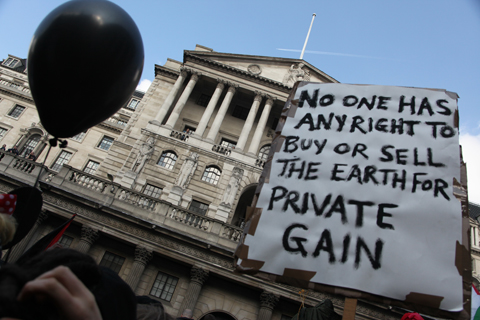
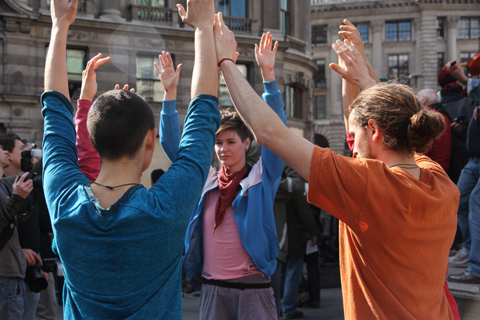

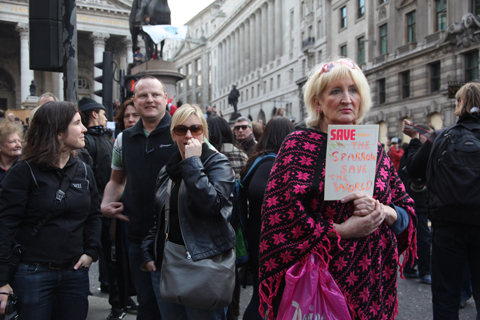


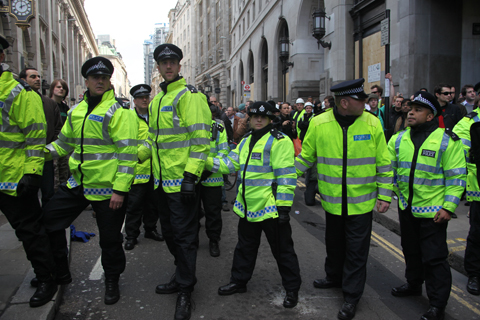
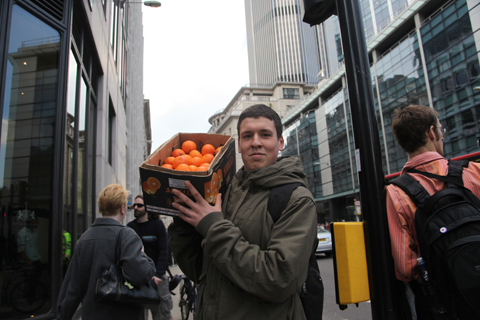


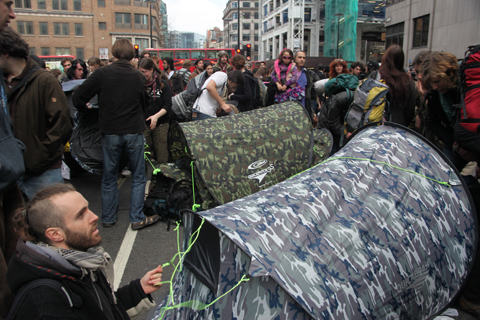


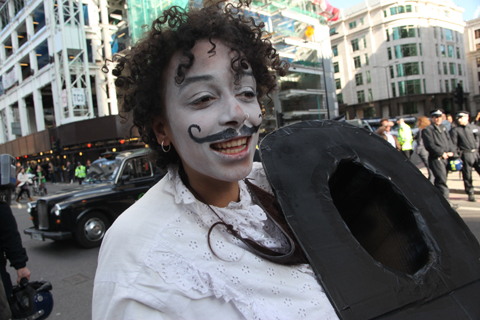
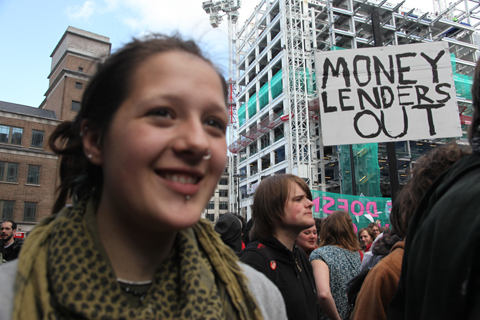
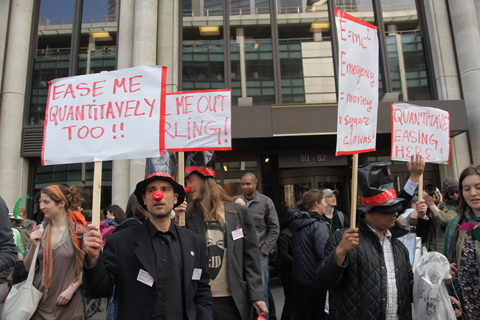


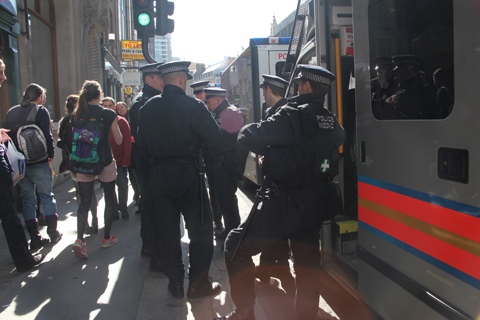


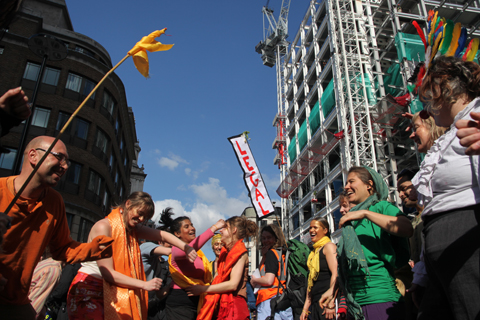


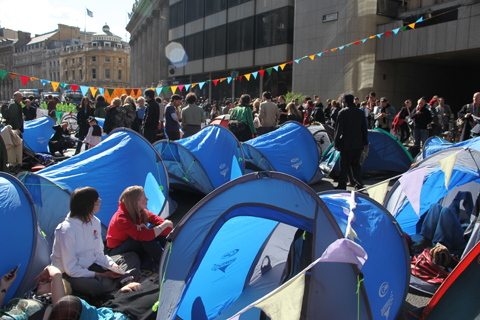


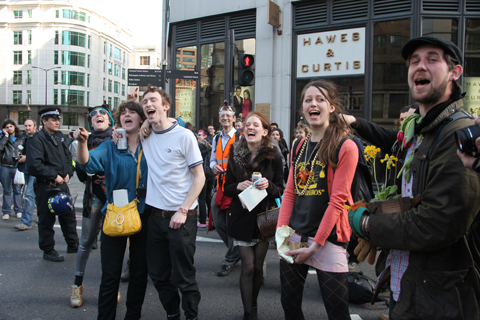


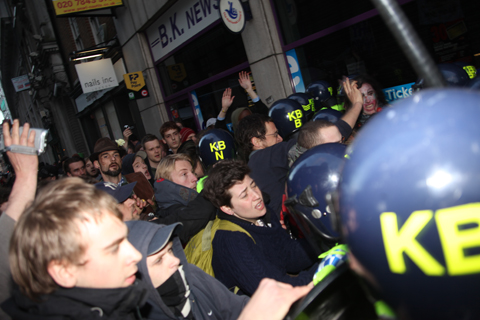


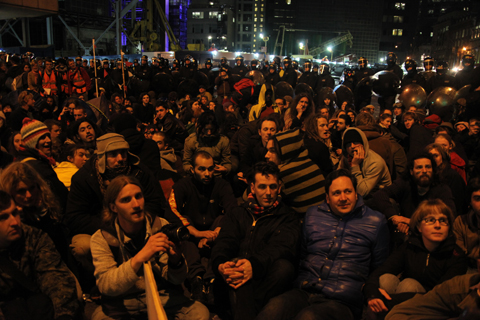


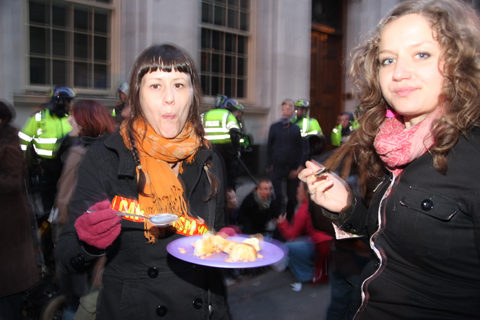


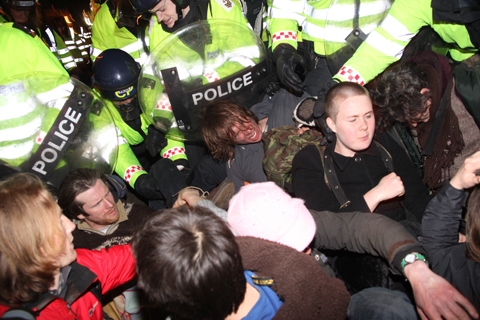


 UK Uncut gathers on the South Bank on Saturday 26th March 2011. All photography by Amelia Gregory.


 Inside Fortnum & Mason. They look super scared don’t they?


 visit web _Another_Level,