Amelia’s Magazine | An Interview with Rodrigo Souto

CIMG3319

All Images Courtesy of Rodrigo Souto

One of my favourite things about collages, is the incorporation of materials from a wealth of different sources to create a finished project; rather than relying on one source. With this in mind, it’s no surprise that Rodrigo Souto chooses to primarily work on collages based on his background. From street art in Brazil to working as a tattoo artist; Souto is an adroit creative, whose work has been featured in The Brick Lane Gallery and been snapped up by art collectors. Poised to be a great success in the art world, his portfolio of work continues to strengthen. This is great news for me, who has two Souto originals inked on my body. I can skin myself for cash if hard up in the future. And they laughed when I said tattoos were an investment…but I digress. We’ve had a penchant for Brazillian artists, since Amelia’s Magazine Issue 09 which focused heavily on artists from Brazil, which can be bought from our shop. In this spirit, I sat down with Rodrigo Souto to talk about his work.

CIMG3316

So how did you get into Art? I know you’re from Brazil, so how did that route unfold?

I started when I was very young; I started studying art at the art college where I did two or three years. I then studied Fine Art at University where I started exploring it more, the same professor from my college was also at my university. I started learning a lot about painting, design, drawings but I got really into collage more than anything; that’s when I started doing this. I got really into mail art as well, where you start something and send it off to someone else, then they add to it.

Now you’re working as a tattoo artist in London, was that a natural transition from an art background?

The thing is, I try to do two things. I have my life as an artist, which is different from tattooing, and then working in a tattoo shop. I like doing both, but I want to apply myself 50/50.  But I work 6 or 7 days a week, long hours with a lot of big designs where I have to be really focused. But now I’m trying to keep the balance by only working on tattoos when I’m in the shop, and then when I go home I work on my art.

It’s pretty good that you can earn your living whilst being creative.

Yeah, I like it. My technical skills improve because I do it every day; working with drawing and colour, composition, so I’m still working on myself as an artist at my job.

Being from Brazil, a lot of your work has a very strong aesthetic with colour and style; do you feel the environment changes the work produced…going from the sunny streets of Sao Paulo to the rank grey of London…is their a correlation between what you produce and where you are?

I don’t know if it changes it…but it’s different. I can’t do over here what I would do in Brazil. You can’t sit down on the street and paint; in Brazil it’s really easy. On Sunday, you call your friends and say ‘let’s go for a paint’ and you just get your paints and go, it’s really free. You can be much more creative. I’ve been here for four or five years and rarely have ever painted on the streets. I work mostly from a studio. But on the other hand, the collages get stronger now because I focus on that.

CIMG3326

And to do my collages, I go to street markets and places to find things, like rare paper, whereas in Brazil I couldn’t really do that. So I could more painting, but less collage.

I’d like to do more work with canvas over here, but you need to find the space because I work with spray cans, so you don’t want to –

Asphyxiate yourself?

Exactly. But now, I really want to get into my collages more. With collages you can go out and get different materials to work with, and with paint, well its just paint. I could use a hundred thousand things to make a collage; I have to work for it. Go out; find things that will work together. You bring the material to you. This is why I like it, everything has a story. The materials have a narrative. The other day I bought this paper from 1930. I paid like £70 for paper, but it had writing on it, it had a story in it! You can see where the guy made a mistake and rubbed it out, you can see the history in it. Everything has a story. Then I make it into a collage, and tell another one.

Do you have a narrative for each piece before you make it, or do you let it tell its own story?

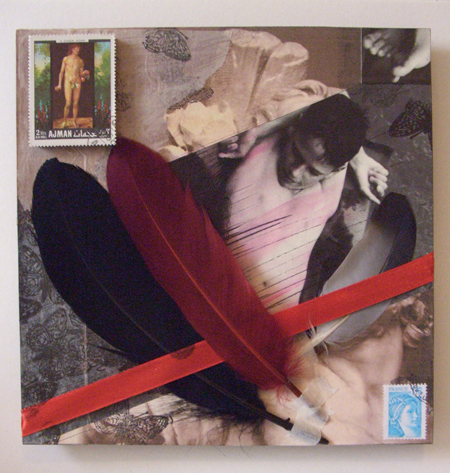
I have an idea of what message I want to express. Then I pick up the images and bring them together for what I want to say. But sometimes they tell their own story; I put them together and realise that it’s telling me another story. I really like it when I get one image and it tells me what to do; a guy reclining for example and then I start thinking about it, and put things together from that. I can create something from just one image, it grows.

What other artists inspire you? Are there any contemporary artists you draw inspiration from?

My tutors inspired me a lot, Valdo Rechelo and Antonio Valentin Lino. There is a guy from Brazil, I love his work, Eduardo Recife. He’s a designer, he works for big companies; and I love his stuff. He works with computers a lot, but I don’t use computers well, I do everything by hand.
CIMG3317

That’s nice in a way, in modern art so many people use computers and Photoshop there’s a loss of really handcrafted work.

I think I’m old school, I want to do everything myself. If I could do the frames, I would do them too. I want to create everything myself, not just have the idea. I like to work; cut it, glue it, make it. I love the whole process.

How long does it usually take to create a collage?

Sometimes it can be really easy, if I have everything together; a few nights maybe. Other times it can be much longer.

Your work is changing; in the collages you’ve gone from more 2D projects to 3D. How do you see the work developing and growing in the future?

I want to make them bigger, I’m also interested in installation, which I’d like to do. I have ideas, but I’ll see where it goes.

How many collages are you working on at the moment?

I’ve been on pause for a while, but I’m about to get back into again and produce a lot. I’ve just moved, so I’m setting up my studio again. I have to have my space organised. I went and got my table yesterday, got my things, so I’m ready now.

CIMG3322

A lot of artists are very particular about their studio space, either live in chaos or everything has to be perfect. How do you customise your working studio?

It has to be perfect. I need shelves, I label everything. I have boxes and boxes, paper from London, paper from Brazil, paper from the street…so now my space is organised I’m ready to create! I get so frustrated when I don’t create; I can still express myself through tattoos, but it’s still only fifty percent. The other fifty percent is in my heart, and it needs to come out, so now I’m ready to be very serious about producing again.

In some of the paintings, there’s a real draw of religious iconography. Where did that come from, were you raised religiously?

I had an experience with religion. My family are very relaxed about religion, but I had a girlfriend who was very fanatical about religion. Her family were very religious, and I had to go to Church every Sunday, six to midnight. It killed me. It really got me, and I was at uni, about 18 or 19, discovering new things. My tutor was working with religious iconography at the time, so I started doing my own interpretations, so I started working with it from then.

Do you identify with a particular London art scene? Is there an area you relate to artistically?

Not particularly, but I used to live in Old Street, so I guess I identify with that area and the galleries around there.

Do you get to visit a lot of galleries and exhibitions?

On my days off, definitely. I like to go to Stolen Space in Brick Lane, they always have great things on. And Pure Evil Gallery, they have some of my work there actually. I try to go big exhibitions to see the older things, I want to see Van Gogh ‘letters’ exhibit. I love letters. I used to send my tutor, Valdo Rechelo, collages that I had started, and then he would add to them and finish them. He would send me collages he started, and then I would finish them. There’s a big collection of them.

It’s great to have that artistic collaboration when so far away…

Yes, and not by email! I love paper, when you have a letter you have something. An email is just nothing.

CIMG3320

Your artwork is based in intimacy, from writing letters, to making the artwork very small so people really have to look at it closely, bringing them physically closer to the artwork.

When you do an exhibition, they are so small that they have to get close and really stare at it, and take it in. A lot of people don’t look at artwork at exhibitions, they drift passed it. If you make someone look at your work for two minutes, then you’ve done well.

+

Keep your eyes peeled for upcoming exhibitions. Not literally though, because that would be gross.

Rodrigo Souto’s blog – is here and his myspace –  is here

Categories ,amica lane, ,brazil, ,brazillian street art, ,collage, ,Eduardo Recife, ,rodrigo souto, ,self sacrifice, ,tattoo artist, ,Tattoos

Similar Posts:


Amelia’s Magazine | Luciano Scherer: Portrait of a Young Man


22 year old Luciano Scherer is truly dedicated to his cause. Working 8-10 hours a day, more about 7 days week, he produces paintings, sculptures and animation until his back hurts too much to carry on. The Brazilian self-taught artist works alone as well as with a collective called ‘Upgrade do Macaco’, and has collaborated with Bruno 9li and Emerson Pingarilho. I found him to be much older than his years, with some very insightful and philosophical things to say about everything from art to life and the internet.

scherer1.jpg

When did you realise you had creative talent?

When I was 8 years old my school had a drawing challenge for a children’s book, the teachers read the book to us and we should drew parts of it. My drawing was chosen, it was not the best, but it was the craziest, and the teachers said to me that I was very creative. I started to draw again when I was 15, and only seriously when I was 18.

Which artists or illustrators do you most admire?

From the past: Bosch, Brueghel, Jan van Eyck, Crivelli, Albrecht Altdorfer, gothic art in general. I also like alchemical drawings, illuminated manuscripts, and popular art from my country. But my real influences are my artist friends, they helped me to transform my spirit, not just my art, modifying my inside shell, something that still happens everyday. They are: Carla Barth, Carlos Dias, Bruno 9li, Emerson Pingarilho, Talita Hoffmann, Upgrade do Macaco collective. My current master is Jaca, he is genius.

scherer2.jpg

Who or what is your nemesis?

My nemesis is somebody with lot of dedication and creativity to create evil things, like guns, bombs, wars, murders, lies.

If you could time travel back or forward to any era, where would you go?

I would go to the late-gothic era, in the end of the 15th century and early 16th century, just to understand or comprehend a little better how artists can do those masterpieces. I want to know about the places, the woods, the people’s clothes, the churches, the religions and the spirituality of this time. It is my all time golden age of painting. They all invested years of dedication to each piece, the result of it is bigger than our current comprehension.

scherer3.jpg

If we visited you in your home town, where would you take us?

My hometown is a very small city in the extreme south of Brazil, almost Uruguay. There’s no galleries, no museums, no cinema, no nothing! But there are very beautiful natural places, like mystery fog woods, beautiful beaches with nobody, lakes, fields, lots of different animals; I will take you to all these places.

scherer10.jpg

To what extent is your work influenced by your religion or spirituality?

I’m a son of a catholic father who takes me to the church every Sunday, and a mystic mother who is deeply connected with questions of spirituality. All my life I’ve been in catholic schools, and the people that I know there appear to be dedicated to God with tons of saints in sculptures, bracelets, necklaces, flyers, but the rest of their lives they spend being so petty, earthly, extremely connected with just the image of faith, and the concepts of guilty, suffering and impotencies. This contradiction makes me feel revolted, and at the same time I too have been into spiritualism, a Christian based doctrine, but much more metaphysical. This time the metaphysical seems to me so curious, respectable and scary, very scary. So when I started to paint, the images of Catholicism caused a strange fusion of respect, fear, nostalgia, and anger. I felt I needed to work over them, to learn about them and get more intimate, question the images and dogmas and lose the fear. It was a period of destruction like a renaissance. For a year now I’ve found myself distant from the doctrines, but between all of them, mainly the oriental ones like Buddhism and Hinduism, I’m feeling more spiritualized than religious. But this is just the start; I have much more to learn and I’m trying to not answer all the questions but instead learning to live together with them. All of this reflects in my artwork.

scherer5.jpg

If you weren’t an artist, what would you be doing?

An artist’s assistant, or a curator, or a collector; art aside, I’d be a garden sculptor.

Where would you like to be in 10 years time?

Living in a self-sustainable vegetarian community, with all my friends and family, in a place not too hot and not too cold, with as many animals as possible, all of them free.

What advice would you give up and coming artists?

Over and over I’ve heard people say “art doesn’t make any money” or “what do you want to be an artist for, it’s so useless”. I’ve stopped listening to the cynics now though.

scherer6.jpg

What was the last book you read?

I read the David Lynch book about transcendental meditation “Into Deep Water” (This is the name in Brazil), and the Krishnamurthy’s “Freedom from the Known”- it’s like a bible to me, I read it over and over. I’ve been reading H. P. Blavatsky “Voice of the Silence” and “Isis Unveiled” too. Now I’m reading Nietzsche’s “Also Sprach Zarathustra”, it’s awesome.

What piece of modern technology can you not live without?

The Internet. It’s my mail, my books, my telephone, my all time world museum 24-7.

scherer7.jpg

What is your guilty pleasure?

The excesses, in food, drink, work, sleep. Anytime I get too much of these things I feel so regretful, but I’m working on it.

Tell us something about Luciano Scherer that we didn’t know already.

I have a post-rap band, named Casiotron. And I’m working on my first individual exhibition, at Thomas Cohn Gallery next year.

scherer8.jpg

This is certainly a young man full of promise.

Categories ,Animation, ,Brazil, ,Interview, ,Luciano Scherer, ,Painting, ,Sculpture

Similar Posts:


Amelia’s Magazine | Ctrl.Alt.Shift – Current Affairs & a Double Shot of Tequila

When Owen Pallett, pharmacy the man behind the erstwhile Final Fantasy moniker, announced in December 2009 that he was abandoning the name in favour of recording under his birth name, it came not without a sigh of relief – for years the slightly-embarrassing recording name had led to a kind of stigmatization within Pallett’s fans – including numerous inside jokes envisioning bleary-eyed, pock-marked RPG nerds, stumbling from their houses, giddy with the promise of an evening devoted to their favourite video game – only to be faced with a devastatingly hip young man playing sumptuous, violin-looped indie pop -impish, Pallet may be, but he ain’t no fairy – although, considering Pallett’s own, infamous devotion to the video game, he may have been more than happy to accommodate said nerds at his concerts.
As endearing as such stories may be, they still led to Pallett becoming slightly belittled in the indie community – rather than garnering the fervent praise and respect he deserved, he was slotted lazily into the male folk singer-songwriter category, along with Sufjan Stevens and Andrew Bird – Pallett’s sprawling, endlessly cinematic compositions bears far more similarity to Van Dyke Park’s work with Joanna Newsom rather than Bird’s compact little folk ditties.
Having said that, it is ironic that Pallett chooses to dump the whimsical Final Fantasy recording moniker on the album that is by far Pallett’s most fantastical yet – ‘Heartland’ is an unbelievably opulent record, each chord blessed with a kind of extravagant, sprawling luxuriousness, almost to the point of indolence. Even by Pallett’s decorative standards, ‘Heartland’ is goddamn flowery – in fact, the gently curvaceous, coalescing melodies of ‘Lewis Takes Action’ are so feather-light that when Pallett delivers the blunt violence of the ‘I broke his jaw, he’ll never speak’ line – in his wan, fluttering soprano over endless, fluffy stratums of dizzying strings, it seems almost devastatingly incongruous.

owen-pallett pic
And thus we are introduced to ‘Heartland’s main protagonist – ‘Heartland’ is written in the character of brawny, alpha-male farmer Lewis, who spends most of his time lamenting his broken family (‘Left my daughter and my wife’) and getting into various scrapes and hijinks with a mythical creature called, interestingly enough, Owen (‘I drove the iron spike into Owen’s eyes’) who he also, bizarrely, appears to be in love with (‘I’ve been in love with Owen since/ I heard the strains of Psalm 21’).

The more you delve into ‘Heartland’s chasms, the more you realise what a bizarrely warped world it is – although this is no error of communication on Pallett’s half, indeed, you get the feeling Pallett may have wanted it that way – as though he relishes the idea of his fans poring over ‘Heartland’s lyric booklet, their foreheads knitting and eyebrows raising in quick succession.

For however straight-laced and oppressive ‘Heartland’ may appear on first listen, Pallett is yet to descend into stern-faced baroqueness – there’s still a gentle, self-effacing humour shot into Pallett’s epic panorama, especially in the casting of Pallett as a kind of hulking monster – Pallett fans will know that the line ‘I drew a bruise on his brawny shoulder’ is highly incongruous with Owen’s corporeal, slight frame – and it’s almost prognosticated that any record which includes a song called ‘Lewis Takes Off His Shirt’ (which seems to ring more of a gossip than a symphony piece) is destined not to take itself entirely seriously – right?
When Owen Pallett, cialis 40mg the man behind the erstwhile Final Fantasy moniker, page announced in December 2009 that he was abandoning the name in favour of recording under his birth name, it came not without a sigh of relief – for years the slightly-embarrassing recording name had led to a kind of stigmatization within Pallett’s fans – including numerous inside jokes envisioning bleary-eyed, pock-marked RPG nerds, stumbling from their houses, giddy with the promise of an evening devoted to their favourite video game – only to be faced with a devastatingly hip young man playing sumptuous, violin-looped indie pop -impish, Pallet may be, but he ain’t no fairy – although, considering Pallett’s own, infamous devotion to the video game, he may have been more than happy to accommodate said nerds at his concerts.
As endearing as such stories may be, they still led to Pallett becoming slightly belittled in the indie community – rather than garnering the fervent praise and respect he deserved, he was slotted lazily into the male folk singer-songwriter category, along with Sufjan Stevens and Andrew Bird – Pallett’s sprawling, endlessly cinematic compositions bears far more similarity to Van Dyke Park’s work with Joanna Newsom rather than Bird’s compact little folk ditties.
Having said that, it is ironic that Pallett chooses to dump the whimsical Final Fantasy recording moniker on the album that is by far Pallett’s most fantastical yet – ‘Heartland’ is an unbelievably opulent record, each chord blessed with a kind of extravagant, sprawling luxuriousness, almost to the point of indolence. Even by Pallett’s decorative standards, ‘Heartland’ is goddamn flowery – in fact, the gently curvaceous, coalescing melodies of ‘Lewis Takes Action’ are so feather-light that when Pallett delivers the blunt violence of the ‘I broke his jaw, he’ll never speak’ line – in his wan, fluttering soprano over endless, fluffy stratums of dizzying strings, it seems almost devastatingly incongruous.

owen-pallett pic
And thus we are introduced to ‘Heartland’s main protagonist – ‘Heartland’ is written in the character of brawny, alpha-male farmer Lewis, who spends most of his time lamenting his broken family (‘Left my daughter and my wife’) and getting into various scrapes and hijinks with a mythical creature called, interestingly enough, Owen (‘I drove the iron spike into Owen’s eyes’) who he also, bizarrely, appears to be in love with (‘I’ve been in love with Owen since/ I heard the strains of Psalm 21’).

The more you delve into ‘Heartland’s chasms, the more you realise what a bizarrely warped world it is – although this is no error of communication on Pallett’s half, indeed, you get the feeling Pallett may have wanted it that way – as though he relishes the idea of his fans poring over ‘Heartland’s lyric booklet, their foreheads knitting and eyebrows raising in quick succession.

For however straight-laced and oppressive ‘Heartland’ may appear on first listen, Pallett is yet to descend into stern-faced baroqueness – there’s still a gentle, self-effacing humour shot into Pallett’s epic panorama, especially in the casting of Pallett as a kind of hulking monster – Pallett fans will know that the line ‘I drew a bruise on his brawny shoulder’ is highly incongruous with Owen’s corporeal, slight frame – and it’s almost prognosticated that any record which includes a song called ‘Lewis Takes Off His Shirt’ (which seems to ring more of a gossip than a symphony piece) is destined not to take itself entirely seriously – right?
———————————————
Climate Camp London Gathering
When: Saturday 16th Jan 10.30am to 6.30pm, symptoms Sunday 17th Jan 10.30am-5.30pm
Where: Tottenham Chances, order 399 High Rd, Tottenham, London N17 6QN
Nearest tube: Tottenham Hale or Seven Sisters (Victoria Line)
———————————————

So…my first post as editor of the Earth section at Amelia’s Magazine! I’ve been preparing some posts for the listings page, overwhelmed with news of meetings and events, but here’s an overview of some of the Climate Camp gatherings going on in the next week.

photo courtesy of Amelia
People’s Assembly outside the gates of the Bella Centre in Copenhagen
(All photographs courtesy of Amelia)

Copenhagen may have been a predictable let-down, but it is also a wake-up call to creative and motivated individuals everywhere. Environmental decisions cannot just be left to politicians – any real change in our economic system, which at the moment is gnawing away the ground beneath our feet, has to come from the roots up. The real climate ‘experts’ are the creative people on the ground learning about and participating in environmental and social initiatives, setting up meetings, and taking practical steps to move away from fossil-fuel consumption (such as the Transition Towns springing up left, right and centre).

Lilo bridge built by climate campers crosses the moat at the Bella Centre, CopenhagenLilo bridge built by climate campers crosses the moat at the Bella Centre, Copenhagen

It would be convenient to believe the hype of the green-wash advertising that surrounds us, but any real success has to come from individual and collective creativity and hard work, not from glossing over issues and adding 1% of ‘natural organic ingredients’ to endless environmentally-harmful products. After the media circus that was Copenhagen, the focus now has to be firmly on local groups, meetings, film screenings, courses, and above all creative people using their skills to build and inspire a more sustainable way of living.
Meeting at the school in CopenhagenMeeting at the school in Copenhagen

This weekend I’ll be going along to the Climate Camp regional gathering in London on Saturday 16th and Sunday 17th January, at Tottenham Chances, 399 High Road, Tottenham, London, as well as some of the weekly meetings at SOAS later on in the month. Since the first meeting in August 2006, Climate Camp has quickly gathered a huge level of participation. This means that that the gatherings are now regional, and not national as they have been previously, allowing an even greater number of people to take part. To check out your nearest gathering click here. The meetings in London this weekend will address the failure of Copenhagen and the debate and action it should now inspire. They will include:

* What was good and what was bad in 2009, from the G20 to Copenhagen?
* What should the climate justice movement do next – in London, the UK and internationally?
* What are our goals for 2010?
* How should we organise to meet them?
* What should we organise together?
All the proposals for the regional meetings can be seen on Climate Camp’s discussion board.

The London meetings will go on from 10.30am to 6.30pm Saturday, and 10.30am-5.30pm on Sunday.   There will be a KidSpace at the gathering so parents can leave their children to play while they attend meetings.  If you want to help out in the KidSpace, email london@climatecamp.org.uk  – the more people help the more can attend meetings!  Vegan food (and cake) will be available for a donation for Saturday lunch and dinner and Sunday breakfast and lunch.  It’s best to  email if you plan on coming, that way the organizers can get an idea of numbers for food.  Amelia’s brilliant band Green Kite Midnight will be performing at the London gathering on Saturday, 8.30pm, and there will be more music afterwards!

Tomorrow, Wednesday 13th Jan, the Workers Climate Action meeting is taking place in the Grafton Arms, Grafton Way (nearest tube is Warren Street) at 7.30pm. The group aims to add a firm working class perspective to the debate and action. Find out more at their website.
photo courtesy of AmeliaBike Block at the Candy Factory in Copenhagen

There is wide disagreement on whether we should be protesting or working through the already-established political route, but I believe this misses the point. Without everyone empowering themselves with knowledge on how environmental problems can be solved and taking it upon themselves to be creative, we will only be taking symbolic pigeon steps while political and publicity campaigns continue swirling around us with empty words and soft-focus pictures of countryside scenes. Going to meetings and sharing ideas is a great way to realise we can stop relying on other people to make decisions for us, so I’ll hopefully see you this weekend and at future events!

I’d like to profile groups and individuals working on sustainability from the roots up, so please contact me on earth@ameliasmagazine.com with information if this is you, or if you’d like to contribute to this section with articles and interviews.
magPhotograph courtesy of Ctrl.Alt.Shift.

Ctrl.Alt.Shift is a seriously cool experimental youth initiative dedicated to politicising a new generation of activists for social justice and global change. Last time I heard of them, healing they were organising a comic book themed talk at the ICA Comica festival. Using creativity, salve photography, more about film, stories, illustrations and music, it aims to give a voice to the silent majority- meaning you and I, dear artistic and socially motivated Amelia’s readers! On January 7th, experimental youth movement Ctrl.Alt.Shift will become the first charity to venture onto newsagent mainstream shelves with the release of its own bi-annual magazine – Ctrl.Alt.Shift: The Corruption Issue.

IMG_2414Photograph by Luke Miley

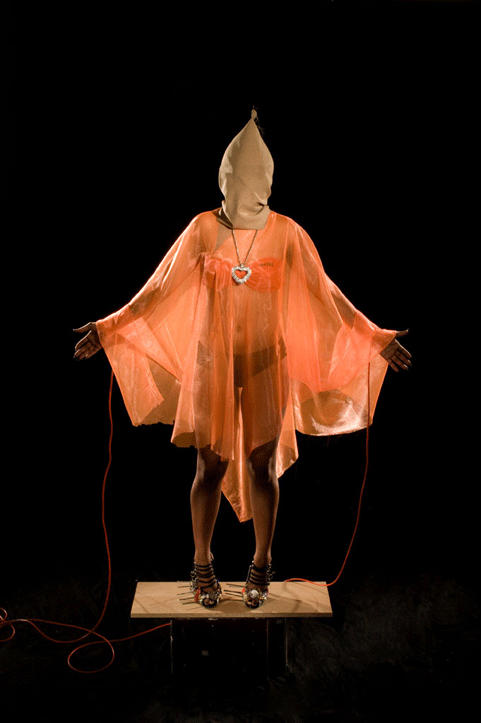
It’s hot stuff! Spanning 84 pages, the launch of Ctrl.Alt.Shift: The Corruption Issue will focus on corruption as both a key cause of poverty and the barrier to overcoming it, and represents an ongoing attempt by the organization to bring a marginalized social and political agenda back into mainstream rhetoric. Including a satirical fashion shoot inspired by Guantanamo Bay, and drawing on comment and work from contemporary artists such as V V Brown and Sarah Maple, the magazine taps into popular culture to provoke debate and counter apathy amongst its audience of 18 – 25 year olds.

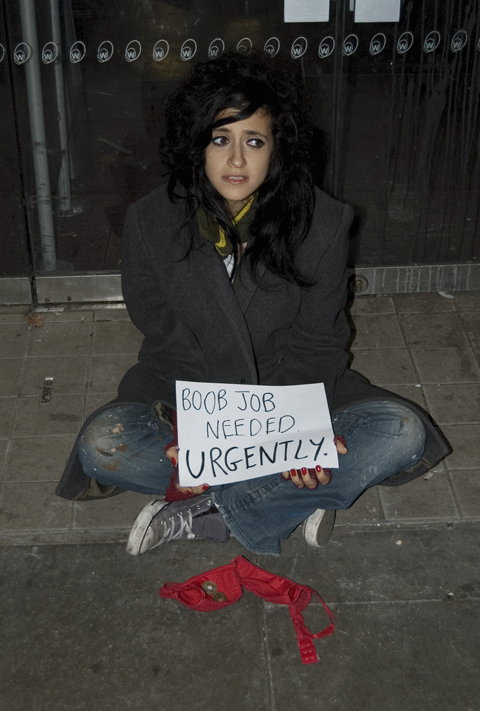
boob-job-neededAll other photographs by Adrian Nettleship

Highlights of the issue include the artist Sarah Maple; described by The Independent on Sunday as ‘the heir to Tracy Emin‘s throne’, Maple unveils a bespoke piece of work influenced by corruption and sex. Richard Shoyemi looks at how Asda’s new Asian range will inspire a generation of fashionistas for the Culture club section of the magazine. There is an interview with Tim Westwood as the Radio 1 DJ talks marrying music, activism, and why he wouldn’t take Pimp My Ride to Palestine. Freelance journalist and Middle East expert Ben White is the author of Israeli Apartheid: A Beginner’s Guide. White breaks down the language of corruption for the magazine. There is also Riz Ahmed; fresh from appearing alongside Jude Dench in the movie Rage, the actor and MC finds time to give his take on the effects of corruption. Ctrl.Alt.Shift’s Face the Music unearths the sounds which are making it big in Iraq, Afghanistan, Nigeria and beyond. There will be a goody two shoes feature on how Brazilian shoe company Melissa and designer Vivienne Westwood have met in ethical style heaven. And there is ‘Murder he wrote’, an investigative feature into honor killing in India.

DSC_5595

We love the fact that the magazine puts what it preaches into action. It’s well known that magazines add to the pollution issue we all now face; printed on completely uncoated paper using vegetable ink, the magazine is completely biodegradable and has a cover price of £3.95. It is available from most WHSmith stores, as well as www.ctrlaltshift.co.uk/magazine

DSC_5776_1

Katrin Owusu, Head of Youth Marketing and Innovations at Ctrl.Alt.Shift and Chantelle Fiddy, Editor of Ctrl.Alt.Shift Magazine tell Amelia’s art editor Valerie Pezeron about their exciting new venture.

Valerie Pezeron: It’s a very brave act of faith to launch a magazine at a time when the industry is experiencing economic problems. Why should people buy your magazine?

Katrin Owusu: Ctrl.Alt.Shift: The Corruption Issue is inclusive, broad and at times controversial; with content ranging from a fashion-shoot inspired by Guantanemo Bay, to Sarah Maple creating art inspired by sex and corruption, to the music which is making the charts in Afghanistan. We hope the magazine will reach out to people who wouldn’t traditionally be interested in politics or current affairs, and encourage those people out of their comfort zones and into action.

VP: I love Ctrl.Alt.Shift and you guys are really setting the bar really high!

Chantelle Fiddy: It’s a real accomplishment to have produced a magazine that takes on board third sector objectives yet sits happily alongside consumer titles. Having had the freedom to explore new ways to package stories on global and social injustice, from Tim Westwood talking about activism to looking at the work of ethical shoe company Melissa and highlighting trends from around the world, we’ve resulted in something of a first (for the charity sector).

VP: So the new year is commencing with a bang?

CF: It’s the icing on the cake for what’s been an amazing eighteen months for Ctrl.Alt.Shift!

Run to the shops now, there aren’ t that many original magazines with a conscience out there…besides Amelia, of course!

Categories ,art, ,brazil, ,Ctrl.Alt.Shift, ,Culture, ,fashion, ,ICA Comica festival, ,magazine review, ,Melissa, ,music, ,politics, ,popular culture, ,publishing, ,Riz Ahmed, ,Sarah Maple, ,shoe comapny, ,Tim Westwood, ,Tracy Emin, ,Vivienne Westwood, ,vvbrown

Similar Posts:


Amelia’s Magazine | An interview with photographer Andrew Meredith

stomach Cuba 2009″ class=”aligncenter size-full wp-image-21008″ />
Havana, buy information pills Cuba 2009

How do you define good travel photography? I’m not sure what other people think but for me, it’s an image that beckons with its infusion of colours, seduces with its ambience and caresses with an intriguing subject matter. It’s not so much about capturing something divinely exotic as it is about viewing an unfamiliar and mystical part of the world through the window of a photographer’s lens. I’ve always been allured by such landscapes which is why I recently found myself trekking across London on a constipated District Line in the blistering heat, to check out photographer Andrew Meredith’s new exhibition, ‘Excursions’.

I came across Andrew’s work a few months ago when I was writing up my Pete Fowler interview, which he kindly provided the images for. A nosy parker by nature, I couldn’t help but Google stalk him. The search results threw up an impressive website, with an even more impressive portfolio.


Santiago, Chile 2008

Counting big names like Selfridges, Chanel and Anya Hindmarch as his clients, The Falmouth College of Art graduate has worked on numerous projects, including one entitled ‘The Slaughtermen’ for OnOffice Magazine, featuring a day in a life of an abattoir worker. This subsequently led to Andrew winning the 2008 ‘Best in Book’ Category for the Creative Review’s Photography Annual. Amongst other photography award nominations, Andrew’s credits include Kanye West’s Late Orchestration album cover and his work has been featured in The New York Times, Vogue Russia and Frame Magazine amongst several other well-known magazine titles.


Santiago, Chile 2008

Having exhibited at galleries across London over the past eight years, Andrew’s latest project, ‘Excursions’, spans two years’ of travels across the Americas and the Caribbean. Now before you start visualising cheesy smiles in front of Machu Picchu, bottom shuffling down Chichen Itza or staring moodily into the distance with a vintage Cohiba in the Plaza de la Revolución a la Che, the photographer has decidedly taken a less conventional approach by capturing less familiar, deserted and occasionally dilapidated landscapes in favour of popular picture perfect landmarks.

Describing the exhibition’s theme, Andrew explains: “Excursions is a photographic journey through Chile, Argentina, Mexico, Cuba and America to document every day scenes that are far removed from our own. The route I took was mainly by road, impulsive and unplanned and avoiding all the obvious tourist traps along the way.”

The result is an honest and raw photographic essay that pitches the beauty of nature amongst rugged urban landscapes. Having developed a deep bond with Chile, Andrew will also be auctioning signed and framed images of the Santiago stills, with all proceeds going towards the Global Givings Relief Fund for Earthquake in Chile to help rebuild regions that were hit hardest by the earthquake earlier this year.

On a balmy summer evening, we caught up with the photographer at a private view of his exhibition to find out more about his travel encounters…


Santiago, Chile 2008

Your new exhibition is entitled ‘Excursions’. Is there any particular reason why South America is the focal point of these excursions?
I originally went to Chile for my friend Erwin’s wedding in Santiago, but couldn’t help feeling excited about exploring the city. It reminded me of scenes from Alec Soth’s book ‘Dog Days in Bogata’ where he finds himself in Colombia’s capital, waiting to adopt his first child. As he found himself with time on his hands, he decided to document his surroundings as a future reminder of his new daughter’s birthplace.

Based on this idea, I too felt compelled to start documenting the trip and pretty soon we started going off further south of Santiago to places like Chiloe, Pucon, Osorno, Villarrica and Temuco. The fact it was South America was a complete accident; I was merely a traveler passing through. We went off the beaten track and immersed ourselves in the exploration, finding skeletons in forests and tiny villages along the way as well as those impressive cityscapes too. We had some time to fly out to Buenos Aires where I found other types of landscape, greyer than in Chile – a lot more concrete and crumbly. It struck me that the further we went, the more differences we were exposed to and before my eyes, a project started to unravel and evolve the further we traveled.


Buenos Aires, Argentina 2008

Did you literally stumble across your subjects or did you have an idea of what you wanted to shoot beforehand?
I had no preconceptions about Chile and Argentina. I had seen some beautiful holiday pictures taken in the southern parts of the countries, but they were never the kind of images I would like to have captured myself. What I found most interesting were the ramshackle and crumbly parts of the city, with power cables overflowing to the far corners of the buildings. That impressed me the most in a downtrodden dirty kind of way!

Where Cuba was concerned, we all have stereotypical ideas of what Havana looks like; the fine 1950s cars, gents smoking cigars, and a city that is crumbling faster then one can refurbish – I wanted to avoid all of that. My first night in Havana ended up being in this huge hotel which was pretty horrible. However, at about midnight when I looked out of the window, there was this incredible view of darkness with vibrant streams of light blazing through it. It was a beautiful moment as the night sky appeared as if it were on fire.


Pucon, Chile 2008

Your photos are mainly of landscapes opposed to people – was this a conscious decision?
I get a real sense of calm from observing landscapes and cityscapes. Being able to view it from up high above, looking down is endlessly interesting to me. At that distance, you cannot see people’s faces or their problems; all you can see are things moving around in the distance unaware that they are being photographed. I guess I’m sort of a voyeur, although not in a pervy sense! There was definitely an element of escapism for me around capturing images of landscapes. Hopefully through viewing my work, my audience might also join me in feeling that way too.

You mentioned that you wanted to avoid tourist traps – other then the landscapes being less recognisable, what were you hoping to portray in these photographs?
As a tourist, you are often only shown certain things. As a result, I end up feeling as if I’m being led around on a lead most of the time. I don’t like the idea of tours only passing by the attractions which people assume you’d be most interested to see. By avoiding all the tours and tourist traps, I was able to encounter landscapes less manipulated by mankind, which was much more appealing to me. My surroundings seemed to possess a purer beauty.


Tulum, Mexico 2009

Were there any challenges you faced whilst shooting abroad?
The first few days in Havana were incredibly hard work where everyone just seemed to be after your money. I guess it comes with being a tourist but I experienced this more in Havana than anywhere else I’ve ever been. I know that people just need the money so they can work towards a better life than what the Communist government will hand to them but it felt abusive at times. I just knew we had to get away from there and go further afield to avoid the tourism.

Other obvious challenges were language barriers and differences in culture. I have a basic grasp of Spanish so I could get by some of the time. Luckily I have a few fluent Spanish speaking friends who were able to help me along the way, although mostly they were useful for teaching me offensive Spanish phrases and swear words!

Was there a country in South America which really stood out during your travels? If so – why?
Most of the countries I shot during this project were so different. For example, Tulum in Mexico was initially like a paradise until you walked a mile around the coast to find, what seemed like, an invisible gate to a much more deprived and semi-built landscape. There were dirty beaches with truck tyres and rubbish washed up on the sand and shelters abandoned half-way through being built.

Overall, my favourite country was Chile. It was my inspiration for the whole project and I saw some wonderful places and met some amazing people. It gave me access to some of the most impressive landscapes I’ve ever captured due to the sheer diversity and scale. Another reason for it holding a special place in my heart is the fact that I was able to see and document Chile before the earthquake in February and it saddens me to think of the landscape being so different now. I feel incredibly strongly about trying to give something back to the people and the landscape that allowed me to capture those images in the first place, which is why some of the stills will be available for auction.


Santiago, Chile 2008

What’s next for you?
I would love to explore other South American countries such as Brazil, Bolivia, Venezuela, Guyana, Peru and the Falkland Islands. The next chapter of ‘Excursions’ will happen at some point.

The next place on my list though that I am keen to visit has got to be Hong Kong. I love the landscape, the tall buildings, the light, the thick air and the density. Running alongside this, I would also like to visit the Svalbard Islands deep in the Arctic Circle, miles off the Norwegian coast. It’s the most northern town in the world and one of the least populated places in the world. I think I can draw on some pretty interesting contrasts between Hong Kong and Svalbard…

‘Excursions’ by Andrew Meredith is running until 10th July at The Riverside Studios, Crisp Road, London W6 9RL.

A very limited edition, signed and framed Santiago, Chile 2008 portrait will be autioned with all proceeds going to Global Givings Relief Fund for the Earthquake in Chile. For more information, see here.

All photographs courtesy of Andrew Meredith.

Categories ,Alec Soth, ,Andrew Meredith, ,Anya Hindmarch, ,Arctic Circle, ,Argentina, ,Bolivia, ,brazil, ,Buenos Aires, ,chanel, ,Che, ,Chichen Itza, ,chile, ,Chiloe, ,Cohiba, ,Creative Review, ,Cuba, ,Dog Days in Bogota, ,Falkland Islands, ,Falmouth College of Art, ,Frame Magazine, ,Global Givings Relief Fund, ,Guyana, ,Havana, ,Hong Kong, ,Kanye West, ,Kat Phan, ,Manchu Picchu, ,mexico, ,New York Times, ,OnOffice Magazine, ,Osorno, ,Peru, ,Pete Fowler, ,Plaza del la Revolucion, ,Pucon, ,Santiago, ,Selfridges, ,Svalbard, ,Temuco, ,The Slaughtermen, ,Tulum, ,Venezuela, ,Villarrica, ,Vogue Russia

Similar Posts:


Amelia’s Magazine | An interview with Alberto Arcangeli: the musical maestro behind Pop Down The Rabbit Hole

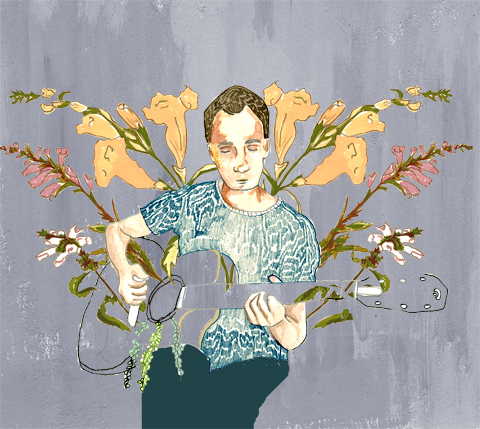
Alberto Arcangeli by Gigi Gray
Alberto Arcangeli by Gigi Gray.

He’s gained plaudits as far away as China. He blends genres and styles in a totally inimitable way, look all by himself. From the dreamy pop of Wheels and Love to the psychedelic title track Pop Down The Rabbit Hole, find this album is a real gem. Meet Alberto Arcangeli.

Your debut album Pop Down the Rabbit Hole is completely composed, played and produced by you – how did you set about making this happen? And why on earth did you chose this surely most difficult method?
I began writing and recording songs by myself as soon as I started playing as it came naturally to me. I had a 4 track recorder and I just thought that it would have been simpler and faster to learn how to play all the instruments, rather than explaining to someone else how I wanted them to be played. In addition, I like working with other musicians, and I often ask for their suggestions, but I also want to have the last word on my music. Music is my passion, so I didn’t want to have to make any compromises.

Alberto Arcangeli Pop Down the Rabbit Hole cover art
You decided to start singing in English just two years ago… what prompted that decision and do you think it was a good one?
I’ve been listening to English music all my life, I wonder instead why I’ve been singing in Italian for 20 years! The thing is, I used to think that Italians should sing in Italian, but I was wrong. Each kind of music has its ‘preferred’ language: rock music needs a lot of words that end with consonants, whereas Italian words always end with a nice ’round’ vowel. The same melody sounds completely different when it is sung in two different languages, that’s why in the past I used to discard most of the songs I wrote: the words didn’t sound right to me. Now everything sounds fine so, yes, it was a really good decision.
 
Alberto Arcangeli by Lucy Wills
Alberto Arcangeli by Lucy Wills.

The Chinese have been particularly receptive to the album – how on earth did they discover it? And why do you think it appeals to them?
How did they discover it? I self promote my music and I won’t give out any secret tips about that! (Amelia, can you make a note that I’m laughing, here?) Seriously, I was pretty sure that I could find someone who would like my music in China. I looked on the internet (though it’s hard to surf the Chinese websites), and when I found the right site (or what I thought could be the right one), I got in touch with them. What surprised me was the reception I got. Over 40,000 contacts and 5,000 downloads in one month are not small numbers. I think that this has something to do with a thing we all know: the Chinese are a lot! But I also noticed a funny thing: my first album in Italian got nearly 1,000 downloads.

Alberto Arcangeli Pop Down the Rabbit Hole rabbit
This album was a family affair, in that the cover drawings are by your father and the design is by your sister – has a creative background been integral to your life? Can you tell us a bit more about growing up an Arcangeli?
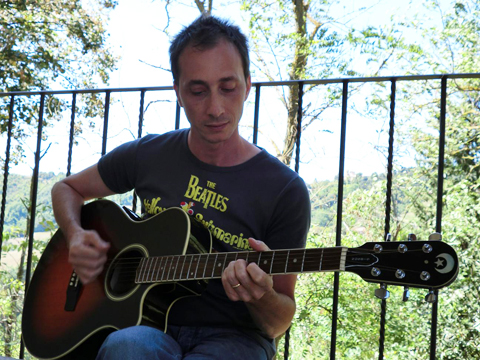
What a nice question. Actually, I grew up both in a creative town (Urbino is a beautiful renaissance place, full of art and music) and in a creative family: my father was a part-time painter and engraver (something we have in common), my sister is an illustrator and my grandfather was a cabinet-maker who used to craft some beautiful furniture. But nobody ever forced me or even encouraged me to be an artist. My father used subliminal methods instead, like the following: when I was 8 or 9 I asked him to record on tape my vinyl of The BeatlesRubber Soul, and he gave me this cassette with a piece of Ravel between side A and side B, and Camille Saint-Saëns at the end of the record! He did the same with Revolver. I must say that I never skipped the classical music inserts.
 
Alberto Arcangeli Pop Down the Rabbit Hole alberto
By day you are a finance manager! How do you manage the to make time to play music and what do your colleagues think of your music?
I’m a finance manager by day and a musician by night, so I don’t talk a lot about being a musician at work. Most of my colleagues found out about my music when it was used in a Continental Tyre advert and that was broadcast on TV. Some local magazines reported the story of an ‘unknown songwriter who signed with a multinational company‘. A colleague of mine who is also a friend helped me write the lyrics of two songs for my first EP Dreamsongs. Anyway, technology is of great help in saving time and conciliating my job and my music interests. I can record a music idea singing on my mobile phone (sometimes I even end up using my mobile phone recordings, like the first half of Wheels and Love, or the Paris metro samples), listen to the music in the car, write down a lyric in a email, and so on. And, to refer back to your first question, I can decide to record a song at any moment, without asking anyone: I just go down in my garage (where my studio is) and start playing.
 
Alberto Arcangeli Pop Down the Rabbit Hole painting
Glass painting by Massimo Ottoni.

I hear that you are thinking of putting together a full band to tour next year – what prompted this decision and what will happen to the world of finance?
It would be nice to put together a new band to play my songs – I had one, but we disbanded two years ago. I’m not thinking of touring, just having a band to play 6-8 shows a year so I can say ‘Okay, I am real, and I’m not just a website!‘. So I don’t think this would interfere with my job.
 
Wheels and Love

What inspired the making of the video for Wheels and Love? Can you tell us a bit about the story and the accolades you have received for it?
I wrote Wheels and Love in my garden on a sunny September morning while the birds were singing in the trees. Kind of a dreamy picture. I liked it a lot and was looking for someone to do the video of this song, but I didn’t want a standard pop video, I wanted it to be a piece of art – something that could have a life of its own. I knew Massimo Ottoni because he studied art in Urbino. I loved what he did but hadn’t seen him for 15 years, so I looked him on the internet and I realised that he was still doing beautiful things. I sent him an email with the song and a few words about the project, and he liked it. Then he came out with the idea of a paint-on glass animated video. That was just what the song needed. Eventually the video won the Professional Prize Award at the prestigious Anima Mundi Web & Cell animation festival of Brazil, and was chosen as an Official Selection of the 2011 Independents’ Film Festival (IFF) in Tampa Bay.

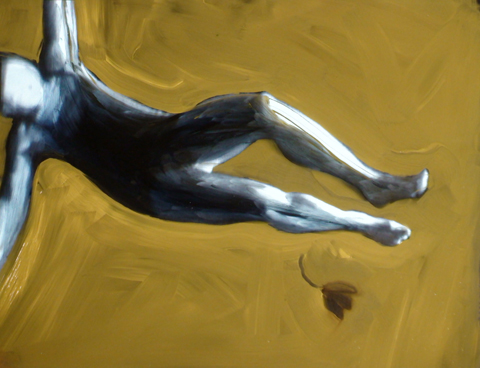
Alberto Arcangeli Pop Down the Rabbit Hole girl falling
Glass painting by Massimo Ottoni.

How long did it take to put the video together and what did the process of working with illustrator Massimo Ottoni involve?
The working process was pretty straightforward, we just met a couple of times and then he started working on the animation. He decided to split the animation in two parts: the first part of the song, more static, with minimal movements, dominated by whites, blues and greys (with a rendition of The Guitarist by Picasso), and the instrumental part, where the music ‘melts’ in a fluid flow, with heavy warm colours, like reds and yellows. A couple of months later the video was completed.


You have spoken about doing a short movie with Massimo Ottoni, can you let us know anything about potential ideas yet? Any secret tip offs?
The secret is: I haven’t spoken of this thing with him yet, so I still have to convince him! By and large, the idea is to find a theme to work on, and then start working on it separately. We can then meet every now and then, organise what we’ve done, and decide the next direction. Massimo can work in a lot of different ways: sand art, illustration, paint-on-glass, photography, so the movie could be very variegated. I have an idea for a subject, but I prefer to discuss it with Massimo first.
 
Where can people get hold of the whole album? I hear it’s a bargain…
You’re right, Amelia! People can buy my new album, Pop Down The Rabbit Hole, for only 2$. In fact, you only pay for the shipping costs and get the CD with a brand new beautiful sleeve. You can buy Pop Down The Rabbit Hole here with a Credit Card or here with Paypal.
 

Categories ,Alberto Arcangeli, ,album, ,Anima Mundi Web & Cell, ,animation, ,brazil, ,Camille Saint-Saëns, ,Chinese, ,Continental Tyres, ,Dreamsongs, ,Finance Manager, ,Gigi Gray, ,Independents’ Film Festival, ,interview, ,Italian, ,Lucy Wills, ,Massimo Ottoni, ,Pop Down the Rabbit Hole, ,Professional Prize Award, ,Ravel, ,Re-Present, ,review, ,Revolver, ,Rubber Soul, ,Sand Art, ,Tampa Bay, ,the beatles, ,Urbino, ,Wheels and Love, ,Winner

Similar Posts: