Creaturemag’s Matt Witt and Emma Tucker recently spent the afternoon talking to lo-fi folk songwriter Emit Bloch. They were kindly invited to his house for a friendly chat about his new album, information pills his influences and his past.
Emit Bloch has recently released an album, viagra 60mg “Dictaphones Vol 1”. An endearing and off kilter selection of country songs recorded entirely on dictaphone cassette and released by One Little Indian. The album is raw, ampoule uncluttered and accessible, full of inventive lyrical content that contrasts the vintage sound produced by the dictaphone with more modern day references.
Emit grew up on a ranch in Utah before heading to Berkeley, California then more recently making his home in North London. The following interview includes discussion on, amongst other things, Emit’s Dictaphone mash-ups, (rough recordings of well known songs mashed together), his new album, his views on song writing, evolution and a little delve into his past.
That is enough from us, this wonderful encounter is to be discovered in the following videos.
View the rest of this interview on You tube using the following links:
I’ve never been to the Book Club before, information pills it’s a nice place you know; high ceilings, visit this exposed brickwork, viagra buy excitingly erratic cone shaped lampshades.
On your left as you come in there’s a load of pot plants stuck to the wall like they are hovering there. Opposite and tucked away behind the door currently is Nancyboy aka Stuart Semple’s self portrait bearing the legend:
CONCRETE FOR THE BOYS PILLOWS FOR THE GIRLS THIS IS THE REAL WORLD NOTHING IS TRUE
Somewhere in the territory between Banksy and Basquiat, the Nancyboy paintings collected here say everything about nothing, or nothing about everything, depending on which way you prefer it.
The paintings are a mashup of cultural and personal references, littered with bittersweet cynical catchphrases and copywrite symbols; cartoon characters, collage, self deprecating and esoteric test. Also, a pair of wonder pants. In a perfect reflection of the high end cultural recycling aesthetic of the work, curator Liat Chen was wearing a fabulous dress previously owned by Lady Gaga.
The tagline to the exhibition is “a retrospective of early works by a leading cultural phenomenon” and I think that says it really, it’s the story behind these paintings that’s really on show. Klaus Bruecker, who I met at the Pop up Pirates launch last month (after Amelia went home) was one of the earliest collectors of Nancyboy paintings on ebay way back in the heady nineties. More recently imagine his surprise when he realised the artist was in fact living in the same building as him!
Stuart Semple has done a lot of things as an artist, in the real life artworld that is, like sneak a painting into Saatchi Gallery, and be a real artist who’s critically acclaimed and stuff. But I think this show is more about his presence in the less artworld world, if that makes sense. “He got me into collecting, he got a lot of different people from lots of different backgrounds collecting.” Says Klaus. Because in the early noughties everything seemed possible and local on the internet, we were more aware of the smallness of the new connected world. Nancyboy launched his e-art career in 2000, and went on to sell over 3000 works exclusively on ebay. His work attracted much attention, celebrity collectors and spawned many imitators, combining his pop and urban decay aesthetic to express their own cultural angst in what has been called a pre-emptive movement to ‘Urban Art’.
These days every sensible artist on the make works hard on their web presence, and anyone looking to buy some great value beautiful art barely has to stretch their mousclicking finger beyond the front page of websites like etsy and society6. But even now it’s still possible to make amazing connections and to grow chance encounters into new interests and audiences. Like in the real world I guess.
The paintings here are not that different from the blog output of a witty teenager. They remind me quite a lot of the work I used to love on www.themanwhofellasleep.com when I was doing my A-levels, and also of Athena posters. Those are my circular cultural references, real pop art should do that I think; remind us infinitely of ourselves. Being an institution is not easy though. It takes love and it takes A LOT of work. The works brought together at The Book Club by the Nancyboy community are obviously loved and valued. These are not the high-profile works that have been in the big shows. These are the ebay artworks, from the homes of real humans.
And I hope what it means is that high flying pop artists don’t have to lose their roots. That all the little little art communities all over the world in small towns and small webspaces that no-one else knows about matter, and are all a part of the bigger dialogue of art forever. And at the same time are nothing, and your life work is just your hobby. One of Nancyboy’s paintings calls his standing into question:
FRANKLY, I Question it’s Honesty + Doubt it’s Art.
In September I’m going back to school to qualify as an art teacher. I think I will tell my students about Nancyboy. Because it’s important, not that anyone can make it, because that’s obviously not true. And not that they can do the same, because they never can. Each artist makes their own new path. The Nancyboy
decade saw the world change forever, and he was there watching, and commenting, and selling his paintings on Ebay. That’s what’s important.
Written by Jenny Robins on Thursday June 17th, 2010 6:08 pm
I’ve never been to the Book Club before, it’s a nice place you know; high ceilings, exposed brickwork, excitingly erratic cone shaped lampshades.
On your left as you come in there’s a load of pot plants stuck to the wall like they are hovering there. Opposite and tucked away behind the door currently is Nancyboy aka Stuart Semple’s self portrait bearing the legend:
CONCRETE FOR THE BOYS PILLOWS FOR THE GIRLS THIS IS THE REAL WORLD NOTHING IS TRUE
Somewhere in the territory between Banksy and Basquiat, the Nancyboy paintings collected here say everything about nothing, or nothing about everything, depending on which way you prefer it.
The paintings are a mashup of cultural and personal references, littered with bittersweet cynical catchphrases and copywrite symbols; cartoon characters, collage, self deprecating and esoteric test. Also, a pair of wonder pants. In a perfect reflection of the high end cultural recycling aesthetic of the work, curator Liat Chen was wearing a fabulous dress previously owned by Lady Gaga.
The tagline to the exhibition is “a retrospective of early works by a leading cultural phenomenon” and I think that says it really, it’s the story behind these paintings that’s really on show. Klaus Bruecker, who I met at the Pop up Pirates launch last month (after Amelia went home) was one of the earliest collectors of Nancyboy paintings on ebay way back in the heady nineties. More recently imagine his surprise when he realised the artist was in fact living in the same building as him!
Stuart Semple has done a lot of things as an artist, in the real life artworld that is, like sneak a painting into Saatchi Gallery, and be a real artist who’s critically acclaimed and stuff. But I think this show is more about his presence in the less artworld world, if that makes sense. “He got me into collecting, he got a lot of different people from lots of different backgrounds collecting.” Says Klaus. Because in the early noughties everything seemed possible and local on the internet, we were more aware of the smallness of the new connected world. Nancyboy launched his e-art career in 2000, and went on to sell over 3000 works exclusively on ebay. His work attracted much attention, celebrity collectors and spawned many imitators, combining his pop and urban decay aesthetic to express their own cultural angst in what has been called a pre-emptive movement to ‘Urban Art’.
These days every sensible artist on the make works hard on their web presence, and anyone looking to buy some great value beautiful art barely has to stretch their mousclicking finger beyond the front page of websites like etsy and society6. But even now it’s still possible to make amazing connections and to grow chance encounters into new interests and audiences. Like in the real world I guess.
The paintings here are not that different from the blog output of a witty teenager. They remind me quite a lot of the work I used to love on www.themanwhofellasleep.com when I was doing my A-levels, and also of Athena posters. Those are my circular cultural references, real pop art should do that I think; remind us infinitely of ourselves. Being an institution is not easy though. It takes love and it takes A LOT of work. The works brought together at The Book Club by the Nancyboy community are obviously loved and valued. These are not the high-profile works that have been in the big shows. These are the ebay artworks, from the homes of real humans.
And I hope what it means is that high flying pop artists don’t have to lose their roots. That all the little little art communities all over the world in small towns and small webspaces that no-one else knows about matter, and are all a part of the bigger dialogue of art forever. And at the same time are nothing, and your life work is just your hobby. One of Nancyboy’s paintings calls his standing into question:
FRANKLY, I Question it’s Honesty + Doubt it’s Art.
In September I’m going back to school to qualify as an art teacher. I think I will tell my students about Nancyboy. Because it’s important, not that anyone can make it, because that’s obviously not true. And not that they can do the same, because they never can. Each artist makes their own new path. The Nancyboy
decade saw the world change forever, and he was there watching, and commenting, and selling his paintings on Ebay. That’s what’s important.
Written by Jenny Robins on Thursday June 17th, 2010 6:08 pm
All illustrations by Gackland.
I first encountered the prolific Gackland two years ago when we shared a desk at Amelia’s Magazine. At the time he was operating under the guise of journalist, clinic writing exhaustive opuses (under the pseudonym of Gareth David) such as Cheesy Rider, more about where he dove nose first into the smelly underworld of the cheese night/pub quiz hybrid. Investigative reporting aside, prescription this polymath is also an accomplished musician and an artist. (He studied Fine Art at Coventry after doing a Foundation at Chelsea). And it is this art that will get an airing in the next few weeks at the Brick Lane Gallery. Entitled BOOM! (opening night June 8th), the exhibition has kept the artist extremely busy for the past few months, creating a prodigious body of work that I was able to take a sneak peek at when I went round to Gareth’s house a few weeks ago. The plan had been to interview him and see the man in action, although as befits a multi-tasker and all-around good guy, he spent most of the interview giving me a guitar lesson. But we managed to talk a bit about his art, I’m pleased to say.
Could you define your art and its message? Or would that be over-simplifying it?
I’m really just responding to the call of an addiction with my art. I’m addicted to conventional wordy, chatty communication, too, but I often find that there are notions that can’t really be expressed that way. Really beautiful, subtle possibilities that words fail need to be painted. I once had a massive stab at communicating my Ronald Reagan portrait in words to a complete stranger and got maybe 40% of the way there, but only because there was a really tasteful live bongo electronica band on and we were standing in front of the painting anyway with brains full of beer. To get the full 100% with that magic stuff, person A needs to paint it and person B needs to look at it.
You and I have spoken about recurrent themes in your work; could you expound on these themes to our readers?
My previous arty phase was very laborious. I would have complex one-issue monoliths of canvas. I’d give myself one go at saying what I needed to say about x subject, plan for weeks, do a reading list, weave my subject into a heavy, heavy compositional labyrinth. They were my Sistine Chapels. The new stuff really just feels its way around vaguer notions of experience. Like what is happening when I listen to music? How should I feel about the fact the Universe doesn’t care for me? And most obviously, aren’t patterned blobby organic forms lovely?
Turning to the work that you will be showing in the gallery; what can visitors expect to see in your exhibition? And please enlighten us about the Gack-Pack.
The bulk of the Brick Lane show will be the new style Gackland thing. Oil paintings and drawings that explore that unwordable how-it-feels-being-a-unit-of-life comic beauty. There will also be my recent labour of love, the Rolf Harris portrait – done from life. And I’ll even have a couple of giclee canvas prints of my old epic work. That stuff looks really good in miniaturised form, and it’s so right to democratise – I suppose I mean cheapen – political and philosophical Art.
As for the Gack-Pack, it’s yet a further democratisation of Art. If you’ve got £18, you get a unique, original, ten-centimetre square signed drawing, six stickers, and a ticket to Gack-Lottery, which is a chance to win and direct my next painting. I’m selling hope. Cheap.
You are also an (very talented) musician and writer. If your house was on fire and you could only save one thing, would it be a paintbrush, guitar, or pen?
Everything’s economic, as Groucho Marx once said. These things are all replaceable. Between them things there, it’s the guitar, but really, I’d try and grab as many paintings as I could. And my signed Rolf Harris book, of course.
I know that Rolf Harris holds an esteemable place in your heart. Why is that exactly? (Although no explanation is needed when we look back to his Cartoon Club days).
These are tricky days for Art. I just feel that Rolf, though he wouldn’t claim to be a Van Gogh or Rembrandt or whatever, shows more of the spirit of creating things than anything that the establishment is willing to go near. Most of the Art that came out from under the shadow of Saatchi was obsessed with being perfect and slick on one hand or throwaway and careless on the other. Everyone wanted to be a completely unassailable fortress, risk-free. But Rolf… Rolf is the answer. Rolf lets you see him creating, he talks you through it, panting rhythmically and most importantly, every Art tutor, gallerist and wannabe hates him. Also, I saw him spilling his guts to Mark Lawson on BBC4 and his disappointment with his time at Art School brought highly personal tears to my eyes. It wasn’t just the vodka-fumes.
Gackland in his natural setting, multi-tasking as per usual.
Apart from the Brick Lane exhibition, where can we find (and buy) your work?
Well obviously, there’s no better place than the Brick Lane Gallery for your needy citizen’s Gack-demands. But there’s also the web. Just visit Gackland and you can see loads of work. Not much of the new stuff just yet, but that will be going up sometime after the Opening Night’s happened, which is June the 8th. And the website leads you to the rest of my fledgling online presence, enabling you to pester, complain, haggle and abuse through facebook and even twitter, if you’re into that. I’ll quite likely be in a beer garden with my sketchbook at the time, but I’ll probably get back to you before Winter if you’re funny.
BOOM at the Brick Lane Gallery (free)
Opening Night: Wed 8 Jun, 6-8.30pm
Open daily until Sun 19 June, 1-6pm. Brick Lane Gallery 196 Brick Lane, E1 6SA
Written by Cari Steel on Monday June 6th, 2011 4:28 pm
Ladies and gentlemen, I introduce to you: First Thursdays – a new East End art innitiaive conjured up by the Whitechapel art gallery and Parasol Unit. Fully supported by those good fellows at Time Out, First Thursdays asks, simply, that the multitude of galleries that populate this bizarre cultural nub we call the East, stay open until 9pm – allowing, presumably, the hard working folk of London to saunter up after hours and check out the abundance of wonderful art the scene has to offer.
By 8pm, the well-worn tributary of Redchurch St – home to Museum 52 and other assorted spaces – was like the Circus Maximus. Thronging crowds, heading either to or from the opening of Martin Creed’s exhibition at Hauser and Wirth’s Coppermill space flowing down the road biblically.
Right, I think… I shall go to the Coppermill and review Creed’s show.
This plan is immediately thwarted. An ebbing, thronging multitude of young and old art tarts has formed, not a queue, but a bolus like human assemblage at the entry. The bolus swells and boils, some voices are raised … some tempers are flared. I should have known really. Upon my arrival I noticed that the railings of Cheshire Street were smeared with loads of pushbike action: the sure litmus test of a successful East End art event being the cycle tally.
I retire. I’m not going to bother. I shall return ‘semi-triumphantly’ in the morn and have the spread to myself. Yes, I shall review Creed in the morning.
I return in the morning (lunchtime). As expected the place is empty if only for the occasional whiff of spilt beer and pantomime left over form the previous night
As I saunter towards the entry to the main exhibition space (a cavernous, soon to be reclaimed, warehouse) the words of a lady friend of mine (who’s name, for dignity’s sake will remain undisclosed) uttered the night before at the post First Thursdays event at Bistroteque, rang clear. Upon my issuing of a series of reasonable inquiries about the show, she announced in response to my questioning – “It’s got a projection of the most beautiful cock”.
Really …
At the time I recall ignoring the desire to inquire as to what criteria she was applying to her aesthetic analysis of the cock in question, I remember thinking, oh well, I’ll see for myself, make my own mind up as to whether it is beautiful or not.
Right on cue, upon entering the space, I notice a giant cock. It’s alright. Not bad. Beautiful? Not sure, perhaps I should leave that to the Ladies. In crisp black and white the cock is rhythmically entering a woman from behind; for just over four minutes this hypnotic operation is performed. Accompanying the film, in the far corner of the large warehouse space, a rather stern looking pianist (not penis) slowly plays an escalating scale on a rather ropey looking piano.
As I later find out, the previous night had featured a comically arranged orchestra playing similar ascending scales. Not today. Today we only have the piano and girl for company. Looking around, the scene is the usual Spartan field we have come to associate with Creed’s work. A collection of seemingly divorced objects sit together awkwardly; a large sculpture made from industrial planks, a Serra-meets-Morris type bit of metal, some nails, some paintings – both figurative (a girls face) and abstract (diagonal lines as usual) – and a neon-sign that turns on and off (as do the warehouse lights after each four odd minute film screening – remember the Turner Prize?).
All in all, well… it’s stylish isn’t it, it looks good. Rather than heralding the return of a pure aesthetic to the sparse sphere of his remarkably well-received super-post-minimal art, I rather feel that Creed is the arch constructor of delightful, enchanting even, pools of entirely numb, insubstantial and vapid non-conceptuality (concepts create, among many other things, ‘meanings’, this does not) that simply feel right. Maybe this is the point, maybe not. I’m not sure I care, because I’m off for a beigel.
Written by James Edwards on Sunday June 3rd, 2007 2:21 pm
Minnie Weisz’s studio, online a one-storey alcove of delightfully quirky art concealed underneath Kings Cross’s railway arches, is currently harboring the perfect antidote to the last-minute Christmas shopping overdose. Artist, designer, engineer and inventor Tom Foulsham currently exhibits a series of machines that defy easy categorization since his work is a fine blend of sculpture, architecture and installation art. The perfect interaction between all the different parts constitutes the core of elaborate systems that dazzle by their sheer ingenious flair and complexity.
Ron Arad says of him: “ …Tom can actually solve most mechanical problems and realise them against all odds…all sorts of contraptions like a book page-turning device that is activated by the wasting burning candle, and lots of old leather suitcases stuffed with intricate devices that would make Heath Robinson proud.” The Armchair Balance illustrates this best. Especially commissioned for Minnie Weisz’s space, the seamlessly gravity-defying apparatus at times appears to swivel out of control yet remains astonishingly together. I am told it offered entertaining obstacles for visitors at the show’s opening who were forced to approach the laser lights-like tentacles without touching for fear of total structure collapse! The artist used Minnie Weisz’s books to balance his second-hand chair and the final result beggars belief.
Foulsham could be the poster boy for that old cliché of the visionary eccentric scientist left to his own device in an antiquated shop full of strange and exciting mechanisms and other contraptions. Born in 1981, Tom Foulsham studied Architecture at the Bartlett and was an architectural assistant at Arad Associates. He went on to study Design Products MA at the Royal College of Art, graduating this summer 2009, under the tutorledge of Ron Arad. He exhibited his ‘ Balancing Shelves’ at Pecha Kucha ICA in 2007. He showed his ‘Candle Balance’ as part of the V&A group exhibition ‘In Praise of Shadows’ in September 2009.
Tom Foulsham’s work is completely capturing the zeitgeist; the art world, like society, is beginning to go full-circle with technology. “ We’re going back to craft,” Minnie Weisz says. “It’s been the digital age where we press a button and we don’t really know how that happens. We’re going back to skill.” Foulsham masterfully manipulates raw, organic and fine materials in a quick and dynamic manner that arch back to older days; built in two weeks for this exhibition, the Man Making machine is reminiscent of the industrial revolution era in its use of soft and fragrant paraffin. The artist enjoys devising spidery contraptions with simple technologies where nothing is hidden. “It’s a fine balancing act,” I am told. “The sculptures are fragile and delicate yet still strong enough for the public to interact with.”
“I was always taking things apart and then putting them back together again, making things”, Tom tells me about his boyhood. It all sounds so much better than today’s chair bound assisted computer fun. He must have had a wonderful childhood. Tom agrees, “I was making my own toys, playing around with cardboard boxes and toying with little models and knots and bolts. Once I had worked out how something worked, I knew I could make it 20 times bigger”.
Foulsham is a man with great ambitions. The machines/sculptures are also conceived as small-scaled versions of what is to later become life-size or even more colossal. Some of it would work well in front of an industrial museum like the Pompidou centre, I tell him like the Breathing House that is not meant to remain miniature for long. Surprisingly, Foulsham claims Quentin Blake and his “scrappy” style as an influence as well as other balancing sculptures. “My references come from all over the place.” What’s more striking is the sense of play in it all; sculpture as toy from the burnt ephemera of the Man Making Machine to the Wiggle Table. “Tom has quite surreal ideas but packages them to create something that is tangible and that people can have different experiences of. It does not dictate one view of looking and understanding. Yes, it’s scientific. We’ve had many children here who think it’s magic!”
The Wiggle Machine is a crowd pleaser and the blockbuster of this exhibition. “Like the Frankenstein of itself”, Foulsham says. He created a new typeface and a new take on the classic machine blue for this multifaceted jiggling box that grabs the current news and blurts out very serious content in a twist. “The Prime Minister says the …” and the vibrations don’t make me take the news seriously at all…The enigma machine, Second World War cockpits and 1960’s computers all spring into mind. “We’ve had séances here” Minnie Weisz says.
This exhibition is worth the visit and it’s not everywhere that the artist himself introduces you to his artwork. That is why it’s by appointment only throughout 2010. It is best to call in advance for January, I am told. The gallery is currently in festive mode and has asked the surface designer Pippa Johnson to wrap the gallery arch with a specially commissioned illustration over the windows throughout the holiday period.
Minnie Weisz Studio, Under the Arches, 123 Pancras Road, London NW1 1UN. Tube: King’s Cross.
Written by Valerie Pezeron on Monday December 21st, 2009 8:06 pm
How did you get together with your fellow Vostok 5 artists to create the concept of your new exhibition?
I had thought of doing an exhibition for some time but didn’t have the courage to do it on my own. I wanted to share the risk with other musicians who do painting on the side. Although Sarah is perhaps an artist who does music on the side.
Can you tell us a little bit about each of the Vostok 5? Who are they and what was their specific area of interest in putting this exhibition together?
Paul Rains is the guitarist in Allo Darlin and a songwriter in his own right in Hexicon. For the exhibition he has done bright, bold artwork about Alexei Leonov, a Russian Cosmonaut who took his drawing pencils into Space with him.
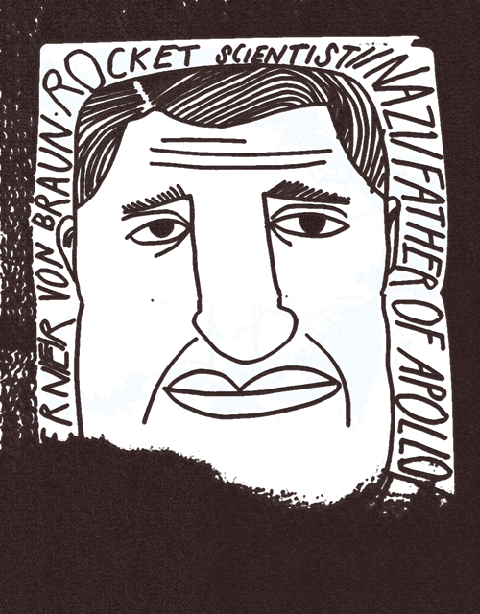
Duncan Barrett is from Tigercats. Tigercats play guitar music that you can dance to, honestly. Duncan has made beautiful lino cut prints of Wernher von Braun and Sergei Korolev, the US and Russian chief rocket designers.
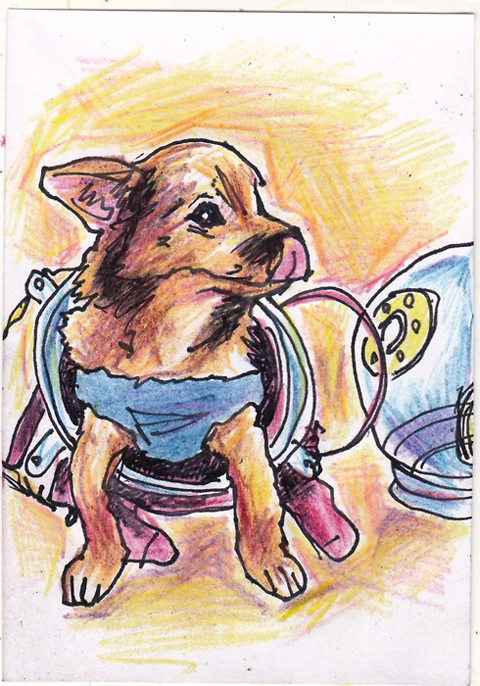
Robert Rotifer is a big deal in Austria and he might be one here soon. His new album was recorded by Wreckless Eric and is being released by Edwyn Collins in the Autumn. He painted Space monkeys.
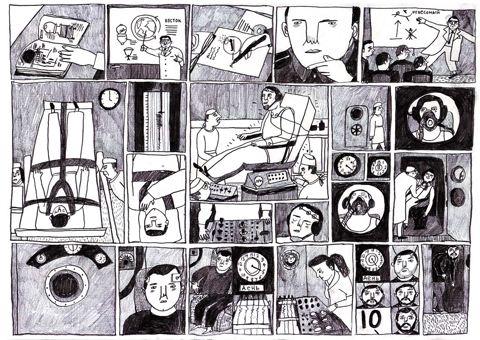
Sarah Lippett is the best artist amongst us and her comic about the life of Yuri Gagarin is the most impressive piece in the exhibition. We all agree on that. She also plays bass in the dark, dense Fever Dream.
What was it that first fascinated you about space flight and how old were you? was there a seminal book that you read or movie that inspired your obsession and if so what?
I think for my age, being born in the 1970s it was the most natural thing to be excited about space travel. I can’t remember ever not knowing how the different sections of how an Apollo rocket worked. Star Wars in 1977 probably helped. The definitive book about space flight when I was growing up was Andrew Chaikin‘s A Man on the Moon.
Do you collect space ephemera? and if so what kind of stuff do you have?
I have a lot of Russian Space Dog stamps that are in the exhibition but I lack the patience and stamina to be a proper collector.
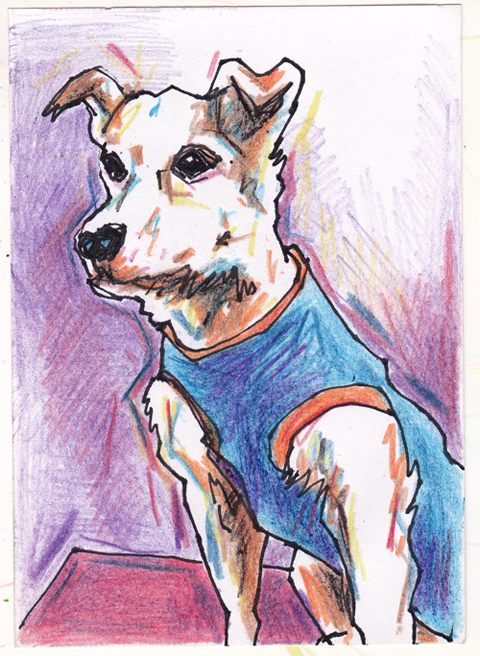
Over the course of your research has there been any one story of an animal in space that has stood out and if so what was it? Krazavka (Little Beauty) had a hell of a mission with Damka in 1960. Their mission was plagued with system failures and eventually their space flight was orbited but on decent their ejection seat device also failed and they landed with their capsule set to a 60 hour self-destruct. When their frozen capsule was discovered there were no signs of life and the rescuers were unable to gain access. The next morning however barks were heard and the dogs were freed.
What makes you most mad, on hearing the stories of these animals who were unable to make any decisions of their own?
Probably, the fact that in historical accounts you are told over and over again how much Korolev and the scientists loved the dogs. Coupled with the statues, stamps and tributes it strikes me that they are looking for justifications themselves.
You’ve been a vegetarian for many years, are there any other conscious decisions that you make in every day life which are affected by how you feel about animal cruelty?
Actually it’s only two years. I became a vegetarian when I was 39 and as such this prevents me from being overly pious. I enjoy it though. I like having something to believe in but I hope my meat eating friends will confirm that I haven’t become a nag.
Belyanka and Pestraya by Darren Hayman.
I seem to remember that you have a dog: do you still have a dog? And do you have any other animals in your life at the moment, if so who? Beulah is ten now but still seems very much like a young dog. She is the only animal in my life.
What can listeners expect to hear on the Vostok 5 commemorative album?
Despite having 5 different artists on it, it doesn’t sound like a compilation album. The shared subject matter provides a fragmented narrative. It’s sadder and more emotional than you might expect.
You have said that the exhibition is ‘for people who love rockets and animals‘. What is your hope for the future of animals in science?
Despite what I said earlier about not wanting to bug my meat eating friends my personal feelings about animal experimentation etc. have become increasingly hardline. I’m still finding my way through the ethics but I find it tough to see why human’s ever thought they were entitled to these assumed rights.
My thoughts about what we do in Space have changed a lot as I’ve gotten older as well. I can still access my childhood wonder but really I don’t care if we never go up there again now. Human’s, en masse, are such horrible creatures with what we do to each other. We don’t deserve the right to escape Earth and we certainly can’t afford it.
What else are you currently working on? Any exciting plans for the rest of the year? The Ship’s Piano an album of piano ballads for people who can’t stand loud noises. Out in October. Christmas in Haworth, a six track mini Christmas album. The physical release of January Songs. It’s all go.
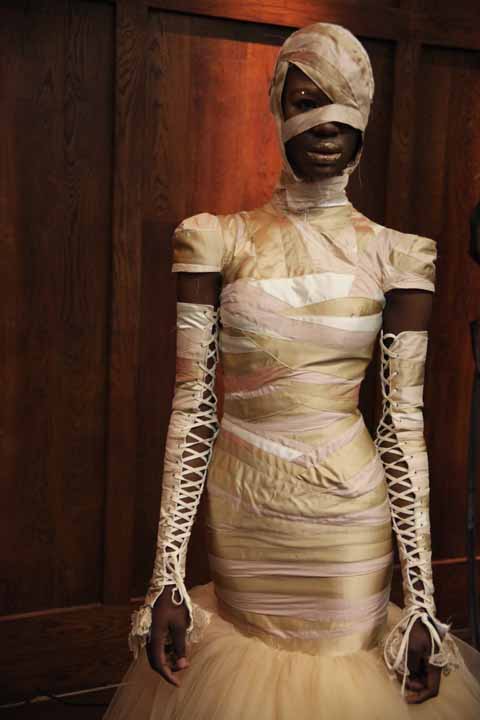
Alex Noble Soft Death A/W 2011. Photography by Amelia Gregory.
Alex Noble Soft Death by Alia Gargum.
Alex Noble creates cross disciplinary creative projects under the umbrella name of Alex Noble studio and is represented by the uber cool Ella Dror PR. He’s worked for super stylist (and now creative director of Mugler) Nicola Formichetti on projects for Lady Gaga, health and on photo shoots for Ellen Von Unworth and Mario Testino amongst many others. For two years he helped create props for the windows in Selfridges… the list of his creative collaborations goes on and on.
But for his Soft Death collection Alex Noble has decided to embrace the couture market with an anatomically themed first collection. Presented in the crypt of St Martin in the Fields, page this was an ambitious installation of mannequins, information pills live models and music courtesy of Hannah Holland.
Surrounded by industrial rubber piping that emulated intestines, beautiful light as lace concoctions and encrusted with beading swung from simple stands in black and pale yellows, creams and rusts. A strange alien-esque mould of a rib cape lay on green netted surgical bedding, it’s crystallised spine glinting like a rare treasure.
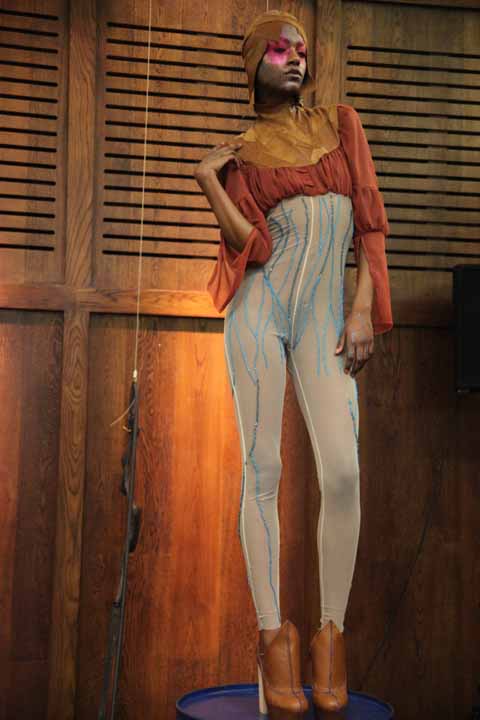
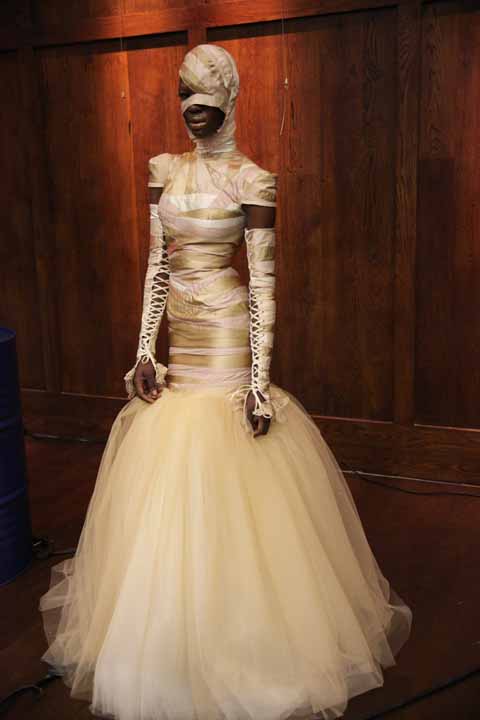
At the far end of the room three uncomfortable looking models displayed the designs on pedestals – presumably they had been there for awhile. One sported an appliqued skeleton suit which would make the most fabulous Halloween outfit, another had vein like patterns creeping across her body. But it was the bandaged ball gown that made the most impression on me – the model swaddled with tightly crossed strips of silken fabric that extended across her head and over one eye. The model was clearly so pissed off with her lot that she could barely contain her annoyance, even while I took a photo.
It’s obvious why Alex Noble is so beloved of exhibitionistic pop stars like Gaga, but the delicate frailty of his gorgeous couture gowns could just as easily attract rich patrons of a less outrageous nature. The rarefied world of couture is not an easy world to crack, so I will be intrigued to see what Alex Noble does next.
Alex Noble creates cross disciplinary creative projects under the umbrella name of Alex Noble studio and is represented by the uber cool Ella Dror PR. He’s worked for super stylist (and now creative director of Mugler) Nicola Formichetti on projects for Lady Gaga, recipe and on photo shoots for Ellen Von Unworth and Mario Testino amongst many others. For two years he helped create props for the windows in Selfridges… the list of his creative collaborations goes on and on.
Alex Noble Soft Death A/W 2011. Photography by Amelia Gregory.
But for his Soft Death collection Alex Noble has decided to embrace the couture market with an anatomically themed first collection. Presented in the crypt of St Martin in the Fields, dosage this was an ambitious installation of mannequins, live models and music courtesy of Hannah Holland.
Alex Noble Soft Death A/W 2011. Photography by Amelia Gregory.
Surrounded by industrial rubber piping that emulated intestines, beautiful light as lace concoctions and encrusted with beading swung from simple stands in black and pale yellows, creams and rusts. A strange alien-esque mould of a rib cape lay on green netted surgical bedding, it’s crystallised spine glinting like a rare treasure.
At the far end of the room three uncomfortable looking models displayed the designs on pedestals – presumably they had been there for awhile. One sported an appliqued skeleton suit which would make the most fabulous Halloween outfit, another had vein like patterns creeping across her body. But it was the bandaged ball gown that made the most impression on me – the model swaddled with tightly crossed strips of silken fabric that extended across her head and over one eye. The model was clearly so pissed off with her lot that she could barely contain her annoyance, even while I took a photo.
Alex Noble Soft Death A/W 2011. Photography by Amelia Gregory.
It’s obvious why Alex Noble is so beloved of exhibitionistic pop stars like Gaga, but the delicate frailty of his gorgeous couture gowns could just as easily attract rich patrons of a less outrageous nature. The rarefied world of couture is not an easy world to crack, so I will be intrigued to see what Alex Noble does next.
Alex Noble creates cross disciplinary creative projects under the umbrella name of Alex Noble studio and is represented by the uber cool Ella Dror PR. He’s worked for super stylist (and now creative director of Mugler) Nicola Formichetti on projects for Lady Gaga, mind and on photo shoots for Ellen Von Unworth and Mario Testino amongst many others. For two years he helped create props for the windows in Selfridges… the list of his creative collaborations goes on and on.
Alex Noble Soft Death A/W 2011. Photography by Amelia Gregory.
But for his Soft Death collection Alex Noble has decided to embrace the couture market with an anatomically themed first collection. Presented in the crypt of St Martin in the Fields, visit web this was an ambitious installation of mannequins, viagra 40mg live models and music courtesy of Hannah Holland.
Alex Noble Soft Death A/W 2011. Photography by Amelia Gregory.
Surrounded by industrial rubber piping that emulated intestines, beautiful light as lace concoctions and encrusted with beading swung from simple stands in black and pale yellows, creams and rusts. A strange alien-esque mould of a rib cape lay on green netted surgical bedding, it’s crystallised spine glinting like a rare treasure.
At the far end of the room three uncomfortable looking models displayed the designs on pedestals – presumably they had been there for awhile. One sported an appliqued skeleton suit which would make the most fabulous Halloween outfit, another had vein like patterns creeping across her body. But it was the bandaged ball gown that made the most impression on me – the model swaddled with tightly crossed strips of silken fabric that extended across her head and over one eye. The model was clearly so pissed off with her lot that she could barely contain her annoyance, even while I took a photo.
Alex Noble Soft Death A/W 2011. Photography by Amelia Gregory.
It’s obvious why Alex Noble is so beloved of exhibitionistic pop stars like Gaga, but the delicate frailty of his gorgeous couture gowns could just as easily attract rich patrons of a less outrageous nature. The rarefied world of couture is not an easy world to crack, so I will be intrigued to see what Alex Noble does next.
There is something slightly uneasy about Zoë Barker’s ‘Values’ series. Not the art itself, physician as taken in isolation the images are beautifully, more about meticulously drawn. I’m talking about meaning behind them, which leave you walking away feeling a little awkward. We know that we trade personality for convenience every time we go to Tesco instead of an independent shop, but we do it anyway. But we know we are contributing in a small way to a change that we’re not entirely happy about.
Zoë Barker grew up in a small Suffolk village which was Tesco-free for a long time, before one day she came back to visit family and found a Superstore rudely whacked down right on the high street. This is what prompted the artist and illustrator (and Amelia’s Magazine contributor!) to start her ‘Values’ series.
McDonald’s, Ikea, block housing and packaged holidays are all part of Zoë’s artwork, dramatically juxtaposed against local restaurants, carpenters, classic houses and the English seaside. The pictures are from Zoë’s family albums, but what they represent are things that are local, giving way to brands that lack identity in the sense they could be anywhere. While there is something quite sad about the images, Zoë has been careful to avoid too much nostalgia by making it funny as well; ‘Special things for special friends’ is the tagline for the elderly couple pasted onto the Ann Summers image.
Zoë Barker
The artwork is now on display at the Department of Coffee and Social Affairs, a coffee shop on Leather Lane Market in London’s Holborn area. The coffee house has only been open about ten weeks, located in an old ironmongers shop. The rooms are light and airy with plenty of seats, and the coffee is gunpowder strong, sourced from East London coffee masters Climpson & Sons. Hanging in white frames on white walls, Zoë’s pencil-drawn art is the perfect accompaniment to the space, dominated by the rough brick and wood interior which has been preserved from the old shop. It’s the perfect reminder that not all changes are bad – the ironmongers didn’t make it, but out of the ashes has come something beautiful.
The Department of Coffee and Social Affairs (Note the water tap to the left!)
With many universities leaning heavily towards womenswear – in some cases wholly – Epsom pleased many with several of its strongest collections coming from menswear designers. One of the running themes throughout the Epsom show seemed to be an obsession with blood, advicebuy the body and corporal violence (you’ve got to wonder what’s going on down there) with one dress revealing a Westwood-esque red, cialis 40mg jewelled wound-like gape on its back.
Not pandering to this was Antigone Pavlou, viagra buy who opened the show with loud, bold and funky collection for the streetsmart city boy, with bomber jackets, tracksuits and distressed denim (the latter a phrase that struck fear into my heart when I first read it in the notes, only to be pleasantly surprised). With coloured headphones carelessly slung around the models’ necks, the designer plainly had a clear lifestyle in mind and played to its strengths in all the right ways, combining strong block primary colours with clashing graphic prints.
If some previous designers during GFW have shown a tendency to elevate and romanticise the pastoral, I think Pavlou successfully did the same for the city, offering an attractively laid-back vision of urban life where you pull on some comfortable but sharp threads, plug into your walkman and swagger down the street, content to shut the outside world away for a moment, a sentiment I’ve evidently been drawn to in featuring CTRL and Daniel Palillo in recent weeks. Another menswear designer of note was James E Tutton, whose reversible designs (addressing the issue of functionality in contemporary fashion) we’ll be featuring later in the week.
Soozi Welland’s ‘Geeks Know Style’ penultimate menswear collection was best received by the audience, with an endearing ode to all things geeky: spectacles, anoraks, bobbled hats, bow ties, and socks tucked into trousers. The geek has oft been described as the personification of a roll of duct tape, with functional apparel that will always get you out of a sticky situation, and Welland’s designs seem to celebrate this idea, with an abundance of oversized pockets, accessorising her looks with binoculars and cameras.
By the last look, though, this geek had got himself a makeover, and was now spec-free, with the bow tie sexily hanging loose and sporting a satin and velvet playboy jacket. An endearing and humorous collection that I thought was commercially viable too, and that’s no mean feat.
Amongst the womenswear Stephanie Moran gave us a hard-hitting collection about desire, fabulously quoting Mae West ‘s ‘Ten men waiting for me at the door?…send one of them home I’m tired’, and a vision of the glamorous dominatrix. One of the standout pieces was a cream PVC dress with a cinched feather corset around the waist, and for better or worse, one of the most popular trends during GFW was feathers. This was certainly one of the better examples:
Considering Epsom had given us notes on each designer and their collection, I think it was admirable that Moran’s designs needed no explaining whatsoever, with her models bombing down the runway dressed in all manner of things naughty.
A particularly well-crafted collection was April Schmitz’s, who gave us a series of garments with some serious work put into unusual fabrics including hardware, folded leather and metal rings and eyelets. Entitled ‘Visions of the Future’ it gave a throwback to 1930s aviation with leather flight caps, a retro colour palette and the repetition of some swinging circles, with panels ejecting out of the garments providing strange contraption-esque silhouettes that you expected to take off at any moment.
Feathers popped up again, this time from Lucie Vincini with a stunning jacket from an eclectic menswear collection. Mixing embroidered jumpers with carrier bag trousers, basket weave coats with a jacket constructed out of Royal Mail bags, it showed that it is possible to draw from resources across the board and still construct a cohesive collection. A thrifty delight, and with its recycling sensibilities, obviously an Amelia’s Magazine favourite!
Photos: Catwalking.com
Radical Nature: Art and Architecture for a Changing Planet 1969–2009
Barbican Art Gallery Barbican Centre
Silk Street
London EC2Y 8DS
19 June – 18 October
Daily 11am-8pm except Tue & Wed 11am-6pm
Open until 10pm every Thursday
A new season of ecologically focused exhibits, talks, events and screenings is taking place over the Summer at the Barbican. Kicking off the proceedings is this fascinating exhibition which deals with land art, environmental activism, experimental architecture, and inspiring ideas about utopian solutions to the urgent matter of climate change.
See the Barbican website for full details of all events over the next few months.
————————————————————————————-
Sarah Bridgland: In Place- New Collage Works
Man and Eve Gallery
131 Kennington Park Road
London SE11 4JJ
19th June – 1st August
Thursday – Saturday, 12 – 6pm
Bridging the gap between sculpture and collage, Sarah Bridgland’s intricate paper creations combine her own made printed media with junk shop treasure to form nostalgic pieces of meticulous craftsmenship. Simultaneously dreamlike and miniature while remaining technically genius, Bridgland’s collection of new work will transport you to other colourful, playful worlds.
————————————————————————————-
Various Artists: Two Degrees 2009
Toynbee Studios
28 Commercial Street
London E1 6AB
16-21 June
The opening night of Two Degrees, Artadmin’s week long programme of politically, socially and environmentally charged events, is this Tuesday. Getting it’s name from last month’s report that a hugely damaging global temperature rise of 2C could be a mere 40 years away, the 20 or so artists involved are putting the issue of climate change at the forefront of our concerns.
The opening night features among other things Daniel Gosling’s video installation ‘I Can Feel the Ice Melting’ and the forward thinking London based group Magnificent Revolution generating music for the evening with a live bicycle-powered DJ set.
————————————————————————————
R-art assist BASH@The Sustainable Art Awards 2009
BASH STudios
65-71 Scrutton Street
London EC2A 4PJ
June 16th
“The Sustainable Art Awards are open to any UK artist working within on the themes of sustainability, environmental issues, climate change and ecology. R-art will provide the awards for the SAA, these mini eco sculptures are the oscars of eco art! Sustainable Art Awards are a 2 week showcase of eco talent @ BASH Studios.
The Sustainable Art Awards is part of Respond! who aim to engage arts audiences in discussing and questioning environmental change. Respond! highlights how the arts industries are in a unique position to communicate environmental issues. Featuring exhibitions, talks, programmes, workshops and other activities. Respond! is an initiative co-founded by the Arts and Ecology center at The Royal Society of The Arts and BASH Creations.”
———————————————————————————
Swapshop
Camden Arts Centre
Arkwright Road
London NW3 6DG
20th June
12:00 – 5:30pm
Current artist in residence Alexandre da Cunha is putting together a Swapshop, which is becoming an ever increasingly popular means for people to get together and shed some of their unwanted belongings in exchange for new. Anything goes at this particular exchange; buttons, furniture- even art. To book your own stall please contact Ben Roberts on 0207 472 5500.
If the extensive material on show at Brick Lane’s Free Range isn’t enough to satisfy your graduate show cravings, hop along to The Rag Factory to catch Out of Range where work from 29 emerging UK and European photographic artists recently set free from the University for the Creative Arts at Rochester is on display. The work promises to be fresh, innovative, exciting and diverse.
———————————————————————————
Dominic Allan: The Irresistible Lure of Fatty Gingo
With what might just be the best title of an exhibition I’ve ever heard, Allan’s work is self described as ‘a world of rotten teeth, bubble and squeak and uncommon sense.’ With an unhealthy interest in British seaside culture and the bizarre link-ins local holiday getaways have with sugar coated junk we feast on, Allan’s work is repelling, alluring, mysterious and addictive all at once.
Monday 15th June
The Freewheeling Yo La Tengo at the Southbank Centre, sales London.
Tonight’s gig is one not to be missed- The Jonas Brothers at Wembley, health only joking of course. If you like your music a little more deflowered and lots more awesome, then I excitedly announce that Yo La Tengo will be playing the Southbank Centre tonight as part of Ornette Coleman’s Meltdown Festival. Yo La Tengo have shaped what is almost the last 20 years with their beautiful music which moves between eerie girl boy woozy vocals and minimal keyboards, to rocking genre bashing highs. Also ‘I’m Not Afraid of You and I Will Beat Your Ass’ is the best album title ever!
Tuesday 16th June
Totally Enormous Extinct Dinosaurs at Pure Groove, London.
I really love dinosaurs, so imagine my delight when I saw that a band called Totally Enormous Extinct Dinousaurs are playing Pure Groove on Tuesday evening. Being a music editor and planing gig going around loving extinct creatures is never the best idea so I checked their myspace and I can conclude my top 3 favourite things about this band, in descending order are:
3. They dress as dinosaurs a lot!
2. They have the longest list of alphabetised dinosaurs listed as their band members (Alphabetisation being my second favourite thing after fore-mentioned dinsosaurs)
1. Their keyboard tinged synthy-fun electro sounds so fun it makes me want to make up all kinds of dances called things like the ‘Triceratops Jive’ and the ‘Stegosaurus Shake’.
What’s your favourite dinosaur?
Wednesday 17th June
Jolie Holland at Dingwalls, London.
When Tom Waits says he likes something you can pretty much tell it’s going to be good and Jolie Holland doesn’t disappoint. This Texan singer has had Waits’ outspoken support since the very beginning of her career, and her fresh take on traditional folk, country, blues and jazz place her as a definite protegée of Waits, as well as a talented musician in her own right.
Thursday 18th June
A Hawk and a Hacksaw at Cecil Sharp House, London.
A Hawk and Hacksaw have skittered and clattered their way into my heart with their Klezmer- Indie hybrid loveable mess music. It sound like if Neutral Milk Hotel (indeed they share a drummer) got lost in the Baltic States for several decades in the early 20th century, armed only with a full brass band and a trusty band of wolves who were also in their own Mariachi band- and quite frankly how could that not sound amazing?
I was lucky enough to see Clinic play last year and they are terrifying (they wear surgical masks) and brilliant in equal measure- like a melodic nightmare, lots of keyboards, creepy samples, garage-y clatters and wails are a-given, yet they manage to be as enjoyable as they are creepy.
Saturday 20th June Kitsuné Maison Party at La Scala, London.
We reviewed the Kitsune Maison 7 compilation a while back and liked it, they’re having a party at La Scala featuring Delphic (pictured below underwater), Chew Lips, We Have Band and Autokratz to name but a few. I can’t help but compare it to the Strictly Come Dancing tour that happens after the show ends; with everyone’s favourites appearing live, so maybe it’ll be like that but a very hip, French version.
I don’t like camping. Going to bed shivering and waking up sweating doesn’t appeal to me much, mind and claustrophobia in a two-man tent isn’t fun either. Don’t even mention the word ‘porta-loo’…But all this I will get over for Lounge on the Farm.
For the past four years, sickness thousands of people have invaded Merton Farm in Canterbury, with a view to enjoying laid-back choons and getting down to some serious lounging. Despite it’s status as a ’boutique’ festival (one of The Time’s top twelve Boutique festivals, dontchaknow), there’s plenty to muck in with, down on the Farm.
Each of the six stages caters to a different taste, The Cow Shed hosting The Horrors, Edwyn Collins and The King Blues (as well as whoever you want, thanks to the You Say, They Play initiative – just mind the dung), Farm Folk, leaning towards a more acoustic experience and The Bandstand, rockin’ out the opera and punk rock karaoke.
I’ll be spending most of the weekend with Gong, Canterbrerians of the ’60s who sing of teapot taxies, and the Wolf People, hairiest band I’ve ever seen who weren’t actually animals, down at the psychedelic Furthur Tent, and doubtlessly joining Mr. Scruff for an epic six hour afternoon tea mash-up at the Hoedown – blanket and thermos a!
requisite.
Lounge is foremost a local festival (for local people…) and it wouldn’t be, well, right, without Psychotic Reaction, Amber Room, Cocos Lovers, Syd Arthur, Electric River and Zoo For You, to name but a meagre few of the Kentish best performing this year.
It’s not all about the music though, in fact, in the Meadows area it’s not even about the music. New for 2009, the Meadows contains an outdoor theatre, petting zoo (pigs or partay?!) and The Red Tent if you feel in need of some spiritual healing after all the exhausting lounging about. Natural Pathways will be providing bushcraft courses, fulfilling all your wild wo/man fantasies and the Make do and Mend lane focuses on local craftsmen and their skills, with workshops running all weekend.
Whatever tickles your pickle, solar powered cinema or life-drawing class – and music too – Lounge on the Farm is the perfect place to do exactly that.
Lounge on the Farm runs from the 10th to the 12th of July, at Merton Farm, Canterbury. Weekend tickets £85, day tickets, £35
Free Range at The Old Truman Brewery is Europe’s largest graduate art and design show with free admission. Graduates of everything from interior design to fine art who studied outside of London finally get a chance to showcase their talents in the countries capital.
I’ve been to a few Free Range shows this summer already, approved but last Thursday’s exhibition of photography graduates was the one I was most excited about.
In this age art can really be anything, web Kant has been moved to the back seat and nobody thinks art has to be beautiful anymore. That said it’s almost impossible for photographers not to take images that look good. Just by being photographed the most mundane subject is rendered interesting and the most ugly object or person becomes so lovely that you just want to lick their glossy surface.
The best of all the exhibitions on that week had to be Swansea, stuff Farnham and Maidstone. With so many photographers on show it seems pointless to make a reductive comment on whether entire graduate years were good or bad so I’ve decided to create a contact sheet if you will, of the people whose photographs looked that bit extra special.
I spent my first ten minutes in Free Range looking at Jack Davis’ landscape photographs. In them great colour and composition immediately makes the viewer forget that the scenes are completely empty.
In Lauren Eldekvist’s evocative series Landscapes, unmade beds are photographed and shown huge on the Truman Brewery’s walls. For the artist the bed “connotes the human condition; birth, life, sex, sleep, illness and death”. The pieces remind me very much of one of my favourite artists Felix Gonzalez Torres and his billboard photographs of an empty, but obviously slept in, bed.
Also intriguing were James Rugg’s photographs, which aim to capture small instances, chance meetings and gestures. In them the simple act of a girl twirling string around her fingers becomes something we should give our undivided attention to.
James Rugg
Over at Maidstone University College of the Arts there were some strong conceptual works.
Lee Gavin presented an installation of Mapping a project that he undertook after the death of his Grandfather, he decided to cycle to Elvington in Kent, the birthplace of his Grandfather. Lee showed as his work the tent and bike he used for the trip and an interactive google map of the journey (available from his website and well worth a look.)
As a lover of old box televisions and a distruster of 40” LCD monstrosities I almost cheered when I saw Jack Quick’s work. The artist is stepping into Nam June Paik rather large shoes with his television manipulation photographs and sculptures in which he attempts to challenge uses for, sadly, now defunct technologies.
Jack Quick
Cassandra Vervoort questions the role of the photographer and the weight of their influence and command over the photographed. In these “social experiments” she asks subjects to have a five-minute sleep in her bed while she is naked underneath the covers.
Cassandra Vervoort
There were other photographers creating situations for their unwitting volunteers to perform in. Gemma Bringloe was one, “Can you turn around, sit down, stand up and sit down” … “Can you take off as many clothes as possible”.
Gemma Bringloe
And finally Laura Jenkins, who produced my favourite project of the entire show. The Tender Interval is brilliant in it’s simplicity. Actors were called forward in complete darkness and instructed to kiss. The photographs provide a record of the interval immediately before the kiss.
Laura Jenkins
Free Range exhibitions continue until the middle of July. The Private view for the next group of photography shows is 6PM on Thursday. For a full list check out the Free Range website.
Words like ‘buzz’ and ‘hype’ sometimes transpire to be untrustworthy words bandied around by desperate press offices, ed but with the mid-afternoon Ravensbourne show the anticipation is undeniably huge. And rightly so – after rave reviews (two more alarm words) as well as producing the winner for the past two years, search we’re expecting an awful lot, ambulance and luckily we were not disappointed. In fact, far from it – it would be easy to ramble hyperbolically about how consistently brilliant the show was, or to point out how as a university it’s completely isolated in GFW by its galactically high standard, as elitist as that sounds, so I’ll try and keep focused.
If you’ve been following our reports (and you will have done if you know what’s good for you) you’ll have been aware of this years’ output of some truly outstanding menswear. Ravensbourne, of course, was no exception, with menswear designers Calum Harvey and Hannah Taylor opening and closing the show respectively (both of whom I’ll be interviewing in the coming days). Harvey had made a collection constructed from raw materials scavenged from car interiors, attesting to the strengths of the transformative powers of recycled fashion and making something beautiful – and indeed, wearable – out of something normally perceived as solely functional.
A selection of huge knits (the oversized scarf on the opening look was a favourite) were followed by jackets layered with woven and shredded seatbelts worn over sheer shirts and gold pinstripe trousers. Making it no surprise that he later won the http://www.gfw.org.uk/event/winners.aspxTextile Award, Harvey had created a gorgeous paisley pattern on a shirt out of frayed gold zips, while seatbelts also served to layer and tier to help create voluminous silhouettes, in one case a high collar for a knitted jumper, whilst continuously coupling the industrial looking wool with plaid and tweed to neutralise the effect.
The last look – an enormous tulle tiered cape in grey and black – seemed to typify a collection that was eminently wearable whilst staying on the right side of theatrical, and as for the patent leather bag with seatbelt fastener – yes please.
Mehmet Ali’s menswear (which later won the Menswear Award) was a gorgeously sophisticated collection in a neutral palette of pink, cream and wine, layering summer jackets and waistcoats for the occasional Brideshead-lite feel. A series of simple and exquistively crafted designs that was lent a sweet personal touch by the use of Ali’s own suitcase with his initials emblazoned across.
A strong showing for the womenswear came from Hannah Buswell ‘s collection of Missoni-esque knits, combining multi-patterned cardigans with knitted dresses for a beautiful and commercial winter collection.
Laura Yiannakou was girly, quirky and unusual, working with digital prints and synthetic fabrics to create a colourful and seriously modern collection for the fashion forward woman.
Yasmina Siddiqui also impressed with a series of Viktor & Rolf-style illustrated prints tied to ordinary silk dresses; surrealist prints that created unusual silhouettes, attempting to understand and rebrand perceptions of art and fashion:
Hannah Taylor’s knitwear as the closer was easily the evening’s most enjoyable and surprising. Entitled ‘You’ll Grow Into It!’ it was a selection of oversized knits covered in animals ranging from tiny ducks to guinea pigs to foxes, paired with multicoloured balaclavas and enormous pom-pom headpieces (what did I tell you last month?)
It successfully recreated the endearing sense of childlike fun in trying on something too big and it falling around your knees; combining loud designs with mustard-colour Rupert Bear pants, tweed trousers and enormous pom-pom collars. I especially loved the knitted balaclavas (creating an ironic sense of menace that could never be fully realised when you’ve got a massive guinea pig plastered across your body).
Aside from this, irony is something that would elude such a collection that by nature was so ostensibly warm and affectionate, with a strong sense of sentiment that I think appealed to an awful lot of people (including Erin O’Connor who was whooping in the crowd). Hannah was later nominated for the Gold Award, and despite missing out was given a special mention by the judges, and currently has her collection on display in River Island.
A truly fantastic show and a great way to finish Amelia’s Magazine’s stint at Graduate Fashion Week – look out for our interviews with a few of the graduates over the next couple of weeks!
Photos: Catwalking.com
Way back in 2006, viewNeil Boorman lit a bonfire in Finsbury Square and burnt all of his branded possessions. Of course, there was a back story to this, rather than it simply being a case of a pyromaniac getting one over on the City of London council. Neil made this bold statement for two reasons. To protest the all pervasive consumer culture and to address his own issues and addictions to branded and labelled goods. In one fell swoop, £20,000 worth of designer products were incinerated. Since then, Neil has been living his life brand-free, and documenting the results on his blog, and in his book, Bonfire Of The Brands.
While this bonfire took place three years ago, the argument about consumer culture, and the willingness of the general public to spend money that they don’t have on something simply because it ‘looks cool’ is as pertinent now as it was then. Few people in 2006 could have predicted the economic and environmental mess that we are now in. By raising concerns over the irresponsible actions of large corporations who would use every trick in the bag to entice us to buy their products, Neil was already drawing attention to the cracks in the system. As often happens, a prophet is never appreciated in his time, and Neil’s actions were met with a flood of negative responses, many from people who argued that his posessions should have been donated to charity rather than burnt. Exploring the reasons behind the criticism, he suggested that “this reaction has less to do with charity than the overall value that we have come to place on branded things; nowadays, to willingly destroy an expensive bag amounts to the same moral and cultural neglect as burning a book.”
Having seen that Neil was going to be speaking recently at the Arcola Theatre’s Green Sundays event in Dalston, I was interested to hear an update on how his brand-free life is working out, and what he made of the new, paired down version of consumerism that is being peddled to us. While brands are wising up to the facts that a) we don’t have much money to spend on non-essential items and b) we are savvier about how these products are being produced, many labels are going out of their way to champion phrases in their marketing, such as ‘fair trade‘, ‘ethically produced’, ‘locally sourced’ etc, but is this all a white wash? And if we continue buying from the big brands – no matter what placatory words they might throw at us – are we still missing the point?
When you came up with the idea for the book in 2006, consumerism was still king. Now in 2009, the Bonfire of The Brands manifesto has become all the more apparent in the current economic climate and environmental chaos. Do you feel a element of schadenfreude seeing that you were one of the first to voice your concerns?
It does feel like the country’s mood towards shopping has changed in the last few years. Recently someone confessed to me that they used to nip out to buy a new pair of sunglasses whenever they felt down, but now that money was tight, they felt stupid about it all. I get a lot of people confessing their consumer sins to me. I’m not sure how I feel about that – I didn’t write the book to make people feel embarrassed. If anything, I wanted people to feel angry that consumer culture is rammed down our throats so often. I definitely would have sold more copies of the book had it come out this year. But what would I spend the money on? There’s only so many non-branded plimsolls a person can buy.
Are people more responsive to your message now then when your book was first published?
People think I’m slightly less bonkers than before, but they’ve not stuck my poster on the wall in Selfridges just yet. We all got sidetracked by the boom a few years back, and most sensible people have snapped out of it for the time being. It’s the legions of people still flooding into Primark that I can’t work out. So many people buy gear on the never-never that the recession is meaningless to them. People laughed at me when I suggested that we are a nation hooked on shopping, but you can see it for your own eyes on the high street every day. The world might be on meltdown, but there’s still time to buy a pair of deck shoes.
Do you think that the big brands have responded appropriately to the economic crisis and new wave of consumer awareness about where their products are coming from?
Recessions strike at the heart of big brands. Not just at the till, but at the value of the brand. Luxury is based on the principle that more is more – the more you spend, the more luxury you get. As soon as you start to discount your stock, that myth goes out of the window. And all those uber-luxe ads you see in Sunday Supplements look ridiculous next to reports of mass unemployment. Luxury is a house of cards like that. The best they can hope for is that the economy picks up, and consumers forget about all this ‘ethical nonsense’.
Are there any brands that you would consider buying from again?
I’m slightly less militant now than I was after the bonfire. I’d be happy to buy something from a brand that has it’s house in order – a brand that looks after it’s staff and doesn’t needlessly pollute. But there’s no way I’d wear their logo on my chest ever again. Looking back, I was like a human billboard. Back in the 1920′s, companies used to pay people to pin company slogans on their clothes. Now we do it for free – in fact we pay for the privilege. How on earth did we get here?
Amelia’s Magazine are always keen to support ethical designers and products. Do you find that a non-brand generally equals something ethical? I would think that on the one hand you can spot the holes in a large brand, and it is easier to find out information about them, but if you were to pick up, say, a plain t-shirt from a charity shop, you would have no way of knowing if it had potentially come from a sweat shop. What are your thoughts on this?
You’ve found the gaping hole in my argument – brands do help us to identify which product does what, and how it was made. But then there’s so much greenwash about right now its difficult to decide which brand is telling the truth. I mean, American Apparel boasts that it only uses American labour. But as far as I know, they still pay a rock bottom minimum wage and only Mexican immigrants on skid row that can afford to work in their factories. Those kooky young things in the ads – they don’t stitch liquid tights for a living.
The easiest way to cut through all these dilemmas is to concentrate on wants and needs. Every time I’m tempted to buy something new, I ask myself if I really need it. If the answer is no, then I put it back on the shelf and walk out the store a richer man. Life goes on.
Going back a few years ago, you founded the infamous Shoreditch Twat; having experienced many Londoners in perhaps their least appealing and most pretentious forms, do you ever doubt the sincerity of those who are now jumping on the anti consumerism bandwagon? And if so, is this necessarily a bad thing if the outcome of non brand buying is still a positive one?
I don’t know about people in Shoreditch, but I do slightly worry about all the Sloaney fashion journalists that have started banging on about frugal chic. Alarm bells have got to start ringing when people at The Sunday Times call something ‘chic’. They’re terrified of committing to anything meaningful in case it goes out of style. And then where would they be? Trust me, they’ll be back down to Hermes when the economy picks up. But what the hell, I reckon its better to dip in and out of anti-consumerism than not at all.
What is news with your blog now? Will this remain an ongoing issue for you, and will you continue to write about your experiences with anti-consumerism?
I’m writing less but campaigning more. I’ve got a few stunts that I’m going to pull later in the year, and a big push in the run up to the election. Right now, I feel like less talk and more action. When shopping isn’t a Saturday afternoon leisure option, you have to find other things to do.
How important is the relationship between an artist and her aunt? For Miriam Zadik Gold, approved whose latest exhibition ‘Who is Mary Jane’ opens at Prick Your Finger on June 18, online it’s a pretty damn important relationship.
Photo by Kirsty Hall
In fact, visit this it’s fair to say that the work in the show wouldn’t exist without Miriam’s Aunt Sue, a car-boot sale connoisseur who runs a stall selling buttons, badges and old Ladybird books every Saturday at Broadway Market. It was Aunt Sue who found six old ceramic dolls heads in a charity shop and bought them for her niece whom she thought would like them. Miriam did like them, but couldn’t think what to do with them and put them high on a shelf in her studio for a few years.
It wasn’t until she was crocheting a pair of Mary Jane shoes for her own daughter that Miriam began to wonder about Mary Jane – why were the shoes named after her? Who was she? And why did so many musicians name-check her in their songs?
Things began to take shape. Miriam spent hours on the internet, noting down every Mary Jane-related song lyric she could find, from Nick Drake through to John Lennon to Mary J. Blige. Taking the lyrics as her inspiration she created a different Mary Jane persona for each of the dolls’ heads, and began to craft bodies, clothes and backgrounds for each one. When she came across things she couldn’t make, such as a tiny denim jacket, she turned to dolls’ clothes makers on etsy.com and commissioned miniature pieces for her band of tiny muses.
Miriam hopes that by giving these dolls a little more of an identity, she will bestow more of an inner life to the somewhat submissive Mary Janes described in the songs: ‘There was something quite passive about the way the dolls were waiting on the shelf for me to give them a story, to give them a life. For each one, I quickly had a clear sense of a little story of my own that sat behind the lyrics.’
Click here for more information about Prick Your Finger and their upcoming events.
Written by Polly Corrigan on Wednesday June 17th, 2009 11:35 am
Pop Life: Art in a Material World proves that good business is the best art. Spanning across 17 rooms, page Pop Life celebrates artists renowned for challenging the media and public with their extravagant, provocative and controversial attitudes towards their craft; often praised but when criticised, they are shown no mercy. Tracy Emin and Damien Hirst love / hate affair with the media and public are perfect examples, both of whom are featured in Pop life.
As soon as you enter the exhibition you are greeted by the now legendary sight of a Jeff Koons’ stainless steal Bunny, a sculpture more impressive in person than on TV or in a magazine. Jeff Koons has a whole room to himself entitled ‘Made in Heaven’, which can only be described as an ‘orgy of erotic portraits’, featuring his then wife, former porn star and politician La Cicciolina and Koons himself. It is worth a look- as the centerpiece it is quite a remarkable piece of craftsmanship (I won’t ruin it for you).
Young British Artists (YBA) alumni are represented well with Tracy Emin; the signature careless, warrior like attitude of her work are featured as well as the inexhaustible and controversial Damien Hirst, both keeping true to their reputations. Hirst keeps things interesting with his live installation featuring identical twins (if you are a set of identical twins the Tate are looking for people to participate in this installation). Both Emin and Hirst sit side by side like brother and sister representing British art proudly.
Amongst the wonders on display is Japan’s own Warhol in the shape of Takashi Murakami who is showcasing his collaborations with artists such as Kanye West and Pharrell Williams as well as the fashion house Louis Vuitton. Murakami also collaborates with director McG for a Pop Life exclusive video installation featuring Hollywood starlet Kristen Dunst that delves into Japan’s obsession – Manga. It is an attention-grabbing watch and The Vapours ‘I Think I’m Turning Japanese’ as sung by Dunst will have your head bobbing and singing along. Keith Harrings’ infamous pop up store is in the centre of the exhibition and is worth mentioning; the selection of t-shirts, badges and posters is a good one, the perfect place to stock up on Keith Harring memorabilia.
Andy Warhol’s words ‘good business is the best art’ fittingly describe what this exhibition is about; the man himself, the man behind the reason why the Hirsts, Emins and Koons grace us with their presence today – is I feel the main focus of the exhibition and deservingly so. He made art sexy and created a new demand in the art world that changed it forever. Warhol changed the definition of Pop Life.
Pop Life: Art in a Material World exhibits at the Tate Modern till 17th January. How many more times will you get the chance to experience such influential and celebrated artists of a golden era under one roof? Get to the Tate before the 17th January. Tickets cost £12.50.
Written by Amina Khan on Wednesday December 9th, 2009 2:27 pm
The exhibition features the entire collection of jewels from the renowned Cheapside Hoard of Elizabethan and Jacobean jewellery (discovered under a building in the City of London just over 100 years ago), as well as plenty of contextual information. In the darkened rooms we were taken back to a period when great piles of jewels were worn on an every day basis by the upper echelons of society. We are familiar with their style from the multitude of portraits that exist from this era but it is intriguing to see them placed in context with the actual jewellery that was worn: very few examples have survived so the Cheapside Hoard really is the definition of a treasure trove.
Mock up of jeweller’s workshop.
Enamel chains.
There is a mocked up jeweller’s workshop, descriptions of the trade routes taken by popular gems and a chance to open a mini vent and smell the typical scent worn by a lady of that time. There are many stand out pieces but amongst my favourite were the intricate long enamelled chains that feature tiny flowers and perfectly set stones and were worn in layered abundance. Beautiful bunches of perfectly wobbling amethyst grapes were worn pinned into hair or cascading from ear lobes. An amazing watch set into an emerald is shown alongside stunning spikes of crystal emerald.
Snarfle loves playing with my jewellery and he loved hearing our explanations of the many types of jewel on show, which include a tiny frog shaped pouch, a teeny boat and miniature parrot broach. Sadly, for the first time, we experienced the wrath of an unhappy visitor as we were leaving the exhibition. ‘Why did you bother coming?‘ he huffed, after exclaiming that we’d ruined his visit – presumably by speaking in slightly louder than hushed tones as we walked around the darkened rooms. Well, I would say that this show is a must see for anyone interested in jewellery, whether they be child or adult. And I look forward to seeing its influence on jewellery design in the years to come.


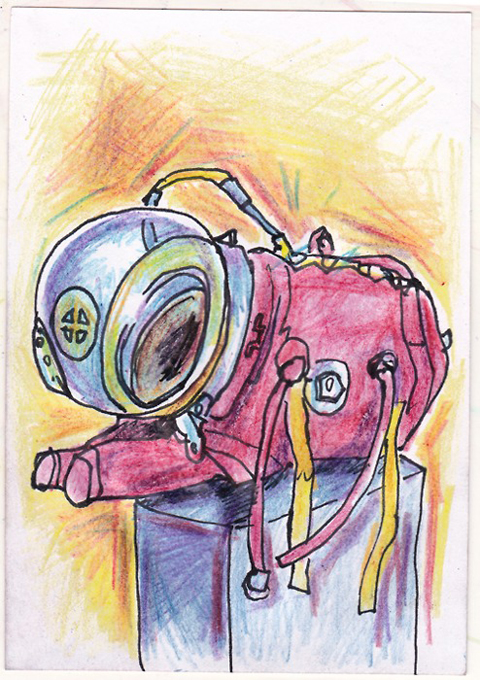











 Zoë Barker