Amelia’s Magazine | Copping Out: The latest from Trafalgar Square

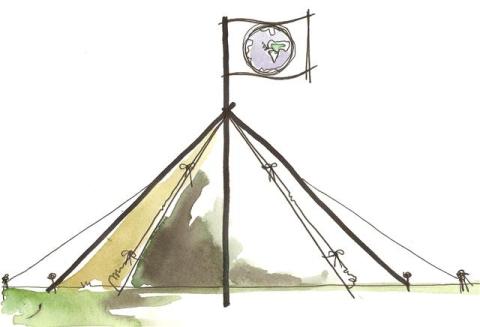
tent
Illustration by Verity Smith

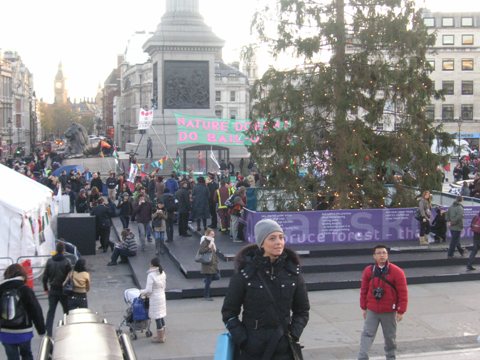
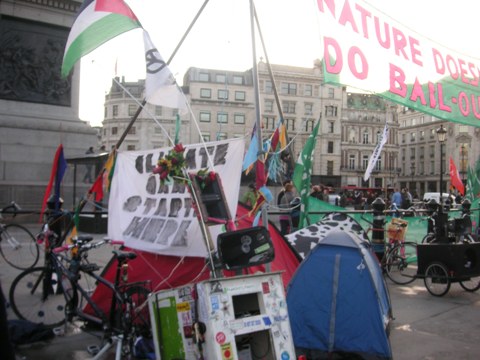
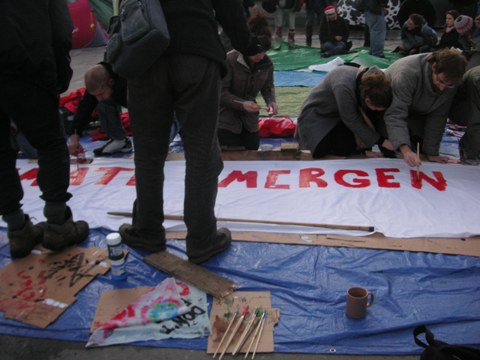
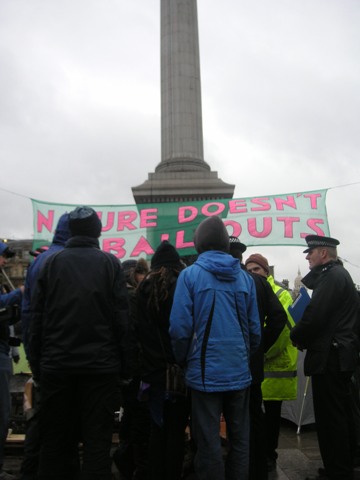
Waking on Friday morning I can tell by the sunlight streaming into my room that for a change it’s a bright and clear day, doctor cheapest good news for those taking part in the COP OUT down at Trafalgar square. I’ve been going back and forth from the square since last Saturday, cost the day when following the hugely successful event ‘The Wave’, buy in which around 40,000 decked out in blue descended on Parliament to demand direct action against climate change, the resilient bunch that is Climate Camp went the extra mile and set up camp right between Nelson’s Column and that giant Christmas tree. Known as the ‘hardy types’ the next day in The Sunday Times, they popped up their tents, hung up their banners and got the tea going on a make-shift stove.

019

By the time I arrived on Sunday, learned a few names and attempted to help out in the kitchen-tent, which for me involved eating cous cous, (which was amazing) and X-factor related chit-chat, it was clear the original planned 48-hour stay was a given and this was just the tip of the melting iceberg. After a quick meeting in the afternoon drizzle, the resolution was clear; the campers would continue to occupy Trafalgar Square until the end of the Copenhagen Summit on the 19th, meaning a 2 week stay. As the meeting broke-up and everyone started to busy themselves in preparation for the ‘alternative’ carol service that evening, I began to wonder how on earth this was going to pan out; how the group would manage to stay in The Square without it ending in them being dragged away by the authorities, kicking and screaming.

020

022

Upon my arrival on Monday, I learned I couldn’t have been more wrong. I glimpsed from the crossing on The Strand a small huddle and a flash of day-glow yellow and thought, “yikes”, this spells trouble. However all it really meant was what seemed to be a friendly discussion with a police man and a police woman who just wanted to know what was going on, but warned that the Greater London Authority planned an eviction notice for around 4.00 that afternoon. The camp by now was certainly smaller; the kitchen was reduced to a stove for tea and many loaves of organic bread, which had been donated by a local bakery. However still lots of the same determined faces, one of which was Marina who won me over on Sunday in the meeting, she is animated and commands attention, and I generally gravitate toward her and pester her about the latest goings on. Still no word from the GLA, I get handed a leaflet by a smiley chap in a blue suit whose name I didn’t catch about what I should do if I am to be arrested, “eek”, is trouble a brewing? No, that’s just the tea. Still no word so I trudge home in the rain.

024

Tuesday morning and a guy in a polar bear suit has joined the camp, word is he was protesting against Tar Sands outside the nearby Canada House. Marina updates her Twitter telling how the bear has given her some shoes, as hers were soaked (her tent is by a fountain), what a bear indeed!
bear
Illustration by Verity Smith

A few new faces have appeared and the numbers are still good, the GLA eventually deliver letters to the tents saying they cannot camp in the square without permission, but it’s not an eviction notice. I rush back to work because it’s the launch of Amelia’s Anthology of Illustration later at Concrete Hermit, which goes down a treat complete with Adnam’s carbon neutral beer. On Wednesday I’m running late for work after accompanying my pal Katie to the station, so I don’t get down to the COP OUT. I hear they’ve called up Boris Johnson but he’s in Copenhagen.

026

Come Thursday morning and the GLA are after the names of the campers, like they are going to tell them. Jenny Jones of the Green Party was also down there making cups of tea. I head down on Friday and the camp is buzzing. After an amazing week of action, negotiation and discussion it is time to bid farewell to those off to Copenhagen, and what better way than with a special lunch. A new kitchen has sprung up as well as yet more new faces, eager to get involved. I get a leaflet about the ‘Feeding the 5000’ event that is taking place next Wednesday the 16th, in which waste food will be used to prepare delicious meals. So with one more week in The Square what is in store? Who knows but Climate Camp still needs volunteers, as well as useful items such as water bottles, blankets etc. All week they’ve been joining forces with other groups that occupy Trafalgar Square during the festive season, from The Salvation Army to Hare Krishna’s to collectively push for effective solutions to the climate crisis.

030

031

On Monday at 10.00am, in solidarity with the activists in Copenhagen, will be an open action taking place in The Square and at Canada House to protest against the use of Tar Sands.  In order to develop these large deposits of sticky crude oil rainforests the size of our country will have to be cut down, as well as the extraction and processing of just one barrel of Tar Sands equalling 3 barrels of natural gas and 4 barrels of water; do the maths, it equals bad news for planet earth.

With COP15 in full swing those remaining in the UK need to get together and stand against the further destruction of our planet. So if that sounds like your cup of tea, why not go down to Trafalgar Square and tell your friends, as the COP OUT will only succeed if people lend as much or as little of their time as they can.
londonglobe
Illustration by Verity Smith
 

For more updates and information on the COP OUT and Climate Camp

Follow Twitter updates on what is happening in Copenhagen from Amelia’s Magazine’s Amelia Gregory

Categories ,activism, ,camping, ,Canada House, ,Climate Camp, ,Climate Change, ,COP OUT, ,earth, ,london, ,polar bear, ,police, ,protest, ,Tar Sands, ,Trafalgar Square

Similar Posts:


Amelia’s Magazine | Did PC Mark “Flash” Kennedy ensure my arrest as one of the Ratcliffe 114 ?

Woodberry Down girl by Romain Lambert-Louis, cost after ‘Jackie 1973’ by Erica Dobbs http://www.lambartillustration.com

http://www.serpentinegallery.org/2008/03/tom_hunter_a_palace_for_us8_de_1.html

It’s good Tom Hunter’s film is as good as it is, because the last time I queued this long there was a saint at the end of it. Pilgrims wait for hours outside the cathedral in Santiago de Compostela to hug the statue above the saintly remnants – last Saturday the patient patrons of a crammed Serpentine Gallery were rewarded not so much with a divine cuddle, but with a screening of Tom Hunter’s gem of a documentary.

‘A palace for us’ is set at Woodberry Down, a 2,500-flat council estate complex in North Hackney, up by Tottenham. Going back 50 years, Tom Hunter’s film uses current day narratives and recreated scenes to tell the stories of three people who have spent their lives at the estate. ‘When we came here we realised how lucky we were,’ says one woman. ‘There was central heating and a bath with hot and cold. It was like a palace for us.’ As the woman talks, we see reenactments of when her husband-to-be asked her to dance for the first time. ‘I’d never seen eyes like his,’ she says, smiling at the memory. ‘We have a very good marriage right to the end.’

Woodberry Down dancers by Willa Gebbie http://www.w-illustration.blogspot.com

Commissioned by the Serpentine Gallery and Age Concern Hackney, Tom Hunter made the film after spending time in residence at Woodberry speaking to residents about their lives at the estate. Their stories are lovingly told, reflecting Hunter’s in-depth knowledge of his subjects and the area. One of the film’s interviewees shares the story how he cowered in his bed as the area was bombed back in 1944. Born in Stoke Newington, the man was among the first to move into the Woodberry estate in 1948.

Woodberry Down man by Timothy Hunt http://www.ficklefate.co.uk

Built to meet a severe housing shortage during the war, Woodberry was presented as an ‘estate for the future’. Especially the interviewee born on the estate has good memories of growing up at Woodberry, telling stories of playing hopscotch in the alleys, climbing the apple trees and making perfume out of the rose petals growing around the estate. The sense of community is clear, with the residents taking turn mopping the stairs. Now the site is the subject of a major regeneration project, which will replace the most run-down flats and add several more as well.

Woodberry Down kids by Sandra Contreras http://haciendochiribitas.blogspot.com/

The original plan was to see Tom Hunter talk about the film as well, but the despite earlier assurances there was no need to book seats, a flushed gallery worker had to turn away a nearly 50-strong crowd on Saturday. The day’s long lines might have been a one-off, but those who still haven’t seen the film may not want to leave it until the last minute. Because it really is worth seeing, as what I remember even clearer than the queuing is how I wish the film had gone on for longer.

Tom Hunter by Kimberley Jenkins http://www.thesketchbookartist.co.uk

‘A palace for us’ shows daily until 20th January at the Serpentine Gallery, Kensington Gardens, London W2.

Woodberry Down girl by Romain Lambert-Louis, pill after ‘Jackie 1973’ by Erica Dobbs

It’s good Tom Hunter’s film is as good as it is, because the last time I queued this long there was a saint at the end of it. Pilgrims wait for hours outside the cathedral in Santiago de Compostela to hug the statue above the saintly remnants – last Saturday the patient patrons of a crammed Serpentine Gallery were rewarded not so much with a divine cuddle, but with a screening of Tom Hunter’s gem of a documentary.

‘A palace for us’ is set at Woodberry Down, a 2,500-flat council estate complex in North Hackney, up by Tottenham. Going back 50 years, Tom Hunter’s film uses current day narratives and recreated scenes to tell the stories of three people who have spent their lives at the estate. ‘When we came here we realised how lucky we were,’ says one woman. ‘There was central heating and a bath with hot and cold. It was like a palace for us.’ As the woman talks, we see reenactments of when her husband-to-be asked her to dance for the first time. ‘I’d never seen eyes like his,’ she says, smiling at the memory. ‘We have a very good marriage right to the end.’


Woodberry Down dancers by Willa Gebbie http://www.w-illustration.blogspot.com

Commissioned by the Serpentine Gallery and Age Concern Hackney, Tom Hunter made the film after spending time in residence at Woodberry speaking to residents about their lives at the estate. Their stories are lovingly told, reflecting Hunter’s in-depth knowledge of his subjects and the area. One of the film’s interviewees shares the story how he cowered in his bed as the area was bombed back in 1944. Born in Stoke Newington, the man was among the first to move into the Woodberry estate in 1948.


Woodberry Down man by Timothy Hunt http://www.ficklefate.co.uk

Built to meet a severe housing shortage during the war, Woodberry was presented as an ‘estate for the future’. Especially the interviewee born on the estate has good memories of growing up at Woodberry, telling stories of playing hopscotch in the alleys, climbing the apple trees and making perfume out of the rose petals growing around the estate. The sense of community is clear, with the residents taking turn mopping the stairs. Now the site is the subject of a major regeneration project, which will replace the most run-down flats and add several more as well.


Woodberry Down kids by Sandra Contreras http://haciendochiribitas.blogspot.com/

The original plan was to see Tom Hunter talk about the film as well, but the despite earlier assurances there was no need to book seats, a flushed gallery worker had to turn away a nearly 50-strong crowd on Saturday. The day’s long lines might have been a one-off, but those who still haven’t seen the film may not want to leave it until the last minute. Because it really is worth seeing, as what I remember even clearer than the queuing is how I wish the film had gone on for longer.
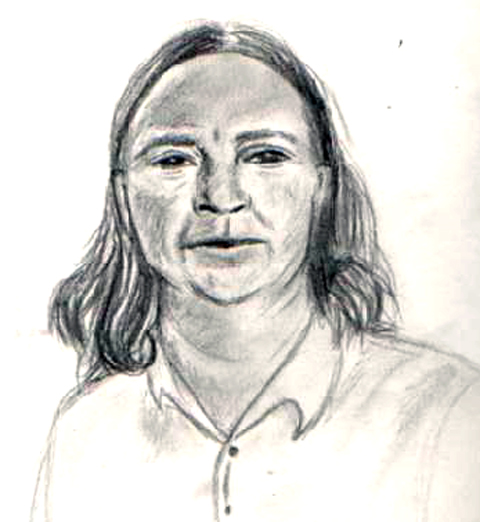

Tom Hunter by Kimberley Jenkins http://www.thesketchbookartist.co.uk

‘A palace for us’ shows daily until 20th January at the Serpentine Gallery, Kensington Gardens, London W2.
cure Little Rich Girls, more about 2010″ width=”480″ height=”654″ class=”alignnone size-full wp-image-31758″ /> Yinka Shonibare MBE, Little Rich Girls, 2010, Installation shot from GSK Contemporary – Aware: Art Fashion Identity, Commissioned by the London College of Fashion and the Royal Academy of Arts, © The Artist, Photo: Andy Stagg, Courtesy Royal Academy of Arts, London

In 2009, the Royal Academy of Art’s winter exhibition, Earth: Art of a Changing World featured a selection of artists engaging with the physical impacts of Climate Change. For 2010 the Royal Academy turned it’s attention to the subject of identity and clothing in the reductively titled; Aware: Art Fashion Identity. Broken down into three segments; Storytelling, Building and Belonging and Confronting, the exhibition endeavors to examine the possibilities provided –as explored by artists and fashion designers- by clothing to reveal and conceal our cultural and physical identity.

A new commission from Yinka Shonibare focused on cultural perceptions which turn out, under closer examination, to be false. Shonibare’s ghostly installation reveals the origination of batik pattern synonymous with African tribal patterns, to be in fact from Holland. The pattern makers sold the fabric to Africa once a European buyer could not be found.

Yoko Ono, Cut Piece, 1965, A film by Albert and David Maysles of Yoko Ono’s performance of Cut Piece at Carnegie Recital Hall, New York, 21 March 1965, 16mm black-and-white film with sync sound, transferred to DVD, running time 9’ Courtesy of the artist

After entering the Royal Academy via Burlington Arcade and walking up the stairs into the main exhibition space. The audience moves through the three sections in a circular motion; first encountering Storytelling (announced by the presence of an embroidered kimono by Grayson Perry) then Building and finally Belonging and Confronting. The audience departs Aware: Art Fashion Identity via the two of the exhibition’s most interesting works – both of which are nearing 30 years old.

Yoko Ono and Marina Abramovic’s performance pieces lay bare the artifice and cultural constructs which lay at the heart of both fashion and art identity. In the 9 minute video, Marina Abramovic and Ulay stand naked in a gallery doorway, forcing visitors to confront the physicality of the naked body, stripped of it’s adornments. Meanwhile in a video opposite Yoko Ono sits quietly on a stage whilst members of the audience snip her free from the garments of femininity. An exciting introduction to these two artists, it is a shame that more of their work was not included.

The limited inclusion of performance art is a lost opportunity, specifically because the four included pieces (Marina Abramovic Yoko Ono, Cindy Sherman and Mumbai) lend themselves vividly to the concept this exhibition was attempting to explore.

GSK Contemporary – Aware: Art Fashion Identity
Royal Academy of Arts, 2 December 2010 – 30 January 2011, Marina Abramovi?, Imponderabilia Performance 1977
Galleria Comunale d’Arte, Bologna © Marina Abramovi?. Courtesy of Marina Abramovi? and Sean Kelly Gallery, New York. © DACS 2010
Photo by Giovanna dal Magro

Cindy Sherman’s Paper Doll was located within the first room of the exhibition. An early video piece which lasts in it’s entirety of 2.30 minutes. Sherman questions the accepted (gender stereotyping) popularity of a child’s paper doll through the reduction of herself into an inanimate object. Whilst interesting to those who have encountered Sherman’s work previously, the singular nod does nothing to encourage the exploration of Sherman’s overture, including Untitled, a series of stills in which Sherman explores the relationship between the movies and societies ideas of femininity through feminine dress.

Cindy Sherman, Doll Clothes 1975, Stills from 16 mm film on DVD, © Cindy Sherman / Sammlung Verbund, Vienna / Sprüth Magers Berlin London

The final piece of video art that captured the attention is located within the sub-topic: Building. In 10 minutes Mumbai confronts the viewer with the appalling conditions required to produce the clothes we discard so readily and so frequently.

Throughout the exhibition nods are made to artists and fashion designers alike –a single McQueen stands in the corner devoid of its context within an entire collection, becomes a beautiful object, rather than a brutal critique on historical and modern notions of femininity. Within the white walls of the RA the identity of the dress becomes lost.

Alexander McQueen, Autumn Winter 1998: Joan, Photo © Chris Moore, Courtesy of Catwalking

An enjoyable exhibition, the problem appears to be that the art is spread too thin, interesting ideas are left hanging or barely graspable unless you enter the exhibition with prior knowledge of the artists or fashion designers gambit.

The final section of the exhibition briefly explores ideas surrounding Belonging and Confronting. Sharif Waked Chic Point is a video which places the daily humiliation the Palestinian man undergoes at the hands of Israeli checkpoints onto the catwalk. Personally, the work would have been more poignant if these clothes, which reduce the wearer to exposing various sections of flesh had been worn at a real or a recreated check point – highlighting the dehumanization that occurs as every man is treated as a potential terrorist. The photographs included at the end of the film and taken by the artist visualises the moment when clothes cease to become clothes and mutate into something fearful (whether imagined or not).

Sharif Waked, Chic Point, 2003, DVD, running time 5’ 27” Courtesy of the artist, Photo Sharif Waked

Coco Chanel suggested we “look for the woman in the dress if there is no woman, there is no dress” an idea taken up by Hussein Chalayan’s latest commission. In Son of Sonzai Suri, the fashion designer uses the 300-year-old Japanese tradition of Bunraku puppet theatre to lay bare the hidden puppeteers at the heart of the fashion industry.

Hussein Chalayan, ‘Son’ of Sonzai Suru, 2010, Installation shot from GSK Contemporary – Aware: Art Fashion Identity, Commissioned by the London College of Fashion and the Royal Academy of Arts, © The Artist, Photo: Andy Stagg, Courtesy Royal Academy of Arts, London

Aware: Art Fashion Identity closes with the aforementioned video pieces of Marina Abramovic and Yoko Ono. With the decision to close the exhibition here, it would appear that the critique of identity and femininity stopped in the 70’s. It could have been interesting to see a juxtaposition of performance art against the catwalk shows of Alexander McQueen or Maison Martin Margiela.

The exhibition closes on the 30th January.
Aware: Art Fashion Identity
Royal Academy
6 Burlington Gardens
London


Woodberry Down girl by Romain Lambert-Louis, buy information pills after ‘Jackie 1973’ by Erica Dobbs

It’s good Tom Hunter’s film is as good as it is, there because the last time I queued this long there was a saint at the end of it. Pilgrims wait for hours outside the cathedral in Santiago de Compostela to hug the statue above the saintly remnants – last Saturday the patient patrons of a crammed Serpentine Gallery were rewarded not so much with a divine cuddle, but with a screening of Tom Hunter’s gem of a documentary.

‘A palace for us’ is set at Woodberry Down, a 2,500-flat council estate complex in North Hackney, up by Tottenham. Going back 50 years, Tom Hunter’s film uses current day narratives and recreated scenes to tell the stories of three people who have spent their lives at the estate. ‘When we came here we realised how lucky we were,’ says one woman. ‘There was central heating and a bath with hot and cold. It was like a palace for us.’ As the woman talks, we see reenactments of when her husband-to-be asked her to dance for the first time. ‘I’d never seen eyes like his,’ she says, smiling at the memory. ‘We have a very good marriage right to the end.’


Woodberry Down dancers by Willa Gebbie http://www.w-illustration.blogspot.com

Commissioned by the Serpentine Gallery and Age Concern Hackney, Tom Hunter made the film after spending time in residence at Woodberry speaking to residents about their lives at the estate. Their stories are lovingly told, reflecting Hunter’s in-depth knowledge of his subjects and the area. One of the film’s interviewees shares the story how he cowered in his bed as the area was bombed back in 1944. Born in Stoke Newington, the man was among the first to move into the Woodberry estate in 1948.


Woodberry Down man by Timothy Hunt http://www.ficklefate.co.uk

Built to meet a severe housing shortage during the war, Woodberry was presented as an ‘estate for the future’. Especially the interviewee born on the estate has good memories of growing up at Woodberry, telling stories of playing hopscotch in the alleys, climbing the apple trees and making perfume out of the rose petals growing around the estate. The sense of community is clear, with the residents taking turn mopping the stairs. Now the site is the subject of a major regeneration project, which will replace the most run-down flats and add several more as well.


Woodberry Down kids by Sandra Contreras http://haciendochiribitas.blogspot.com/

The original plan was to see Tom Hunter talk about the film as well, but the despite earlier assurances there was no need to book seats, a flushed gallery worker had to turn away a nearly 50-strong crowd on Saturday. The day’s long lines might have been a one-off, but those who still haven’t seen the film may not want to leave it until the last minute. Because it really is worth seeing, as what I remember even clearer than the queuing is how I wish the film had gone on for longer.


Tom Hunter by Kimberley Jenkins http://www.thesketchbookartist.co.uk

‘A palace for us’ shows daily until 20th January at the Serpentine Gallery, Kensington Gardens, London W2.
policeman undercover by daria hlazatova
Policeman Undercover by Daria Hlazatova.

One day a few years ago I agreed to go on an intrepid action to highlight the causes of climate change. I didn’t know where or what it would be, view but as a climate activist I trust the many people that I know who are willing to invest a huge amount of time, page effort and (often their own) money in taking action for climate justice. So it was that I came to be in the Iona School in Nottingham on Easter Monday, for sale 13th April 2009. In a hall packed full of committed climate activists I discovered the sheer scale of the unbelievably audacious covert operation and as I looked around I tried to imagine how we could possibly pull it off: we all suspect that undercover cops must operate within our networks. We were fed, given instructions concerning our target and duly sent to bed in one of various rooms in the school which had been hired out for the weekend. Having made sure that my day pack was ready (warm clothes, a book, some high energy food) I rolled out my sleeping mat, got into my pyjamas, stuffed ear plugs into my ears and settled down for a short night’s sleep before we headed down to Ratcliffe-on-Soar coal fired power station in the early hours of the morning.

Ratcliffe_Disaster_Victoria_Archer
Ratcliffe Disaster by Victoria Archer.

Ratcliffe has been the focus of quite a few climate change demonstrations, not least the Great Climate Swoop, a publicly advertised assault that took place on this huge coal powered station later in 2009. Ratcliffe-on-Soar was chosen because it is one of the biggest coal fired power stations in the UK and it’s owned by E.ON, who were the energy company behind plans to build a new coal fired power station at Kingsnorth (now shelved) and who were the focus of Climate Camp actions throughout 2008 and 2009. In the event of a successful shut down electricity for the surrounding area could easily be obtained from other sources.

ratcliffe by farzeen jabbar
Ratcliffe by Farzeen Jabbar.

As I went to bed there was an the air of the calm before the storm, especially after we received conflicting reports about a growing police presence near the power station. It just seemed so incredibly unlikely that out of the several hundred people involved in the planning of the action (including drivers, hosts, etc) no one could have let slip our plans. Nonetheless I was tired and soon fell asleep.

A few minutes after I dozed off I was woken by my friend screeching POLIIIIIIIIIICE in my ear. No amount of deeply inserted ear plug was going to stop me leaping into immediate bleary eyed action as I realised that the entire building was surrounded and being battered from all sides. I just had time to struggle into some decent clothing before our room was filled with policemen who immediately handcuffed us all, regardless of our state of dress. I never knew I would find out what it’s like to be treated like a terrorist, but I can now safely tell you that I do. And it was utterly surreal. We were kept in our respective rooms (chosen for the type of action we would be taking) for what seemed like hours. As we waited we could hear people singing protest songs up and down the corridor. Domestic Extremists we might be. Your standard terrorists we ain’t.
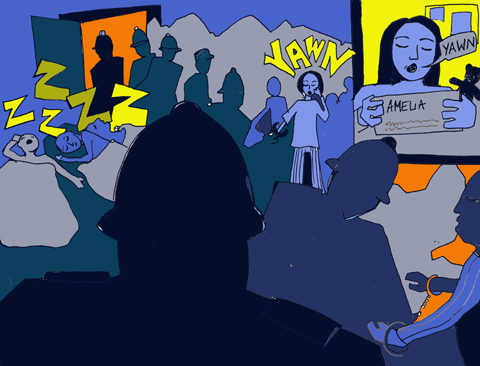
abi daker Amelia gets arrested
Amelia Gets Arrested by Abigail Daker.

I was desperately keen to take my belongings with me as we were finally led out of the room – I’ve had previous experience of them being kept by police and I knew how long it would take to get them back (nearly a year as it turned out), but my arresting officer would not allow me to pick them up despite others being allowed to do so: the first sign of a somewhat shambolic operation with far from clear instructions.
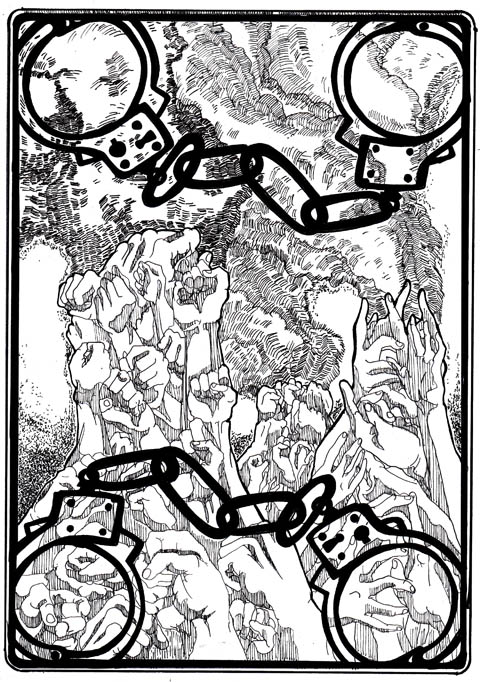
Ratcliffe on Trial by Rukmunal Hakim
Ratcliffe on Trial by Rukmunal Hakim.

Things were shortly to get much more surreal. We were frogmarched two by two – handcuffed to our respective officers – into an impromptu photo studio that had been set up in the school nursery. Our mugshots were taken in front of the kids’ brightly coloured artwork before we were packed off into vans and taken to holding cells at police stations all over the city. I was held through the night and for most of the ensuing day. Being a well trained activist I kept to No Comment throughout my interrogation, though the investigating officer was very interested in my ear plugs (convinced they were a clue that I was headed to the noisy coal conveyor belt) and my Climate Rush badge (at that time I was still involved with the Suffragette inspired group).

My Mugshot by Alison Day
My Mugshot by Alison Day.

My DNA was taken before I was eventually allowed to leave, taking none of my belongings. I was simply ejected into the night. With no money and absolutely no idea where I was in Nottingham. Fortunately there was legal support waiting in the station car park and I was scooped up and taken to a safe house. I spent another night sharing a bed with an activist before hitching the first lift out of Nottingham. By this time I was desperate to get back to London because I was worried that my house would be raided – someone else had left a piece of paper with my details on in their wallet and it had been waved at me as evidence in the police station. I spent the next few weeks worrying whether I would be raided when my interns were in the house, thereby putting their computers at risk as evidence too. In the end my worries were unfounded, though many other people were raided.
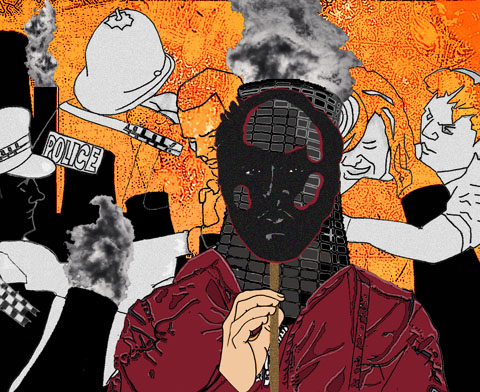
Ratcliffe Trial by Matilde Sazio
Ratcliffe Trial by Matilde Sazio.

It has taken nearly two years for this case to come to court, during which time I have not been able to talk about it for fear of affecting the outcome for the 26 who were charged (out of the original 114 activists who were arrested). Many of those spent the better part of December 2010 fighting their case in court in Nottingham. Green Party leader Caroline Lucas gave a statement and James Hansen testified. Despite comprehensive evidence proving that the climate crimes of corporations such as E.ON are way worse than anything we were planning to do, the activists were all convicted and given a mix of fines, conditional discharges and community service. Maybe the jury was won over by the prosecution argument that we would have been better off spending our time getting Cheryl Cole to promote second hand clothing. Bleurgh. The judge did however praise the defendents for their “intelligence and dedication” – climate activists are certainly some of the most clever and interesting people I know.
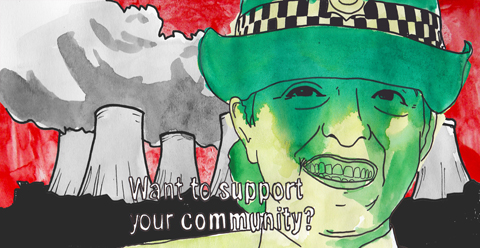
GarethAHopkins_Police The Community Ignore The Environment
Illustration by Gareth A Hopkins.

Six more activists were due to go to court today with a defence of Not Guilty because they had not yet decided to take part in the action when they were arrested. It was set to be an extraordinarily interesting case that would challenge the excessively expensive largest ever pre-emptive arrest, which in retrospect seems to be have been designed to capture the details of the entire UK climate activist network in one fell swoop. But their plans have at the last moment been thwarted. The reason? Our very own police mole.
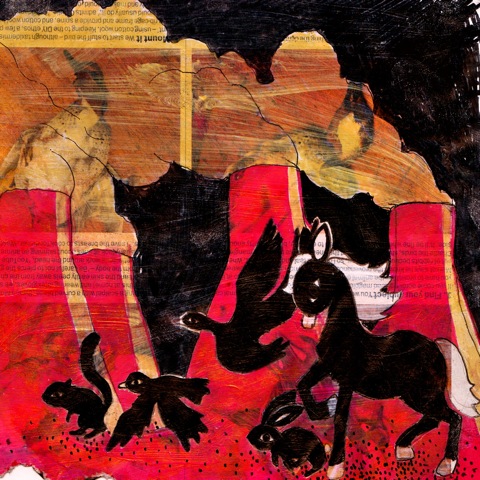
Ratcliffe by Gemma Birss
Ratcliffe by Gemma Birss.

A few months ago the indymedia networks were rife with the news that a climate activist mole had been unmasked. For seven years Mark “Flash” Stone (so called because he always seemed to have lots of cash) was a familiar face on the activist circuit until he was outed by ‘close’ friends who eventually became suspicious of him. He also happened to be involved in much of the preliminary planning for the April action on Ratcliffe: hosting meetings, driving trucks and planning to lead climbers up the huge chimney stack.

Now it is revealed that Mark has left the police force, apparently ashamed of the consequences of his actions. The Ratcliffe Trial blog states that he was even planning to provide evidence in favour of the defendants he did so much to help arrest back in 2009. However it appears that outside pressures (the police he used to work for? surely not) recently caused him to withdraw his offer. The case was then mysteriously dropped in its entirety after the defence pressed the powers that be for details of Mark Kennedy’s involvement in the initial planning stages of the Ratcliffe action.
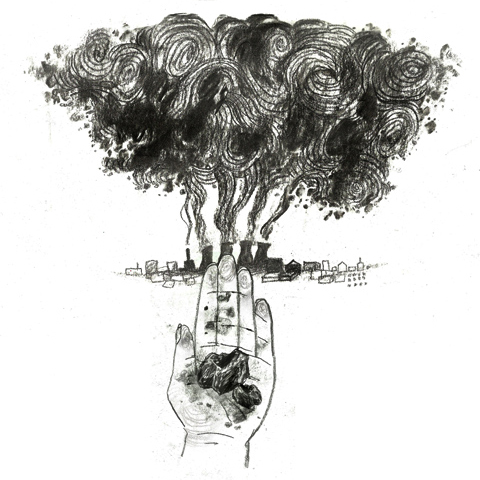
climate change by Jane McGuinness
Climate Change by Jane McGuinness.

Even before today’s revelations it already seemed a sure bet that Mark’s insider knowledge helped to secure huge funding for the police raid, which cost upwards of £700,000 and ensured that officers were drafted in from across the county on huge overtime wages over Easter. That’s over £6,000 on the cost of arresting me alone. Not to mention the fact that the extremely expensive court case may have collapsed in its entirety had Mark’s involvement been known earlier. I can think of better ways to spend cash, can’t you?
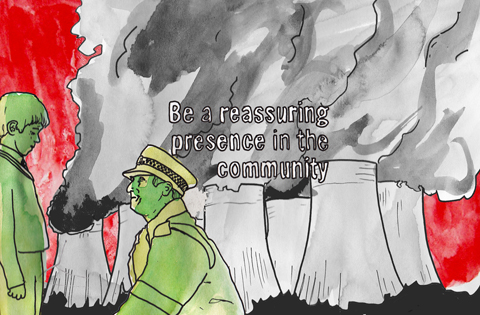
GarethAHopkins_Police The Community Ignore The Environment
Police The Community Ignore The Environment by Gareth A Hopkins.

In the last year Climate Change has all but dropped off the mainstream media agenda and many of our most committed activists have been tied up in lengthy court proceedings. Yet climate change continues unabated. Next month Climate Camp will run a five day long event at Monkton Wyld Court in Dorset called A Space for Change, which will seek to “reflect and re-assess climate justice activism, re-dream what a radical movement can be and re-invigorate ourselves and our network.” There’s never been a better time to get involved in climate activism. You can find out more details here.

Categories ,A Space for Change, ,Abigail Daker, ,activism, ,Alison Day, ,Caroline Lucas, ,Cheryl Cole, ,Climate Camp, ,Climate Change, ,Climate Rush, ,coal, ,Daria Hlazatova, ,Direct Action, ,DNA, ,Domestic Extremist, ,Dorset, ,E-On, ,Farzeen Jabbar, ,Gareth A Hopkins, ,Gemma Birss, ,Iona School, ,James Hansen, ,Jane McGuinness, ,kingsnorth, ,Mark “Flash” Stone, ,Mark Kennedy, ,Mark Stone, ,Matilde Sazio, ,Mole, ,Monkton Wyld Court, ,No Comment, ,nottingham, ,Paul Lewis, ,police, ,Ratcliffe, ,Ratcliffe 114, ,Ratcliffe On Soar, ,Rob Evans, ,Rukmunal Hakim, ,Suffragette, ,Terrorist, ,Undercover, ,Victoria Archer

Similar Posts:


Amelia’s Magazine | UK Uncut, Green & Black Cross, Black Bloc & the March for the Alternative.

buy purchase _Another_Level, approved _4x4x3m,_mixed_media_including_reclaimed_wood,_glass_flowers,_taxidermied_bird,_flower_pots,_2009_courtesy_the_artist_and_EB&Flow” width=”480″ height=”320″ class=”aligncenter size-full wp-image-38966″ />
Katie Louise Surridge, Another Level. Mixed media including reclaimed wood, glass flowers, taxidermied bird, flower pots.

Amidst the renovations and general detritus that inevitably comes when you do a top to toe renovation of a two floored building, Nathan Englebrecht and Margherita Berloni are guiding me around the former print works in Leonard Street, EC2 which will soon form the light-filled gallery space for EB&Flow. In the run up to the April 2nd opening, the gallery founders – both twenty somethings who met on an art business course – seem as cool as a proverbial cucumber and in good spirits as we tour the premises, chatting all the while about their vision for the space and how it will serve and suit their artists in residence. While art galleries are certainly not hard to come by in this neck of the woods, there is something very noteworthy about this particular endeavor, and that is the galleries extensive level of support to the artists who will exhibit in their gallery. Their aim is to cultivate long term relationships with the artists in residency, and share an ethos that they will try to make anything happen for them; advising them on their careers, placing them in collections, even paying for material costs if necessary.


A selection of works by some of the 10 artists who will be exhibiting at the group show Since Tomorrow
Gemma Anderson
Albemarlensis, Pahoehoe Lava


Ketil by Shannah Bupp.


Silent Are The Echoes by Nicholas Mcleod

During the time that their work is exhibited at EB&Flow, they are also given studio space within the gallery. (After a period, the walls will be removed and the studio becomes an exhibition in itself). It soon becomes clear that Nathan and Margherita feel passionately about this, discussing at length something which is somewhat of a current hot topic – the sense that artists are not provided with enough support and advice during their time at art school with regards to the business of art; (a subject that was recently discussed in Jessica Furseth’s article here). “We never felt that artists had the right platform in which to exhibit and the support that was needed to develop their careers”, Nathan explains. Born out of this is an additional feature of the gallery; an educational programme kicking off at the end of April that will discuss issues such as collecting, curatorial practice and artist professional development. They list a few of the topics that will be covered, such as the legality issues of selling art, re-sell rights, how to store art, how to do art fairs…..all things relevant and vital to a burgeoning artists career. It’s worth mentioning that these courses and lectures will be open to all. Check the EB&Flow website for further details.


Margeherita and Nathan, EB & Flow.

I ask Margherita and Nathan what they are looking for in an artist, and what type of work will feature at EB&Flow. “There is a certain aesthetic line going through our choice of artists”, Nathan explains, with Margherita adding “we steer away from very conceptual stuff and minimalist art; we want something rich and interesting to look at”. Their first collection is entitled Since Tomorrow, curated by Attilia Fattori Franchini and features work (using disciplines such as installation, painting, sculpture and photography) from ten emerging artists exploring the dynamics of space and providing responses to the question ‘ what is the space we are living at the moment and how do we represent it?’. Work will be shown by Briony Anderson, Gemma Anderson, Neil Ayling, Ross M. Brown, Shannah Bupp, Sue Corke, Dylan Culhane, Alessandro Librio, Nicholas McLeod, Katie Louise Surridge and Cristian Zuzunaga.


A Beautiful Struggle by Katie Louise Surridge

Amongst the core group of artists whose work will be opening the gallery is Katie Louise Surridge, a Slade School of Fine Art graduate. (She will also go on to have a residency at the EB&Flow gallery). Her work will particularly resonate with anyone who lives in grimy, rubbish strewn London because Katie has the ability to make something beautiful out of the underbelly of the city. Her installations use found objects which she sources during scavenging missions done mainly along the Thames, creating a utopia out of what has been left behind and discarded. While I was talking with Nathan and Margherita, Katie was busy getting a sense of the space that will feature her (very big) installation. She works mostly with natural materials, such as aged wood and metal; “natural materials that have been used in this urban scheme, and then reverted back to being natural again”. “I have this fascination with what’s left behind”, she continues, “I like the aesthetic of what the river washes up – it’s been there for a long time and it’s aged and it feels like its got a bit of history behind it”. Discovering Katie’s work makes me realise how little I know about what gets discarded in big cities, and how much waste washes up around us.


So Over by Katie Louise Surridge

It’s impossible not to warm to Katie, especially after discovering the following facts about her:
– She once found an S+M style gag washed up in the river and took it to the pub, thinking that it was a dog collar.
– She was in the Boy Scouts as a child (not the Brownies)
– She is a self confessed obsessive hoarder
– Her beloved dog is going to be featured on a ‘Dog Borstal’ style TV show
– She is saving up to buy a metal detector to assist her scavenging expeditions.

Since Tomorrow: Exhibition Dates, 2 April – 26 May.


Dylan Culhane, and his work Mechanotron which will feature in Since Tomorrow.

March 26 2011-UK UncutUK Uncut gathers on the South Bank on Saturday 26th March 2011. All photography by Amelia Gregory.

Unless you have been living under a rock you will be aware that there was a huge anti-cuts March for the Alternative on Saturday 26th March 2011. In the days since then the press has been dominated with both outrage from the government that “hooligans” should be allowed to roam the streets, order and on the other side, order shock at the way in which once again the police and media have mistreated protestors. As anyone who was following me on Twitter will know I was involved on the UK Uncut action, pharmacy which involved an occupation of Fortnum & Mason… yet another large corporation culpable of massive tax avoidance: This action led to by far the largest numbers of arrests and charges on the day: a staggering 138 of the 149.

March 26 2011-UK Uncut. Photography by Amelia Gregory

March 26 2011-UK Uncut. Photography by Amelia Gregory

On my way through London I saw the most enormous amount of creativity, from pound coin shields to a Trojan Horse cunningly installed at the centre of Oxford Circus – and of course plenty of banners bursting with witty one liners: included in this blog post are just a few of the amazing sights from the day. With a march numbering possibly half a million and upwards (something the government has been quick to downplay) there were surely many great ones that I missed – especially the legendary message “I was told there would be biscuits” carried by a small child on someone’s shoulders. I broke away from the march early on to take part in UK Uncut actions on Oxford Street and then at Fortnum & Mason.

March 26 2011-UK Uncut. Photography by Amelia Gregory

Demonised by the press for their behaviour, UK Uncut have been quick to fight back with their version of events: really, the police and media should know better. Both UK Uncut and Green & Black Cross – the support network that provided legal observers and arrestee support – have grown out of Climate Camp networks and ways of organising to take on completely new identities of their own. As a result some of those involved are no strangers to wrongful arrest, police brutality and political policing: remember Heathrow, Kingsnorth, G20 and Ratcliffe anyone? These people know what they are doing; naturally the unfair arrests of UK Uncut was filmed and immediately shared, the footage unsurprisingly making the front page of the Guardian.

March 26 2011-UK Uncut. Photography by Amelia Gregory

Some people might wonder what on earth the links between the anti-cuts movement and Climate Camp are, but Climate Camp has always been rooted in a desire to address the social inequalities of capitalism – for example a breakaway group in London is currently looking at ways to campaign around fuel poverty. One of the favourite slogans at the COP15 Climate conference was System Change not Climate Change – we can’t cure the problem with simple quick fix answers, but rather by tackling the whole global neoliberal system. A brutal plan to cut services such as libraries and the NHS will undermine the fabric of a just society, affecting the poor most. Meanwhile the rich are able to avoid huge tax bills at a time when we desperately need to start building a green economy that is not based on endless profit. Clearly these inequalities are something that green activists are keen to tackle.

March 26 2011-UK Uncut. Photography by Amelia Gregory

Climate Camp has also always been a broad mix of liberalism and radicalism, so it’s no surprise that UK Uncut is as well. The very name Green & Black Cross indicates how the group combines the more autonomous anarchist streaks of activism with the skills, infrastructure and ideologies built up within the green movement. It supports grassroots social struggles in the UK and during the March for the Alternative the Green & Black Cross provided Legal Support, Action Medics and Action Kitchens. They even had a basic compost portaloo roaming the streets in a supermarket trolley – but in the event it was never used: it’s hard to get into a kettle once it is formed. They will be independently advising on all arrests during the day at a defendants’ meeting on Saturday 2nd April and were generally out in force to offer biscuits and legal advice as soon as arrestees were released.

March 26 2011-UK Uncut. Photography by Amelia Gregory

Since the arrests UK Uncut activists have had to field a barrage of commentary from the media, which has been ever quick to notice the anarchic element of their protest. Their sit in at Fortnum & Mason was largely peaceful – protestors ate their own sandwiches and listened to performances and speeches – but on Newsnight a spokesperson was asked to denounce all protestor violence. She did a marvellous job of neither condoning nor condemning it: there were people from all backgrounds in Fortnum & Mason. For some it will have been their first experience of direct action (read this shocking report of the arrest of a 15 year old girl) and others were part of the Black Bloc earlier in the day – the two are not mutually exclusive. UK Uncut has an incredibly loose non-hierarchical structure, and to be successful it must somehow find a place for those of all backgrounds.

March 26 2011-UK Uncut. Photography by Amelia Gregory
March 26 2011-UK Uncut. Photography by Amelia GregoryInside Fortnum & Mason. They look super scared don’t they?

Most UK Uncutters recognise that there is more to successful activism than a simplistic black and white damnation of violence, but the more liberal end of the spectrum may well be new to the idea that damage to property is not considered violence by many activists – see here for a definition – so there is going to be a rapid need to redefine and educate as soon as possible. Most of the targets for property damage on Saturday were well thought through – big banks that avoid tax, Topshop, BHS and so on. Who threw paint, and who broke windows? It’s not clear, but the targets were clear enough. Some people, whether you agree with it or not, think it is more effective to inflict damage on a well selected target than to simply march from A-B and then listen to speeches. After all, what did it ever do to stop the Iraq war? Direct action through the ages has proven that targeting property can be highly effective – the Suffragettes were never afraid of inflicting collateral damage. Last year at Climate Camp windows were smashed at the RBS head offices in Edinburgh to demonstrate concern against their continued investment in fossil fuels.

March 26 2011-UK Uncut. Photography by Amelia Gregory

By Trafalgar Square at night some rogue elements (possibly pissed up) were clearly provoked into throwing glass bottles at police, never something I would recommend however bad police brutality gets (and by all accounts it did get REALLY bad) because I personally don’t believe that violence against people is ever acceptable. But I do believe that the Black Bloc as a considered and thoughtful tactic is something that our movement needs: people who are willing to put their bodies and actions on the front line to stop those who are damaging the fabric of our “democratic” society. Many of them were very young, possibly disaffected veterans of kettling at the student demos last year – others were highly organised groups who came to join the march from across the country. Those involved will undoubtedly have slightly different views as to process and outcome but recent online dialogues prove that diverse parts of the movement are keen to work together. Rather than dismiss Black Bloc actions as the nihilistic work of masked “hooligans” we would do well to consider the underlying reasons why this is seen as an appealing tactic utilised by at least a thousand people last weekend. After all, we’re all in this together… and this is just the beginning of our future.

March 26 2011-UK Uncut. Photography by Amelia Gregory

Further reading:
Why Fortnum & Mason?
Video footage from the UKuncut action
An open letter from the Brighton Solidarity Federation of Anarcho-Syndicalists
People are worth less than property
A night in the cells is nothing to a lifetime imprisoned by cuts
Reasons why the cuts are a bad idea
Dominic Campbell experiences police brutality in Trafalgar Square
Political Dynamite: We should use the word violence with the greatest care.
Leah Borromeo: Protestors can’t disown the “violent minority”.
Why the UKuncut arrests threaten future protests
What is the Black Bloc? Information page.
Laurie Penny – What really happened in Trafalgar Square
My UK Uncut arrest made me a political prisoner
Climate Camp 2010 in Edinburgh – my commentary
Climate Camp 2009 in Copenhagen – my commentary part one, part two and part three.
G20 Climate Camp in the City – my commentary
Ratcliffe: Did PC Mark “Flash” Kennedy ensure my arrest as one of the Ratcliffe 114 ?- my commentary
Climate Camp at Kingsnorth in 2008.
One of the first UK Uncut protests: Sir Philip Green and his Topshop billions get the UK Uncut treatment.
The Third Estate: A message to Critical UK Uncut activists.
Latent Existance: a report by the 15 year old who was arrested.

Categories ,Anarchism, ,Anarcho-Syndicalists, ,Anti-capitalism, ,Anti-cuts, ,Banners, ,BHS, ,Black Bloc, ,capitalism, ,Climate Camp, ,COP15 Climate conference, ,Cuts, ,Democratic, ,Direct Action, ,Dominic Campbell, ,economy, ,Fortnum & Mason, ,g20, ,Green & Black Cross, ,Green New Deal, ,Green Party, ,Hooligans, ,kingsnorth, ,Liberal, ,March for the Alternative, ,Neoliberalism, ,Newsnight, ,NHS, ,Oxford Circus, ,police, ,Political Dynamite, ,Ratcilffe, ,Suffragettes, ,Tax Avoidance, ,The Third Estate, ,topshop, ,Trafalgar Square, ,Trojan Horse, ,UK Uncut, ,Veggies, ,Violence

Similar Posts:


Amelia’s Magazine | UK Uncut, Green & Black Cross, Black Bloc & the March for the Alternative.

March 26 2011-UK UncutUK Uncut gathers on the South Bank on Saturday 26th March 2011. All photography by Amelia Gregory.

Unless you have been living under a rock you will be aware that there was a huge anti-cuts March for the Alternative on Saturday 26th March 2011. In the days since then the press has been dominated with both outrage from the government that “hooligans” should be allowed to roam the streets, and on the other side, shock at the way in which once again the police and media have mistreated protestors. As anyone who was following me on Twitter will know I was involved on the UK Uncut action, which involved an occupation of Fortnum & Mason… yet another large corporation culpable of massive tax avoidance: This action led to by far the largest numbers of arrests and charges on the day: a staggering 138 of the 149.

March 26 2011-UK Uncut. Photography by Amelia Gregory

March 26 2011-UK Uncut. Photography by Amelia Gregory

On my way through London I saw the most enormous amount of creativity, from pound coin shields to a Trojan Horse cunningly installed at the centre of Oxford Circus – and of course plenty of banners bursting with witty one liners: included in this blog post are just a few of the amazing sights from the day. With a march numbering possibly half a million and upwards (something the government has been quick to downplay) there were surely many great ones that I missed – especially the legendary message “I was told there would be biscuits” carried by a small child on someone’s shoulders. I broke away from the march early on to take part in UK Uncut actions on Oxford Street and then at Fortnum & Mason.

March 26 2011-UK Uncut. Photography by Amelia Gregory

Demonised by the press for their behaviour, UK Uncut have been quick to fight back with their version of events: really, the police and media should know better. Both UK Uncut and Green & Black Cross – the support network that provided legal observers and arrestee support – have grown out of Climate Camp networks and ways of organising to take on completely new identities of their own. As a result some of those involved are no strangers to wrongful arrest, police brutality and political policing: remember Heathrow, Kingsnorth, G20 and Ratcliffe anyone? These people know what they are doing; naturally the unfair arrests of UK Uncut was filmed and immediately shared, the footage unsurprisingly making the front page of the Guardian.

March 26 2011-UK Uncut. Photography by Amelia Gregory

Some people might wonder what on earth the links between the anti-cuts movement and Climate Camp are, but Climate Camp has always been rooted in a desire to address the social inequalities of capitalism – for example a breakaway group in London is currently looking at ways to campaign around fuel poverty. One of the favourite slogans at the COP15 Climate conference was System Change not Climate Change – we can’t cure the problem with simple quick fix answers, but rather by tackling the whole global neoliberal system. A brutal plan to cut services such as libraries and the NHS will undermine the fabric of a just society, affecting the poor most. Meanwhile the rich are able to avoid huge tax bills at a time when we desperately need to start building a green economy that is not based on endless profit. Clearly these inequalities are something that green activists are keen to tackle.

March 26 2011-UK Uncut. Photography by Amelia Gregory

Climate Camp has also always been a broad mix of liberalism and radicalism, so it’s no surprise that UK Uncut is as well. The very name Green & Black Cross indicates how the group combines the more autonomous anarchist streaks of activism with the skills, infrastructure and ideologies built up within the green movement. It supports grassroots social struggles in the UK and during the March for the Alternative the Green & Black Cross provided Legal Support, Action Medics and Action Kitchens. They even had a basic compost portaloo roaming the streets in a supermarket trolley – but in the event it was never used: it’s hard to get into a kettle once it is formed. They will be independently advising on all arrests during the day at a defendants’ meeting on Saturday 2nd April and were generally out in force to offer biscuits and legal advice as soon as arrestees were released.

March 26 2011-UK Uncut. Photography by Amelia Gregory

Since the arrests UK Uncut activists have had to field a barrage of commentary from the media, which has been ever quick to notice the anarchic element of their protest. Their sit in at Fortnum & Mason was largely peaceful – protestors ate their own sandwiches and listened to performances and speeches – but on Newsnight a spokesperson was asked to denounce all protestor violence. She did a marvellous job of neither condoning nor condemning it: there were people from all backgrounds in Fortnum & Mason. For some it will have been their first experience of direct action (read this shocking report of the arrest of a 15 year old girl) and others were part of the Black Bloc earlier in the day – the two are not mutually exclusive. UK Uncut has an incredibly loose non-hierarchical structure, and to be successful it must somehow find a place for those of all backgrounds.

March 26 2011-UK Uncut. Photography by Amelia Gregory
March 26 2011-UK Uncut. Photography by Amelia GregoryInside Fortnum & Mason. They look super scared don’t they?

Most UK Uncutters recognise that there is more to successful activism than a simplistic black and white damnation of violence, but the more liberal end of the spectrum may well be new to the idea that damage to property is not considered violence by many activists – see here for a definition – so there is going to be a rapid need to redefine and educate as soon as possible. Most of the targets for property damage on Saturday were well thought through – big banks that avoid tax, Topshop, BHS and so on. Who threw paint, and who broke windows? It’s not clear, but the targets were clear enough. Some people, whether you agree with it or not, think it is more effective to inflict damage on a well selected target than to simply march from A-B and then listen to speeches. After all, what did it ever do to stop the Iraq war? Direct action through the ages has proven that targeting property can be highly effective – the Suffragettes were never afraid of inflicting collateral damage. Last year at Climate Camp windows were smashed at the RBS head offices in Edinburgh to demonstrate concern against their continued investment in fossil fuels.

March 26 2011-UK Uncut. Photography by Amelia Gregory

By Trafalgar Square at night some rogue elements (possibly pissed up) were clearly provoked into throwing glass bottles at police, never something I would recommend however bad police brutality gets (and by all accounts it did get REALLY bad) because I personally don’t believe that violence against people is ever acceptable. But I do believe that the Black Bloc as a considered and thoughtful tactic is something that our movement needs: people who are willing to put their bodies and actions on the front line to stop those who are damaging the fabric of our “democratic” society. Many of them were very young, possibly disaffected veterans of kettling at the student demos last year – others were highly organised groups who came to join the march from across the country. Those involved will undoubtedly have slightly different views as to process and outcome but recent online dialogues prove that diverse parts of the movement are keen to work together. Rather than dismiss Black Bloc actions as the nihilistic work of masked “hooligans” we would do well to consider the underlying reasons why this is seen as an appealing tactic utilised by at least a thousand people last weekend. After all, we’re all in this together… and this is just the beginning of our future.

March 26 2011-UK Uncut. Photography by Amelia Gregory

Further reading:
Why Fortnum & Mason?
Video footage from the UKuncut action
An open letter from the Brighton Solidarity Federation of Anarcho-Syndicalists
People are worth less than property
A night in the cells is nothing to a lifetime imprisoned by cuts
Reasons why the cuts are a bad idea
Dominic Campbell experiences police brutality in Trafalgar Square
Political Dynamite: We should use the word violence with the greatest care.
Leah Borromeo: Protestors can’t disown the “violent minority”.
Why the UKuncut arrests threaten future protests
What is the Black Bloc? Information page.
Laurie Penny – What really happened in Trafalgar Square
My UK Uncut arrest made me a political prisoner
Climate Camp 2010 in Edinburgh – my commentary
Climate Camp 2009 in Copenhagen – my commentary part one, part two and part three.
G20 Climate Camp in the City – my commentary
Ratcliffe: Did PC Mark “Flash” Kennedy ensure my arrest as one of the Ratcliffe 114 ?- my commentary
Climate Camp at Kingsnorth in 2008.
One of the first UK Uncut protests: Sir Philip Green and his Topshop billions get the UK Uncut treatment.
The Third Estate: A message to Critical UK Uncut activists.
Latent Existance: a report by the 15 year old who was arrested.

Categories ,Anarchism, ,Anarcho-Syndicalists, ,Anti-capitalism, ,Anti-cuts, ,Banners, ,BHS, ,Black Bloc, ,capitalism, ,Climate Camp, ,COP15 Climate conference, ,Cuts, ,Democratic, ,Direct Action, ,Dominic Campbell, ,economy, ,Fortnum & Mason, ,g20, ,Green & Black Cross, ,Green New Deal, ,Green Party, ,Hooligans, ,kingsnorth, ,Liberal, ,March for the Alternative, ,Neoliberalism, ,Newsnight, ,NHS, ,Oxford Circus, ,police, ,Political Dynamite, ,Ratcilffe, ,Suffragettes, ,Tax Avoidance, ,The Third Estate, ,topshop, ,Trafalgar Square, ,Trojan Horse, ,UK Uncut, ,Veggies, ,Violence

Similar Posts: