Amelia’s Magazine | Review: Silver Metal Clay Jewellery Class with Sima Vaziry at the London Jewellery School

Silver Metal Clay necklace small
Silver metal clay has intrigued me since I did silversmithing classes a few years ago, simply because it promises so much: all the gleam and precious feel of silver and… well… about a quarter of the work to achieve it. What’s not to intrigue? But my then teacher scared me off with stories of how difficult it is to work with, and its purported inferior quality.

Well, now I’ve worked with the stuff and I’m a convert. It’s a very different material to manipulate than sterling silver, which requires large amounts of heating and hammering. Working with silver metal clay is more like working with ceramic clay, in that you have to work fast or it dries out. It is also a lot like working with a polymer clay such as Fimo – you push it around with your fingers to achieve the effects you want.

Sima Vaziry London Jewellery School
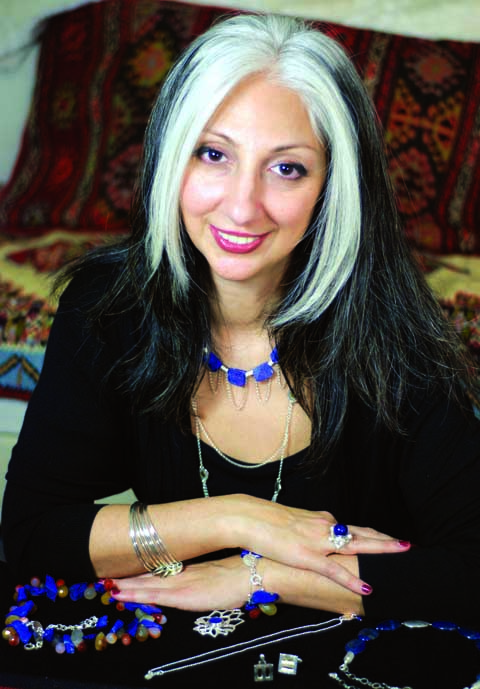
At my London Jewellery School class we were taught by silver clay enthusiast and expert Sima Vaziry, whose upbringing has clearly influenced her love of all things Persian and Afghan. A trained graphic designer, she’s been silver smithing for years, etching her own calligraphy onto jewellery and increasingly struggling to achieve her desired finish. That is until she discovered silver metal clay – and this beguiling material is now used to create her bestselling collection, which is available to buy at the British Museum. Describing why she decided to make the move from graphic design to jewellery design she made the very good point that in the former you rarely get pure praise: no one ever says ‘wow, that’s beautiful’ which they do when they fall in love with a stunning piece of jewellery. The perfect advocate for the London Jewellery School, Sima turned her love of jewellery into a serious career by taking a number of short courses over two years. And there’s me dreaming of another career…

Our class was small, which was perfect since it turned out to be quite intensive – there’s a lot to fit in if you want to create a fully formed piece of jewellery in just two and a half hours. But it turns out that it is possible! And whilst I had some moments of frustration (damn, that stuff dries fast, you need to have your design ready planned and all the materials close at hand) by the end I was happy as a pig in muck. There’s nothing like holding that weighty bit of silver in your hand, and thinking – blimey, just a few moments ago that was no more than a slab of white clay. Whilst I might not have achieved a final design that was fully to my liking, for a quick process with eminently satisfying results you really can’t beat this medium – and I’d love to give it another go, only next time with better design preparation and planning.

Sima Vaziry Bloom gold necklace silver clay metal
Sima Vaziry‘s Bloom necklace made out of silver metal clay. She was wearing one at the class and I can testify that it was beautiful. I’d like to have these kind of skills, but I guess they take time (you can see my first efforts at the top of the blog)!

The London Jewellery School offers all sorts of interesting courses so their website is well worth checking out: how about a taster class for just £35 as a unique and thoughtful present? If you fancy learning more about how to work with silver metal clay then you can still join the second pre-christmas offering next week, listed here. You can find jewellery by Sima Vaziry at the Grenville Shop in the British Museum or online. She will be giving a talk about her designs to friends of the British Museum on March 19th, at 18.30 & 20.00 in the Lecture Theatre, titled ‘A journey into jewellery – Hajj range designer Sima Vaziry talks about her life and her story-telling pieces‘.

Categories ,Afghan, ,British Museum, ,Class, ,Fimo, ,Graphic Design, ,jewellery, ,London Jewellery School, ,Persian, ,Polymer Clay, ,Precious Metal Clay, ,review, ,Silver, ,Silver Metal Clay, ,Silversmithing, ,Sima Vaziry, ,Taster Classes

Similar Posts:


Amelia’s Magazine | Defining Beauty at the British Museum: From a Child’s View

Defining Beauty British Museum-statue
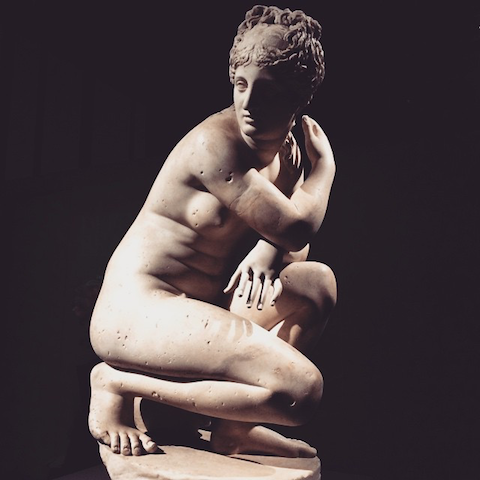
Earlier this week I dragged Snarfle down to the press preview of Defining Beauty, the new blockbuster exhibition from the British Museum. When we arrived the curator was giving a chat, a part I had hoped to avoid… but well, toddlers, it’s hard to get them moving, and the bus ride took forever. So we circumvented the first room, which showcased some stunning examples of Greek sculpture, including a bronze in near perfect condition that was apparently only recently dug out of the sea.

Defining Beauty British Museum-Gold Goddess Athena
Golden goddess Athena at the new British Museum exhibition.

I wasn’t sure how my penis obsessed little boy would react to loads of nude marble sculptures, so was prepared to give a whispered commentary on the state of the various body parts – intact or not – as we moved around the exhibition. Snarf was the youngest attendee by at least 30 years but perhaps surprisingly he was rather enraptured by many of the sculptures, including the gorgeous gold Athena and a wriggling bronze baby, beautifully captured holding it’s arms out to be picked up.

The exhibition includes depictions of the body on vases and reliefs, but it is the sculptures which really provoke awe. The rooms showcase Greek art through the ages, revealing how these skilled artisans became adept at making movement out of rock, an amazing feat if you think about it.

Defining Beauty British Museum-Alexander the Great
Alexander the Great. A flattering depiction I feel.

Towards the end we encountered the Laughing Boy, which Snarfle also loved. However when we got home and looked through the press kit he wanted to chop the Laughing Boy image up. ‘I liked it at the museum, but I don’t like the picture, it’s scary,’ he told me, scissors in hand. I have to agree, it did have a rather sinister edge.

A must see exhibition for anyone who loves classical art – there are a host of events associated with the show, including some fun sessions over Easter for kids. Find out more here. The exhibition continues until 5th July 2015.

Categories ,Athena, ,British Museum, ,children, ,Classical Art, ,Defining Beauty, ,exhibition, ,Family, ,Greek, ,Greek Art, ,Laughing Boy, ,review, ,sculpture, ,Snarfle

Similar Posts:


Amelia’s Magazine | An Interview With Zoe Paul

Jam Free Project Leytonstone
The Ethical Fashion Forum has been popping up all over the place at here at Amelia’s Magazine. Back in June we covered the first section of their biannual competition established to reward good deeds regarding sustainability in Fashion. Titled PURE, information pills the winners – South African designer Lalesso and Malawi designer MIA– would display their designs at the PURE tradeshow. Yesterday in the rather lovely setting of the Hospital Club, ask the EFF announced the second half of their competition, website like this the Esthetica awards. Judged by Dolly Jones from vogue.com.

mia%20nisbet%203.jpg
MIA

As the crowd waited perched on sofas, leaning against walls as we huddled round the catwalk Dolly Jones announced the winners: Mark Liu, Henrietta Ludgate (who was championed by Amelia’s Magazine earlier this year as a one to watch), MIA and Lalesso (both of whom you will have noticed were mentioned earlier in reference to winning the PURE awards in June).

mia%20nisbet%204.jpg
MIA

After the announcements, the catwalk begin to sounds of bouncing pop and the models began to work the room. Each designer sent two designs down the catwalk, as teasers for their entire line. I would have loved to have seen more of the collections. Especially as the majority, if not the entirety, of what was sent down the Innovation catwalk was jump-off-the-catwalk-and-onto-my-back wearable.

lalessoeff2.jpg

Lalesso

To accompany the catwalk, the Ethical Fashion Forum provided recycled cardboard handouts detailing the reasons behind each designer’s selection. Mark Liu for developing a pattern cutting process that minimizes the amount of waste material produced by each garment, helping to “pioneering Zero Waste Fashion”. This made me think instantly of the “A-POC” line by Issey Miyake or taking it out of the acronym; the A piece of cloth project. From which the wearer is able to create endless items out of a single well-cut piece of fabric. Myakke is said to be continuing to develop this idea after becoming concerned about the impact of textile waste on the environment. It’s great to see young and established designers tackling the industry’s waste problem and turning it into a conceptual wearable idea. To compliment Liu’s pattern cutting he uses organic fabrics, low impact dyes and water based pigments. The two dresses, sent down the catwalk, were reminiscent of Peter Pan or an elfish child as they hung playfully off the models. Perfect for a summer’s day in the park.

lalessoEFF.jpg

Lalesso

Henrietta Ludgate worked with Osman Yousefzada after graduating from St. Martins and is now starting her own label. Ludgate’s philosophy lies in the maintenance of British craftsmanship. All the materials are sourced from British Mills and the collection is made entirely in a traditional Scottish crofting village. Her dresses really intrigue me being a combination of what appears to be felt and fleece. The pieces (not shown on the catwalk, but worn by members of the audience) had a similar feel in their shapes as Matthew Williamson’s graduate collection at St Martins. The new collection contained a wearable jersey dress with interesting piping detail to structure the back. Alongside a maxi dress which appeared to be an extended bankers shirt.

ludgate%202.jpg

Henrietta Ludgate

Lalesso creates women’s wear out of traditional East African Fabrics, which translate perfectly for a Saturday spent walking around town and sitting in parks. The bold floral patterns were instantly eye catching.

MIA’s recycled fabrics and traditional Malawain textiles produced a refreshing take on up-cycling old urban sportswear into summer dresses.

The Innovation competition is importantly drawing attention to the numerous ways new designers are tackling challenges of sustainability that the fashion industry faces as a whole.

ludgateeff21.jpg

Henriette Ludgate

MIA is tackling craftsman’s jobs lost through the abundance of cheap second hand clothes on Malawi’s market stalls by employing local people in the process of up-cycling. All profits are put back into the community support, as well as buying equipment and training to maintain market access and community livelihoods. Furthermore (thanks again to the cards handing out by the Ethical Fashion Industry at the show), Lalesso recently founded SOKO – an ethical and eco fashion production plant in Kenya. Offering opportunities for other design companies to produce collections with the profits and increased job market to benefit communities in Kenya.

mark%20liu%202.jpg

Mark Liu

The Ethical Fashion Forum and Innovation are proving not only that designers are environmentally aware when making their clothes and considering waste. But importantly they are using their businesses to recreate jobs and a skill based workforce in local communities effected by both the waste and desire for Fast Fashion.

pythia futuremap copy

In June 2009 Zoe Paul graduated from Camberwell BA Sculpture. Whilst at college Zoe participated in numerous shows around London from the group exhibition Factory at the James Taylor Gallery organised by Royal College MA Curation graduate Dean Kissick to ‘Between the Eyes’ at Coleman Road. Zoe Paul has recently been selected to participate in ‘Future Map 09’. Amelia’s Magazine spoke to Zoe Paul about her creative processes and the development of a sculpture from idea to creation.

What is it in particular about sculpture that interests you?

I am interested in the form and mass that is sculpture. I like the way we as humans relate ourselves to objects through their three dimensionalism. We are given the option to walk around and view the object from multiple angles and vantage points, side effects creating our own image from that object. We judge the object as being larger or smaller than human scale and this plays a large role in our perception of the object.

DSCF1038

You have made numerous paintings, have interests crossed over from painting into sculpture?

I feel happier thinking in three dimensions and I have always felt more successful in making objects but I highly appreciate painting and drawing. It’s a very different way of thinking. I’ve done a fair amount of life drawing and painting; which I think has helped me to appreciate form.

I strongly believe in drawing, if not as a final out come, then as a practice to learn to see. I think as a sculptor it is important to learn to look at things and see how they work formally in order for you to understand them. I always think I can see things better after I draw from life because it forces me to look and not just glance. The art school in Athens I went to for a year before my degree in London provided amazing classical training. I definitely think it gave me a different perspective.

I am a bit shy to make paintings now because I feel like I expose too much of myself, but with sculptures I rely on the materials and the mass of the objects to defend themselves.

amazon boob

How do your sculptures develop through the design process?

For myself the making process is a vital part of how I develop an idea. I make a lot, a lot of which, doesn’t always work but I find the action useful. I try not to think of anything as a definitive piece, the process is important.

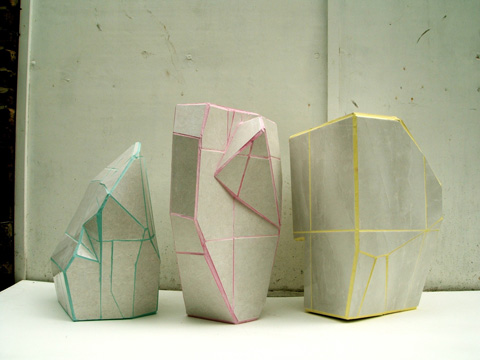
My work is frequently based around materials. By using impoverished materials I devalue the monumentalism classical sculpture holds. Making ‘Pythia’ was an incredibly labour intensive process. I relate the carving of the polystyrene armature and the precise measuring and cutting of each individual tile to the carving of ancient marbles. It was industrial and ordered. I made the sculptures imagining I was making an architectural fitting, similar to what classical sculptures were in their day. I also spent time in the British Museum taking photographs and working on these as drawings and sketches.

Do you start with an idea or a medium or are both equally important in your work. If this is a bit vague, I mean does the medium start the idea or does the idea influence the medium used?

I think the two go together, although I pay more attention to materials than I realize. I thought up ‘Sunset Island’ whilst in LA, I wanted to represent the crummy, grimy glamour of Hollywood with the cocktail sticks and the industrial fiberglass sphere. Materials make me think of ideas, my degree show work on temporal exoticism and classical Hellenistic sculpture developed from working with tiles, trawling the isles of hardware stores, and finding cheap marble effect ceramic tiles. This cheap marble effect alludes to the wealth represented by classical marbles.

GetAttachment.aspx

Do you prefer to work entirely on your own as you are creating a sculpture?

I need to think and write by myself, but its really boring working alone. Now I’ve finished college, my studio is really small, crammed and damp. I miss being able to find someone to get a coffee with, when I want a break.

Sculpture is a social process, I didn’t really paint at college because of the open studios and I need to be alone to paint, its much more personal. Sculpture, however, requires banter. Conversely I pretty much had to make my degree show piece, ‘Pythia’ entirely on my own. The tile cutter makes such an awful noise I was as good as exiled out the studios at college.

Rock and tuft

Who or what are your artistic inspirations

My biggest inspiration was going to Los Angeles last year when I interned as a studio assistant for Mindy Shapero. College was OK but working for Mindy made me really hungry to make and to be an artist. There was so much energy and exuberance in the approach to life. I realized that I could do it if I wanted it badly enough.

I met amazing artists out there, like Thomas Houseago. He was so inspirational and had so much energy.

I can’t help being inspired by greats such as Picasso and Brancusi. Recently I have been reading about Rodin’s love for Greek sculpture as it conveyed the ‘ravages of the time’ in its ‘fragmentary aspect’. Rodin was a pioneer of the existential being conveyed through representation of human form, which he showed through his tactile figures.

My interest in classical Hellenistic sculpture lies in the history attached to it, ‘the ravages of time’, and the wars fought around it. Also the way sculptors repeatedly revert back to it as true sculpture.

I love museums, especially the old musty sort. They contain an exoticism: a longing for a bygone age. I am interested in fragmentary discovery and understanding history, therefore museums are exciting transient spaces full of mystery and discovery.

ahrodite study double

Do the paper drawings feed the physical process of making a sculpture?

The drawings are really beautiful. I started making them as plans for sculptures to understand the anatomy and form of classical sculptures. Really, they are just spruced up working plans, but I think that’s what’s attractive about them. I tried making sculptures directly from them but it was a complete failure so in a sense they are failures at working drawings. Again they were important for my process, especially as I was making work about existing work, it was important for me to understand existing sculptures.

I tried to convey the museum feel in them. Displaying the images like old school posters or crumbling educational departments in museums. As museums attempt to explain history, the classical sculptures I was looking at. They are objects, which represent an exotic bygone age, but essentially are just glorified rocks
The Amazons1

What’s next for Zoe Paul?

I’m excited to have been selected for ‘Future Map 09’, a selection of a handful of graduating students from across the University of the Arts London, of both graduates and post graduates.

In terms of work I’m excited to continue my idea of temporal exoticism and the allure objects hold. I’ve been reading an amazing book about a shipwreck containing sculptures on their way to Rome during the Roman occupation of Greece around 70BC, discovered off a Greek island in 1900. The book delivers amazing descriptions of the sculptures being gnarled and eaten by the sea. I like the idea of these vast powerful sculptures rotting at the bottom with such history attached to them.

I would like to make more tactile works that show my process. I love the way Rebecca Warren’s figures do that.

Future Map 09 will be hosted by 20 Hoxton Square Projects and will run from the 25th November 2009.

Categories ,British Museum, ,Camberwell, ,Coleman Road, ,Dean Kissick, ,drawing, ,Futuremap 09, ,Greek Sculpure, ,James Taylor Gallery, ,Mindy Shapero, ,picasso, ,Rodin, ,Unversity of the Arts, ,Zoe Paul

Similar Posts:


Amelia’s Magazine | An interview with Augusta Akerman

GUS AKERMAN aka AUGUSTA AKERMAN is an incredibly talented polymath, cost since training as a photographer, shop Akerman has turned her hand and eye to a variety of creative endeavors: Art Direction, Set Design, Still and Fine Art Photography, Illustration and costume design. Last week I had the pleasure of interviewing Augusta with regards to this skilled multi-tasking whilst picking her brains for any tips she has for budding creatives…

The work is rooted in a sense of humanity, questioning human behaviour and ideas of natural selection, photography and illustration lend themselves to this action of watching and recording the minutie of everyday life (See Amelia’s Magazine’s Review on the new Tate Show exploring the Voyeristic nature of the Camera). With this in mind lets delve into the interview…

What came first photography or illustration?

I started taking photography seriously during my A levels, although I had been taking photographs for a long time, it was my Design Technology teacher who encouraged me to use them as my final piece. As for drawing, it is quite a new thing for me, I was very unconfident with my drawing skills at school and quit Art as a subject due to an ongoing struggle against Art teachers who despaired at my dysfunctional representations of still lives and self-portraits. Whilst at Glasgow School of Art I started to keep small drawing books that I would show to no one, and then suddenly I realized I was drawing every day and forcing people to look at them!

How did the illustration drawing book project develop?

The book project developed over a long period of time in which I drew every day. It started as a way to try and improve my drawing “practice makes perfect etc, etc” and ended up being a culmination of everything I did that month. The shows I went to see, the books I read, the conversations I overheard until I then put the drawings, scribblings and photographs into some kind of order. The book as a format is such an amazing instrument for an artist to explain themselves, and without sounding too dictatorial, can direct the viewer through handpicked images in sequence with a kind of reveal. I love making the books, as everything however small or silly suddenly becomes something in its own right when put alone on a page or sat opposite another image.

What inspires you on a day to day basis?

It changes all the time. Mostly its social histories, how people lived and how they survived, what they did/ do with their time. I’m inspired by a lot of literature from science fiction to The Moomins especially ‘Moominvalley in November’ which I re-read recently and found it to contain such perfect descriptions of the funny character traits of humans. The Imperial War Museum is one of my favorite places and one I find especially inspiring as well as the British Museum with its collection of the ‘Lewis Chessmen’. Working on jobs where you meet so many different people every couple of weeks, becoming very close very quickly due to waking up at 5 in the morning looking awful! And spending the whole day together whilst having to be completely silent during takes is quite inspiring.

You’ve been involved in a range of projects from photography to short films as well as illustration. Could you perhaps talk a little about how you manage all your different projects?

Working freelance I think is the most wonderful thing, although tough and discouraging at times I think that it allows me to really enjoy all the projects I happen to be involved in, be them personal or as part of a bigger production. Creating a website for me was also a fantastic way to keep working privately and still have the chance to allow others to see the work I was making as an artist who is also looking for a job! Balancing working as part of the Art Department for productions and Photography I find is very natural. I enjoy creating sets and props, thinking about characters and colour and then find that Photography allows me to see the reality as an image. I feel that when I take stills on a film I have worked on as an art director or part of the art department I am more sensitive to the character within the set environment we have created, celebrating the set and including it within the photograph with I think is sometimes unfortunately overlooked when filming begins. Where illustration and drawing is concerned I draw with the hope of perhaps making a new book or exhibiting, this is generally done in the studio in my spare time.

How did these projects develop? And in a difficult market do you have any tips for graduates/art students currently thinking about job prospects outside of the relative safety of university?

After leaving art school I spent months on the internet looking for Photography jobs or jobs that would allow me to still be involved in making things and thinking about artists and talking about creative making to people. Which is I think what many recent graduates miss when coming out of university and not having anyone to talk to about arty farty things. After a while I started e-mailing Photographers, Art Directors, Production designers all people whose work I had seen and really enjoyed. Some got back to me some didn’t, but through the safety of email I managed to convince some people that I was hard working and a willing assistant. For someone coming out of University I would say once again that making and maintaining a website is such a fantastic tool to show people that you do work, you do make things and that you are interested.

What has your favourite project been so far?

Most recently I made a short film with my brother, a collaboration between several art schools in different countries. It was his project but I said I would like to help out, we made huge Bauhaus inspired costumes out of paper and fabric and filmed still tableaux’s of them destroying their property, it sounds crazy but it was so much fun! I also recently worked on a short film called ‘AilemA’, about a young girl coming to terms with Dyslexia who mixes words and drawings together on paper and all over her bedroom wall. I made a lot of the artwork for the film and used many of my drawings to cover a wall in the girl’s bedroom. It was not only the fact that I got to do a lot of my particular style of drawing for the film but I also had rather sentimental feelings for the story due to being a dyslexic myself.

What was your experience working on short film Rain? How did this opportunity develop?

Working on ‘Rain’ was a fantastic and yet surreal experience for me, the Production designer and I went to stay in the location for nearly two weeks, we dressed the sets all day and then withdrew to the attic to sleep at night. It definitely was one of the bigger short films I have worked on highlighted by the fact we had to have a rain machine on constantly throughout the whole shoot. I was fortunate to get this opportunity through the fantastic production designer; Miren Maranon, who I often work with. She is fantastic to work with and extremely talented I owe a lot to her.

What was your role on set?

Usually on set I work as a standby art director, art department assistant or stills photographer. I do enjoy working on set but my favourite part is definitely the pre production. Coming up with ideas and colour palates, finding and making props, its always quite sad breaking down the set at the end of the shoot.

You have shown in an extensive range of galleries – what is the nature of your work in these exhibitions?

In most of these exhibitions the work I have shown has been Photographic with perhaps some of the handmade books. It is only recently that I have shown a video piece and have never had a show based solely around the drawings. The subject matter of the exhibitions is dependant on what I am interested in at the time. For ages I was obsessed with this book ‘England in Particular’ and would go to National Trust properties photographing Dovecotes and village Yew trees. Although coming from a fine art background my photography has more of a documentary style to it. Whereas my illustrations are not realistic at all, but completely the opposite, they try to get the right size, shape and proportion but fail and maybe because they fail so spectacularly I like them.

Who are your favourite designers/photographers/illustrators?

I have many favorite artists, designers, and photographers. The ones I can think of at the moment are… the photographer Rinko Kawauchi, sculptor Richard Long, writer and illustrator Tove Jansson, writer and illustrator Rudyard Kipling, photographer Martin Parr, writer Douglas Adams, photographer Tierney Gearon, photographer Richard Billingham, photographer Homer Sykes, illustrator Pauline Baynes, artist David Shrigley and artist Louise Bourgeois. The list could go on and on….

Do you look at any blogs or use twitter to communicate as part of your creative practice?

No I do not really use twitter, but I do look at quite a lot of blogs to do with fashion, drawing, photography, magazines, news and opinion etc. I really respect people who create blogs and websites in their own spare time about the subjects they are enthusiastic about. It’s interesting to see how this generation has become so confident in themselves as a singular inventor or creator. Drawings and artwork don’t have to hide away in the corner of a studio or under a bed, someone somewhere will accidentally come across them and think “hey! That’s great!”

What role do you see photographers and illustrators playing in society?

A role with as much importance as anything else, illustration is such a natural way of communicating ideas to people and provides a kind of escapism for both the drawer and the viewer. Photography has provided us the perfect mirror and document of the time we live in and the ability to really see the past. Both mediums contribute to society by allowing us to take a step back and enjoy human invention and imagination.

What’s next for Augusta?

Not long ago I moved into a new studio in Elephant and Castle with my friend Carolyn here we come up with lots of ideas for projects and spend the evening drawing and talking, mostly talking! We are hoping to have a small exhibition in the studio later this year. During the summer I am starting work on my first feature film, which is so exciting, fingers crossed it will all go well!

Could you tell me about your short film plan for the summer?

Im not sure how much I can say! Its a kind of dark british comedy being shot in and around London about a burglar. The production company and crew is made up of lots of people I worked with before so I am very excited to see them all again. We have been discussing the films atmosphere and colour palate for some time now and I cant wait to get started in the next couple of weeks choosing materials and seeing locations.

Categories ,AilemA, ,Augusta Akerman, ,bauhaus, ,British Museum, ,Douglas Adams, ,Glasglow School of Art, ,illustrator, ,Moomin, ,Neve Campbell, ,photographer, ,Rain, ,Richard Billingham, ,Rudyard Kipling, ,Set Design, ,The Imperial War Museum, ,Tove Jansson

Similar Posts: