Amelia’s Magazine | An interview with indie band Delays

Most bands have a limited shelf life, information pills especially the ones who are hyped. Although a review like: “The first band in a decade to lay serious claim to The Stone Roses throne” (The Guardian) can put you in good stead while you’re starting out, for sale it can also set you en route Destination Doomsville, burdening you with a reputation you simply can’t live up to.

British indie rock band Delays have so far managed to defy the odds. They have gone from strength to strength, following the release of their debut album ‘Faded Seaside Glamour’ in 2004. Six years on, the four-piece are set to release their forth record, ‘Star Tiger, Star Ariel’ produced by Duncan Lewis.

In a tiny room in the basement of music venue Water Rats in King’s Cross – decorated with blue and white fairy lights, a few old shelves and an enormous brightly coloured abstract painting – I join spiritual frontman Greg Gilbert (GG) and down-to-earth drummer Rowly (R) before they take to the stage at their sold out London gig, to talk about their latest album, town criers and livin’ it up at Glastonbury over lime-flavoured Doritos

How would you describe your new album in three words?
GG: Rustic, organic and psychedelic
R: I don’t like organic, it sounds a bit vegetably
GG: OK then; rustic, psychedelic and melancholic
R: Yeah, that sounds better – I second that emotion
GG: Or we could say “Our. Best. Album” – three words – succinct and to the point

What has inspired your latest album?
GG: Our last album had a lot of orchestral arrangements and there was a real urge between the four of us to strip the sound back and become a four-piece band again. With that in mind we started to go for long drives at night along the New Forest, making music to soundtrack the journey. We built the record from the ground up and it was just a case of being inspired by the environment opposed to any concerns about writing a single. We banned the words ‘single’ and ‘commercial’ from the studio.
R: We used to do it all the time; we would say: “I think this one’s a single”, which makes you approach making music differently. We spent a lot of time in Southampton, reacquainting ourselves with the city and each other again, which does come through on the record. The result is a much more personal and honest sound.

How have you found the audience’s response to your new material so far?
GG: We’ve found that people who wouldn’t have liked our previous stuff have been positive about the new album. They’re responding to the fact that it’s a more personal record – they’re getting from it more from us as individuals then a commodity. So far, the people who have heard our record think it’s the best one.
R: The new tracks are going down just as well as our old stuff. It’s a great feeling when the roar for a new song is as enthusiastic as for an old song, like ‘Long Time Coming’.

How do you think your sound has evolved over the years?

GG: The first album sounds like a beach, the second album sounds like a club, the third album sounds like a festival and this album sounds like the forest, with the roots growing underneath the city at night making the buildings shake whilst you’re asleep. The first album is quite delicate because we recorded that before we toured so there was a certain amount of discovery. For the second album we worked with Graham Sutton who is genius producer; he brought a real club edge to the record which had a raw but beautiful precision about it.
R: We wrote the third album with the approach that it would be amazing at a festival; it’s big and bombastic and sounds like you’re playing it to 100,000 people rather then making a record for headphones.
GG: This album’s much more abstract; you can hear this on a beach in Scandinavia at two in the morning with mist flowing in the morning. We were trying to create a record which maintained a mood and an atmosphere which carries you into different surroundings. I think the best records take you to different worlds and that’s what we tried to emulate.
R: It’s not necessarily one genre of music. There’s a certain atmosphere which you can’t quite put your finger on, but it works for late night drives with aerial views over the city.

What’s your proudest achievement to date?
GG: To me it’s the fact that we’re about to release our fourth album and our songs are still playing on the radio. Very few bands get to make four albums so that makes me feel very proud. We’ve been around since 2004 and we’ve managed to sustain and grow our fan base in a way that has been pure because there is no hype now around what we do.

What’s the best gig you’ve ever played?
R: I’ve been going to Glastonbury for years so to play there was amazing. I was really ill on the day and I came so close to calling the others to say I couldn’t do it, but by the time it came to going on stage I’d never felt so healthy in all my life – Glastonbury has that effect, it wakes you up. There was another time when we played in Mexico City; we were headlining on one of the nights at a festival called ‘Manifest’ and we had no idea how big it was going to be. There were 6,000 people crammed into a wrestling/bullfighting arena all chanting ‘Delays, Delays!”. We were slightly in shock for the first couple of numbers.

Did you have any ridiculous demands on your rider in the early days that you don’t feel embarrassed about fessing up to now?
R: I don’t think our rider has changed much since the start; just the same stuff: vodka, beer, water bottles. In the beginning we did have one thing that we thought would be great to collect, which was to have a picture of the local mayor from every town where we played. The only one we got in the end was from Gloucester where they gave us a picture of the town crier which they also got signed – that was ace!

Now that you have played with your long-term idols the Manic Street Preachers, who would you most like to support?
GG: I always come back to Prince. I’m also pretty obsessed with Scott Walker at the moment – he’s the musician I most admire. I’m not sure how we’d go down with his audience but he’s awesome.
R: It’s still The (Rolling) Stones for me. Apparently we did get an offer to support them in Vienna about three years ago but we were already booked in for a festival in Wales on the same day.
GG: Keith Richards is pretty much top of the tree when it comes to rock and roll. Hopefully the opportunity will come up again…

Delays release their fourth album ‘Star Tiger, Star Ariel on 21st June 2010 on Lookout Mountain Records, preceded by the debut track ‘Unsung’ on 14th June.

Categories ,Delays, ,Doritos, ,glastonbury, ,Graham Sutton, ,Greg Gilbert, ,Kat Phan, ,Keith Richards, ,Long Time Coming, ,Manic Street Preachers, ,Manifest, ,Mexico City, ,New Forest, ,prince, ,Rowly, ,scandinavia, ,Scott Walker, ,southampton, ,The Guardian, ,The Rolling Stones, ,The Stone Roses, ,Vienna, ,Water Rats

Similar Posts:


Amelia’s Magazine | An interview with DJ/disco-dance/electro-pop musician Ali Love

Big Chill Festival 2010

I am standing on a sweaty tube to Ladbroke Grove and boy do I want to bust a move. I want to glide across the carriage, this wind it up, look shake my bootie (even though I don’t have much of one), viagra do the robot, shimmy back and forth and clap – but I don’t. Instead I repress all of my disco dancing energy into a few gentle taps with my fingers on the pole I’m meant to be holding onto; my inner Tony Manero bound and gagged.

Summer has arrived in full bloom as I listen to Ali Love’s latest single ‘Smoke and Mirrors’ on my hot pink ipod; I am on my way to meet the man himself. If truth be told, the first time I heard of Ali was only a few weeks ago when I was invited to a one-off exclusive show at East London art venue, CAMP. Although initially weary of all the hype, on seeing him perform and hearing his latest material, I couldn’t figure out why it had taken me so long to ‘discover’ him.


Photography courtesy of Pietro Pravettoni.

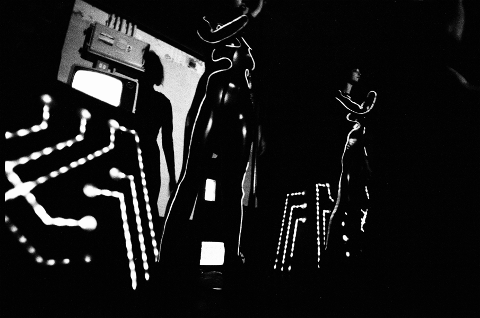
Storming onto the stage dressed head-to-toe in black with a cloak, studded vest and what oddly enough appeared to resemble a tassled curtain tie-back around his neck, Ali worked the stage with his two slinky backing singers dressed in rubber black cat suits, stitched with fluorescent electric blue tubing, like a veteran pop-maestro. As the girls writhed behind him in synchrony with lashings of mascara and kohled eyes, Ali delivered his anabolic steroid pumped disco tunes, filled with dirty bass lines, swirling-synths and throbbing melodies, laced with Prince-esque vocals, to an enthusiastic party audience who seemed to know every word.

Ali’s sound may not be groundbreaking in its 1980s electro-inspired genre nor particularly durable, but it is fun, upbeat, catchy and infectious, and his new album, Love Harder, features plenty of floor-fillers, such as ‘Done the Dirty’ featuring Lou Hayter from New Young Pony Club, reminiscent of Tom Tom Club’s Genius of Love, and ‘Show Me’, sampling Steve Winwood’s Higher Love, which deserve to be hit singles.


Photography courtesy of Pietro Pravettoni.

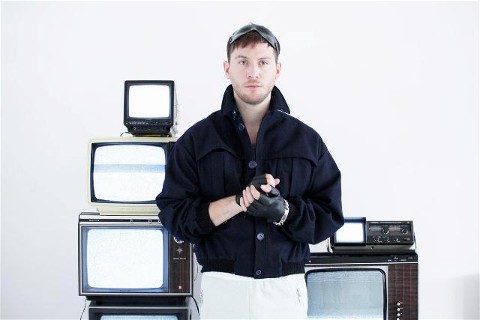
Today, there is no cloak and I arrive at Ali’s early to find myself loitering outside his flat, waiting for him to return from picking up his DMX drum machine. I spot him approaching me in distinctively 80s attire; a bright green t-shirt, blue skinny jeans, white Nike high tops with a fluorescent orange tick and a gold vintage bling watch. Ali towers over me, greeting me with a hug and a Sarf London accented: “Hey babe”.

On stage, Ali appeared extroverted, flamboyant and massively confident. On a one-to-one, however, he is more reserved than I had imagined, making little eye contact and often flits between intense and evasive, lucid and incoherent. As the evening progresses, a cheekier and more spiritual side of Ali emerges, as we talk about his cosmic stage sets, his preference for recording in the studio over performing live and potential collaborations, over a nice strong brew in his cosy flat in Notting Hill…


Photography courtesy of Pietro Pravettoni.

I loved the cosmic theme of your stage set at CAMP. How did the idea come about?
In colour, the music I’ve created is black and electric blue. When I visualise the sound, I can picture things like arpeggiators and my DMX drum machine (Ali points to the electric blue lines on his Oberheim DMX drum machine). On the cosmic theme, well I like cosmic music coz I’m a cosmic guy.

How do you go about composing your records? Do lyrics or a tune come to you first?
Most of the time, it’s the melody that comes to you first. Then I’ll just pick up my guitar and try to re-create it. Other times, it’s being struck by a word that someone says; something that you instantly pick up on and connect with. A good word can just spark off an idea. Songs write themselves most of the time. It’s like a flame; you have to keep feeding it with your creative energy.


Photography courtesy of Pietro Pravettoni.

How would you describe your new album, Love Harder, in three words?
Electric love music.

What has been the general response from the audience who you have played to so far?
What I’ve done has been well-received by the gay community and all over Europe. They’re mainly my kind of people; slightly left of centre, so not mainstream. I don’t really make music for closed-minded people; I make music for open-minded people and cosmic party people. I don’t know if that sounds snobby but those are the kind of people I want to impress. When musicians like Aeroplane say they love my music, it’s a really great feeling because that’s the kind of audience I’m trying to reach out to. It means a lot to gain respect from the people that I respect.

There’s a track on the album where you collaborate with Teenagers in Tokyo. How do you think they complement your sound?
Well the opportunity arose to work with Sam (Lim) who has a lovely voice so I just grabbed it. I told her to sing like a space siren and she nailed it. She really went for it on the record and to me, she sounds like an angel singing. I think it’s a great track to end the album on.


Photography courtesy of Pietro Pravettoni.

Your sound is distinctively 80s – is this an era that you look to for inspiration?
I don’t see myself as a retro artist. The palette was slightly electro and analogue so that lends itself to sounding 80s. The machines that I used are all 30 years old. I don’t care whether something is retro or not, it’s about whether you can hold a tune or whether it’s good to listen to. We live in a post-modern world and it’s hard to create new ground.

What has your career highlight been so far?
I’ve been to lots of different places in the world and have experienced a lot of stuff and that’s all because of the music – that aspect has been good. I’m pretty even minded about most things in a Buddhist middle way; I try to stay emotionally consistent, whether things are good or bad. My most blissful musical times aren’t when I’m doing gigs – they’re when I’m in the studio, recording material. That’s what I love doing the most.

It’s interesting you should say that as most musicians tend to enjoy the gigging aspect the most…
The last gig was really good and I felt really confident and happy that people were there, which felt like a breakthrough. I’d like to be like Harry Nilsson, he never played live, he just made beautiful amazing songs in the studio. Same with Georgio Moroder – he gave up playing live. I’m more interested in being a recording artist.

What do you gain from making music from a spiritual point of view?
If I didn’t do music I’d have to do meditation or something to stop me from going mad. Music for me is meditative. I need to concentrate on something and it’s been the one thing I can concentrate on. I was terrible at school. My dad died when I was 13 and it stopped me from caring too much about things. I became quite spiritual as I was suddenly hit by the question of death. My whole mind started to move in a different direction. It has given me a place to escape to and a lot more empathy for feeling things in the world. It has enhanced my musical palette which happens to a lot of musicians. You need to find a place to visit to write songs. If everything in your life was normal, it would be quite difficult to find inspiration to write. Having said that I do still really like boner jams about sex; they’re all fine.

How have you changed as a person since you started out in the music industry?
When I started out I was living above a club on Kingsland Road in East London and high all the time. I was living on the dole but passionate about my music; just the classic clichéd punk rock vibe. But somehow I managed to get a big record deal. So because I’d been on the dole for six years beforehand, it all went to my head a bit. I went a bit crazy and the partying outweighed the music-making even before it all started. But luckily I had the hit with the Chemical Brothers which kept me financially afloat for a while. I wouldn’t change anything; it was a good journey. Now I’d love to have a guru or teacher and learn kung-fu in the hills; get more in touch with my spiritual side.

Who interests you most on the music scene at the moment and why?
I’m mostly drawn to disco people like Aeroplane and the guy who did my remix, Bottin. I really like the work that Prins Thomas does and the Lindstrom stuff. Pop wise, I like Empire of the Sun.

Who would you most like to collaborate with?
I’d like to collaborate with rappers, some kind of US stuff. I think it’s because I’ve just moved to West London and there’s a bit more rap around where I live and that’s starting to soak into me.

So do you find that where you live influences your sound?
Well I was living in East London before which is why I made a totally gay disco record!

And finally – what random piece of advice can you offer readers of Amelia’s Magazine?
Be nice to each other and always look right twice when you cross the road.

Ali Love’s new album Love Harder is out on 9th August on Back Yard Recordings.

Categories ,Aeroplane, ,Ali Love, ,Bottin, ,Chemical Brothers, ,DMX drum machine, ,Georgio Moroder, ,Harry Nilsson, ,Kat Phan, ,Lindstrom, ,New Young Pony Club, ,prince, ,Prins Thomas, ,teenagers in tokyo, ,Tony Manero

Similar Posts: