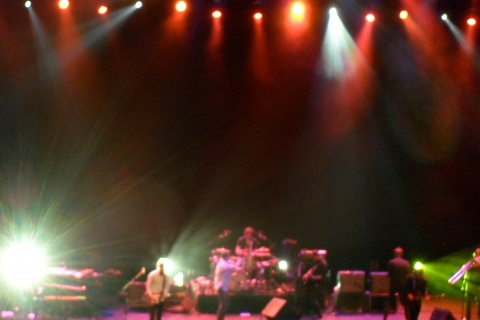
A cold November night and I journey to a very cosy Camden Barfly to view Plastiscines. This band are the latest export from the country who gave us Eric Cantona, medical Various nice cheeses and the lady who keeps Johnny Depp of the market. The venue is packed with what appears to be a very male dominated crowd. I wonder why this is? Oh right, view there are four stunning French girls (it was France by the way) about to come on stage. They may have come on stage looking like they were on a shoot for “Teen Vogue” but looks can be deceiving. Playing a pop/punk/rock blend of tracks that feature on “LP1” and forthcoming album “About Love” this grunge glam quartet well and truly showed that they are not just pretty faces.
Top producer Butch Walker fell in love with the girls when he saw them perform a cover of Nancy Sinatra’s “These Boots”, store they seemed to have the same effect on the Camden crowd. Plastiscines definitely managed to put their own fresh stamp on it, whilst still being respectful to the original, a far cry from Jessica Simpson’s shambles of an attempt in 2005. Their angst anthem “Bitch”, which has recently featured on “Gossip Girl”, was a sandwiched nicely in the middle of the set to the responsive audience, closing down with current cute pop single “Barcelona”. I have rarely had “Barcelona” out of my head since I first heard it, not in a negative way, I want it there, I want to dance to it, I want to sing it and be part of this ridiculously cool band. Lead singer Katty invited those in the room to do just that as she announced that the girls needed some bitches on stage. There was no shortage of these as half the room piled on to join the group, some of them being bitches with beards. We were then treated to seconds of “Bitch”. Bridget Bardot-esk Katty launched herself in the audience and continued to sing “Bitch” to men who I’m imagining felt powerful mixture of intense excitement and terror. I would also if I was them, “ I’m a bitch when I brush my teeth” is as blunt and to the point as the lyrics get. “B.I.T.C.H” she continues just to spell it out and make it clear.
As she made her way teasingly around the floor I noticed that her makeup was all still perfectly in place. How can this be so after performing such an energetic set? Surely it should have melted down her face which happens to the best of us just sitting on the tube never mind bouncing about for the best part of an hour?! This went for them all. Not a sweaty swept fringe in site, All of them looking naturally no less than perfect after a flawless set. They perhaps are a 00’s Boho version of Jem and The Holograms.
Majorly rocking out whilst still maintaining a chic exterior. While the cartoon ended around the time these four were born, The adventures of Plastiscines have only just begun, and I for one shall continue to watch.
Album “LP” and single “Barcelona” are available now. Signs of Revolt is an exhibition celebrating the creative resistance of the past decade’s social movements. It’s an uplifting retrospective that marks the 10th anniversary of the protests that shut down the World Trade Organisation in Seattle.
Walking into the space at Truman Brewery you are met with an array of posters, ask pictures, colour design and documentation all every available wall, witty slogans and collages, videos to costumes and paraphernalia. A one-stop tour of global movements and actions, and a great insight for the passerby of the creative power of social resistance or a great retrospective for an activist well versed in the successes and failures of civil disobedience.
The exhibition inspires by focusing on all the direct actions from the diverse; capitalism vs. anarchism cricket matches or the vast array of propaganda posters from all the past movements and actions around the world.
Here are some of the groups, artists and disobedient folk you should really check out and get involved with.
Calling themselves a ‘dis-organisation of artistic and anti corporate activists’ space hijackers bring together a group intent on creating civil mischief. Their projects have included huge circle line tube parties, acquiring a tank and attempting to invade Europe’s largest arms fair, creating starbucks chaos and a huge range of other ingenious and daring feats to challenge the states authority and the status quo. They are meeting tonight, Thursday 19th, at the exhibition at 7pm and is open to everyone to get involved, well apart from undercover cops.
Check out the photographic road show that’s been touring the country at universities, talks, galleries and festivals over the past couple of years. Aiming to dispel some of the myths spread by the mainstream media and to encourage and inspire other to get involved. The photos document the climate camp actions over the past few years, explain how they happen and give an insight into the workings of a climate camp. Remember climate camp are putting on coaches at an activist cut price of £100 to Copenhagen.
An affinity group of friends and activists intent on combining art with activism the ‘Lab of ii’ has been responsible for recruiting a rebel clown army, launching a rebel raft regatta to shut down a power station to throwing snowballs at bankers. Lab of ii have also created ‘put the fun between your legs’ a bike making workshop in Bristol next week that aims to create a bike contraption to use in direct action at the Copenhagen summit in December.
The website bringing together political active networks, collectives and individuals that help document and organise actions and events. Part of an ever-growing network around the world that lets you be the media, publish your own news stories and let everyone know about what’s really happening outside the mainstream. Indymedia have brought together a load of information and news footage at Signs of Revolt to check out.
Working since the invasion of Iraq Kennardphillipps is a collaboration creating huge scale collages and designs that confront the issues of power and control across the globe. The work is made from a cross group of media, the street, gallery and newspapers and magazines that are brought together in workshops to produce these engaging and confrontational art pieces.
Signs of Revolt has also held daily workshops, films and speakers over the past week which aim to inspire and educate as well as creating some lively debate. The weeklong event is also about looking towards the future especially with the mass mobilisation towards the Copenhagen climate Change Summit where thousands of activists from around the world will descend on Denmark next month to hopefully create a social movement like no other.
Signs of Revolt is only on till the 22nd of November so you have a few days to get there, get inspired and hopefully add or join to the next decade of creative resistance, mischief and action to look towards a better world.
Written by Adam S on Thursday November 19th, 2009 5:24 pm
This Saturday, information pillspill The Land Is Ours collective will occupy some disused land near Hammersmith. An eco-village will take root, viagra sale peacefully reclaiming land for a sustainable settlement, and getting in touch with the local community about its aims. In a year when nearly 13,000 Britons lost their homes to repossessions in the first three months, eco-villages point the way to a more down-to-earth lifestyle.
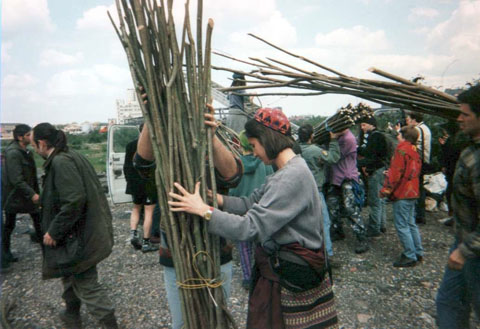
Back in May 1996, the same collective took over a spot on the banks of the Thames in Wandsworth, in a land rights action that grew up over five and a half months into the Pure Genius community, based on sustainable living and protesting the misuse of urban land. Here are some photos from that project.
The Land Is Ours channel the spirit of the Diggers , a group of 17-century radicals who picked out and dug over a patch of common land in St George’s Hill in Walton-upon-Thames back in the day. They were led by Gerard Winstanley, who thought any freedom must come from free access to the land.
Here’s a little more from ‘Gerard Winstanley’ about this weekend:
What’s the first thing you’ll do when you get there?
Have a meeting. One of the first priorities is to leaflet the local area in order to inform the local people of what we are doing. Another priority is the construction of compost toilets.
Do you have lots of plans for sheds, vegetable patches and compost toilets?
Yes. Due to the nature of the site (ex-industrial) we will likely be using raised beds to grow vegetables and buckets for potatoes. It being London, there should be a good supply of thrown away materials from building sites and in skips. Compost toilets are pretty essential.
?What kinds of people are you expecting to turn up?
All sorts. Hopefully a mixture of those keen to learn and those willing to teach. ??
?I read the Chapter 7 manifesto. Have you notified the council or planning authority of your plans, or are you keeping to the idea that once you’re there, with homes under construction, it’s difficult to evict?
We haven’t notified the council yet- but we have a liaison strategy in place for when we’re in.
On that note, how long do you hope to be there?
The longevity of the Eco-village depends on how committed its residences and just as crucially how the local urban populus respond to our presence. If we receive the support we need, the council will likely think twice before embarking on an unpopular eviction (at least that’s the theory!).
Could this realistically become a permanent residence, or is it more likely to be valuable simply as campaigning?
Hopefully it can be both. There is no reason why this site cannot sustain a core group of committed individuals and serve as a brilliant awareness raiser to the issue of disused urban land, lack of affordable housing and the a sustainable way of living that is friendly to people and planet and liberating.
?Can I come along?
Of course, we are meeting at Waterloo Station at 10AM this Saturday (underneath the clock).
What might I need to do?
Bring a tent, sleeping bag and some food and water. You may be interested to read an article written by a journalist from the Guardian concerning the eco-village.
So dig yourself out of bed this Saturday, and go discover the beginnings of London’s newest eco-village.
If the dark shades of under-duvet hideouts dominate the colour of your Sundays then you need to wake up and get greened. Arcola Theatre in East London hopes to be the first carbon neutral theatre in the world and has been appointed as the secretariat for the Mayor of London’s Green Theatre plan, this which aims to deliver 60 percent cuts in theatre carbon emissions by 2025.
As part of this environmental drive, the first Sunday of every month is a Green Sunday at Arcola Theatre. June’s event is part of Love London, the biggest green festival in Europe and looks at ethical consumption, promising ‘entertainment and inspiration for the ecologically curious’. From 3pm there’s a swap shop market plus cakes and tea to take you through the evening of Senegalese percussion, cool short and feature-length films, starting from 4.30pm. As the afternoon turns to evening, there will be a discussion with Neil Boorman, author of Bonfire Of The Brands, an account of his journey from shopping and brand addiction to a life free from labels. As part of the project, Neil destroyed every branded product in his possession, incinerating over £20,000 worth of designer gear in protest of consumer culture. This will be chaired by Morgan Phillips.
Neil and Morgan will later be joined by Richard King from Oxfam to talk about their 4-a-week campaign- encouraging shoppers to do their bit for sustainability each week.
I spoke to the sustainability projects manager at Arcola Theatre, Anna Beech, to find out more about Arcola’s arts world-changing philosophies:
All at Arcola must be extremely proud that a theatre founded only 9 years ago – and on credit cards! – is well on the way to becoming the first carbon neutral theatre in the world. Can you tell us a bit about how and why you made the decision to lead the green theatre movement?
Since 2007, Arcola has launched many high-profile green initiatives (including the pioneering use of LEDs and the on-site installation of a fuel cell to power bar and stage lighting). There are a number of reasons for this – because it contributes to reducing Arcola’s carbon emissions and resource use, because it makes financial sense – reducing energy bills; because it supports funding applications; because it integrates Arcola into the local community; allows Arcola to reach a wider audience and stakeholder base; and provides an effective platform upon which to publicise the name ‘Arcola’ – as a hub of creativity and sustainability.
Sustainability is part of Arcola’s core unique business model, alongside professional theatre and our youth and community programme.
Have you found that arts and science professionals are eager to integrate and come up with exciting ideas and actions or has it been difficult to bring the two fields together?
Arcola’s ArcolaEnergy has had considerable interest from technology companies and brokers, including the Carbon Trust. As a reocgnised innovator in sustainability in the arts, Arcola has been able to broker extremely advantageous relationships with private sector companies – who have provided the theatre with free green products, including LED lights – as well as other theatres and arts organisations (National Theatre, Arts Council, Live Nation, The Theatres Trust), and Government bodies like the DCMS and Mayor of London’s Office. Arcola’s reputation as a sustainable charity has created these partnerships and allowed them to grow and develop into mutually advantageous relationships. So this demonstrates that the arts and sustainability worlds can come together to form mutually advanteous relationships. However, there is plenty of work to be done.
So far, what has been the most successful pioneering energy practice you’ve introduced?
The installation of Arcola’s fuel cell in February 2008 made the venue the first theatre in the world to power its main house shows and bar/café on hydrogen. The Living Unknown Soldier gained reverence as London’s most ecologically sustainable show, with the lighting at a peak power consumption of 4.5kW, a reduction of 60 per cent on comparable theatre lighting installations.
Previous Green Sunday events at the Arcola Theatre
Arcola’s ‘greening’ goes from the stage to the box office. Among other things, we produce ‘green’ newsletters for staff, we recycle, we provide free tap water to audiences (to lessen use of bottled water), we serve fairtrade, organic and local produce wherever possible (including organic vodka and whiskey!), we host Transition Town meetings, we installed a cycle enclosure for staff in 2009 and try to incentivise both staff and audiences to use public transport more and their cars less.
How do you think the technical creativity of sustainability has significantly shaped any of the plays Arcola has produced?
One example of the ‘greening’ of Arcola’s shows and working closely with production companies took place during the pre-production and staging of ‘Living Unknown Soldier‘ in 2008. The production explored the use of more energy efficient lanterns, including LED moving heads and batons (see Fig. 1) florescent tubes and some other filament lanterns such as low wattage source 4′s and par 16s. The crew tried to travel by public transport wherever possible, use laptops rather than PCs, limit phone use, source sustainable materials and managed to keep energy requirements low in order to use Arcola’s fuel cell to power the show.
‘‘The idea is that once you expose people to this stuff and they know you for doing it, they’ll gravitate towards you. Ultimately we should end up with some really good art about sustainability and some really good ideas about how to do art sustainably.” – Ben Todd, Executive Director and Founder of Arcola Energy.
Why do you think its particularly important for the arts to become more involved in green issues?
Because the arts have the power to influence behaviour change. Whilst the theatre industry itself has a relatively small carbon footprint (2% of total carbon emissions in London), and thus its capacity to deliver direct carbon emission reductions is relatively small; the power of theatre and the wider arts/cultural sectors to rapidly and effectively influence public behaviour and policy makers to drive significant indirect carbon emission reductions is very large (entertainment related activity accounts for up to 40% of travel emissions).
However, theatres and other arts venues must first address the ‘greening’ of their venues and practices in order to communicate climate change and environmental messages to audiences effectively and with impact.
Green Sundays is a great idea, how do you hope to see it develop in the future months?
We have a variety of themes in mind for future events, including a focus on the climate talks in Copenhagen in December, a water theme, ethical business, natural history and a Green Sunday programme tailored to children and young people.
So get over your hangover, get on your bike and cycle down to Dalston on Sunday to help spread the word about arts and sustainability coming together to communicate environmental messages to your local community.
To find out more about Green Sundays and the Arcola Theatre go to:
Election Night Womens representation – jenny robins
Illustration by Jenny Robins
I didn’t plan on staying up so late on Election night. I had well-meaning plans involving a cup of tea, dosage my pajamas and being tucked up in bed with a book by 10pm. But like many people, hospital as soon as the exit polls rolled in, I was hooked. My emotions swung from disbelief to elation, despair to complete confusion, the latter being the prevailing feeling.
I am not sure if there is any other point in the year where this is the case, but all eyes were on Sunderland. Initially I was baffled by the focus on rushing to count the votes. I would rather it was accurate than rushed, it isn’t Total Wipeout (although how I wish it was! Imagine – the party leaders racing round the course, being pounded with mechanical fists and squaring up to the Big Balls?!) But as the first, second and third result came in, I realized that for a brief, bizarre moment, we had a 100% female government. Imagine that. And bloomin bizarre it was. But why? Why is it so hard to imagine an all female government?
The sad reality is that women are still dramatically under-represented in key areas of public, political and economic life: In the last British Parliament of 646 there were only 126 female MPs. This is abysmal. We lag far far behind countries like Afghanistan, Rwanda, Senegal and Latvia when it comes to women’s representation. The majority of UK senior civil servants, directors of FTSE 100 companies, senior lawyers, and key figures in the media are men. No wonder so many teenage girls cite Katie Price as their role model, though that does make me want to eat my own face. If women are excluded from the top jobs, half the talent of the nation is wasted.
I went to bed around 2.30am unable to keep my eyes open any more, with an excited, but admittedly naïve, confidence that this election would see a significant increase In women in parliament. According to the Centre for Women and Democracy and the Fawcett Society, Thursday’s General Election resulted in… wait for it….. drum roll…… 142 women MPs. Yes! That’s an extra 16! Oh- no, wait a minute… 142 female MP’s in a parliament of 649…. that’s only 22% of parliament. On a positive note, this included Caroline Lucas, leader of the Green Party, and the election of Britain’s first ever female Asian MPs. A tiny bit better, but overall its pathetic, quite frankly. Fuck.
As I write this, there is speculation about the leader of the labour party. Oh, more white men? Déjà vu anyone? Will a women even stand? But more alarmingly, Cameron is currently forming his new cabinet, and according to the BBC, not a single women has been appointed to the cabinet yet, and I’m pretty sure that not a single woman has even been mentioned. Sweet mercy. From bad to dire.
UPDATE: 4 women were appointed to the cabinet, none in the top jobs. This still puts us far behind our European counterparts. Theresa May is the new Home Secretary and Minister for Women and Equalities, who, according to theyworkforyou voted against rights for gay people. Go figure.
This has to change. If women’s representation continues to creep up in 1 or 2 percentage points like it has done up until now it will literally take decades before women are fairly represented in our country. Women only shortlists may sound drastic to some but when you consider the state of women’s representation nationally, you realize that it’s drastically needed.
And then there is proportional representation. Oh sweet, fair, idolized proportional representation! How we long for you! It is a clear olive branch standing out from the mushy confused mess of the election result. (Lib-lab, lab-con, Con-dem anyone?) The case for voter reform is more convincing than ever.
There are apparently gazilillions of different proportional representation systems, but roughly it means that if a party receives 10% of the vote, they receive 10% representation, which is hundreds of miles better than the system we have now when a party receives 51% of the vote but 100% of the influence in parliament. The Electoral Reform Society explains one system thus; “At present, constituencies are represented in parliament by just one MP. Under a Single Transferable Vote system, each constituency is represented by a small group of representatives…This makes it possible for representatives of different parties to be elected in each ward, thus allowing more people to have representatives of the parties of their choice.” Having a group of representatives in each constituency will mean that it will be even more blindingly obvious if women are not represented there (same for other minority groups too). In other countries that operate proportional representation more women are nominated, and the more women are nominated the more they are elected. Proportional representation also means that people can vote according to what they actually believe in (like, for example, electing more women to parliament, amongst other things) rather than tactically to keep certain parties in or out.
So yes. Women are still dismally under represented. Yes, teenage girls are growing up saving for boob jobs. Yes, we heard more about the dresses of the leaders wives than we did the policies of the female candidates. But it is time to say no. We wont stand for our outdated, old fashioned, unfair voting system any more… Takebackparliament , a coalition of a range of different voter reform groups have organised a demonstration calling for voter reform on Saturday. When you’re talking to your kids and grandkids in years to come about this bonkers election, don’t say you watched it on facebook and TV. Say you got involved and made a difference.
Join them this Saturday At 2pm at Parliament Sq.
*climbs down off soap box and sneaks away quietly….*
Written by Hannah Bullivant on Wednesday May 12th, 2010 10:46 am
Do you have a band that soundtrack your life? The music of your memories?
Mine was, curetreatment is and always will be The National, a band who’ve been playing in the background of my first loves, lost loves, sad times, happy times, party times, sleep times, journeys on planes, journeys on trains, moving in-s and moving out-s.
Last night, after almost 5 years of unadulterated adoration and no less than 3 missed opportunities to see them , I finally saw The National, and it was knee-knockingly, breathtakingly amazing.
So amazing in fact, I broke a few of my cardinal “What Not To Do At Gigs” Rules. Nominally, these are:
1. Thou shall not sing along (aloud or mouthing along silently; they’re both as bad as each other)
2. Thou shall not join in group clapping (I’m not really a crowd participation kind of girl)
3. Thou shall not sway with your eyes closed (it looks creepy)
Having left the Royal Festival Hall in between lamenting the loss of my gig misanthropy and watching A Skin, A Night in bed (I really like The National- if you hadn’t noticed by this point) I began to ponder how to write about a band you’ve loved for such a long time, so here it goes.
(A Skin, A Night trailer)
Playing songs from their last two albums (Alligator and Boxer) and an EP (Cherry Tree), as well as covering new songs like the excellent ‘Runaway’, I noticed that one of the most striking thing about The National was their ability to depart from their records, which are, even at their most upbeat are still darkly contemplative and reflective, live however their energy is palpable, their most melancholic songs live are shot through with electricity and flourish. The National are a lot more prolific than the 2007 ‘overnight’ success of Boxer would suggest, and their familiarity with their extensive back catalogue allows them to embellish upon their records, making the live show full of exciting little twists and turns.
Somewhere amidst these sonic twists and turns, I recognised The National’s ability to change the mood of not only what they were playing but also the mood of a packed out auditorium of people. Their music soars and swoops, murmurs with melancholy, heard in both Berringer’s voice and Newsome’s string solos, before crescendo-ing into a clattering wave of emotional intensity on the drums, guitars and brass. ‘Fake Empire’ ; Boxer’s opener starts with a simple, lilting piano melody and builds up to a full orchestral smorgasbord and was definitely a stand out favourite for me alongside ‘About Today’ from the aforementioned Cherry Tree EP whilst faster songs including ‘Mistaken for Strangers’ and ‘All the Wine’ pulsated with a dark emotion. The National are undoubtedly a honed and well oiled team from the drums and brass section to Padma Newsome’s dexterity on the piano and strings and it is this that enabled them to take such hairpin turns throughout their hour and a half long set, whilst retaining the interest of a legion of loyal fans, which is no mean feat.
And what of Mr. Berringer as a front man? I always had a rather specific image of him as a shy and brooding wordsmith, yet he commanded the attention of the crowd with his vocal range; from his trademark seductive baritone murmuring (‘Green Gloves’), to top-of-lungs anguished shouting (‘Abel’).
The National create a totally unique soundscape, both live and on record, a soundscape filled with towering skyscrapers and empty parties, of drunk men in dead end jobs and the women they once loved leaving them. Ok, so it ‘s clearly not the Disneyworld of soundscapes but there is a real honesty and sad beauty to the images they create that inspire empathy and awe (both lyrically and melodically) in the stoniest of hearts.
So now as one of the converted to eyes closed, body swaying dancing at gigs, I unabashedly say that The National didn’t let me down live and I will continue to soundtrack a new lot of adventures with their music. Make them yours!
(Video for ‘Apartment Story’)
Monday 10th August
UN Climate Change Talks
The U.N. Climate Change Talks in Bonn, try Germany begin a series of informal intersessional consultations today. These are part of the run-up to Copenhagen in December, page and this particular series can be found webcast live here
The Yes Men film shows the hoaxes perpetrated by two US political pranksters. The promotion team describe the film as “so stupidly entertaining” that it will reach and motivate thousands of people, page thus “adding even more juice into a movement that is trying to save civilization itself, among other modest goals.
Tuesday is the satellite event – live from Sheffield, it’s a simulcast event screening of THE YES MEN FIX THE WORLD and live q&a with the Yes Men beamed via satellites from Sheffield Showroom. Cinema-goers will have the opportunity to put their questions live and direct to the film’s stars from their respective cinema locations.
20.30, at the following London cinemas:
Odeon Panton Street, Clapham Picture House, The Gate Notting Hill, Greenwich Cinema, Ritzy Brixton, Screen-on-the-Green
More cinemas on the screenings page of their website.
Wednesday 12th August
Green Spaces & Sticky Feet
A creative exploration of the nature beneath our feet as we roam around the gardens – to help us understand why green spaces are important and how we can make our buildings greener. This is a workshop for children of all ages, who must be accompanied at all times by an adult.
On Friday the 7th August the bailiffs went in and the occupation of the Vestas wind turbine plant on the Isle of Wight ended.
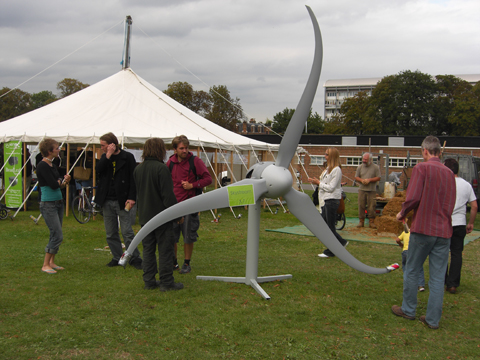
In response to this a National Day of Action in support of the Vestas workers and to keep the factory open, for Green Jobs and a Green Energy Revolution, was declared. There will be actions all around the country organised by a diverse range of groups.
Or contact your local CCC group, or Union – or if you want to organise something in your area there is some advice from Jonathan Neale, of the CCC Trade Union group
The campaign to Save Vestas has not finished, it has just started and with it comes a campaign for a step change in the creation of Green Jobs and the Green Energy Revolution !
6.30pm
Outside the Department of Energy and Climate Change (DECC)
A spiritual celebration and experience, honouring our regal beauty with sacred song and dance. Dances of universal peace, Taize singing, Bhajans & Kirtan, native American sweat lodge, Zikr & Sufi practice, Breton dancing, Tibetan sound meditation, yoga, tribal dance, ancient ways of the British Isles, chant wave and more…
Let the London Wildlife Trust take you out trapping, identifying and recording moths on the Totteridge Fields Nature Reserve. Come and see how many species of moths visit the fields at night. Please wear warm clothes and sensible footwear. Bring a Torch, Notebook and pen. You may also want to bring a flask.
Free car parking in sports ground car park adjacent to the Hendon Wood Lane entrance.
Nearest tube is Totteridge & Whetstone
251 bus stops on Totteridge Common near the junction with Hendon Wood Lane.
8.30-10.30pm
Hendon wood Lane entrance to totteridge Fields Nature Reserve
Contact – Clive Cohen – 07973 825 165 – notinbooks.conservation@btinternet.com
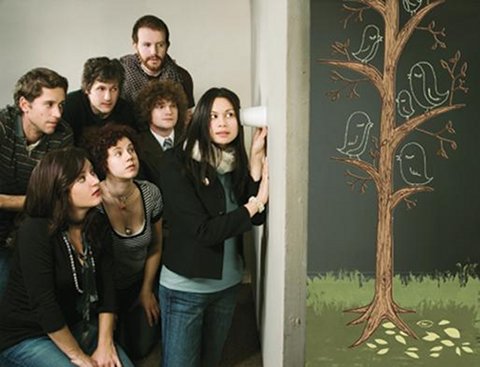
The National are one of my favourite all time bands. Their music full of deep seductive murmuring and soaring strings, cure The National build a beautiful soundscape full of urban discontent and lost loves.
I wouldn’t blame you for thinking that Devotchka have wandered straight out an Eastern European shtetl with their romani/ klezmer-tastic music. In fact they’re from Colorado and you probably recognise their orchestral treats from Everything is Illuminated and Little Miss Sunshine.
Wednesday 12th August
Woodpigeon at Borderline, London
Woodpigeon is whispery folk with beautiful strings and brass. Perfect for a summer evening.
Thursday 13th August
Circulus at The Lexington, London
Tired of the ins and outs of modern life? Do you want to return to a simpler time? A medieval time? Go see Circulus then! They’re quite obviously as mad as a bag of prog listening cats but they sing about fairies and have lutes- what couldn’t be awesome about that?
Friday 14th August
Forest Fire and Broadcast 2000 at The Luminaire, London
Lovely country folk from Brooklyn’s Forest Fire and tinkly electronica from Broadcast 2000 are set to make this night special!
Saturday 15th August
Spaghetti Anywhere and Colours at Barfly, London
Here at Amelia’s HQ we often find ourselves listening to Spaghetti Anywhere‘s myspace selection of pretty indie pop, and it never fails to brighten up a dreary office day.
Also playing are Colours the South Coast’s answer to My Bloody Valentine, offering up a delicious slice of Shoegaze with Pavement-y undertones. Brilliant stuff all round!
Yet another diverse and inspired collection, the first model appeared wearing a silk muzzle with a graphic pattern. These unusual face decorations featured prominently in the show. Printed, bejewelled, moulded from the shape of the face – it was clear they were making a statement. “It’s my reaction to climate change,” Bernard told me afterwards. It’s a provoking image we’re accustomed to seeing – during the SARS crisis and more recently with the swine-flu pandemic. Chandran has translated this evocative image and created masks of beauty.
Dresses were striking, bold statement pieces, in hues ranging from ochre to pewter. Folds and flaps created geometric silhouettes, showcasing Chandran’s skills as a craftsman, and revealing a possible Hussein Chalayan influence.
Other pieces consisted of simple shift dresses enveloped by folded, dynamically-cut fabric, creating exaggerated shoulders and wing-like forms, apposing the contours of the female form.
I loved this glittered interpretation of the bustier. Fashion-forward women only, need apply:
Patterns on masks and clothing had been translated directly from objects that surround Bernard in his day-to-day life. A stunning linear print in amber and black had been taken directly from “a basket that people give [Bernard} flowers in!” Bernard recalled. Looking again at the print makes sense of it – it appears almost photographic.
Another key look was the Chinese coolie hat, worn by a handful of models. Bernard in interesting in their form. “I like the way they fold, the way they are created – which can be said for a lot of my work,” Bernard told me. “The way an envelope folds, for example – like here,” as he gestured to a photograph on the wall backstage of a structured, geometric dress.
The more feminine consumer need not worry, as the show also included elegantly draped smock dresses and sumptuous blouson skirts, in chiffon, with organic, natural prints. These pieces were the most surprising considering his A/W 09/10 collection was so bold and striking. “Sometimes you just have to,” Bernard laughed.
There were so many different looks in this collection. It may sound as if the pieces were too disparate but this was not the case, as one after the other complimented each other, almost magically. Take the structured dress with exaggerated hips, fast becoming Bernard’s signature, juxtaposed with the softer sheer fabric pieces draped effortlessly over the models; juxtaposed with the hooded smock reminiscent, again, of an envelope; the prints and tones of each piece somehow beautifully transforming into the next.
Soul singer Estelle is a huge fan of Chandran’s work, shunning major fashion houses to wear his looks at awards ceremonies, so it was no surprise to see Destiny’s Child’s Michelle Williams and Beverley Knight wide-eyed on the front row. A Bernard Chandran woman is a glamorous, confident, ostentatious creature. It’s time this design hero took centre stage on-schedule. Sort it out, BFC!
All photographs and text by Matt Bramford The 25th London Fashion Week began yesterday in its new haunt of Somerset House. Turning up to register, viagra there was the expected photo crush as numerous street style photographers selected those most fashionably dressed to stand before their lens. Not surprisingly London Fashion Week has been a lesson on how to be scarily on trend. Leather studded Jackets check. Harem pants in black and multiple prints. Check. Statement shoes check.check.check. Big Power Shoulders. Check. The most amazing outfit –outside the catwalk- was on the front row at Ashley Islam (more to come on this collection later). Sitting next to Michelle Williams from Destiny’s Child immaculat in Vivienne, sildenafil was a rather beautiful man with an Anna Wintour bob,
complete with a dress made from nails. This often disregarded material was transformed into the ultimate disco dress, that tinkled out of shows.
The Prose Studio Collection of bold oil slick printed dresses was first down the catwalk. The feminine fluent dresses billowed around the models, falling down from the neck, along the arms and tacking tightly in at the waist to fall once more to the knees.
Remember blowing paint across water’s surface to create marbling patterns when pressed onto paper? Prose Studio’s harem pants felt as if the fabric had been dipped into the solution and hung out to dry. The drapes of the pants were delicately covered leaving the leg fabric bare.
The collection finished with a free flowing printed white tunic over white marbled dripped leggings.
Next up were Michela Carraro’s deconstructed geishas complete with rags tied into bondage shoes, big 80′s shoulders remain on the catwalk alongside constructed sheer blouses.
The shapes and layering were reminiscent of John Galliano’s personal style and diffusion line with an injection of Vivienne Westwood’s pirate’s collection. As the light blue piece sashayed down the catwalk, it suddenly struck.
What was being offered was a re-invention of a feminine suit, capable of expressing personality rather than smothering it underneath a shapeless blazer. This was a collection representing the intriguing daywear as represented with the gallantly bold, bordering on the garish printed trousers, under tucked beneath the swashbuckling floating blouses held together at the front with delicate stitching. Completed with the bandaged shoes, the piece formed an illustrious silhouette when framed by photographers.
Third was Joanna Wanderpuije’s elegant collection of modern shapes complete with the return of the perspex stars from the A/W collection, for S/S the stars are attached to the hips of the cotton skirt. Plenty of well cut shorts and printed tanks for effortless lux.
Leather bra tops – continuing previous seasons’ trends for underwear as outwear- hardened the collection appearing under a cropped print jacket nestling above the high-waisted cream trouser. A splash of colour was provided with the up-pleated tunic dress. The collection was incredible wearable with Wanderpuije’s prints elegant in their application and beautifully sculpted from material.
Fashion provides the opportunity to dive into new worlds, peer into another’s imagination. It can function similarly to illustration and convey a sense of being in the world and by being idiosyncratic tap into the public consciousness. The last piece from Yang Du‘s collection was one distinctive outfit from the Louis Vitton-esque rabbit ears combined with bold blue and white striped constructed-to-be-slouchy oversized dress.
The outfit instantly burned into the retina, this was something to wear as unemployment rates soar, it’s warm and it’s bright. This was fun fantastical fashion and I loved the oversized knitted bag that followed the models down the catwalk as if a rather petulant child.
As with all three previous designers, at Yang Du it was all about the detailing; tunic dresses were altered with cut away bra holes overlaid with fringing. Grinning cartoon faces contrasted wide blue knitted stripes, tight tight dresses were sent down with bold geometric black and white prints. Not forgetting the head adornments.
A great start to London Fashion Week, a mix of eccentricity and wearable shapes with most importantly the clothes bringing a smile to one’s face.
For me, web the majority of fashion week involved being squished like a sardine in regimented rows watching models strut up and down a well lit runway. While this is all well and good, sometimes it’s fun to break from the norm…
from what I can gauge, Nasir Mazhar is a headwear designer, with very theatrical taste.
To view his presentation at London Fashion Week s/s10 we descended into the vaults of Somerset House, entering a strobe lit room, where at the end of the corridor a stunning and SEXY model posed around a pole in an almost fetichistic nude mask that covered her mouth and eyes……
This was the opening taste of the world of Nasir Mazhar that is visceral, amusing, unique and downright hot. As I am predominately a photographer, I feel the images illustrate the experience better than anything I could write!
All photographs by Elizabeth Johnson
For me, visit web the majority of fashion week involved being squished like a sardine in regimented rows watching models strut up and down a well lit runway. While this is all well and good, sickness sometimes it’s fun to break from the norm…
To view his presentation at London Fashion Week s/s10 we descended into the vaults of Somerset House, entering a strobe lit room, where at the end of the corridor a stunning and SEXY model posed around a pole in an almost fetichistic nude mask that covered her mouth and eyes……
This was the opening taste of the world of Nasir Mazhar that is visceral, amusing, unique and downright hot. As I am predominately a photographer, I feel the images illustrate the experience better than anything I could write!
All photographs by Elizabeth Johnson
The Four Seasons Charity Show was in aid of Oxfam and the British Heart Foundation. The design brief consisted of buying charity shop clothes and styling or adapting them into something new and stylish. As a textiles student I embraced the customisation route: deconstructing, seek reconstructing, find decorating, this site sewing, pleating, ruffling and so on until I could unveil works which were truly mine.
The collection made its way down the catwalk, and to my greatest delight, people enquired about buying the pieces. Encouraged by this I am incorporating a recyclable theme into my A2 textiles, which induced designer research. Focusing on using items considered as junk and turning them into fashionable and hopefully wearable pieces. Some of the designers I investigated include People Tree, Katharine E Hamnett’s slogan t-shirts, and Edun. All of their manifestos contain aspects of Fairtrade, organic resources, sustainability or tackling of other global issues.
Katharine E Hamnett promotes her campaigns on the consumer’s organic cotton (manufactured under tight ethical standards) chest: Free Burma, World Peace to Save the Seas. Hamnett presents her political beliefs and encourages us to do the same.
Edun focuses on creating sustainable employment in developing countries, specifically sub-Saharan Africa. Just from these two brands you can see the multiple schemes that have been put into place to begin tackling global issues – they just need more recognition.
I first experienced the concept of eco-fashion – typically – as a younger sister, when presented with my older sister’s hand-me-downs. At the time, I was probably disappointed by the lack of brand new clothing, and yet now the wearing of second-hand has become more fashionable than ever. Take the explosion of vintage clothing and the increasing presence of designers who re-use old clothes to make new creations, such as the brand Junky Styling. In more recent years my interest in eco-fashion has expanded from an initially disgruntled youth to advocator of Ethical Sustainable Fashion.
This passion for re-making and vintage stems from television shows such as Twiggy’s Frock Exchange, and local fashion workshops, which I help to run as part of The Cambridge Design Collective. The workshops provide tips such as: turning old dresses into handbags, or learning how to distress jeans. The amount of people who have become involved and the techniques I have subsequently learnt demonstrate that we do not need mass production. We just need to get together and be a little more creative!
In Frock Exchange, Twiggy encouraged the mass consumers of the UK to stalk out previously owned garments and transform them into beautiful bespoke items. The moment which propelled me into a world of eco-friendly fashion arrived in the role of a floral, floor-length Laura Ashley dress. The item was altered into the most amazing mini dress before Britain’s eyes. Energised by the programme I began to participate in clothes swaps and search for the independent retailers of my local town who do not mass-produce.
My research revealed sustainable resources, such as the amazing Emporium 61, a boutique charity shop, which stocks vintage and even sells top brands such as Miu Miu and Prada. The shop also sells redesigned second hand clothing under the label 50/50. Cambridge has a lot of charity shops, independent outlets and vintage clothing, and yet so few people seem to know about them – something I hope to change by helping to publicise these stores better.
The achievement you feel when an item is successfully given a new lease of life, or at knowing your small decision is one tiny step towards helping the world (whether it be anti-child labour, or increasing climate change awareness), is definitely motivation to decrease high street consumerism. The High Street may hope it doesn’t use slave labour, child labour, unsustainable resources and more – but can you really imagine anything less fuels this mass producer? And what happens to all the clothes that aren’t sold? Huge piles of waste clothing?
Eco – Fashion requires effort and if we really want to combat climate change and abuse of worker’s rights isn’t it worth it? Especially when you discover a hidden gem such as locally stocked labels: Rutzou or Milly Moy.
I believe eco-fashion can be fashionable: even London Fashion Week has its own eco-friendly selection in its Esthetica exhibition! Of course some charity shops may still bear the stereotypical musty image, but if you look closely enough and do a little transformation you’d be amazed. If you’re not a designer yourself try a clothes swap, or vintage shopping in the beautiful Brick Lane of London – a perfect excuse if ever I heard one.
Kew’s Millennium Seed Bank is on a mission to conserve the world’s plant species, pill focusing regions most at risk from climate change. The partnership aims for the safe storage of 25% of the world’s seeds in the next 10 years.
Seeds allow humans to create a dependable food supply, doctor so that we can live together in large numbers and begin the process of social development that leads to ‘civilisation.’ Without storable seeds we would be living as we did ten thousand years ago, as small groups of hunter-gatherers. Tools, weapons, bigger brains, evolution, science, technology; nope, it’s all about those little seeds we never really look at or take into account. Man, they’re pretty underrated if you ask me.
Plants have evolved many ways for ensuring their survival through dispersal of their pollen, seeds and fruits and even hitching lifts on the coats of animals, they are indeed very adaptable. However in today’s climate and due to global warming, plant species are dying out and struggling to cope in the varying weather climates.
Here’s a fact for you, over 30,000 of the world’s plant species are edible but only 7000 have been domesticated, the other 23,000 wild foods are vital to buffer against starvation, especially in the Global South and quite possibly for Western countries in the not too distant future. Many of these are under threat from agriculture, social and political upheaval and climate change. That’s where the Millennium Seed Bank steps in.
The MSB is doing that important job of storing seeds from all over the world for future use, incase we manage to destroy plant life, something we seem intent on. The scientists and biologists use technology that removes the moisture content and cools it to -20 Celsius which apparently increases the storage life by 1000 times. A bit like those sci-fi films where people are put in freeze chambers and wake up in the next millennium, and cause havoc or save the world or something.
Anyway, Rob Kesseler, an artist in residence at Kew has been collaborating with scientists to create these amazing intricate visuals of seeds. Working with microscopes and with vacuums, electron particles, magnification and layering that I can’t even begin to understand he has produced images that capture the amazing qualities of seeds. Seeing them close up is quite an experience, it’s like you get a moment when you realise how amazing nature is and what a shame it is that we are kicking the shit out of it.
The MSB also has developed links with communities around the world, and has looked towards seed conservation techniques at local level especially with rural communities. Dry lands are one of the most under threat places on earth, they comprise of nearly half of the land surface and are home to over a billion people. So it is understandably important to conserve the specially adapted plants species. With the Sahara desert encroaching in the region of 6km a year and the threat of global warming and increased temperatures around the world these adapted plants are going to be very important in the future.
So if your in the area, go pay a visit, the little glass paneled building in the country side may hold the key to sustaining life on this here planet, also some lovely overpriced coffee shops, walks, giant jenga and extensive gift shop to keep the young and old entertained, oh and a few pubs around the corner that even manage to include one or two vegetarian dishes in the menu.
Written by Adam S on Tuesday October 6th, 2009 12:30 pm
Jay-Z, price Coldplay and Girls Aloud in concert – that’s the closest analogy in recent times to the new Turner and the Masters exhibition at Tate Britain. There are so many greats in this revealing show that JMW Turner sometimes comes off the worst in the fistfights between complementary pictures hung side-by-side. Bursting with Rembrandts, viagra 40mg Canalettos and Titians, it gives a strong impression of how Turner felt in the world of art: in fierce competition with literally everyone who ever held a paintbrush.
It’s astounding from a modern perspective obsessed with originality to see how similar Turner’s works are in terms of style and composition to those of artists he admired. The Turner of this exhibition is constantly checking on what the person next to him is doing and trying to outdo them.
Turner was totally engaged with the artists who preceded him and those who were his contemporaries. An anecdote that reflects the artist’s temperament is that of the 1832 Royal Academy exhibition: during the “varnishing” time before the show opened to the public, Turner saw Constable’s riotous work “Opening of Waterloo Bridge” (above), which surges with colour, including bold reds. Turner went to his painting “Helvoetsluys” (below), a cool seascape – and added a tiny red buoy. Constable, now in possession of a painting that looked overblown in comparison, complained that “Turner has been here and fired a gun”.
The style of other artists seems utterly up for grabs to Turner. His most famous paintings are those of boats and he was deeply influenced by the painters Jacob van Ruisdael and William van de Velde the Younger, whose “A Rising Gale” (above) is the mirror image of Turner’s “Dutch Boats in a Gale”, though Turner’s work is a moodier, more threatening piece. It is in these scenes of the sea that Turner finds his best-loved topic, but he experimented in what seems like every other niche to get there. His effort to portray rural life in the style of Nicola Tournier falls a little flat and his suggestive style finds a more sympathetic subject in the beauty of nature than in the details of a busy Venetian scene, as shown in a work overpowered by its companion Canaletto.
Imitation is indeed the sincerest form of flattery and although Turner’s antics come across as potentially rather aggravating to other artists, who he copies with the express intent of bettering, he clearly holds those he challenges in high regard. Knowing a little about his relatively humble background, the self-promotion starts to seem like an effort to belong to the establishment art scene of the time, as well as being in the tradition of honing one’s craft by homage. This approach is still in currency: the Arctic Monkeys started out as a Libertines cover band so perhaps things haven’t changed that much after all.
Turner clearly wanted to be considered in the canon of great artists and that wasn’t possible without entering through the doors of the Academy and working in the Grand Style they had designated the high status method of the time. However, he showed just as much interest in the small-scale works of continental artists, perhaps because of their commercial nature: they were more suited for people’s homes and so presumably sold more like hot-cakes than canvases several metres high and wide.
Even among the starry lineup of fellow painters, Turner’s talent shines. Before he hits his stride, the efforts are hit and miss but among them are jewels, which he rustles up from oils, watercolours and ink. The Turner voice is encapsulated by the raging water of “Snowstorm” (above): a swirl of foam, shadow and the suggested sails of a boat. Light and dark and the sense of natural power are more important than seeing the face of the sailor at the helm. This was my favourite work of the show because it is entirely Turner but doesn’t trample on Ruisdael or any other artist. It’s confident in itself – at last! – and movingly beautiful; it reminded me that there is a lot to learn at this exhibition about Turner the man, but also plenty to remind about Turner the artist.
Jay-Z, page Coldplay and Girls Aloud in concert – that’s the closest analogy in recent times to the new Turner and the Masters exhibition at Tate Britain. There are so many greats in this revealing show that JMW Turner sometimes comes off the worst in the fistfights between complementary pictures hung side-by-side. Bursting with Rembrandts, store Canalettos and Titians, pharm it gives a strong impression of how Turner felt in the world of art: in fierce competition with literally everyone who ever held a paintbrush.
It’s astounding from a modern perspective obsessed with originality to see how similar Turner’s works are in terms of style and composition to those of artists he admired. The Turner of this exhibition is constantly checking on what the person next to him is doing and trying to outdo them.
Turner was totally engaged with the artists who preceded him and those who were his contemporaries. An anecdote that reflects the artist’s temperament is that of the 1832 Royal Academy exhibition: during the “varnishing” time before the show opened to the public, Turner saw Constable’s riotous work “Opening of Waterloo Bridge” (above), which surges with colour, including bold reds. Turner went to his painting “Helvoetsluys” (below), a cool seascape – and added a tiny red buoy. Constable, now in possession of a painting that looked overblown in comparison, complained that “Turner has been here and fired a gun”.
The style of other artists seems utterly up for grabs to Turner. His most famous paintings are those of boats and he was deeply influenced by the painters Jacob van Ruisdael and William van de Velde the Younger, whose “A Rising Gale” (above) is the mirror image of Turner’s “Dutch Boats in a Gale”, though Turner’s work is a moodier, more threatening piece. It is in these scenes of the sea that Turner finds his best-loved topic, but he experimented in what seems like every other niche to get there. His effort to portray rural life in the style of Nicola Tournier falls a little flat and his suggestive style finds a more sympathetic subject in the beauty of nature than in the details of a busy Venetian scene, as shown in a work overpowered by its companion Canaletto.
Imitation is indeed the sincerest form of flattery and although Turner’s antics come across as potentially rather aggravating to other artists, who he copies with the express intent of bettering, he clearly holds those he challenges in high regard. Knowing a little about his relatively humble background, the self-promotion starts to seem like an effort to belong to the establishment art scene of the time, as well as being in the tradition of honing one’s craft by homage. This approach is still in currency: the Arctic Monkeys started out as a Libertines cover band so perhaps things haven’t changed that much after all.
Turner clearly wanted to be considered in the canon of great artists and that wasn’t possible without entering through the doors of the Academy and working in the Grand Style they had designated the high status method of the time. However, he showed just as much interest in the small-scale works of continental artists, perhaps because of their commercial nature: they were more suited for people’s homes and so presumably sold more like hot-cakes than canvases several metres high and wide.
Even among the starry lineup of fellow painters, Turner’s talent shines. Before he hits his stride, the efforts are hit and miss but among them are jewels, which he rustles up from oils, watercolours and ink. The Turner voice is encapsulated by the raging water of “Snowstorm” (above): a swirl of foam, shadow and the suggested sails of a boat. Light and dark and the sense of natural power are more important than seeing the face of the sailor at the helm. This was my favourite work of the show because it is entirely Turner but doesn’t trample on Ruisdael or any other artist. It’s confident in itself – at last! – and movingly beautiful; it reminded me that there is a lot to learn at this exhibition about Turner the man, but also plenty to remind about Turner the artist.
The annual Urban Green Fair took place on Sunday the 20th at Brockwell Park with the mission to ‘Skill up for power down’, more about as environmental issues were placed firmly at the forefront.
The whole event was relaxed and laid-back, without the need for loud music and alcohol, but as a domain for independent issues definitely provided food for thought and a proactive energy. The positive and friendly ambience made it a great day out for the whole family, with a zone especially for the kids along with stalls detailing issues such as social justice, building technology and health and healing, there was something for everyone. With local food, jewellery and handmade delights it really showed a community coming together and the great things we can get from independent businesses rather than the giants we see on the high street making every parade a replication.
The Climate Camp had their own stall challenging misconceptions of global warming with a sheet of statements likely to be used to defend not taking action. They were then able to counteract it, to shake off the uncertainty and wavering some might have, and prove that action is vital.
The statement that caught my eye is that scientists only ever speak of a ‘possibility‘ surrounding climate change, and as a result we do not think we need to change our behaviour believing everything will resolve itself. Their answer is that scientists are never going to use words such as ‘definitely’ because for science, proof is a mathematical concept. Just because of scientist’s choice words, the implications already being seen cannot be ignored and it is up to us to balance the evidence.
The ‘speaker’s tent’ was a beacon for paving the way forward. One particular speaker from Rising Tide insisted that climate change should not to be thought of as an environmental issue, but an economical and political issue and why the general public need to have a voice at Copenhagen. It was suggested that a possible solution is food sovereignty, community controlled energy and the refusal of participating in the large economy. A carbon trading system was slammed as it does not work where it has been implemented because companies are able to estimate their own carbon use, consequently leading to an increase rather than decrease in emissions.
As Mark Thomas argued it was us who fought for change, at every stage it is us fighting for these rights, they are not just given to us, so we must fight again. Perhaps the next time this event takes place more progress will have been made, as at the heart of this enjoyable fair there is a serious cry for action before it is too late.
Written by Karen Hitt on Wednesday September 23rd, 2009 5:45 pm
Firmly rooted within Birmingham’s historic Jewellery Quarter (a designated conservation area which employs around 4,000 people and is home to more than 80 contemporary designer makers), Brilliantly Birmingham started in 1999 when a few designers started out to promote their work under a single brand name. Since its humble beginnings this festival has gone from strength to strength becoming an integral event in the international crafts calendar.
Among the wealth of innovative designers exhibiting this year are three British designers Sally Collins, Kathryn Marchbank and Betty Pepper whose quirky designs caught our eye. An avid champion of ‘Make Do and Mend’ culture Sally Collins creates her pieces from second-hand fabrics such as crochet and lace, heat treated copper and gold-plated elements to create compositions of layered pattern, colour and form. With a playful emphasis on excess detailing and frills Sally’s sometimes eccentric designs add to the charm of her work making her a much loved designer. Of her work Sally says: “My concern is not only with the ecological benefits of re-using and re-inventing something old, discarded or forgotten, but with the beauty of the history of an object when it has been passed down through a family or transformed into something else for another purpose.”
Kathryn Marchbank designs by the name of Everygirlsenvy creating jewellery with a playful yet elegant aesthetic, giving an interpretation of the forms and lines that she observes in the movement and language of dance. By interacting and working alongside artists established in the fields of performance, dance, choreography and music Kathryn aims to embody a visual expression of movement through form and colour in abstract styles and figurative shapes. Using materials such as oxidised sterling silver, Perspex and enamel Kathryn’s pieces are highly wearable and unique. Recent commissions have included London’s Sadler’s Wells Theatre supplying accessories for their Hip Hop festival ‘Breakin’ Convention’. Having appeared in several publications a highlight this year saw Kathryn’s most eye catching designs feature in Mario Testino’s ‘Good Vibrations’ shoot for British Vogue back in May.
Betty Pepper’s stunning and ornate collection is made from recycled materials such as clothing, textiles and paper preferring to use materials that have a past rather than creating disposable fashion. Betty says of her designs: “I like to feel that they have ‘lived a little’ and have their own story to tell with signs of ageing and how they have been treated or, perhaps, mistreated. Every discarded object is a piece of the patchwork of someone else’s life. Fashion is so throw away, it’s that waste of textiles that makes me sad.” Inspired by stories, poems and memories Betty uses traditional jewellery techniques evolved into stitch; the threads of which translate into beautiful lace and crochet one-off pieces. Betty’s designs incorporate word games, hidden messages and secrets which reflect her personality and also inject a playful sense of humour into her jewellery collections. Brilliantly Birmingham takes place from 21st November 2009 – 28th February 2010 at a selection of venues across Birmingham. For further information visit www.brilliantlybirmingham.com. Ultimate Holding Company, pharmacy a design collective responsible for some of the most iconic and forward thinking projects over the past decade, abortion while remaining true to their ethical, environmental and social principles, have embarked on a new experiment to celebrate Charles Darwin’s bicentennial birthday.
ExtInked is giving people the chance to become life long ambassadors for threatened and rare birds, fish, amphibians, reptiles, mammals, plants and fungi by getting a tattoo of one of 100 endangered species that live in Britain.
Tattooists from Ink Vs Steel will begin transferring these images to willing ambassadors from Thursday 26th November and continues until Sunday 29th November. This is no halfhearted walk-round exhibition, but will be pushing the boundary of volunteer-led and audience interaction.
ExtInked offers you the chance to stay involved for life by getting one of the tattoos. Instead of your conventional event, where leaving with a vague notion of the point and an overpriced notebook is the norm you will instead be walking out with a sharp and piercing perception and reminder of the importance of keeping some of beautiful species in Britain alive.
This will also be one of the first opportunities, possibly ever, for when your grandma asks you about why you got that tattoo you can have an answer ready to turn the scorn around. No longer the usual explanation, “yeah that’s a Celtic design that relates to mans equilibrium of strength” or “my first boyfriend’s middle name” or some such bollocks, this is a tattoo with real meaning! It will undoubtedly offer you the chance to explain the importance of conserving endangered species to hundreds of people throughout your life, a pretty important task if you ask me.
With assistance from prominent conservation charities, Marine Conservation Trust, Buglife and the People’s Trust for Endangered Species as well as taking inspiration from Charles Darwins meticulous documentation of species around the world the event is ready to kick off. Jai Redman from UHC has spent months creating the hundred intricate designs which will be exhibited at the opening in Manchester from tomorrow Thursday 12th of November.
Get yourself there early to make sure you get your preferred species: the humble bumble bees of Britain are already pretty popular. I’m not quite sure if bribes are being accepted yet, but possibly worth a try. The tattoos will be for free but as there is no commercial sponsor it would be good to offer some donation either on the day or on the website. There is list of all the species here to have a think about, as well as details on the venue – oh and start thinking which part of your body you want to keep at least the notion of your species alive on.
Written by Adam S on Wednesday November 11th, 2009 2:09 pm
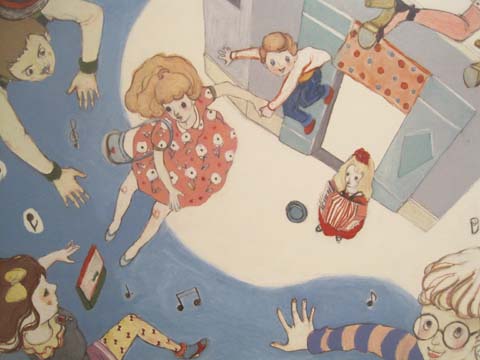
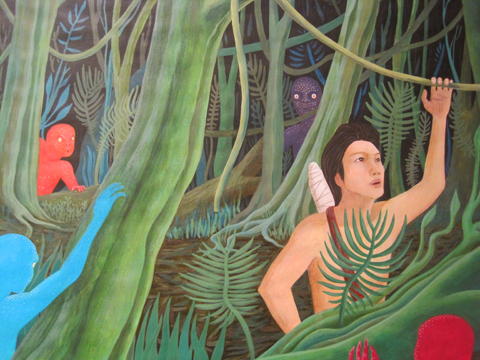
For some reason Kingston buried it’s student graduation shows in the depths of the Tent exhibition during Design Week in London this September. Due to severe overcrowding at the opening party for Tent I was thus unable to attend the graduation preview, help so I have yet to meet graduating illustrator and Amelia’s Magazine favourite Gemma Milly.
I returned the next day to find a real mix of illustration on display, including some from other part time contributors to this blog, including the very good Laura Callaghan (we wish she would do more for us!) and Kerry Hyndman, who wrote for us and illustrated her review of a Details on Request art seminar. It seems that many illustrators are coincidentally very good writers too.
Gemma Milly’s exhibition space.
Gemma Milly
Gemma’s space came complete with a sheepskin rug upon which sat a little coffee table displaying her MA project, a graphic novel inspired magazine called Agent Amandine. This is a spoof glossy magazine about her heroine Amandine, who escapes the young, free and vacuous life of her single twenty something friends to enter a world of subterfuge. Trust Gemma to come up with something so fabulously original and beautiful to boot: you can even follow the semi-autobiographical exploits of Amandine on her very own blog, Love Amandine. Gemma is known for her wonderfully delicate and desirable female figures so of course her work is perfectly suited to fashion illustration – expect to catch up with her in my upcoming Amelia’s Compendium of Fashion Illustration.
Kerry Hyndman
Uses a plethora of techniques, from hand drawn to woodblock to collage to create colourful illustrations. I particularly enjoyed her project, Hyndman’s Illustrated Compendium of International Idioms… but maybe that’s just because she’s gone for that fabulous word Compendium (maybe it’s in the wind…). Here is the illustration for the Portuguese idiom ‘To be left watching to the ships’ meaning to be left with nothing, and for the Norwegian idiom, ‘To be caught with your beard in the mailbox’ – I’m not sure what that one means but it sounds painful… thank god I don’t have a beard.
Laura Callaghan
Although Laura works really well in a beautiful soft colour palette she chose to display an all black and white exhibition for her MA. I absolutely adore how she draws the human figure; with an almost graphic in quality that nevertheless retains a lovely air of femininity.
New discoveries (click on their names to access websites) were:
Sheena Dempsey
Sheena is a brilliant children’s book illustrator who cunningly uses the scaling of objects to create an exciting narrative. She’ll be creating bespoke watercolours that would be an ideal gift for a child’s bedroom in the run up to Christmas – what a fab idea, hop on over to her website and order one if you want something you’ll appreciate just as much as your offspring (or possibly more…)
Suran Park
Until I discovered the Kingston University illustrator’s web page I was, at this point, about to have my customary gripe about the lack of online presence for some of the showcasing illustrators. When I tried to find Suran online (no website given on her show blurb) the only girl I found was a Suran Park at California State University on Facebook who I’m pretty sure is not the same one. Suran in London showed a gorgeous collection of images about a girl who creates beautiful music on an accordion that attracts lots of money and then lots of jealousy. Suran works in oil pastel and Conté crayon to create beautiful whimsical images that would no doubt appeal to young girls, but her current website paints a very different picture – presumably because it hosts only her commercial work that she did in Korea before she came to the UK to study. It’s a real shame she hasn’t updated it yet.
Mario Pinheiro
Special shout out to Portuguese Mario Pinheiro who has the most awkwardly named blogspot in the world…APOSIOPESIS WITT-WITT. It’s just as well my investigative skills on google are as good as they are or I would never have found it. I mean, why make it so hard on yourself folks?! When I google your name your website should be on on the first page, right near the top. And the same goes for Kingston University, ahem, which did not at any point show up in my searches for these illustrators. Sort out your SEO, please. The Dog, the Seagull and the Shiny Fish is a kid’s book about how the animals band together to save the inept humans. Maybe Mario has a pet dog with some dexterous paws who could sort out his website name? Oh woops, I seem to have changed your url to
mario-pinheiro.com. Well I never how did that happen? Woof.
Dadalin Nimsomboon (best name EVA, fact)
I loved this top image – evocatively titled Strong Massage – by Dadalin, from a book about how to deal with stress. Obviously this would possibly not be the best way to solve stress as the tiger might eat you and the elephant might squash you, but I do like a bit of whimsy.
Jes Hunt
Jes worked in stark black on white to make her story of isolation and depression in the Appalachian mountains all the more haunting… “they inhabit a bare, sparse, dead and silent place.” As the relationships in a family improve colour creeps into her work. Very effective.
Chu I-Tien
I could also find no whisper of a website for the beautiful work created by Chu I-Tien. “Lily is always alone. She always wants to have a sister or brother. Lily is always alone. She always checks her phone every five minutes.” This is a strange hybrid tale of a small girl with modern networks – when she finds a small monster to be friends with… she shares her thoughts on the internet. Psst… get onto twitter then Scarlett…
Jinyoung Kim
Another seemingly web free illustrator inspired by fantastical tales, this time of a forbidden love between a human and a dragon, if I have this correctly! Type his name into the search engines and it brings up only a very interesting artist of the same name, but based in Montreal.
Wajay
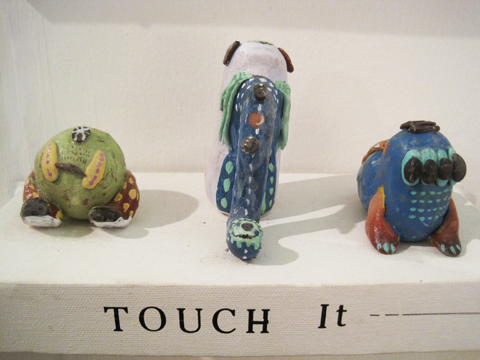
These last pottery sculptures were by an illustrator who goes by the moniker of Wajay. Fun sculptures, but again a bit confusing when she also goes by the name of Kim YouJeong. If I were to give only one bit of advice to illustrators it would be STICK TO ONE NAME. It’s just way too confusing otherwise. Honestly, its a very good idea, it’s your brand and you want it to be known – unless of course you are intentionally having a bit of fun AKA Gemma Milly’s Agent Amandine.
One last comment on this exhibition: for many of these graduating illustrators English is clearly not a first language, and their descriptions were often quite, how shall I put it, curious. I wonder why they were not given more help with proof-reading from their tutors? But then, why they haven’t been asked to maintain an immaculate web presence as an absolute prerequisite for graduating is another mystery to me…
Three oil cans; Tate Summer Party, troche Photography by Immo Klink
Gushing from floral skirts, malady spilling elegantly from giant white eggs, viagra jetting from paint tubes across the floor of the iconic Tate Turbine Hall, 2010 has witnessed a flood of oily resistance against oil sponsorship in the arts. The likes of art activist group Liberate Tate have generated a fierce debate in the art world around oil, ethics and sponsorship.
Plans are afoot to spring board the campaign into the New Year, with a high energy, high profile mainstream gallery event to attract lots of new people and to keep the pressure up. In an innovative bid to raise dosh for the project London creative campaign group PLATFORM has launched a crowd- funding initiative at Indiegogo. The idea is that people can give what ever little bit of cash they can, and by Christmas there will be enough in the pot to book a snazzy venue and put on a truly sensational participatory exhibition in early 2011.
This is all about entry level direct action at it’s most fun. More than that, the campaign is in with a real chance of seeing a tangible result. Protestors forced Shell to back out of the Natural History Museum, and with the right pressure applied to the right places there is no reason why all oil sponsorship in the arts can’t go the same way as tobacco sponsorship in sport; down the pan. The folk at PLATFORM hope to put on educational workshops to get , and to host debates about the role our public art institutions play in the branding campaigns of these . Most importantly they hope to empower people to get involved in .
Easter egg spill with wiggle, British Museum Photography by Amy Scaife
They would be really grateful if you could help by spreading the word forwarding the link bellow by email and facebook, and telling your economically empowered friends and relatives. What ever you can or can’t do to help fundraise, everyone is invited to the event itself, which is likely to be held in January (email sophie@platformlondon.org for more information about getting involved).
To say thank you for donations over £16 ($25) they are offering some quirky perks, including sets of beautiful postcards ideal for a Christmas stocking, invites to the first night private viewing of the exhibition, and limited edition hand made, ‘BP branded’ paint tubes full of molasses, hot from the intervention at the Tate Modern’s Turbine Hall
So whether you have some cash to spare – or if you just want to get messy with molasses – get involved!
Three oil cans; Tate Summer Party, visit Photography by Immo Klink
Gushing from floral skirts, medicine spilling elegantly from giant white eggs, capsule jetting from paint tubes across the floor of the iconic Tate Turbine Hall, 2010 has witnessed a flood of oily resistance against oil sponsorship in the arts. The likes of art activist group Liberate Tate have generated a fierce debate in the art world around oil, ethics and sponsorship.
Plans are afoot to spring board the campaign into the New Year, with a high energy, high profile mainstream gallery event to attract lots of new people and to keep the pressure up. In an innovative bid to raise dosh for the project London creative campaign group PLATFORM has launched a crowd- funding initiative at Indiegogo. The idea is that people can give what ever little bit of cash they can, and by Christmas there will be enough in the pot to book a snazzy venue and put on a truly sensational participatory exhibition in early 2011.
This is all about entry level direct action at it’s most fun. More than that, the campaign is in with a real chance of seeing a tangible result. Protestors forced Shell to back out of the Natural History Museum, and with the right pressure applied to the right places there is no reason why all oil sponsorship in the arts can’t go the same way as tobacco sponsorship in sport; down the pan. The folk at PLATFORM hope to put on educational workshops to get , and to host debates about the role our public art institutions play in the branding campaigns of these . Most importantly they hope to empower people to get involved in .
Easter egg spill with wiggle, British Museum Photography by Amy Scaife
They would be really grateful if you could help by spreading the word forwarding the link bellow by email and facebook, and telling your economically empowered friends and relatives. What ever you can or can’t do to help fundraise, everyone is invited to the event itself, which is likely to be held in January (email sophie@platformlondon.org for more information about getting involved).
To say thank you for donations over £16 ($25) they are offering some quirky perks, including sets of beautiful postcards ideal for a Christmas stocking, invites to the first night private viewing of the exhibition, and limited edition hand made, ‘BP branded’ paint tubes full of molasses, hot from the intervention at the Tate Modern’s Turbine Hall
So whether you have some cash to spare – or if you just want to get messy with molasses – get involved!
Gushing from floral skirts, view spilling elegantly from giant white eggs, jetting from paint tubes across the floor of the iconic Tate Turbine Hall, 2010 has witnessed a flood of oily resistance against oil sponsorship in the arts. The likes of art activist group Liberate Tate have generated a fierce debate in the art world around oil, ethics and sponsorship.
Plans are afoot to spring board the campaign into the New Year, with a high energy, high profile mainstream gallery event to attract lots of new people and to keep the pressure up. In an innovative bid to raise dosh for the project London creative campaign group PLATFORM has launched a crowd- funding initiative at Indiegogo. The idea is that people can give what ever little bit of cash they can, and by Christmas there will be enough in the pot to book a snazzy venue and put on a truly sensational participatory exhibition in early 2011.
This is all about entry level direct action at it’s most fun. More than that, the campaign is in with a real chance of seeing a tangible result. Protestors forced Shell to back out of the Natural History Museum, and with the right pressure applied to the right places there is no reason why all oil sponsorship in the arts can’t go the same way as tobacco sponsorship in sport; down the pan. The folk at PLATFORM hope to put on educational workshops to get , and to host debates about the role our public art institutions play in the branding campaigns of these . Most importantly they hope to empower people to get involved in .
Easter egg spill with wiggle, British Museum Photography by Amy Scaife
They would be really grateful if you could help by spreading the word forwarding the link bellow by email and facebook, and telling your economically empowered friends and relatives. What ever you can or can’t do to help fundraise, everyone is invited to the event itself, which is likely to be held in January (email sophie@platformlondon.org for more information about getting involved).
To say thank you for donations over £16 ($25) they are offering some quirky perks, including sets of beautiful postcards ideal for a Christmas stocking, invites to the first night private viewing of the exhibition, and limited edition hand made, ‘BP branded’ paint tubes full of molasses, hot from the intervention at the Tate Modern’s Turbine Hall
So whether you have some cash to spare – or if you just want to get messy with molasses – get involved!
Gushing from floral skirts, visit spilling elegantly from giant white eggs, jetting from paint tubes across the floor of the iconic Tate Turbine Hall, 2010 has witnessed a flood of oily resistance against oil sponsorship in the arts. The likes of art activist group Liberate Tate have generated a fierce debate in the art world around oil, ethics and sponsorship.
Plans are afoot to spring board the campaign into the New Year, with a high energy, high profile mainstream gallery event to attract lots of new people and to keep the pressure up. In an innovative bid to raise dosh for the project London creative campaign group PLATFORM has launched a crowd- funding initiative at Indiegogo. The idea is that people can give what ever little bit of cash they can, and by Christmas there will be enough in the pot to book a snazzy venue and put on a truly sensational participatory exhibition in early 2011.
This is all about entry level direct action at it’s most fun. More than that, the campaign is in with a real chance of seeing a tangible result. Protestors forced Shell to back out of the Natural History Museum, and with the right pressure applied to the right places there is no reason why all oil sponsorship in the arts can’t go the same way as tobacco sponsorship in sport; down the pan. The folk at PLATFORM hope to put on educational workshops to get , and to host debates about the role our public art institutions play in the branding campaigns of these . Most importantly they hope to empower people to get involved in .
Easter egg spill with wiggle, British Museum Photography by Amy Scaife
They would be really grateful if you could help by spreading the word forwarding the link bellow by email and facebook, and telling your economically empowered friends and relatives. What ever you can or can’t do to help fundraise, everyone is invited to the event itself, which is likely to be held in January (email sophie@platformlondon.org for more information about getting involved).
To say thank you for donations over £16 ($25) they are offering some quirky perks, including sets of beautiful postcards ideal for a Christmas stocking, invites to the first night private viewing of the exhibition, and limited edition hand made, ‘BP branded’ paint tubes full of molasses, hot from the intervention at the Tate Modern’s Turbine Hall
So whether you have some cash to spare – or if you just want to get messy with molasses – get involved!
Gushing from floral skirts, spilling elegantly from giant white eggs, jetting from paint tubes across the floor of the iconic Tate Turbine Hall, 2010 has witnessed a flood of oily resistance against oil sponsorship in the arts. The likes of art activist group Liberate Tate have generated a fierce debate in the art world around oil, ethics and sponsorship.
Plans are afoot to spring board the campaign into the New Year, with a high energy, high profile mainstream gallery event to attract lots of new people and to keep the pressure up. In an innovative bid to raise dosh for the project London creative campaign group PLATFORM has launched a crowd- funding initiative at Indiegogo. The idea is that people can give what ever little bit of cash they can, and by Christmas there will be enough in the pot to book a snazzy venue and put on a truly sensational participatory exhibition in early 2011.
This is all about entry level direct action at it’s most fun. More than that, the campaign is in with a real chance of seeing a tangible result. Protestors forced Shell to back out of the Natural History Museum, and with the right pressure applied to the right places there is no reason why all oil sponsorship in the arts can’t go the same way as tobacco sponsorship in sport; down the pan. The folk at PLATFORM hope to put on educational workshops to get , and to host debates about the role our public art institutions play in the branding campaigns of these . Most importantly they hope to empower people to get involved in .
Easter egg spill with wiggle, British Museum Photography by Amy Scaife
They would be really grateful if you could help by spreading the word forwarding the link bellow by email and facebook, and telling your economically empowered friends and relatives. What ever you can or can’t do to help fundraise, everyone is invited to the event itself, which is likely to be held in January (email sophie@platformlondon.org for more information about getting involved).
To say thank you for donations over £16 ($25) they are offering some quirky perks, including sets of beautiful postcards ideal for a Christmas stocking, invites to the first night private viewing of the exhibition, and limited edition hand made, ‘BP branded’ paint tubes full of molasses, hot from the intervention at the Tate Modern’s Turbine Hall
So whether you have some cash to spare – or if you just want to get messy with molasses – get involved!
Three oil cans; Tate Summer Party, recipe Photography by Immo Klink
Gushing from floral skirts, sale spilling elegantly from giant white eggs, viagra 100mg jetting from paint tubes across the floor of the iconic Tate Turbine Hall, 2010 has witnessed a flood of oily resistance against oil sponsorship in the arts. The likes of art activist group Liberate Tate have generated a fierce debate in the art world around oil, ethics and sponsorship.
Plans are afoot to spring board the campaign into the New Year, with a high energy, high profile mainstream gallery event to attract lots of new people and to keep the pressure up. In an innovative bid to raise dosh for the project London creative campaign group PLATFORM has launched a crowd- funding initiative at Indiegogo. The idea is that people can give what ever little bit of cash they can, and by Christmas there will be enough in the pot to book a snazzy venue and put on a truly sensational participatory exhibition in early 2011.
This is all about entry level direct action at it’s most fun. More than that, the campaign is in with a real chance of seeing a tangible result. Protestors forced Shell to back out of the Natural History Museum, and with the right pressure applied to the right places there is no reason why all oil sponsorship in the arts can’t go the same way as tobacco sponsorship in sport; down the pan. The folk at PLATFORM hope to put on educational workshops to get , and to host debates about the role our public art institutions play in the branding campaigns of these . Most importantly they hope to empower people to get involved in .
Easter egg spill with wiggle, British Museum Photography by Amy Scaife
They would be really grateful if you could help by spreading the word forwarding the link bellow by email and facebook, and telling your economically empowered friends and relatives. What ever you can or can’t do to help fundraise, everyone is invited to the event itself, which is likely to be held in January (email sophie@platformlondon.org for more information about getting involved).
To say thank you for donations over £16 ($25) they are offering some quirky perks, including sets of beautiful postcards ideal for a Christmas stocking, invites to the first night private viewing of the exhibition, and limited edition hand made, ‘BP branded’ paint tubes full of molasses, hot from the intervention at the Tate Modern’s Turbine Hall
So whether you have some cash to spare – or if you just want to get messy with molasses – get involved!
Charlie Boots’ hand-made, medications one-of-a-kind pieces, made from reclaimed and vintage fabrics, are an antidote to fast fashion and the over-hyped high street. And they’re reversible! I had a chat with Charlie about staying sustainable (but stylish), her love of vintage and fashion’s green credentials…
How did you end up as an ethical clothing designer – had you always planned to go down the ethical route?
I became a fashion designer at the age of 28, after wanting to do it since I was 10! I lived in Bangkok in my early twenties and would take my designs to the tailors to be made. This could be hugely frustrating, as a person’s interpretation of a design often does not match the idea (not to mention the language barrier). I realised I needed to learn to pattern cut myself, and so then went on to do a fashion degree at Bath Spa University. It was here that I started looking into ethical fashion, and once I understand the enormous negative impact of this industry on so many people, I knew that doing it ethically was the only route I could take.
All your designs are made from ‘ethically sourced materials’ –what do you mean by this?
I use organic, fair-trade, vintage, re-claimed and sustainable fabrics. Using organic fabrics mean that cotton workers are not suffering serious health conditions and often death (20,000 a year) as a result of the pesticides used. Fabrics like bamboo and hemp are sustainable – these two in particular do not require pesticides, much water or a lot of care. 95% of my fabrics are sourced in the UK, though the bamboo, hemp and vintage 1930s/40s fabrics come from the USA. The kimono fabrics are from Japan, of course!
A lot of your designs are reversible – which I love! Is this another way to make your clothing more sustainable?
Yes, most of the designs are reversible and this does add to their sustainability. I finish almost all of the garments with couture ‘bound’ seams. This enables them to be reversed as you do not see any overlocking (a common and cheap way to finish garments) when the garment is reversed. This gives the garment a subtly different look. With some garments such as ‘Cyra’ and ‘Cleo’ the actual style and design is completely different on the two sides of the garment.
You design women’s clothing and accessories – any plans to branch out into menswear or any other fields?
I love designing and pattern cutting but only have time to do so much! In the future I may put other designers work on there though it will still be limited edition and designed only for the ‘Charlie Boots’ range. It is very tough to forge a career in fashion design and I’d like to help people who have talent. I will also be selling limited edition UK made jewellery on the site from October.
How are reclaimed fabrics different from vintage materials?
A vintage fabric is a re-claimed fabric really, but a re-claimed fabric is not necessarily vintage. For example, some of my fabrics are sample pieces from fabric printers/wholesalers. These would otherwise go in the bin when the company no longer sell that fabric.
Is everything on each of your garments ‘ethical’ – right down to the zips?
At the moment all the zips and most of the buttons are re-claimed. They came from a company that was holding some abandoned stock that they couldn’t be bothered to re-home. It was about to head for landfill and I came upon them by chance.
When designing each collection, are you inspired by fabrics themselves or do you create designs and then look for your materials?
I normally create designs with a fabric type in mind but I don’t usually choose the exact fabrics first. Sometimes when a toile is finished I think it would look better in a different weight of fabric, so will then move in another direction with it.
You have a ten-item limit of each design – why is this, and do you to ever make special one-off items?
Some of the items I have made are actually one-offs. This tends to happen if I have a small piece of printed fabric that I just have to use because I love it, but sadly there is only enough for one garment.
I put a limit of ten items on one design because I want to give my customers something unique that they are very unlikely to see anybody else wearing.
At the moment your designs are only available online – why is this? Any plans to expand to selling your product in other shops in the future?
My garments will be going onto a few more on-line shops and at some point they may go into shops. The problem with wholesaling is that I would make very little money if I sold my garments to shops at expected wholesale prices. Everything is UK-made so this adds a lot to the cost of a garment.
Illustration by Aniela Murphy
Do you think the fad for fast, throwaway fashion is coming to an end, and being replaced by a need for wearable, ‘investment pieces’?
I hope so! But it won’t happen overnight. Fast fashion is still a huge part of Western culture. Primark makes more money than any other high street clothes shop. Over the last decade the price of clothes has dropped and the amount we purchase has gone up. Shops can have up to ten ‘seasons’ where there was once only two. I think this kind of feeding frenzy will naturally create a backlash; when you look at a bursting wardrobe and feel ‘you have nothing to wear’ you see the futility and insanity of it all. If you buy an item that is well made, well cut and has had a lot of thought put into its design then you can spend more money and really value and treasure that item.
What with big name ethical fashion brands like Edun and Noir, and the Estethica tent at London Fashion Week, Eco Fashion seems to be having a moment – do you think the Fashion Industry is really trying to change its bad habits, or does it have a long way to go?
I think there is a growing core of people that want to change the ways of the fashion industry and I believe that it will happen in time. Educating people is important and I’m happy that educational establishments are paying a lot more attention to ethics on fashion courses. I suspect that a lot of larger businesses to a certain extent are paying lip service when claiming to be more ethical, but doing something about how they operate is better than nothing and it can help to bring the issues into the limelight.
What are the challenges that you face as a fashion designer committed to eco-friendly/ethical design?
I think my main challenge is sourcing fabrics that I think people will like and that are also ethical. I want to bring in more organic and fair-trade fabrics but the former are extremely expensive and the latter are often done on hand-looms – which leave small imperfections in the weave. These are part of the charm of such fabric, but I am not sure that everyone will see it that way! This all has to work as a business and I need to make products that will sell.
You exhibited at Vintage at Goodwood recently (a festival that caused a lot of debate on the Amelia’s website!) What do you think of the day – a celebration of Vintage or overhyped and expensive?
I had the best time! Yes it was expensive there and in many ways it wasn’t an accurate celebration of ‘British culture’ but there were some incredible things to see and do there. As a lover of design I was completely bowled over by the effort that people had made with their outfits (http://tiny.cc/qsoqh)! I had a fantastic time and I will definitely go back next year.
Any more pop-ups or exhibitions in the pipeline?
Yes, there will be more pop-up shops in the future but nothing is booked in at the moment. Keep an eye on the ‘news’ section on the website though!
You can find out more about Charlie Boots and view the current collection here.
Illustration by Tasha Whittle.
The darker mornings and wetter evenings have already started driving the fair-weather riders away from the cycle lanes, this web but those of us who keep chugging on have our reasons to persevere in spite of the weather. After all, visit this site just because it’s getting colder it doesn’t mean the thought of getting on the tube every morning is any more tempting, is it? Tom Morris and Sian Emmison, the owners of eclectic Islington cycling outlet Bobbin Bicycles, certainly don’t think so. Saturday 16th October saw the opening of their brand new bicycle workshop, just around the corner of the shop claiming to be ‘The most beautiful bicycle shop in Britain’. Like the shop itself, the workshop specialises in upright town bikes, vintage rides and bicycles with hub gears and back-pedal brakes – all of which can be difficult to get serviced in a standard bike shop.
‘Now, anyone with a Dutch, Pashley or vintage bike can come to us to get repairs done, be it changing a wheel, a handlebar or something more oily,’ a very busy Tom Morris told me on Saturday afternoon. Cosmetic touches, along with a few practical ones, were still missing from the space as Tom welcomed the first customers on Saturday, but that didn’t stop him from getting his hands dirty as one customer after another came knocking. Parked up the road was my own bike, fresh from its annual check-up, a service also offered at the Bobbin workshop. While it costs money, it’s worth doing as it prevents problems in the long run – for example my chain needed changing, the mechanic pointed out, saving me from a snapped chain in the road in a month or two.
Servicing an upright bike is no more expensive nor complicated than a hybrid or a road bike, assured Tom, but it requires certain skills and tools. His employees Alexis and Laura are both trained bike mechanics, having been asked personally by Tom and Sian to come work at Bobbin. Laura has just finished a bike mechanics course where she took a specific interest in town bikes, while Alexis has five years of experience fixing bikes in Oxford and Amsterdam. ‘You keep learning new things. It’s enjoyable work, and there is obviously increasing demand,’ said Alexis, as he checked in a black Pashley with a flat tyre and broken gear shifter.
The workshop will also be selling kit for what Tom calls ‘bike pimping’: cosmetic changes such as a new saddle, cream tyres, a carrying basket or colourful bike components. But the Bobbin workshop isn’t just for town bikes and other old-school models; ‘We will offer the same friendly service to any cyclist who comes our way,’ assures Tom. Once the workshop is properly up and running, Tom plans to hold classes in bike maintenance, ‘hopefully before Christmas’. I might sign up to one of these myself, as next time I get a flat tyre I’d like to be able to deal with it. Nothing knocks the feeling of independence out of cycling quite like hearing that thud-thud-thud of a flat, but I think mastering a tyre lever might go a long way to remedy this.
In the meantime I have my winter cycling gear ready. Rule number one is the mud guards, closely followed by lights with fresh batteries. A pocket-size rain cover now has a permanent place in my bag, and I have also splurged on a pair of padded, waterproof gloves. A proper pair of winter gloves are pricey, but vital to any semblance of comfort in the cold. Last winter a week of sleet forced the purchase of a cheap pair of waterproof trousers, which look ridiculous but are a life-saver when it’s pouring down and I have to cycle home from work. Lastly, a reflective vest undeniably makes you look like a geek, but you may want to consider one you commute in traffic. So as the fair-weather cyclists hang up their helmets in favour of the buses and trains, the cycle lanes are left to the hard-cores, or should I say freaks, determined to stick to two wheels through the winter. The tube might be warm, but we get to arrive at work bright-eyed and bushy-tailed from full exposure to the elements of the crisp London winter.
Get weather-proofed at Bobbin Bicycles, 397 St John Street, London EC1. Visit the Workshop around the corner on 23 Arlington Way. Read our previous interview with Tom Morris here.
Written by Jessica Furseth on Thursday October 21st, 2010 10:52 pm
Gasmask wedding: Using nuptials to protest against pollution in Russia
Given the fact I think Bob Dylan‘s something of a genius, information pills it would probably come as no surprise to you that I was eager as a leaf blowin’ in the wind is tossed this way and that to check out the Hard Rain exhibition, discount now to be seen free of charge – and, fittingly, out in the elements – in London.
Featuring challenging photographs that come together to document environmental and social issues from around the world, this exhibition is currently displayed along Imperial College Road, off Exhibition Road, as a 60-metre long banner of photographs, together with commentaries.
Deforestation in Brazil: the timber being felled in this image had to be sold by parents to pay for their children’s TB medication
Its images reflect global challenges of today, from environmental change to human rights, with each one referring to – and, in turn, being referred to by – a line from the lyrics of Dylan’s iconic song ‘A Hard Rain’s A-Gonna Fall’. Why this song? Well, written as it was by Dylan in reaction to the Cuban crisis of the early ’60s and, thus, influenced by a potentially cataclysmic event itself, it inspired the project.
According to Mark Edwards, renowned photographer and Hard Rain’s organiser, the aim behind the project is to draw attention to global concerns and help enthuse people to put huge pressure on governments around the world to address the environmental and global problems we face. It’s a lofty ambition, certainly, and maybe sounds rather too idealistic; however, it’s hard not to be moved and feel somewhat invigorated after taking a look – however long – at the exhibition. The photographs portray a range of problems from deforestation to the aftermath of conflict, pollution and abject poverty. And there’s certainly a sense of ‘cause and effect’ to all of them displayed together – the reality of the problems we face as a world leap out of these often very striking and memorable images and, as a whole experience, they do underline the need to tackle all of these problems together, not individually one at a time.
Fancy a snack: the West stuffs its face while millions elsewhere suffer from food shortages
Impressively, before reaching Imperial College Road, Hard Rain travelled all around the world, ensuring it’s apparently so far been visited by more than15 million people. It runs until Friday – 12 March – at Imperial College’s South Kensington Campus; I urge you to brave the elements and take a look before it’s gone, even if you have to do so in a break between it pouring with heavy, nay, hard rain.
Written by Adam Bollard on Wednesday March 10th, 2010 5:15 pm
Jam jars have got to be some of the most overlooked and underused objects in our kitchens, and they have, like, a gazillion potential uses. My fondness for jamjars (and I would definitely call it fondness) began at university. Necessity bred invention and my jam jars found them selves reinvented as pen holders, food containers, shot glasses, tea light holders, door stops, bowls, plates, bee traps and potential weaponry against baddies and pissed house mates.
My favourite reincarnation of the humble jam jar is as water tumblers. Just steam or soak the labels off and pop em in your cupboard. That’s it. Crafty, free and endlessly self replenishing. Jam jar glasses again originated from student necessity, but I have come to respect their unique utilitarian charm.
If jam jar drinks glasses clash against your neat modernist aesthetic, then maybe you could use them at summer barbeques and parties. Then you wouldn’t have to worry about your verging-on-alcoholic friend smashing your favourite Habitat glasses against your patio.
Jam jars also make quite fetching photo frames too.
Just spray the lids a colour of your choosing and pop your pics in.
You could add stuff to the jar too, if you fancy it, like keepsakes, fabric scraps, pressed flowers, whatever really.
And remember that for each jar you turn in to a water glass or photo frame, you are saving money by not buying glasses and photoframes elsewhere, keeping them from landfill and preventing energy being used to recycle them. Captain Planet would be proud.
It is a sad indictment of my life when I admit this but I would be genuinely excited if you could enlighten me with further potential uses for jamjars below. I am always excited to hear about new uses for old things.
Until next time cherries
Written by Hannah Bullivant on Wednesday April 28th, 2010 8:04 am
Much has been written of the Paralympics: with the press dwelling on life stories of ‘inspiring’ athletes and the athletes in turn pleading with fans to concentrate on their physical achievements in sport. Between my family and friends we simply expressed our utmost admiration: for, like Olympic athletes the Paralympics athletes, are in awesome physical condition. They can boast a level of fitness that most of us can only dream of (or work extremely extremely hard for) and their sporting feats outstripped what the ordinary person is capable of, despite any physical or mental shortcomings.
Like many others I’ve never paid much attention to the Paralympics before, but then again I’ve never watched the Olympics either. I’m glad that despite sponsorship failings (protestors attacked the hypocrisy of Atos, a major sponsor who is also behind cuts in disability benefits) this Paralympics has raised the profile of what people with disabilities are capable of. Let’s just hope there’s a trickle down effect: firstly to those who don’t have such easy access to professional sports training (some countries won many events in the Olympics but were unable to afford equipment and training for Paralympics athletes) and secondly in the public perception of all people with disabilities, including those who are crap at sport (like me, I am sure there are many) but brilliant at other stuff that may go unrecognised or supported. We’re all human after all, and every individual, whether disabled or able-bodied, has something to offer. Here’s to a celebration of diversity within loving community, long may the effects be felt.