Amelia’s Magazine | At War for the Whales: #1 Heading Out

3238269817_3bc7024140

The M/V Steve Irwin looks for a way out of a dense field of icebergs (Photo: Eric Cheng / Sea Shepherd Conservation Society)

As a young kid, visit this dosage I was always fascinated by the idea that the Blue Whale, more about the biggest animal ever to have lived on this planet, pill was still out there roaming the oceans. I prized a giant mural of a whale above my bed and every couple of months I sent some of my pocket money off to organisations who worked to keep my whale friends safe. Although whales and the whaling issue were kept in the back of my mind, it wasn’t until I reached my mid-twenties that I started realizing that these wonderful creatures were still actively being hunted, despite all the protection they are supposed to enjoy under international treaties. The more I read up on it, the crazier the whole situation seemed. For example, Fin whales are listed as an endangered (and thus protected) species on the IUCN Red List since 1996. They are illegaly hunted down and killed every year in the Southern Ocean Whale Sanctuary, a protected area for whales put in place by the United Nations in the mid 90′s. A whaling fleet from Japan enters these Antarctic waters around mid December to kill nearly 1000 whales (Piked whales and Fin whales) for ‘scientific research’.

Minke whaleIllustrations by Kerry Lemon

One night, after reading some news articles about whaling, I just got so angry. Here are these beautiful creatures, hunted down and killed for a bit of quick money. Scientific research? Yeah, right! It makes me mad when I think about some ignorant businessmen down the line, filling their pockets with total disregard for the animals, the environment and the future generations that I hope will live to see these majestic creatures live freely like they deserve to, just as much as we humans do.

My anger quickly translated into action and within weeks I signed up to join the Sea Shepherd ship’s crew for their annual anti-whaling campaign in the Southern Ocean. Sea Shepherd founder Captain Paul Watson is known for his direct action tactics and the fact that he won’t back down from opposition or controversy and is more willing than anyone to put up a fight to defend ocean wildlife. Since 1979, Sea Shepherd has scuttled and sunk 10 illegal whaling ships at dockside, rammed and boarded ships at sea and confiscated many miles of illegal longline and driftnet. All this in the last 32 years in a war that has put the lives of whales, seals, dolphins, sharks, fish and sea birds first. Most importantly, a war in which Sea Shepherd has never sustained or caused injury to anyone as a result of its actions.

3239108510_1131036cd6

A whale surfaces at the edge of the sea ice in Antarctica. (Photo by Adam Lau/Sea Shepherd Conservation Society)

As a trained violin maker I had no ship skills whatsoever but the ship’s carpenter role was one I was able to fill. Sometimes people ask me what carpentry work there is to do on a ship. ‘Surely it’s all steel?’ Honestly, I have never made so many cabinets, bunks, cupboards, boxes, holders, storage racks, tables, benches, toilet roll holders and other wooden contraptions as in the last 18 months. The ship is always a hive of activity with deckhands, engineers, quartermasters, officers and cooks working hard to get the ship in top shape for the job at hand. Having been involved in activism for over 10 years, I don’t think I’ve ever worked with such a dedicated, hard working and committed bunch of people.

Bryde's whale

With a samba band, Terri, Bindi and Robert Irwin and many local people waving us off at dockside, we left Fremantle on 7th December with a course set for Antarctica. As soon as we left the Australian Economic Exclusion Zone we were trailed by a Japanese surveillance vessel, which has been following us ever since. We will reach the whaling grounds within the next few days and more that ever before we have the ability to shut them down. We have more resources at our disposal, more public support than ever before and the people of Japan are increasingly questioning the ongoing spending of millions of their tax payers money on this useless and cruel industry.
091214_Shonan_Maru_No_2_02_(BV1187)

Close up of the Japanese harpoon ship. (Photo: Barbara Veiga / Sea Shepherd)

As the world leaders gathered in Copenhagen last month, failing to come to an agreement on tackling climate change and make emission cuts mandatory by international law, we were forced to set sail for thousands of miles to uphold another bit of major legislation they had agreed upon, but which they chose to ignore to enforce. What was it again, this thing agreed upon in the 80′s and at the time hailed as a massive victory for conservation? Something to do with whales?

If the nations of the world can so blatantly ignore an international treaty that is supposed to protect an endangered species in an established whale sanctuary, than what hope is there for the international community to enforce any type of legislation that is to fight climate change? The ongoing illegal whaling in the Southern Ocean is a slap in the face to conservation efforts around the world. A set back for environmental activists the world over. A stab in the back to those people who worked so hard to get the legislation agreed upon in the first place. For the sake of the whales, the international community and future generations we will sail into the Antarctic, find the whalers and give them what they deserve.

For latest updates and news, please see the Sea Shepherd website: www.seashepherd.org

Categories ,Antarctica, ,australia, ,Blue Whale, ,conservation, ,Endangered species, ,Hunting, ,japan, ,Kerry Lemon, ,Research, ,Sea Shepherd, ,Steve Irwin, ,united nations, ,Whales, ,Whaling, ,Wietse Van Der Werf

Similar Posts:


Amelia’s Magazine | At War for the Whales, Part 3

Untitled-3
Criss-crossing the international date line over two days, the crew were very possibly the first and last people on Earth to celebrate Jan 1, 2009. (Photo by Adam Lau/Sea Shepherd Conservation Society

New years eve. After the refuel and resupply we are back at sea, enjoying cake, drinks and a super vegan buffet. The sea is rough and outside it is pitch black. As we clear the EEZ boundary the spy ship is nowhere to be seen. Last we heard it was waiting for us just south of Hobart. Our plan of sneaking out under the cover of darkness and in bad weather seems to work. When we left in December the whalers had hired surveillance planes under false pretences so they could track our movements. This worked for a while, until the hire company found out what the real deal was. Even if they were able to find someone to hire them a plane, the weather might be too bad for them to come out. A group calling themselves ‘Taz Patrol’ later announced on Twitter that the spy ship was still waiting for us at the EEZ boundary when we had already sneaked out and were way out of their reach. Hurray!

Untitled-1

Dusk aboard the M/V Steve Irwin (Photo: Eric Cheng / Sea Shepherd Conservation Society) 

We sail straight south towards the Commonwealth Bay area, where we were not more than a fortnight ago. An Antarctic cruise ship spotted the whalers and some of the passengers informed us. The Ady Gil is roughly in the same area, though low on fresh water and fuel, they are waiting on us to be resupplied. As we are heading down, another vessel is coming in from the west. Kept secret until now, this is our third vessel, the ice-classed Bob Barker, named after the American TV presenter and animal rights campaigner who purchased it for us. It has been at sea for over a month now, trying to reach the whaling grounds to join in on the action. With the Ady Gil south east of the fleet, the Bob Barker coming in from the west and us bearing down on them from the north, there is literally nowhere for them to run.

bob barker

The Bob Barker (photo: JoAnne McArthur / Sea Shepherd)
 
We have quite a way to go yet, about two and a half days sailing. The Bob Barker is closing in too and briefly meets with the Ady Gil. This is when things get ugly. The Bob Barker has located the whaling fleet and sets course for the factory ship Nisshin Maru. This ship, where the whales are hauled onto and processed once they have been caught, is at the hearth of the whaling fleet. You shut it down and the rest of the ships are unable to operate. The Nissin Maru starts running at full speed. Meanwhile, the other whaling ships scatter in different directions. It seems the chase is on.

32

photo: Glenn Lockitch / Sea Shepherd

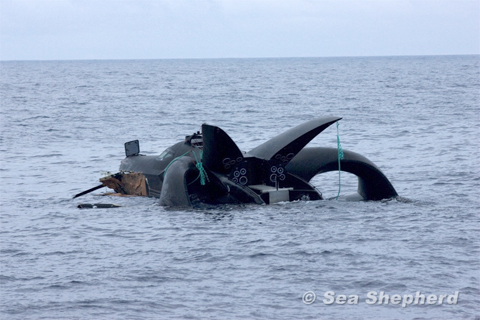
We are on watch in the engine room. The phone rings, it is the bridge. ‘Hey guys, have you heard the news?’ I listen intently as the story unfolds. The Ady Gil is drifting close by the Bob Barker, waiving and cheering before leaving to meet up with us, still some distance away. The vessel is drifting, not accelerating, and the some of the crew sit on the aft deck. In the distance the spy ship Shonan Maru No 2 is approaching at full speed. It is getting closer and closer and at a distance of about a hundred meters it starts to turn sharply towards the Ady Gil. When the crew realize what is going on, they fire up the engines and start to pull back, hoping to avoid a collision, but to no avail. The more than 800 tonnes heavy harpoon ship throws itself into the much smaller trimaran. It crashes into the vessel, tearing open its hull and cutting off 4 metres of the bow.

Untitled-4

Whalers Ram Sea Shepherd Ship Ady Gil  (photo credit: JoAnne McArthur / Sea Shepherd)

The Ady Gil starts sinking. A MAYDAY distress signal is sent out and the Bob Barker changes course and rushes to its aid. It gets there just in time to rescue the 6 crew members from the vessel. The Japanese whaling fleet ignores the emergency distress signals and steams away, hoping to loose us and continue their illegal whaling operation elsewhere. The Shonun Maru No 2 ignores the distress signal at first but later agrees to stay nearby after the Bob Barker makes numerous radio calls to them, relaying the urgency of the situation. The rest of the whaling fleet runs far west.

adygilsinks

Ady Gil Sinking  (Photo: Glenn Lockitch / Sea Shepherd)

The next day, everyone on the ship is catching up with the impact that the ramming and sinking of the Ady Gill is having. On the international stage, media wise and in turn how it effects people all over the world who hear about what is going on and are starting to ask questions. From the emails we are receiving and the reports we are reading, it seems that the world media is all over this. It has definitely put whaling back on the map, though I doubt that governments will finally live up to their obligation to uphold the laws they undersigned to protect these whales. In a sense it feels like governments aren’t even part of this whole situation anymore. It is down to us, the only force in the Southern Ocean to protect these gentle giants of the sea from the deadly harpoons that are after them. Looking to shoot, pull, haul up and process, what in business terms will be another few boxes of whale meat on the inventory. Another product in the freezer storage ready to be distributed once the fleet arrives back in Japan. Another statistic on the books for the whaling company. That is what it is for the whalers, for those with no regard for the sacredness of life, with no understanding of the importance that a healthy ocean and therefore healthy planet has to all of us.

icebergsun

Southern Ocean, Jan 2010 (Photo:  It’s a Wildlife)

After the sinking of the Ady Gil we turn at full speed in pursuit of the whaling fleet. After 10 days they are still running from us. When they are nearing the boundary of the area they have allocated themselves to conduct their ‘research’ in, an announcement is made that the area is to suddenly be expanded by another 1000 nautical miles west. Very convenient. We are forced to change course to meet the Bob Barker as they are running low on supplies.

whale

Humpback breaching, Southern Ocean (Photo:  It’s a Wildlife)

‘Attention all crew, whales breaching off the bow, whales breaching off the bow’. The announcement makes everyone jump into action straight away.
‘Whales! Quick quick!’ We all rush up the stairs and onto the deck. There, about 50 meters from the ship, two humpback whales jump out of the water, throwing their huge bodies up in the air, and crashing back down, causing huge eruptions on the surface. We all stand there in awe. So far, we hadn’t seen many whales at all. Quite a discouraging observation when you consider a vast industrial whaling fleet is looming about. But they’re definitely here and happy to show off their tricks. Under the sound of cheering and clapping from the ever growing spectator crowd on deck, they continue to breach, flip and dive back down. When you see these animals in the free, open ocean, their wilderness, their world, it gives you strength to carry on. Inspiration to pursue our goals in shutting down these pirate whalers.

humpback2

Humpback breaching, Southern Ocean (Photo:  It’s a Wildlife)

Read Part 2 and Part 1

For latest updates and news, please see the Sea Shepherd website

Categories ,Bob Barker, ,Sea Shepherd, ,Whales, ,Wietse Van Der Werf

Similar Posts: