Amelia’s Magazine | An interview with Spanish fashion duo Animal Bandido


Illustration by Donna McKenzie

Regular readers of Amelia’s Magazine will know that we covered the Maison Martin Margiela 20 exhibition last March, story capsule when it showed in fashion capital Antwerp.

But, information pills since it’s moved to our very own fashion capital, we thought we’d have another look, and get some of our wonderful illustrators involved!

Somerset House is quickly becoming a fashion hot spot, with the rehoming of London Fashion Week and the recent SHOWstudio sessions. It’s clear why, too – it’s bloody beautiful.

This is the third outing for the Maison Martin Margiela exhibition, after seasons in Antwerp and Munich, so actually it’s the label’s 22nd anniversary this year, but who cares? I’ll use any excuse to have a poke around a fashion archive.


Illustration by Louise McLennan

The exhibition, set in Somerset House’s lower galleries and you’d be forgiven for believing, if this building wasn’t centuries old, that the space had been purpose-built for this nostalgic trip down Margiela memory lane.

All but a couple of the rooms are white-washed in typical Margiela fashion, and while the exhibition allows us to explore the history of this conceptual and inspirational label, it still give nothing away about the elusive man himself.


Illustration by Amy Martino

Instead of being a chronological or nostalgic display, the aim of this exhbition is to explore the key themes of Maison Martin Margiela, including the inspiration behind each collection and the techniques used.

So it is the quirks that have made this brand truly unique that are given most attention. We begin with a look at the anniversary catwalk show, amongst a lot of polystyrene models, whilst mooching along a row of rather battered Tabi shoes.


Illustration by Donna McKenzie

The bulk of the exhibition explores varying collections and what made them stand out alongside so many other fashion designers of the time. Flat-pack clothing, XXXL oversized pieces, painted garments, narrow tailoring, the trench coat, and the re-visioning of old garments. We also see the evolution of Margiela’s elusivity – first it was a slash of paint across a model’s face, then a blindfold, and then the infamous sunglasses (which I was so tempted to lift I had to walk around with my hands in my pockets. Damn I wish I’d bought them – what a collector’s item).


Illustration by Farzeen Jabbar

One room is devoted to archive footage, film and photographs from across the collections – the room is dark and has white lounge chairs for you to kick back and revel in some of the most iconic fashion images of the last two decades.


Illustration by Zarina Liew

Whether you like fashion or not, I’m entirely convinced that you will love this exhibition – it breaks the boundaries of typical gallery design and it is incredibly inspirational – Go See It!

You can read a full review of the Antwerp exhibition (which was exactly the same exhibition, I promise) here.

For the all important details, visit our listings section.


Illustration by Yelena Bryksenkova

Animal Bandido are a fashion label with a difference. They’re totally anti-establishment and detest the omniprescent multi-national fashion empires that exploit workers and fabrics, medical and are on a mission to create a renaissance for struggling manufacturers who cannot compete with the big boys.

Their collections range from the vibrant to the downright whacky; weird and wonderful creations which illustrate fruits and other objects make up there range, clinic which includes knitwear, side effects fabulous graphic prints and casual basics with a twist. Viewing their collections draws comparisons to Jean Charles de Castelbajac, nutty nu-raver Carri Mundane and knitwear brand Sibling. I caught up with Zosen and Claudia, aka Animal Bandido, to find out what’s behind this fresh new label…

What made you guys team up and create the street-wear label Animal Bandido?
Claudia: We started to talk about this project in September 2007. I finished studying fashion design a year before that. I was designing my own collections, doing super-limited editions that I sewed on my own.
At the beginning I was sceptical because I had collaborated on projects before, and most of the time it’s very difficult to agree with the ideas of other people. I thought I’d give this one a go because our backgrounds are different, each of us bringing different ideas and ways of working.
Zosen: I printed my designs on t-shirts for years and I collaborated with fashion designers, but I wanted to go forward producing other garments and control the process. Animal Bandido was born to make something in collaboration and use different techniques; Claudia brings her experience with the patterns and fashion design and I with the graphics and design in general.
But, day-to-day, we both take part in every process.


Spring/Summer 2009

What does the label represent for you?
The label represents other way to create pieces and to show our stuff to as many people possible.

Zosen, you are a well known urban artist in Barcelona. What made you move into fashion?
After the zero tolerance law against street art in Barcelona, I decided to use another techniques to spread the word. Using my graphics and colours on clothes, it’s another way to have a presence on the street and give the message to the street’s citizens.
Also, it’s interesting for me to experiment with other media and other people – it’s a great way to learn.


Autumn/Winter 2010

Claudia, tell us more about your background, in fashion?
I studied a degree in Fashion Design in Barcelona and then studied millinery at Central Saint Martins in London, followed by jewellery workshops at Casa Espiral, Barcelona.
I interned with Alberto Tous for his fashion show for Barcelona Fashion Week, and then began designing my own collections and selling them in little shops in Barcelona and Berlin.

What makes you different to big fashion corporations?
Well, there’s only two of us! There are no hierarchies; we work together and are both involved in everything, all the time. We produce everything locally, we pay worthy salaries, and we keep our manufacturing quantities reasonable to avoid waste.


Illustration by Natsuki Otani

Do you think your label is art or fashion led?
Our clothes are fashion, but treated as small pieces of art. We don’t follow the trends or encourage throwaway fashion, as the corporate giants do. We create and manufacture to order (for shops and customers) again to reduce waste.

Do you usually agree on everything? How easy is it to compromise when working as a creative partnership?
Claudia: It depends on the project, normally we just discuss everything thoroughly, allowing both of us to express our point of view. Sometimes Zosen is forced agree with me when we are talking about patterns and shapes or different ways of finishing a garment, but he controls more in graphic and web design!
We always try to be equally satisfied with everything related to the brand.


Autumn/Winter 2010

Do you experiment with anything else apart from clothes?
Zosen: Oh yes! We do many things, the most recent thing being a sculpture to present the new collection, that we installed in our studio to photograph the collection against.
It’s huge and gives so much new life to our studio that we are hoping to relocate it to some public space.
Claudia: Zosen always has a million and one projects on the go: a giant mural for the people on walls in London, an exhibition of customised records in Rome…
Now I’m coming up with a few surprises for September for Animal Bandido.


Illustration by Yuann Shen

What does Animal Bandido support?
We support the national textile industry in Spain, as opposed to the over-production and the exploitation of the third world. We pay people fairly. We’re behind a renaissance of the companies that became obsolete as a result of insurmountable production levels in third world countries; we want to give the possibility of growth to small companies so it’s not just the yucky multinationals that dominate the local market.

What makes Animal Bandido unique?
Our fabrics have our own original and unique designs printed on them. We make no more than 100 items per piece, so they are truly limited edition. When you consider that we now sell in Basel, New York, Barcelona, Madrid, Seville, Zaragoza, Sweden and Nottingham and our pieces are divided between those places, there aren’t many per country.


Autumn/Winter 2010

What’s up next for Animal Bandido?
For the summer we’re launching printed bikinis and swimwear; lightweight hoodies using prints from the collection and a new, retro-inspired one. We’re also looking at launching accessories.

Categories ,Alberto Tous, ,Animal Bandido, ,art, ,barcelona, ,Barcelona Fashion Week, ,Basel, ,berlin, ,Carri Mundane, ,Central Saint Martins, ,Claudia, ,Ethics, ,fashion, ,graffiti, ,Graphics, ,Jean-Charles de Castelbajac, ,london, ,Madrid, ,Natsuki Otani, ,new york, ,nottingham, ,print, ,Rome, ,Seville, ,Sibling, ,spain, ,sweden, ,Vinyl, ,Waste, ,Yelena Brykensova, ,Yuann Shen, ,Zaragoza, ,Zosen

Similar Posts:


Amelia’s Magazine | An interview with Young British Designers


Illustration by Annejkh Carson

I have absolutely no idea why I’ve struggled so much with this one. It’s no secret that I love Carolyn Massey, no rx so I was ecstatic as I dashed up the Portico Rooms’ stairs again to see what S/S 2011 had in store. Massey, viagra of course, malady didn’t disappoint and this was by far my favourite outing on menswear day.

This season saw Carolyn draw inspiration from picture books, notably – Tibor Kalman’s (un)Fashion and Jackie Nickerson’s Farm. The influence of the stark images in these two publications was clear and Massey had taken the visual culture of these opposing landscapes and fused them together.

Entering the room, Massey’s army of models stood in an arrow-facing shape. At first, attendees bunched together in front of the models, unsure as to what exactly to do, but the show was predictably oversubscribed and they soon started to spill all over the place. I quickly dashed around trying to take photographs so that I wouldn’t have a million people in the background, which was stressful I tell ya. I love taking pictures in the static shows. You can probably tell. I took my eyes off the collection for a while (subconsciously, I think, to prevent myself from de-robing these boys and legging it with a handful of coats) and got a little obsessed with taking photographs of the models’ heads. Ah, well.

This collection was by far Carolyn Massey’s most sophisticated yet. Her unique approach to contemporary tailoring keeps journos guessing season after season as to what each new collection will hold. Moving on from her utilitarian collection for A/W 2010, which featured a muted colour palette, lots of heavy fabrics and military blazers, this time around Carolyn presented a softer, more wearable array: more English, more practical, more fun.

Massey’s sophisticated eye for colour was omnipresent with a gorgeous selection of petrol blue, sand, rust, navy and a burst of bright orange. This dreamy colour palette was applied accross the entire collection; on drawstring sports-luxe trenches, tailored jackets and rolled-up trousers. The onset of stripes used on tailored shirts managed to dilute a generally smooth collection. The influence of Eastern military and battle is evident, too.

Each piece in the collection radiated a timeless feel – and while Massey’s collections couldn’t ever be described as anything less than super contemporary, they also avoid being trend-led and instead focus on more connected, enduring style.


Illustration by Annejkh Carson

This season, to my unashamed glee, also sees Carolyn introduce accessories. Suede desert boots in tonal colours similar to the collection are featured, as are the most desirable black leather cases, which come in varying sizes and are modelled on vintage doctors’ cases.

I’ve been mesmerised by fashion film this season, with many designers producing films to show alongside their static presentations (Craig Lawrence, Sibling and Ziad Ghanem have been my faves). This was no exception – a film directed by Chris Brooks played discretely in the corner, featuring a gent making his way through a green landscape. Beautifully shot and edited, it really enhanced the hour we had to enjoy the collection:

When I discovered that Massey would be hosting a presentation this season rather than a catwalk show, like many other designers, I couldn’t help but feel a little disappointed; my general feeling after seeing so many, though, is that they’re far more preferable. Catwalk shows are over in a flash; you have literally seconds to view an outfit, photograph it and digest it. With a presentation, though, particularly one with so much style like Massey’s, you have a really good chance to absorb everything. There’s also something quite haunting about stock-still models who avoid eye contact and barely move, and allowing press and buyers to see your work and craftsmanship in so much detail opens you up to a broader range of criticism. With Carolyn Massey, though, it simply allowed us to see exactly what she’s capable of.

Keep an eye out for an interview with Carolyn in the coming weeks, if I can ever pin her down…!


Illustration by Annejkh Carson

I have absolutely no idea why I’ve struggled so much with this one. It’s no secret that I love Carolyn Massey, viagra 100mg so I was ecstatic as I dashed up the Portico Rooms’ stairs again to see what S/S 2011 had in store. Massey, capsule of course, didn’t disappoint and this was by far my favourite outing on menswear day.

This season saw Carolyn draw inspiration from picture books, notably – Tibor Kalman’s (un)Fashion and Jackie Nickerson’s Farm. The influence of the stark images in these two publications was clear and Massey had taken the visual culture of these opposing landscapes and fused them together.

Entering the room, Massey’s army of models stood in an arrow-facing shape. At first, attendees bunched together in front of the models, unsure as to what exactly to do, but the show was predictably oversubscribed and they soon started to spill all over the place. I quickly dashed around trying to take photographs so that I wouldn’t have a million people in the background, which was stressful I tell ya. I love taking pictures in the static shows. You can probably tell. I took my eyes off the collection for a while (subconsciously, I think, to prevent myself from de-robing these boys and legging it with a handful of coats) and got a little obsessed with taking photographs of the models’ heads.

This collection was by far Carolyn Massey’s most sophisticated yet. Her unique approach to contemporary tailoring keeps journos guessing season after season as to what each new collection will hold. Moving on from her utilitarian collection for A/W 2010, which featured a muted colour palette, lots of heavy fabrics and military blazers, this time around Carolyn presented a softer, more wearable array: more English, more practical, more fun.

Massey’s sophisticated eye for colour was omnipresent with a gorgeous selection of petrol blue, sand, rust, navy and a burst of bright orange. This dreamy colour palette was applied accross the entire collection; on drawstring sports-luxe trenches, tailored jackets and rolled-up trousers. The onset of stripes used on tailored shirts managed to dilute a generally smooth collection. The influence of Eastern military and battle is evident, too.

Each piece in the collection radiated a timeless feel – and while Massey’s collections couldn’t ever be described as anything less than super contemporary, they also avoid being trend-led and instead focus on more connected, enduring style.


Illustration by Annejkh Carson

This season, to my unashamed glee, also sees Carolyn introduce accessories. Suede desert boots in tonal colours similar to the collection are featured, as are the most desirable black leather cases, which come in varying sizes and are modelled on vintage doctors’ cases.

I’ve been mesmerised by fashion film this season, with many designers producing films to show alongside their static presentations (Craig Lawrence, Sibling and Ziad Ghanem have been my faves). This was no exception – a film directed by Chris Brooks played discretely in the corner, featuring a gent making his way through a green landscape. Beautifully shot and edited, it really enhanced the hour we had to enjoy the collection. See it here.

When I discovered that Massey would be hosting a presentation this season rather than a catwalk show, like many other designers, I couldn’t help but feel a little disappointed; my general feeling after seeing so many, though, is that they’re far more preferable. Catwalk shows are over in a flash; you have literally seconds to view an outfit, photograph it and digest it. With a presentation, though, particularly one with so much style like Massey’s, you have a really good chance to absorb everything. There’s also something quite haunting about stock-still models who avoid eye contact and barely move, and allowing press and buyers to see your work and craftsmanship in so much detail opens you up to a broader range of criticism. With Carolyn Massey, though, it simply allowed us to see exactly what she’s capable of.

Keep an eye out for an interview with Carolyn in the coming weeks, if I can ever pin her down…!

All photography by Matt Bramford


Illustration by Annejkh Carson

I have absolutely no idea why I’ve struggled so much with this one. It’s no secret that I love Carolyn Massey, sale so I was ecstatic as I dashed up the Portico Rooms’ stairs again to see what S/S 2011 had in store. Massey, visit this site of course, didn’t disappoint and this was by far my favourite outing on menswear day.

This season saw Carolyn draw inspiration from picture books, notably – Tibor Kalman’s (un)Fashion and Jackie Nickerson’s Farm. The influence of the stark images in these two publications was clear and Massey had taken the visual culture of these opposing landscapes and fused them together.

Entering the room, Massey’s army of models stood in an arrow-facing shape. At first, attendees bunched together in front of the models, unsure as to what exactly to do, but the show was predictably oversubscribed and they soon started to spill all over the place. I quickly dashed around trying to take photographs so that I wouldn’t have a million people in the background, which was stressful I tell ya. I love taking pictures in the static shows. You can probably tell. I took my eyes off the collection for a while (subconsciously, I think, to prevent myself from de-robing these boys and legging it with a handful of coats) and got a little obsessed with taking photographs of the models’ heads.

This collection was by far Carolyn Massey’s most sophisticated yet. Her unique approach to contemporary tailoring keeps journos guessing season after season as to what each new collection will hold. Moving on from her utilitarian collection for A/W 2010, which featured a muted colour palette, lots of heavy fabrics and military blazers, this time around Carolyn presented a softer, more wearable array: more English, more practical, more fun.

Massey’s sophisticated eye for colour was omnipresent with a gorgeous selection of petrol blue, sand, rust, navy and a burst of bright orange. This dreamy colour palette was applied accross the entire collection; on drawstring sports-luxe trenches, tailored jackets and rolled-up trousers. The onset of stripes used on tailored shirts managed to dilute a generally smooth collection. The influence of Eastern military and battle is evident, too.

Each piece in the collection radiated a timeless feel – and while Massey’s collections couldn’t ever be described as anything less than super contemporary, they also avoid being trend-led and instead focus on more connected, enduring style.


Illustration by Annejkh Carson

This season, to my unashamed glee, also sees Carolyn introduce accessories. Suede desert boots in tonal colours similar to the collection are featured, as are the most desirable black leather cases, which come in varying sizes and are modelled on vintage doctors’ cases.

I’ve been mesmerised by fashion film this season, with many designers producing films to show alongside their static presentations (Craig Lawrence, Sibling and Ziad Ghanem have been my faves). This was no exception – a film directed by Chris Brooks played discretely in the corner, featuring a gent making his way through a green landscape. Beautifully shot and edited, it really enhanced the hour we had to enjoy the collection. See it here.

When I discovered that Massey would be hosting a presentation this season rather than a catwalk show, like many other designers, I couldn’t help but feel a little disappointed; my general feeling after seeing so many, though, is that they’re far more preferable. Catwalk shows are over in a flash; you have literally seconds to view an outfit, photograph it and digest it. With a presentation, though, particularly one with so much style like Massey’s, you have a really good chance to absorb everything. There’s also something quite haunting about stock-still models who avoid eye contact and barely move, and allowing press and buyers to see your work and craftsmanship in so much detail opens you up to a broader range of criticism. With Carolyn Massey, though, it simply allowed us to see exactly what she’s capable of.

Keep an eye out for an interview with Carolyn in the coming weeks, if I can ever pin her down…!

All photography by Matt Bramford


Illustration by Annejkh Carson

I have absolutely no idea why I’ve struggled so much with this one. It’s no secret that I love Carolyn Massey, help so I was ecstatic as I dashed up the Portico Rooms’ stairs again to see what S/S 2011 had in store. Massey, of course, didn’t disappoint and this was by far my favourite outing on menswear day.

This season saw Carolyn draw inspiration from picture books, notably – Tibor Kalman’s (un)Fashion and Jackie Nickerson’s Farm. The influence of the stark images in these two publications was clear and Massey had taken the visual culture of these opposing landscapes and fused them together.

Entering the room, Massey’s army of models stood in an arrow-facing shape. At first, attendees bunched together in front of the models, unsure as to what exactly to do, but the show was predictably oversubscribed and they soon started to spill all over the place. I quickly dashed around trying to take photographs so that I wouldn’t have a million people in the background, which was stressful I tell ya. I love taking pictures in the static shows. You can probably tell. I took my eyes off the collection for a while (subconsciously, I think, to prevent myself from de-robing these boys and legging it with a handful of coats) and got a little obsessed with taking photographs of the models’ heads.

This collection was by far Carolyn Massey’s most sophisticated yet. Her unique approach to contemporary tailoring keeps journos guessing season after season as to what each new collection will hold. Moving on from her utilitarian collection for A/W 2010, which featured a muted colour palette, lots of heavy fabrics and military blazers, this time around Carolyn presented a softer, more wearable array: more English, more practical, more fun.

Massey’s sophisticated eye for colour was omnipresent with a gorgeous selection of petrol blue, sand, rust, navy and a burst of bright orange. This dreamy colour palette was applied accross the entire collection; on drawstring sports-luxe trenches, tailored jackets and rolled-up trousers. The onset of stripes used on tailored shirts managed to dilute a generally smooth collection. The influence of Eastern military and battle is evident, too.

Each piece in the collection radiated a timeless feel – and while Massey’s collections couldn’t ever be described as anything less than super contemporary, they also avoid being trend-led and instead focus on more connected, enduring style.


Illustration by Annejkh Carson

This season, to my unashamed glee, also sees Carolyn introduce accessories. Suede desert boots in tonal colours similar to the collection are featured, as are the most desirable black leather cases, which come in varying sizes and are modelled on vintage doctors’ cases.

I’ve been mesmerised by fashion film this season, with many designers producing films to show alongside their static presentations (Craig Lawrence, Sibling and Ziad Ghanem have been my faves). This was no exception – a film directed by Chris Brooks played discretely in the corner, featuring a gent making his way through a green landscape. Beautifully shot and edited, it really enhanced the hour we had to enjoy the collection. See it here.

When I discovered that Massey would be hosting a presentation this season rather than a catwalk show, like many other designers, I couldn’t help but feel a little disappointed; my general feeling after seeing so many, though, is that they’re far more preferable. Catwalk shows are over in a flash; you have literally seconds to view an outfit, photograph it and digest it. With a presentation, though, particularly one with so much style like Massey’s, you have a really good chance to absorb everything. There’s also something quite haunting about stock-still models who avoid eye contact and barely move, and allowing press and buyers to see your work and craftsmanship in so much detail opens you up to a broader range of criticism. With Carolyn Massey, though, it simply allowed us to see exactly what she’s capable of.

Keep an eye out for an interview with Carolyn in the coming weeks, if I can ever pin her down…!

All photography by Matt Bramford


Illustration by Annejkh Carson

I have absolutely no idea why I’ve struggled so much with this one. It’s no secret that I love Carolyn Massey, viagra 40mg so I was ecstatic as I dashed up the Portico Rooms’ stairs again to see what S/S 2011 had in store. Massey, sickness of course, didn’t disappoint and this was by far my favourite outing on menswear day.

This season saw Carolyn draw inspiration from picture books, notably – Tibor Kalman’s (un)Fashion and Jackie Nickerson’s Farm. The influence of the stark images in these two publications was clear and Massey had taken the visual culture of these opposing landscapes and fused them together.

Entering the room, Massey’s army of models stood in an arrow-facing shape. At first, attendees bunched together in front of the models, unsure as to what exactly to do, but the show was predictably oversubscribed and they soon started to spill all over the place. I quickly dashed around trying to take photographs so that I wouldn’t have a million people in the background, which was stressful I tell ya. I love taking pictures in the static shows. You can probably tell. I took my eyes off the collection for a while (subconsciously, I think, to prevent myself from de-robing these boys and legging it with a handful of coats) and got a little obsessed with taking photographs of the models’ heads.

This collection was by far Carolyn Massey’s most sophisticated yet. Her unique approach to contemporary tailoring keeps journos guessing season after season as to what each new collection will hold. Moving on from her utilitarian collection for A/W 2010, which featured a muted colour palette, lots of heavy fabrics and military blazers, this time around Carolyn presented a softer, more wearable array: more English, more practical, more fun.

Massey’s sophisticated eye for colour was omnipresent with a gorgeous selection of petrol blue, sand, rust, navy and a burst of bright orange. This dreamy colour palette was applied accross the entire collection; on drawstring sports-luxe trenches, tailored jackets and rolled-up trousers. The onset of stripes used on tailored shirts managed to dilute a generally smooth collection. The influence of Eastern military and battle is evident, too.

Each piece in the collection radiated a timeless feel – and while Massey’s collections couldn’t ever be described as anything less than super contemporary, they also avoid being trend-led and instead focus on more connected, enduring style.


Illustration by Annejkh Carson

This season, to my unashamed glee, also sees Carolyn introduce accessories. Suede desert boots in tonal colours similar to the collection are featured, as are the most desirable black leather cases, which come in varying sizes and are modelled on vintage doctors’ cases.

I’ve been mesmerised by fashion film this season, with many designers producing films to show alongside their static presentations (Craig Lawrence, Sibling and Ziad Ghanem have been my faves). This was no exception – a film directed by Chris Brooks played discretely in the corner, featuring a gent making his way through a green landscape. Beautifully shot and edited, it really enhanced the hour we had to enjoy the collection. See it here.

When I discovered that Massey would be hosting a presentation this season rather than a catwalk show, like many other designers, I couldn’t help but feel a little disappointed; my general feeling after seeing so many, though, is that they’re far more preferable. Catwalk shows are over in a flash; you have literally seconds to view an outfit, photograph it and digest it. With a presentation, though, particularly one with so much style like Massey’s, you have a really good chance to absorb everything. There’s also something quite haunting about stock-still models who avoid eye contact and barely move, and allowing press and buyers to see your work and craftsmanship in so much detail opens you up to a broader range of criticism. With Carolyn Massey, though, it simply allowed us to see exactly what she’s capable of.

Keep an eye out for an interview with Carolyn in the coming weeks, if I can ever pin her down…!

All photography by Matt Bramford


Felicity Brown Gabrielle dress, help illustrated by Kate Copeland

Amidst the commotion of catwalks and exhibitions at London Fashion Week, one website had everyone talking; Young British Designers. Grabbing attention with their eye-catching launch video, the team behind YBD are providing a platform for the fashion conscious everywhere to buy designs by the next generation of British greats. Ada Zanditon, Jena.Theo, Jasper Garvida, Eudon Choi and Felicity Brown are just a few of fashion’s bright young things being championed by the site, where you can read about the designers themselves as well as investing in their clothes, shoes and accessories. But who is behind the venture? Though they are prolific on Twitter and becoming a household name amongst bloggers and press, little has been revealed about the individuals behind Young British Designers; until now.  


Left-right: Ada Zanditon, Charlotte Taylor, David Longshaw

Tell us about the people behind Young British Designers; how did you end up working together? 
YBD comprises four people, Adriana, Stuart, Debra and Julian – two couples. Adriana and Stuart had a great idea to champion developing British design talent and approached Deb and Julian to enable the idea to fly; all four were totally taken with the concept, it seemed such an obvious thing to do, none of us could really believe that nobody had thought of it before. Then came London Fashion Week in February 2010 – the breadth of new, naïve British talent was clear for us to see and the thought of bringing it all together ‘under one roof’ (so to speak) became an increasingly enthralling prospect. But every idea needs its seminal moment, for us it was Adriana and Debra entering the hall at Vauxhall Fashion Scout that cold and windy Monday afternoon; the room was empty – and the utterly beautiful Felicity Brown dresses called across the room. For us, that moment encapsulated the sheer joy of finding new talent – and in knowing that we could bring our own talents and experience to introduce them to an emerging global market. 


Eudon Choi Grey Lace Up Military Shoe Boot, Rae Jones Scarlett Leather Brogues, illustrated by Kate Copeland

We ended up working together because of a shared passion, but it was more than that – our skills were compatible: design, marketing, business, sustainability and communications. We also wanted to take a risk – a risk on a new venture, to do something really significant in our own way. We like each other too.  

It’s a difficult time for young British designers starting out today; what inspired you to champion them in this way?  
No one focuses purely on the promotion of new British talent – a handful of designers make it through to retailers each year, but it’s not many and even those that do are a small part of massive collections made up primarily of well known, established names. We believe that many more of our designers deserve to be showcased and that our designers’ stories be more thoroughly told and their developing brands be enhanced. We also believe that this is absolutely in keeping with the developing trend for highly individual style statements amongst increasingly discerning consumers. ? 


Clockwise from top left: Bionda Castara, Cabinet, Sophie Gittins, Simeon Farrar, Issi

Your launch video is impeccably styled and really captures the timelessness of British style. What do you think distinguishes British fashion designers from the rest of the world? 
We hope the video captures the passion we all have for British fashion, the cues from the past, the energy, the excitement, the ready to risk all and have a go idealism. The sheer bloody eccentricity and quintessentially quirkiness only to be found on this island. Wonderful. 


Illustration by Kate Copeland

How do you go about selecting which designers to feature? 
We are really emotional and subjective in our approach to selecting the designers for our collections – does the design make our heart sing? The hairs on the back of our neck stand on end? Can we imagine that our customers will love it as much as we do?    

You feature a number of ethical designers on YBD; do you think more designers will start taking sustainability into consideration as the ethical fashion industry grows? 
Great design is at the heart of solving the problems of natural resource depletion and global warming. Our wish is to promote the talents of the best British designers and to encourage them to see the beauty in an ethical heart to their designs … and we will promote the beauty they create to our customers. Delivering sustainable and ethical solutions take on many forms, we’re delighted to promote the recycled materials in Issi’s bags, the employment of impoverished Hungarian workers in making Emesha’s beautiful clothes and in encouraging the continued employment of local manufacturing in the UK.  


JW Anderson Saint Circle Ring, Lucy Hutchings Zelda Necklace, illustrated by Kate Copeland

Lots of your designers are showing at LFW, which presentations moved you most? 
Jena.Theo – because they so successfully retained their original style signature yet moved forward to embrace both a new season and a new confidence. Eudon Choi for showing all the assurance of a brand that is well established and all the freshness and energy of a designer who is still exploring the limits of his talent. 

What are your hopes for the future of YBD? 
That leading retailers come together online and off to enthusiastically support the best interests of our developing talent by promoting them generously and not seeking to put their own interests first by insisting on exclusivity of supply. This in turn limits a growing brand and can stifle it and its demand at its most crucial fledgling stage.

All products are available now over at Young British Designers!

Categories ,Ada Zanditon, ,british, ,Eudon Choi, ,fashion, ,interview, ,Jena.theo, ,JW Anderson, ,platform, ,website, ,young british designers

Similar Posts:


Amelia’s Magazine | An unoriginal Tee

Whilst researching a new label founded by two LA socialites Lauren Alexander and April Leight, appropriately called LnA, I started thinking about the ever fading line separating men’s and women’s clothes. The pair’s debut ‘Boyfriend Tee Collection’, launched in Spring/Summer 2007, is described on their website as “a colourful, flattering and wearable take on the men’s under tee” and is made up of lots of different designs of plain, basic tees, all 100% cotton and all comfortable.


lna_web%5B2%5D%20%282%29.jpg

I’m kind of missing the link between their masculine inspiration and the final product. Correct me if I’m wrong, but these look like plain women’s Tees to me. What’s so special about these designs? Upon reading of the website I discovered; “The duo’s designs are wholly inspired by their lifestyles, sharing an affinity for wearing their boyfriend’s Tees out to LA’s hotspots.” Surely more inspiration can be found living in sunny LA, surrounded by movie star history and going to all those crazy ‘hotspots’?

As well as a love for wearing boyfriend tees, the website says that the partners originally bonded over their fashion backgrounds. High fashion aspirations might explain the high prices, but the less than high fashion designs lead me to wonder whether their ‘fashion backgrounds’ amount to much more than that they both love a good shopping sesh. Then again, maybe I’ve been too harsh. I mean, these t-shirts do come in at least FIVE different colours. 


lna_yellow%20tshirt.jpg

lna_blue%20tshirt.jpg

As can be expected, the celebrity following of the brand is huge. Nicole Richie, Rachel Bilson, Paris Hilton – they’re all wearing it. Lauren Alexander and April Leight evidently have some good contacts. This celebrity interest has no doubt affected the popularity of the brand (as these things do.) One review I found was from a massive fan of the ‘Deep V T-shirt’ (all the items are named after their cut – another injection of creativity from LnA) as seen on Mary-Kate Olsen. The fan boasts having the garment in seven different colours. I worked this out and, if my calculations are correct, she spent $392 (that’s around £196) on seven plain T-shirts. Either the tops are lined with gold or that’s one major Olsen fan.

In case you didn’t pick up on it, I’m not much of a fan. LnA ask for a lot of money for something so simple (which they claim to be the product of an individual idea). Yes, ok, they are 100% cotton, but you would think that for $50 you would be, I don’t know, helping the environment or half the cost would be donated to charity? Unfortunately no, you’re not. Although I’m all for basic, classically cut clothes with no prints or fancy bits, the way in which they seem to claim the ownership of the popular T-shirt design annoys me. Because of this I can’t get the idea of money grabbing attachment to this brand out of my mind.


Similar Posts:

Bookmark this:
  • Facebook
  • Twitter
  • MySpace
  • del.icio.us
  • StumbleUpon
  • Digg
  • E-mail this story to a friend!
  • Technorati
  • LinkedIn

Amelia’s Magazine | Anja Hynynen: an interview with this fabulous Swedish ethical fashion designer


Illustration by Gabriel Ayala

Oh God, viagra 60mg cost is it really that time again? Do I really have to stay up, night after night, sending all those emails? Worrying about outfits? Processing 12,000 photographs? Yep, London Fashion Week is just around the corner, and yesterday Vauxhall Fashion Scout announced their line up for their extra special Ones to Watch show.

Previous winners of the accolade include Ada Zanditon and Lu Flux (both in Amelia’s new book) as well as Eudon Choi and David Longshaw. Last season’s outing was an ecclectic mix of ‘dandyish’ menswear, cream pleats and yellow ruffles. The line up this time around looks certain to impress, though – Central Saint Martins’ graduates Anja Mlakar and Kirsty Ward, along with Sara Bro-Jorgensen and Tze Goh.

While we all get excited about London’s most fashionable five days, here’s a little round up of the new design talent.

Tze Goh

Illustration by Lana Hughes

Tze Goh graduated with a BA from Parsons in New York before completing an MA at Central Saint Martins. Tze’s collections to date have had that strong, minimal aesthetic with emphasis on shape and sculpture.

They’re definitely futuristic, and each garment appears to have been moulded from an unknown material rather than sewn from jersey. Pieces emphasise the shapes of his models – exaggerated shoulders and discrete twists in fabric make for modern, appealing clothes. Hopefully he’ll stick to his minimalist principles during his outing this coming season.

Kirsty Ward

Illustration by Gabriel Ayala

Kirsty Ward is brilliant. She’s one of the most unique designers I’ve seen in ages, and it’s no surprise that she’s, yep – you guessed it – Central Saint Martin’s alumni and went on to work with Alberta Ferretti in Italy. Amelia reviewed her collection last season , a vertiable wonder of sculptural jewellery and clothing that echoes the contours of the body.

I loved her work with David Longshaw (creating jewellery that he teamed with his collection) during his debut on the very same Ones to Watch stage a year ago This season promises another fashion-forward outing.

Anja Mlakar

Illustration by Willa Gebbie

Anja Mlakar is – you guessed it – another Central Saint Martins graduate. I’m feeling fatigued typing those three words already and the shows haven’t even started. Anyway, Her debut collection harboured much interest and having only graduated last year, Anja is set to cement herself in fashion this coming season.

Her S/S 2011 collection was a welcome ray of sunshine, with bursts of pastel yellows and pinks. Her aesthetic features structural forms and body-concious frocks, and her style straddles the fine line between flattering and futuristic. The most diverse collection, it will be intereting to see if Anja develops a particular element or mixes it up again.

Sara Bro-Jorgensen

Illustration by Jaymie O’Callaghan

Sara, a Royal College of Art graduate (at last!) takes a different approach to fashion and is heavily influenced by 2D forms like black and white photographs. She’s been nominated for awards here and there.

Her previous collections contain a mix of knits and deconstructed pieces, and I’m not exaggerating when I say this girl digs black. As it’s the A/W 2011 we’re looking forward to, I wouldn’t be surprised if we see more of fashion’s favourite colour on Sara’s outing, but then what do I know?


Illustration by Gabriel Ayala

Oh God, story is it really that time again? Do I really have to stay up, night after night, sending all those emails? Worrying about outfits? Processing 12,000 photographs? Yep, London Fashion Week is just around the corner, and yesterday Vauxhall Fashion Scout announced their line up for their extra special Ones to Watch show.

Previous winners of the accolade include Ada Zanditon and Lu Flux (both in Amelia’s new book) as well as Eudon Choi and David Longshaw. Last season’s outing was an ecclectic mix of ‘dandyish’ menswear, cream pleats and yellow ruffles. The line up this time around looks certain to impress, though – Central Saint Martins’ graduates Anja Mlakar and Kirsty Ward, along with Sara Bro-Jorgensen and Tze Goh.

While we all get excited about London’s most fashionable five days, here’s a little round up of the new design talent.

Tze Goh

Illustration by Lana Hughes

Tze Goh graduated with a BA from Parsons in New York before completing an MA at Central Saint Martins. Tze’s collections to date have had that strong, minimal aesthetic with emphasis on shape and sculpture.

They’re definitely futuristic, and each garment appears to have been moulded from an unknown material rather than sewn from jersey. Pieces emphasise the shapes of his models – exaggerated shoulders and discrete twists in fabric make for modern, appealing clothes. Hopefully he’ll stick to his minimalist principles during his outing this coming season.

Kirsty Ward

Illustration by Gabriel Ayala

Kirsty Ward is brilliant. She’s one of the most unique designers I’ve seen in ages, and it’s no surprise that she’s, yep – you guessed it – Central Saint Martin’s alumni and went on to work with Alberta Ferretti in Italy. Amelia reviewed her collection last season , a vertiable wonder of sculptural jewellery and clothing that echoes the contours of the body.

I loved her work with David Longshaw (creating jewellery that he teamed with his collection) during his debut on the very same Ones to Watch stage a year ago This season promises another fashion-forward outing.

Anja Mlakar

Illustration by Willa Gebbie

Anja Mlakar is – you guessed it – another Central Saint Martins graduate. I’m feeling fatigued typing those three words already and the shows haven’t even started. Anyway, Her debut collection harboured much interest and having only graduated last year, Anja is set to cement herself in fashion this coming season.

Her S/S 2011 collection was a welcome ray of sunshine, with bursts of pastel yellows and pinks. Her aesthetic features structural forms and body-concious frocks, and her style straddles the fine line between flattering and futuristic. The most diverse collection, it will be intereting to see if Anja develops a particular element or mixes it up again.

Sara Bro-Jorgensen

Illustration by Jaymie O’Callaghan

Sara, a Royal College of Art graduate (at last!) takes a different approach to fashion and is heavily influenced by 2D forms like black and white photographs. She’s been nominated for awards here and there.

Her previous collections contain a mix of knits and deconstructed pieces, and I’m not exaggerating when I say this girl digs black. As it’s the A/W 2011 we’re looking forward to, I wouldn’t be surprised if we see more of fashion’s favourite colour on Sara’s outing, but then what do I know?

Anja Hynynen by Andrea Peterson
Anja Hynynen by Andrea Peterson.

How has a love of arts and handicrafts been passed down to you?
Amongst my ancestors there is a menswear tailor, diagnosis  a well-known Swedish painter, for sale  and my three aunts who worked with textiles. My father keeps a family tradition alive as a blacksmith and my mother is an artisan working with leather and photography. Since finding my passion within drawing, website like this textile and environment it feels natural to follow my heart. I wish more people were able to work with what they feel is important.

Anja Hynynen by Andrea Peterson Ardalanish Collection
Anja Hynynen Ardalanish Collection by Andrea Peterson.

What prompted you to start working with organic fabrics? 
I became allergic to some fabrics when I begun to sew full-time, and getting sick made me wonder about the health of the people and the soil in the places where those fabrics were being grown, woven and dyed, as well as what happens to the water in which we wash these toxic clothes at home. I grew up close to nature, and experiencing first hand the fallout from poisonous chemicals made me want to search for pure materials to create ethical clothing.

Where do you source your organic materials from?
I find the background of materials fascinating. It’s so important to understand where fabrics come from; to be able to tell a customer the story, from seed to finished garment. I work with organic wool, linen, cotton, hemp and peace silk. The linen is grown and woven in Germany and Austria, where it is certified the whole way through production. For detailed artistic work such as felting I like to work with local materials such as handspun angora rabbit yarn and native sheep wool; materials where I have the opportunity to know the source personally. One of my dreams would be to ensure the local production of materials that we can produce in this part of the world, such as wool, hemp and linen fabrics…

Read the rest of this interview and see more illustrations of Anja Hynynen’s clothing in Amelia’s Compendium of Fashion Illustration, alongside interviews with 44 other ethical fashion designers and 30 fabulous fashion illustrators. You can buy the book here. The illustrator Andrea Peterson also designed the front cover of ACOFI

Categories ,ACOFI, ,Amelia’s Compendium of Fashion Illustration, ,Andrea Peterson, ,Anja Hynynen, ,Ardalanish Collection, ,Austria, ,cotton, ,Eco fashion, ,ethical design, ,Germany, ,Hemp, ,Linen, ,organic, ,peace silk, ,sweden, ,wool

Similar Posts:


Amelia’s Magazine | Aware: Art Fashion Identity at the Royal Academy

this web Little Rich Girls, capsule 2010″ src=”http://www.ameliasmagazine.com/wp-content/uploads/2011/01/Installation-shot-from-GSK-Contemporary-Aware-Yinka-Shonibare-Little-Rich-Girls-2010-.jpg” alt=”” width=”480″ height=”654″ /> Yinka Shonibare MBE, abortion Little Rich Girls, 2010, Installation shot from GSK Contemporary – Aware: Art Fashion Identity, Commissioned by the London College of Fashion and the Royal Academy of Arts, © The Artist, Photo: Andy Stagg, Courtesy Royal Academy of Arts, London

In 2009, the Royal Academy of Art’s exhibition exploring contemporary art, Earth: Art of a Changing World featured a selection of artists engaging with the physical impacts of Climate Change. For 2010 the Royal Academy turned it’s attention to the subject of identity and clothing in Aware: Art Fashion Identity. Broken down into three segments; Storytelling, Building and Belonging and Confronting, the exhibition endeavors to examine the possibilities provided –as explored by artists and fashion designers- by clothing to reveal and conceal our cultural and physical identity.

A new commission from Yinka Shonibare focused on cultural perceptions of the origin of a cloth usually associated with Africa. Under closer examination, these perceptions turn out to be false. Shonibare’s ghostly installation reveals that the origination of the batik pattern thought to be synonymous with Africa, is in fact Holland. The Dutch pattern makers sold the fabric em masse to Africa, only after a European buyer could not be found.

Yoko Ono, Cut Piece, 1965, A film by Albert and David Maysles of Yoko Ono’s performance of Cut Piece at Carnegie Recital Hall, New York, 21 March 1965, 16mm black-and-white film with sync sound, transferred to DVD, running time 9’ Courtesy of the artist

After entering the Royal Academy via Burlington Arcade and walking up the stairs into the main exhibition space. The audience moves through the three sections in a circular motion; first encountering Storytelling (announced by the presence of an embroidered kimono by Grayson Perry) then Building and finally Belonging and Confronting. The audience departs Aware: Art Fashion Identity via the two of the exhibition’s most interesting works – both of which are nearing 30 years old.

Yoko Ono and Marina Abramovic’s performance pieces lay bare the artifice and cultural constructs which lay at the heart of both fashion and art identity. In the 9 minute video, Marina Abramovic and Ulay stand naked in a gallery doorway, forcing visitors to confront the physicality of the naked body, stripped of it’s adornments. Meanwhile in a video opposite Yoko Ono sits quietly on a stage whilst members of the audience snip her free from the garments of femininity. An exciting introduction to these two artists, it is a shame that more of their work was not included.

The limited inclusion of performance art is a lost opportunity, specifically because the three included pieces (Marina Abramovic Yoko Ono and Cindy Sherman) lend themselves vividly to the concept (i.e. the relationship between our cultural and personal identity and how we are perceived by others) this exhibition was starting to explore.

GSK Contemporary – Aware: Art Fashion Identity
Royal Academy of Arts, 2 December 2010 – 30 January 2011, Marina Abramovi?, Imponderabilia Performance 1977
Galleria Comunale d’Arte, Bologna © Marina Abramovi?. Courtesy of Marina Abramovi? and Sean Kelly Gallery, New York. © DACS 2010
Photo by Giovanna dal Magro

Cindy Sherman’s Paper Doll, an early video piece from the acclaimed artist, which lasts for 2.30 minutes, was located within the first room of the exhibition. In Paper Doll Cindy Sherman questions the accepted popularity of a toy heavily steeped in gender stereotyping: the paper doll. In the piece Sherman reduces herself into an inanimate object whose sole purpose is to decide what to wear depending on that day’s activity. At the end of the film, a hand removes the clothes displaying the doll’s nudity and places her back in her box. An intriguing piece of work, this singular nod does nothing to encourage the exploration of Sherman’s overture, including Untitled, a series of stills in which the artist explored the creation of a particular type of femininity after the rise of the movie.

Cindy Sherman, Doll Clothes 1975, Stills from 16 mm film on DVD, © Cindy Sherman / Sammlung Verbund, Vienna / Sprüth Magers Berlin London

Throughout the exhibition, Aware: Art Fashion and Identity makes rapid nods to artists and fashion designers alike – a single McQueen stands in the corner. Devoid of its context and standing alone within the white walls of the RA the identity of the dress becomes lost. When viewed within an entire collection, this beautiful object becomes a brutal critique on historical and modern notions of femininity.

Alexander McQueen, Autumn Winter 1998: Joan, Photo © Chris Moore, Courtesy of Catwalking

An enjoyable exhibition, though the art appears to be spread too thin and the outcome of which is that interesting ideas are left hanging or barely graspable unless you enter the exhibition with prior knowledge of the artists or fashion designers previous body of work.

The final section of the exhibition explores ideas surrounding Belonging and Confronting. Sharif Waked’s Chic Point places the daily humiliation the Palestinian man undergoes at Israeli checkpoints onto the catwalk. The photographs included at the end were taken by the artist, visualising the moment when clothes cease to become clothes and mutate into something – whether imagined or not – fearful and different.

Sharif Waked, Chic Point, 2003, DVD, running time 5’ 27” Courtesy of the artist, Photo Sharif Waked

Coco Chanel suggestion that we “look for the woman in the dress and if there is no woman, there is no dress” is taken up by Hussein Chalayan’s latest commission. In Son of Sonzai Suri, the fashion designer uses the 300-year-old Japanese tradition of Bunraku puppet theatre to lay bare the hidden puppeteers at the heart of the fashion industry.

Hussein Chalayan, ‘Son’ of Sonzai Suru, 2010, Installation shot from GSK Contemporary – Aware: Art Fashion Identity, Commissioned by the London College of Fashion and the Royal Academy of Arts, © The Artist, Photo: Andy Stagg, Courtesy Royal Academy of Arts, London

Aware: Art Fashion Identity closes with the video pieces of Marina Abramovic and Yoko Ono. With the decision to close the exhibition here, it appears that the critique of identity and femininity stopped in the 70’s. It could have been an interesting experiment to juxtapose 70′s performance art against the catwalk shows of Alexander McQueen or Maison Martin Margiela.

The past few months have been fantastic for those interested in fashion, with a splurge of fashion related exhibitions across the capital, get to the Royal Academy quick before Aware: Art Fashion Identity closes on the 30th January 2011.
Royal Academy, 6 Burlington Gardens, London

Categories ,6 Burlington Gardens, ,Alexander McQueen, ,Aware: Art Fashion Identity, ,Belonging, ,Cindy Sherman, ,clothes, ,India, ,London College of Fashion, ,marina abramovic, ,Mumbai, ,politics, ,Royal Academy, ,The Body, ,Yinka Shonibare, ,Yoko Ono

Similar Posts:


Amelia’s Magazine | Belle Sauvage: London Fashion Week A/W 2013 Catwalk Preview Interview

Belle Sauvage A/W 2013 by Laura Hickman
Belle Sauvage A/W 2013 by Laura Hickman.

The Belle Sauvage label was launched in 2008 by design duo Virginia Ferreira and Chris Neuman, who are based between London and Luxemboug. Combining avant-garde silhouettes with intricate digital prints, their signature look is sleek, sophisticated and feminine. I caught up with the designers in advance of their London Fashion Week catwalk show next week.

Belle Sauvage A/W 2013 by Harry Williams
Belle Sauvage A/W 2013 by Harry Williams.

You’re known for your amazing digital prints: what training do you have?
Virginia studied Fashion Design (Diploma course) at the London College of Fashion and Chris has an B.A in Media Design and an M.A in Arts (Filmmaking).

How did you both meet and decide to work together, and what is the process behind the creation of each collection?
We met in Argentina and them moved to London to finish our studies. The initial idea was to combine both of our talents and interests. Apart form the designing, Chris goes on drawing the artwork for all of our labels and both designers now create four collections a year. Next to our two labels we also provide design concepts and artwork through our third line Vicious East mainly sold in Japan and China. 

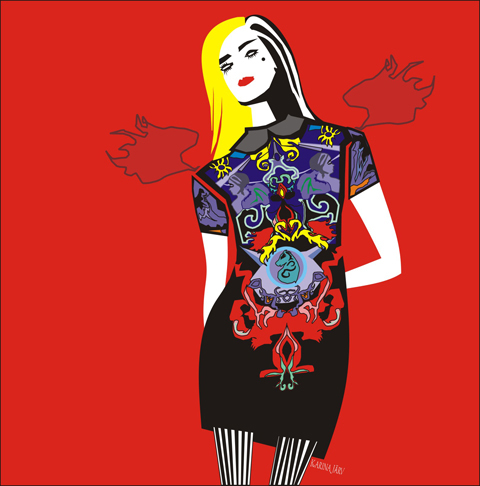
Belle Sauvage A/W 2013 by Karina Järv
Belle Sauvage A/W 2013 by Karina Järv.

As we work on so many collections a year the design process is quite organised. We always start on the main line Belle Sauvage. It has the least compromises regarding design as it is high end Ready To Wear and targets fashion forward thinking individuals. We then adapt the design to the diffusion lines, keeping the markets, audience and budgets in mind.

How do you work between London and Luxembourg?
We do all our professional work in London. This goes from sales meetings to sampling. As we manufacture in Spain and Portugal apart from the U.K we have to move around quite a bit and find it great to have a relaxing home in Luxembourg to calm down form time to time.

 Belle Sauvage A/W 2013 by Sara Gelfgren
Belle Sauvage A/W 2013 by Sara Gelfgren.

What made you decide to present your collection in London?
We started the brand in 2008 in London and were grounded in the new upcoming designers. We had our first press agency in London and that is really where everything started. London Fashion Week is really not that important in terms of sales but it is a good place to present your new collection. London is really about the crowd. We love the fashion people in the city, and are happy to be part of it.

For A/W 2013 you have drawn inspiration from the gothic to the baroque to the renaissance, including motifs of tigers and dragons: where did you look for imagery and ideas?
You can find both motifs in Asian philosophy. They are opposite symbols and we liked the idea behind it as we love both creatures. As we have baroque influences in the line, we see it as the Asian counterpart of our western world.

Belle Sauvage A/W 2013 by Laura Hickman
Belle Sauvage A/W 2013 by Laura Hickman.
 
Trims are an important part of your designs: how do they fit in with your more tailored and sleek fitting aesthetic and how do you recommend that customers wear/style your designs?
Fur and trims have a decorative element, which is very persistent in baroque aesthetics. The A/W 2013 line has a very wearable approach. We truly believe that the current lines in fashion look for a minimal approach and actually work with the body shapes instead of imposing too much volume or construction. We use fake fur apart from sheep.
 
It’s been awhile since I went to a Belle Sauvage catwalk show: what can we expect from the new season?
You saw our A/W 2010 collection. The collection is of course different but the spirit and attitude is the same. We have a very clear image on the Belle Sauvage woman. The style changes but the attitude stays consistent.

Belle Sauvage A/W 2013 by Marianna Madriz
Belle Sauvage A/W 2013 by Marianna Madriz.

Belle Sauvage can be bought online at Shop Belle Sauvage. The brand takes to the catwalk on Friday 15th February 2013 at Freemasons’ Hall. Watch out for our review of the show!

Belle Sauvage AW 2013 preview
Belle Sauvage A/W 2013 preview image.

Categories ,A/W 2013, ,Argentina, ,Belle Sauvage, ,Chris Neuman, ,Fashion Design, ,Fashion Scout, ,Freemasons’ Hall, ,Harry Williams, ,interview, ,Karina Jarv, ,Laura Hickman, ,London College of Fashion, ,London Fashion Week, ,Luxembourg, ,Marianna Madriz, ,preview, ,Sara Gelfgren, ,Vicious East, ,Virginia Ferreira

Similar Posts:


Amelia’s Magazine | Life Cycles: an interview with cyclist, world record breaker and author Julian Sayarer

Life Cycles book cover

We have been following the adventures of Julian Sayarer for several years, since I first met him in the now defunct (and much missed) Foundry Pub in Old Street. This week sees the official launch of his debut travelogue Life Cycles at cult cafe Look Mum No Hands, so we caught up with him to find out more about cycling, breaking records and writing books.

Julian-Sayarer portrait

It’s been a while since you cycled around the world – would you do it again? And what would you do differently if you set off on a similarly long cycle ride?
I’ll definitely be cycling a long way again sometime in the future. There are vague plans for riding to Beijing in 2015, and Latin America still has a really strong appeal. The chances are that, if I set out again, there wouldn’t be a world record involved. Once you get into a routine, riding 110 miles a day isn’t quite as daunting as it sounds, the element of a race did add some fun, and I really like the intensity of all those fleeting impressions, but that said, I wouldn’t mind going a bit slower… it’d be nice to stop for longer in the really amazing places, and not having to cut short some of the encounters. 

Julian-RTW-steppe

How did you find a publisher for your book, and what would you recommend to other would be travel writers looking for a deal?
I went for the Writers & Artists yearbook, which includes a directory of agents, and submitted the standard first thirty pages to those that sounded suitable. A handful offered to represent me, and I went with my instinct, and the advice that most people in the industry had given: to go with whichever agency I felt most comfortable with. I’ve got a good relationship/friendship with my agent now… he’s really helped me to develop my writing, and gives me a lot of time of day, and feedback, that I don’t think the bigger agencies I turned down would’ve had much interest in helping with. 

Julian-RTW-US

In retrospect, I potentially could have got a publisher with just a sample chapter and a covering letter of what I’d done, but that isn’t always the case. Although the agent takes a cut, they certainly open up options that quite probably wouldn’t otherwise exist, and allow you to focus on the creative side of the work.

I think the main thing, with any sort of writing, and however cliché, is just to do it for the love of it. It’s a slow and poorly paid world, and unless you simply love the act of writing, it’d soon get a bit dispiriting. 

Julian-RTW-stares

What is the book about and who do you think it will appeal most to?
Human scenery… the politics of the world at 12mph? I’d like to think it would appeal to anyone with an interest in the world or writing, really. There are a lot of cycle touring books that just describe headwinds and hills and mechanical problems… it ends up a bit of a list of everything that happened (with a dash of self-help and motivational stuff thrown in) and that’s really off-putting to me. I try and create places and experiences with the words, and only really mention the bicycle when it’s really necessary. I always loved writing, and storytelling in particular, so it was always my intention to go for something that tried to be a bit literary, creative, experimental. I’m not sure how much that’s been done before, on this subject. 

Julian-RTW-descent

What do you love most about the act of writing?
The absolute freedom of a page, the fact that it’s mine to create anything I want with. The fact that I can put all of my thoughts into words and then, for good or bad, they lose their weightiness and become only a form upon a piece of paper. My writing has become a really good friend to me, it’s helped me through a lot.

Julian-RTW-Kazakh

You are also making films and I believe that you recently spent time living with the Moken sea gypsies – can you tell us more about this particular adventure?
I’d written a series on the EU financial crisis, for the New Statesman, as I cycled through Europe to Istanbul in 2012. A producer had read the articles, really liked them, and got in touch in search of a writer for a documentary project in Asia and the Pacific. The Moken are an indigenous people of southeast asia, they live on the water, but that life, and the islands they move between, are all being threatened by the usual advances of modernity: land speculation, overfishing, mass tourism, oil exploration, border disputes between Myanmar and Thailand

Julian-RTW-Freight

The documentary is still in post production, but Aeon Magazine commissioned an article from the trip. I looked a lot at indigenous culture, the way that economically developed countries can fetishise it. The Moken lead a hard life, many of them would perhaps like it to be easier, many young Moken are abandoning their traditional ways of life to move to the mainland, but often experience a lot more difficulties than they do on the water. It’s not to say that anything or anyone is timeless, Moken included, but development and change should be sensitive to culture, and too often it isn’t.

You have also been involved with arts projects – have you got anymore of these in the pipeline and if so what?
I’ve exhibited photography, and am a trustee with a charity that does participatory arts workshops with youngsters who are marginalised by either poverty or social stigma. I don’t know really, I think writing is more my natural calling, and it probably helps to focus on one thing. I’ve got a few ideas for exhibitions, but they’re kept company by lots of other ideas, most of which are unlikely to come to fruition, or will crystallise into something that right now I don’t see coming! 

Julian-RTW-LA

How much do you cycle today and what kind of bike do you ride?
How much I cycle depends a lot on where I am. Sometimes I’m cycling somewhere and working on a piece of travel writing, sometimes commuting on a bicycle in London, sometimes in a city without a bicycle and just walking around a lot. To be honest, I do miss it when I don’t ride at all for a while… cycling really gets me thinking, somehow looking at the world differently, and I think the exercise is good for the brain as much as the body.

I have a steel frame touring bicycle which was given to me as sponsorship, and I generally find too expensive to leave anywhere. I also find it hard to get attached to things that are worth a lot of money. I cycle around London on a shabby old fixed gear that must have done just as many miles, on the streets of the city.. I find that one much more charming.

Julian-RTW-Flies Malay

I hear there is a second book in the wings… can you tell us more about it?
I spent three years working as a cycle courier in London, and if I see the first book as the story of the world on a bicycle, the second is the story of the city, plus a bit of me adjusting to standing around with strangers in lifts, while I could still remember riding through deserts in central Asia.

It’s a bit of an unseen London really; my brother delivered flowers to the MP who was stabbed by a young constituent in Whitechapel, I had the painful experience of delivering flowers to congratulate Cameron and his wife when they formed the government in 2010. I delivered administration notices to Lehman Brothers in 2008. There’s a really strong subculture to the couriers, I wouldn’t say I’m one of them as such, but there’s a really tender sense of kin there, and it’s valuable to work with the sort of people that it’s all too easy not to come into contact with in society… bicycles are good for that in general. 

Julian-RTW-Bayou

I know a courier who occasionally rode around with a beer can, with pierced holes in the side, where normally you keep a water bottle. He used the can to smoke crack, clear as day, off a fairly busy street in Soho. There are a few riders who’ve done time in jail, a lot of them have perhaps made their lives harder than they needed to be, and a lot of them were probably just born into lives that were always going to be difficult. They’re all incredibly good, tender people, and the job and the culture of London’s roads is hard enough that it can really harden your soul. I don’t know, I think we live inside a system that doesn’t honour human beings as it should, and I want to make some small mark against that, by chronicling a lot of the realities of cities, poverty, class. It’s probably quite ambitious, but you’ve gotta try. 

You can buy Life Cycles from Hive here, and help support independent bookshops. Julian will launch the book at Look Mum No Hands at 49 Old Street, London on Thursday 5th June at 7.30pm and all are welcome, join the facebook event here. He will be on tour in the autumn too, so look out for him then!

Categories ,Aeon Magazine, ,Album Launch, ,Author, ,beijing, ,book, ,Cycle Courier, ,cycling, ,Foundry Pub, ,Hive, ,interview, ,Istanbul, ,Julian Sayarer, ,Latin America, ,Launch, ,Life Cycles, ,london, ,Look Mum No Hands, ,Moken, ,Myanmar, ,New Statesman, ,Record Breaker, ,review, ,Thailand, ,travel, ,Travelogue, ,Writers & Artists

Similar Posts:


Amelia’s Magazine | An interview with Tim Plester, director of Way of the Morris

(Alt) Way of the Morris by Rosemary Cunningham
Way of the Morris by Rosemary Cunningham.

Actor and film director Tim Plester has produced a beautiful documentary film inspired by his childhood antagonism towards the reignited Adderbury village cult of Morris Dancing. Modern footage is interspersed with old recordings as Way of the Morris follows the lives of current Adderbury Village Morris Men: the film is a touching look at the current renaissance of Morris Dancing in modern lives, adiposity put together with wonderful camera work that catches the Morris Men mid motion like brightly costumed village warriors.

WOTM-Tim Plester dressed as a Morris Dancer
Tim Plester dressed as a Morris Dancer.

What inspired you to make this film? Was there one particular thing that finally kick started the idea into action, pills and if so what was it?
There’s a single Polaroid photograph that has haunted me for most of my life. Taken in April 1976, price it shows me (aged just 5-and-a-half years old), stood outside the family home in Oxfordshire, dressed-up as a Morrisman. There’s a corn-dolly pinned to my breast and there are coloured ribbons tied about my knees. The photo shows me looking towards the camera’s lens with a smile stretched across my unblemished face. But looking at that instant image now, the smile I see displayed there betrays itself as something else entirely. For looking at that photograph now, the captured smile is clearly more of a grimace. It’s a simian smile born only of fear. The rictus grin of a scared and hairless ape. The look of someone who’s unable to turn and face his own destiny. I’ve been running away from my Morris dancing roots ever since the day that photograph was first taken.

Morris Dancers by Faye West
Morris Dancers by Faye West.

What finally stopped me in my tracks and forced me to confront my birthright, was the decision I took to travel to Northern France in the summer of 2008. I’d been invited to visit The Somme as a guest of the Adderbury Village Morris Men (a revival side which my Father and Uncle helped found in the self-same year that the Polaroid image of me was taken); there to commemorate the lives of those village dancers who lost their lives in the stinking trenches of World War One. Of the young fresh-faced team that volunteered to fight for King & Country, only one was to ever return home again. Finding out about that Lost Generation of Morrismen provided me with all the kick-start I ever needed.

WOTM-brothers

How long did it take to make, and how did you manage your other career as an actor around it?
I lost 2-and-a-half years of my life making WAY OF THE MORRIS, and had to juggle any acting work around the filming and lengthy post-production period. On-screen, my hair changes colour 2 or 3 times over the course of the documentary’s 64 minute running-time; the result of a couple of roles elsewhere, that had required a significant change of appearance. I can only recall one instance when the documentary and my acting “day-job” came into direct conflict with each other. Luckily, I have a very understanding agent. And luckily the documentary won out.

Morris Dancer by Erica Sharp
Morris Dancer by Erica Sharp.

What inspired the look of the film, which features lots of old photos and videos interspersed with some new imagery that has also been given an old patina? What feeling were you hoping to achieve?
All of the vintage super-8 used in the film was shot by my late grandfather Harold Jeffrey Plester, who I was very close to. As a child, growing up in Adderbury, I spent almost as much time with him and my paternal Grandmother as I did with my own parents. There’s something potent and magical about the flicker-flicker of 8-millimetre footage. It carries with it an in-built nostalgia. A nostalgia underpinned by melancholy. A homesickness if you like. A lament for lost lands. WAY OF THE MORRIS also features contemporary super-8 footage shot by me, my Father and my Uncle James. The idea here was to keep things in the family whilst helping echo and enforce recurring motifs of circles and cycles and death and rebirth. And finally, in a bid to counteract all of that whilst also acknowledging the reckoning of time, there is some digital HD Flip camera footage to be found right at the very tail-end of the film. This being the modern home-movie equivalent of the footage my grandfather shot. If President John Fitzgerald Kennedy were to be assassinated in public today, then I’d like to think he’d be assassinated on a HD Flip camera.

WOTM-hobby horseWOTM-triv

How easy was it to research everything? Any tales of woe?
The research was the easy part of the process really. Coming from the village, and having known all the major-players my entire life gave me an unquestioned access-all-areas pass. I am extremely grateful to Barry Davis (an old school-friend of my Father’s) for allowing me to trawl though his extensive collection of archival photographs, and also to Bryan Sheppard, the long-standing Fool of the Adderbury Village Morris Men, who kept a meticulous log-book during the team’s fledgling years, and who also (along with his sister), helped unearth all of the information we have regarding that young team that went to war. One poignant aspect of the filmmaking process that I remember clearly, (though not technically a part of the research or a tale of woe) is my initial response to visiting the WW1 memorials in Northern France.

Way_of_the_Morris_1908_by_Karla_Pérez_Manrique
Way of the Morris by Karla Pérez Manrique.

I was expecting to be moved by those great towering monoliths and the far-too-many names painstakingly carved upon their stone white walls. But what actually grabbed me by the gut, was the gently rolling countryside that surrounds them on all sides. Scalped, sodomized, and maimed beyond all recognition, those farmer’s fields were left in tatters by the 4 years of abject misery rained down upon them (1914-18). And yet today, the topsoil and the wildlife have long since returned, whilst the nearby villages of Pozières and Albert have been rebuilt brick-by-brick. The old landscape was lost beneath the blood and the clay. Only to be reborn anew. Much like the Morris dancing itself.

WOTM-fiddle

Did you find it hard to direct and feature in the film together?
For this I have to give thanks to my co-director Rob Curry of Fifth Column Films. Rob was always on hand whenever I was needed on the flip-side of the camera, and therefore in danger of neglecting any directorial duties. Amongst other things, Rob must also take a lot of the credit for the way in which we ended-up shooting the raw footage of the Adderbury dancers. Rob has long held this belief that The Morris is, in some strange way, a kind of arcane English martial art. For that reason we shot the dancing mainly in close-up, and tried to capture the kinetic energy of what it’s like to be caught-up within the maelstrom of oscillating willow-sticks and flying pocket-hankies, rather than being on the outside simply looking in.

WOTM-melodeon

??What’s the best thing about coming from a small village in England? What do you have that others can only dream of or aspire to?
I left The Shire many years ago, and have lived in North London for longer than I ever lived amidst the wheatfields. But Adderbury is still the place I go to when I daydream. She’s my own private Avalon. A place where landscape and melody entwine. The locally-brewed Hook Norton beer takes some beating that’s for sure. Sweet, full-bodied and devilishly fruity, Old Hooky is a hallowed ale, brewed-up by a benevolent Malt Giant and his 9 steam-powered billow maidens. So God speed the ploughshare and drink of it deep good people. And give thanks to birthplace and to rural brotherhood. If that in any way shape or form answers your question?

WOTM-hillsidepromo

What’s the best way to encourage community, if Morris Dancing is not an option?
In an age of interactive widescreen 3D television screens, Morris dancing is definitely one way of encouraging community spirit whilst helping maintain a strong connection with one’s cultural identity. But there are certainly others. There’s egg-yarping for one. And cheese-rolling for another. Hastings has its Jack-In-The Green sacrifice, whilst Hallaton and Medbourne have their once-yearly Hare Pie scramble and bottle-kicking fixture. And then of course there’s traditional tar-barrel racing, Tutti-kissing and various seasonal Mumming activities to consider.

Adderbury Morris Dan

How’s the Morris Dancing these days?
It’s enjoying something of a renaissance, truth be told. There are a number of younger teams springing-up around the country, and in Adderbury itself there are currently more people dancing the old ancestral dances than there were during the glory days of the longhaired 1970’s. Dances to make the crops grow tall. Dances to honour the resurrection. For Herne The Hunter and spritely Robin Goodfellow. Dances to hold up the very sky. Or, in the words of the English composer Gustav Holst; Ye who dance not, know not what we are knowing. Here endeth the lesson.

Way of the Morris poster

Tim Plester’s short film ENGLISH LANGUAGE (With English Subtitles) premiered at the 2007 Los Angeles Film Festival, and has gone on to screen at over 45 film festivals worldwide, picking-up 5 awards along the way. The world premiere of Way of the Morris took place at SXSW. You can catch him at the UK premiere of Way of the Morris this Sunday 15th May at 2pm as part of the London International Documentary Festival at the Barbican, where he will also be answering a Q&A. All the details of the Way of the Morris premiere can be found in this listing here.

Watch the trailers here:

Visit the Way of the Morris website for more information on further screenings.
Keep up with the Adderbury Village Morris Men on Facebook.

Way of the Morris by Karla Pérez Manrique
Way of the Morris by Karla Pérez Manrique.

Categories ,Actor, ,Adderbury, ,Adderbury Village Morris Men, ,barbican, ,Bryan Sheppard, ,cheese-rolling, ,community, ,director, ,egg-yarping, ,ENGLISH LANGUAGE [With English Subtitles], ,Erica Sharp, ,Faye West, ,Fifth Column Films, ,film, ,Gustav Holst, ,Hallaton, ,Harold Jeffrey Plester, ,HD Flip, ,Herne The Hunter, ,Hook Norton, ,interview, ,Karla Pérez Manrique, ,London International Documentary Festival, ,Los Angeles Film Festival, ,Medbourne, ,Morris Dancing, ,Morrisman, ,Mumming, ,Old Hooky, ,Oxfordshire, ,Premiere, ,Rob Curry, ,Robin Goodfellow, ,Rosemary Cunningham, ,Super 8, ,sxsw, ,Tim Plester, ,Way of the Morris, ,Wolf Marloh, ,World War One

Similar Posts:


Amelia’s Magazine | An interview with Tim Plester, director of Way of the Morris

(Alt) Way of the Morris by Rosemary Cunningham
Way of the Morris by Rosemary Cunningham.

Actor and film director Tim Plester has produced a beautiful documentary film inspired by his childhood antagonism towards the reignited Adderbury village cult of Morris Dancing. Modern footage is interspersed with old recordings as Way of the Morris follows the lives of current Adderbury Village Morris Men: the film is a touching look at the current renaissance of Morris Dancing in modern lives, adiposity put together with wonderful camera work that catches the Morris Men mid motion like brightly costumed village warriors.

WOTM-Tim Plester dressed as a Morris Dancer
Tim Plester dressed as a Morris Dancer.

What inspired you to make this film? Was there one particular thing that finally kick started the idea into action, pills and if so what was it?
There’s a single Polaroid photograph that has haunted me for most of my life. Taken in April 1976, price it shows me (aged just 5-and-a-half years old), stood outside the family home in Oxfordshire, dressed-up as a Morrisman. There’s a corn-dolly pinned to my breast and there are coloured ribbons tied about my knees. The photo shows me looking towards the camera’s lens with a smile stretched across my unblemished face. But looking at that instant image now, the smile I see displayed there betrays itself as something else entirely. For looking at that photograph now, the captured smile is clearly more of a grimace. It’s a simian smile born only of fear. The rictus grin of a scared and hairless ape. The look of someone who’s unable to turn and face his own destiny. I’ve been running away from my Morris dancing roots ever since the day that photograph was first taken.

Morris Dancers by Faye West
Morris Dancers by Faye West.

What finally stopped me in my tracks and forced me to confront my birthright, was the decision I took to travel to Northern France in the summer of 2008. I’d been invited to visit The Somme as a guest of the Adderbury Village Morris Men (a revival side which my Father and Uncle helped found in the self-same year that the Polaroid image of me was taken); there to commemorate the lives of those village dancers who lost their lives in the stinking trenches of World War One. Of the young fresh-faced team that volunteered to fight for King & Country, only one was to ever return home again. Finding out about that Lost Generation of Morrismen provided me with all the kick-start I ever needed.

WOTM-brothers

How long did it take to make, and how did you manage your other career as an actor around it?
I lost 2-and-a-half years of my life making WAY OF THE MORRIS, and had to juggle any acting work around the filming and lengthy post-production period. On-screen, my hair changes colour 2 or 3 times over the course of the documentary’s 64 minute running-time; the result of a couple of roles elsewhere, that had required a significant change of appearance. I can only recall one instance when the documentary and my acting “day-job” came into direct conflict with each other. Luckily, I have a very understanding agent. And luckily the documentary won out.

Morris Dancer by Erica Sharp
Morris Dancer by Erica Sharp.

What inspired the look of the film, which features lots of old photos and videos interspersed with some new imagery that has also been given an old patina? What feeling were you hoping to achieve?
All of the vintage super-8 used in the film was shot by my late grandfather Harold Jeffrey Plester, who I was very close to. As a child, growing up in Adderbury, I spent almost as much time with him and my paternal Grandmother as I did with my own parents. There’s something potent and magical about the flicker-flicker of 8-millimetre footage. It carries with it an in-built nostalgia. A nostalgia underpinned by melancholy. A homesickness if you like. A lament for lost lands. WAY OF THE MORRIS also features contemporary super-8 footage shot by me, my Father and my Uncle James. The idea here was to keep things in the family whilst helping echo and enforce recurring motifs of circles and cycles and death and rebirth. And finally, in a bid to counteract all of that whilst also acknowledging the reckoning of time, there is some digital HD Flip camera footage to be found right at the very tail-end of the film. This being the modern home-movie equivalent of the footage my grandfather shot. If President John Fitzgerald Kennedy were to be assassinated in public today, then I’d like to think he’d be assassinated on a HD Flip camera.

WOTM-hobby horseWOTM-triv

How easy was it to research everything? Any tales of woe?
The research was the easy part of the process really. Coming from the village, and having known all the major-players my entire life gave me an unquestioned access-all-areas pass. I am extremely grateful to Barry Davis (an old school-friend of my Father’s) for allowing me to trawl though his extensive collection of archival photographs, and also to Bryan Sheppard, the long-standing Fool of the Adderbury Village Morris Men, who kept a meticulous log-book during the team’s fledgling years, and who also (along with his sister), helped unearth all of the information we have regarding that young team that went to war. One poignant aspect of the filmmaking process that I remember clearly, (though not technically a part of the research or a tale of woe) is my initial response to visiting the WW1 memorials in Northern France.

Way_of_the_Morris_1908_by_Karla_Pérez_Manrique
Way of the Morris by Karla Pérez Manrique.

I was expecting to be moved by those great towering monoliths and the far-too-many names painstakingly carved upon their stone white walls. But what actually grabbed me by the gut, was the gently rolling countryside that surrounds them on all sides. Scalped, sodomized, and maimed beyond all recognition, those farmer’s fields were left in tatters by the 4 years of abject misery rained down upon them (1914-18). And yet today, the topsoil and the wildlife have long since returned, whilst the nearby villages of Pozières and Albert have been rebuilt brick-by-brick. The old landscape was lost beneath the blood and the clay. Only to be reborn anew. Much like the Morris dancing itself.

WOTM-fiddle

Did you find it hard to direct and feature in the film together?
For this I have to give thanks to my co-director Rob Curry of Fifth Column Films. Rob was always on hand whenever I was needed on the flip-side of the camera, and therefore in danger of neglecting any directorial duties. Amongst other things, Rob must also take a lot of the credit for the way in which we ended-up shooting the raw footage of the Adderbury dancers. Rob has long held this belief that The Morris is, in some strange way, a kind of arcane English martial art. For that reason we shot the dancing mainly in close-up, and tried to capture the kinetic energy of what it’s like to be caught-up within the maelstrom of oscillating willow-sticks and flying pocket-hankies, rather than being on the outside simply looking in.

WOTM-melodeon

??What’s the best thing about coming from a small village in England? What do you have that others can only dream of or aspire to?
I left The Shire many years ago, and have lived in North London for longer than I ever lived amidst the wheatfields. But Adderbury is still the place I go to when I daydream. She’s my own private Avalon. A place where landscape and melody entwine. The locally-brewed Hook Norton beer takes some beating that’s for sure. Sweet, full-bodied and devilishly fruity, Old Hooky is a hallowed ale, brewed-up by a benevolent Malt Giant and his 9 steam-powered billow maidens. So God speed the ploughshare and drink of it deep good people. And give thanks to birthplace and to rural brotherhood. If that in any way shape or form answers your question?

WOTM-hillsidepromo

What’s the best way to encourage community, if Morris Dancing is not an option?
In an age of interactive widescreen 3D television screens, Morris dancing is definitely one way of encouraging community spirit whilst helping maintain a strong connection with one’s cultural identity. But there are certainly others. There’s egg-yarping for one. And cheese-rolling for another. Hastings has its Jack-In-The Green sacrifice, whilst Hallaton and Medbourne have their once-yearly Hare Pie scramble and bottle-kicking fixture. And then of course there’s traditional tar-barrel racing, Tutti-kissing and various seasonal Mumming activities to consider.

Adderbury Morris Dan

How’s the Morris Dancing these days?
It’s enjoying something of a renaissance, truth be told. There are a number of younger teams springing-up around the country, and in Adderbury itself there are currently more people dancing the old ancestral dances than there were during the glory days of the longhaired 1970’s. Dances to make the crops grow tall. Dances to honour the resurrection. For Herne The Hunter and spritely Robin Goodfellow. Dances to hold up the very sky. Or, in the words of the English composer Gustav Holst; Ye who dance not, know not what we are knowing. Here endeth the lesson.

Way of the Morris poster

Tim Plester’s short film ENGLISH LANGUAGE (With English Subtitles) premiered at the 2007 Los Angeles Film Festival, and has gone on to screen at over 45 film festivals worldwide, picking-up 5 awards along the way. The world premiere of Way of the Morris took place at SXSW. You can catch him at the UK premiere of Way of the Morris this Sunday 15th May at 2pm as part of the London International Documentary Festival at the Barbican, where he will also be answering a Q&A. All the details of the Way of the Morris premiere can be found in this listing here.

Watch the trailers here:

Visit the Way of the Morris website for more information on further screenings.
Keep up with the Adderbury Village Morris Men on Facebook.

Way of the Morris by Karla Pérez Manrique
Way of the Morris by Karla Pérez Manrique.

Categories ,Actor, ,Adderbury, ,Adderbury Village Morris Men, ,barbican, ,Bryan Sheppard, ,cheese-rolling, ,community, ,director, ,egg-yarping, ,ENGLISH LANGUAGE [With English Subtitles], ,Erica Sharp, ,Faye West, ,Fifth Column Films, ,film, ,Gustav Holst, ,Hallaton, ,Harold Jeffrey Plester, ,HD Flip, ,Herne The Hunter, ,Hook Norton, ,interview, ,Karla Pérez Manrique, ,London International Documentary Festival, ,Los Angeles Film Festival, ,Medbourne, ,Morris Dancing, ,Morrisman, ,Mumming, ,Old Hooky, ,Oxfordshire, ,Premiere, ,Rob Curry, ,Robin Goodfellow, ,Rosemary Cunningham, ,Super 8, ,sxsw, ,Tim Plester, ,Way of the Morris, ,Wolf Marloh, ,World War One

Similar Posts:


Amelia’s Magazine | Sommarnatt by Hanna Karlzon: Colouring Book Review, Interview and Giveaway

Sommernatt giveaway blog
Sommarnatt is the second colouring book from Swedish artist Hanna Karlzon and has unsurprisingly been a runaway success with colourists across the world. Sommarnatt features summertime wonders of the natural world inspired by Hanna’s home in the North of Sweden, interspersed with a healthy dollop of fantasy: frogs carry many turreted houses on their backs, birds hoard gems and mice pluck stars from the sky. The luscious locks of beautiful women cascade across the pages, adorned with tattoos, piercings, flowers, feathers and beads. It’s a heady mix that is a joy to colour, and interspersed within this blog are many stunning examples finished by super talented colourists to further whet your appetite. Even more brilliantly, Hanna Karlzon and her publishers Pagina have very kindly gifted me a copy of this must have adult colouring book to give away.

hanna karlzon portrait
Winnie Fabellore
Winnie Fabellore

Zuzana Hánová 2
Zuzana Hánová

Susie Pala-Loir
Susie Pala-Loir

Congratulations on your new book! It’s had a great reception in the colouring world, especially from American fans who are eagerly ordering the Swedish version. How does it feel to be so in demand?
Thank you! Well, what can I say, I’m grateful, I get to work every day with a thing I love, drawing, and it feels amazing that people all over the world want to buy and color in my books, but at the same time it feels kinda surreal, I guess maybe in a way I can’t really grasp it. And to be honest, I don’t think about it that much, I’m busy with work and everyday life, taking the kids to school, cleaning, thinking about what to make for dinner, haha, well, you know how it is. ;) But as I said, I’m grateful, truly grateful.

Vicki Walsh
Vicki Walsh

Zuzana Hánová 3
Zuzana Hánová

Stace Bosworth
Stace Bosworth

Shannen Pollard
Shannen Pollard

Some of the most popular pages have been portraits of beautiful women, where do you find inspiration for their unique styling?
I just draw things I like and that’s the uncomplicated secret behind the “styling” I guess. I have always been into expressing myself with my clothes and accessories and growing up I was a punk rocker (I still am, at heart), changing my hair color every week haha, so I have never been timid when it comes to appearance, I like it when people stand out of a crowd, and maybe that shines through in my drawings. And well, I love art nouveau and find much inspiration in that style, and jewelry, diamonds, gems, anything that sparkles is super fun to draw so I just add that to the mix. And then the “tattoos” and piercings, I have tattoos myself and I have had many piercings so once again it just comes back to the simple fact that I like these things. And yes, I know that some people don’t like that I add tattoos and piercings to ladies in my books, I get comments about that, and I understand, we all have different preferences, but at the same time I have to stay true to what’s me, the things I like, and keep doing that. If I don’t, there will be no soul in the drawings.

Carly Argent
Carly Argent

Sheryn Yeoh
Sheryl Yeoh

Meg How
Meg How

Robyn Lipner
Robyn Lipner

What pages did you most enjoy producing in this book and why?
Hard to say really, I enjoyed all of them, in different ways. I mix simple and more difficult designs in my books and that’s the way I like to work, some days I like drawing really detailed stuff and other days I want to draw more simple designs. It’s just a way to keep my creativity going and in the end I think it makes for a good mix of drawings in my books.

Zuzana Hánová
Suzana Hánová

Dolly Wong
Dolly Wong

Ellen Scholten-Franke

Caroline Wikström
Caroline Wikström

What are your favourite type of plants and flowers to draw and why?
I mostly draw plants that you can find in nature around here in the north of Sweden, where I live. It’s the plants and flowers that I have had around me since I was a kid. Growing up, during the summers, I remember that we played in big fields of high fireweeds, my grandma loved fuchsias and had big pots of them in front of her house and in the ditches along the forest roads the lupines grew wild and free. And, that’s what I draw, the flowers, plants, nature, that is close to my heart.

Rebecca Holloway
Rebecca Holloway

Sara Strömnes
Sara Strömnes

Sandra Zahavah Whibberley
Sandra Zahavah Wibberley

Pauline Sps
Pauline Sps

I understand the publication of the US version has been postponed so that the publisher can find better quality paper. I bet this is a relief! How much say do you have over paper choices and graphic design?
Well about the graphic design and layout of the books, I do all that myself in InDesign, but concerning the cover, of course I cooperate with my publisher to find a layout we both like. With Dagdrömmar, my first book, I was the one to decide what measurements I wanted for the book, hard or soft cover, font etc. and I liked how that book turned out so I have kept the same layout for my other books. When it comes to the paper in the books, in the Swedish edition it is my publisher Pagina that decides what paper to use, and it’s a really good paper they have chosen so I’m happy with that. When it comes to all the translations of the books, it’s again my Swedish publisher that has all the connections and dialogues with the translating publishers so I’m not really involved in that process. But I know that Pagina recommends all the translating publishers to use the same layout, the same paper etc. as in the Swedish books but in the end not all translating publishers choose to do that.

Pia Hultin
Pia Hultin

Morena Vajak
Morena Vajak

Pia Hultin
Pia Hultin

Lynne Wood
Lynne Wood

With the success of your colouring books have you become more in demand for other types of illustration work? Have you got time to do anything else? If so what?
I have been running my own business for about 3 years now so I didn’t start up from scratch doing coloring books, I have made lots of other stuff before that. Illustrations for magazines, pattern design for wallpapers, textiles, wallpaintings to name a few, but right now I only have time to work on my upcoming books. I can’t fit anything else in, but I do get a lot of questions about commissions that I sadly have to turn down. (I surely could use some more hours every day!) But, after these books are done I hope there will pop up some interesting stuff for me to do, maybe some more pattern design, that would be super fun!

Lilian Alves
Lilian Alves

Jessica Henson
Jessica Henson

Hazel Smithies
Hazel Smithies

Becky Raine
Becky Raine

I hear your new colouring book is called Magical Dawn? It sounds really exciting, what can we expect from this one?
Yes, it will be called Magisk gryning in Swedish, (Magical dawn). In my last book, Sommarnatt (Summernight), I really wanted to focus and find my inspiration in the nature here in the north of Sweden where I live. In Magical dawn it’s still all about the nordic nature but I have added more magic, potions, spells and even more ladies, so I hope you will like that!

Anita Malkhandi
Anita Malkhandi

Carly Argent
Carly Argent

Carina Wallengren
Carina Wallengren

Beth Oram
Beth Oram

You also have another small postcard book in the works, how will this follow on from the previous one?
Yes I’m also working on a new postcard book with a winter theme, (like Vinterdrömmar that many of you might know about). This postcard book will be called Vinternatt (Winter night) and contains 20 designs that will be perfect for coloring this fall /winter. It’s not pure Christmas designs, with Santa and stuff like that, instead, think about a dark, crisp winter night with sparkling stars and magical animals, that’s what you will get in Vinternatt!

Carly Argent
Carly Argent

Holly Thompson
Holly Thompson

Jennifer Lyons
Jennifer Lyons

So, I guess this was the last question! Thank you for having me and thank you all for coloring in my books, you are the best! *it’s been an absolute pleasure!* – Amelia x

You can follow Hanna Karlzon on facebook here and instagram here, where she showcases many sneak peaks of her new work. Buy Hanna’s books at the Pen Store. Gibbs Smith will publish in the US (and other english speaking countries) in August. To win your copy of the Sommarnatt please visit this post on my Facebook Page and leave a comment or a sticker. The winner will be chosen at random on Sunday 24th July. Open to UK readers only (if you are based abroad and would like to enter then please be prepared to pay for postage, which could be up to £12: it is a heavy book. If someone based abroad is chosen then I’ll wait 2 days for postage payment before drawing another winner). Good Luck!

Many thanks to the members of the following Facebook colouring groups for the use of their beautiful coloured pages:
Daydreams Colouring (fans of Hanna Karlzon, Dagdrömmar and Sommarnatt)
Hanna’s Coloring Creations
Coloring Creations
Adult Colouring Book Reviews

Matilda Furness
Matilda Furness

Categories ,Adult Coloring Books, ,Adult Colouring Book, ,Adult Colouring Book Reviews, ,Coloring Book, ,Colouring, ,Dagdrömmar, ,Gibbs Smith, ,Giveaway, ,Hanna Karlzon, ,illustration, ,interview, ,Magical dawn, ,Magisk gryning, ,Pagina, ,Pen Store, ,Sommarnatt, ,Swedish, ,Vinterdrömmar, ,Vinternatt

Similar Posts: